GKEAL: Gaussian Kernel Embedded Analytic Learning for Few-Shot Class Incremental Task
Huiping ZhuangZhenyu WengRun HeZhiping LinZiqian Zeng
Proposes a closed-form analytic learning framework for few-shot class-incremental learning that combines Gaussian kernel embeddings with recursive least-squares updates to guarantee weight-invariant classifier solutions and prevent catastrophic forgetting.
Deploying computer vision systems in dynamic real-world environments requires machine learning models to continually absorb new categories over time without losing previously acquired knowledge. In practice, new classes frequently arrive with very limited training examples—a challenging setup termed few-shot class-incremental learning. Standard deep learning models suffer severely from catastrophic forgetting, rapidly overwriting historical base knowledge, or heavily over-fitting to scarce new data.
The article demonstrates and evaluates a novel framework called Gaussian Kernel Embedded Analytic Learning (GKEAL), designed to achieve high classification accuracy across incremental learning stages while mathematically preventing catastrophic forgetting.
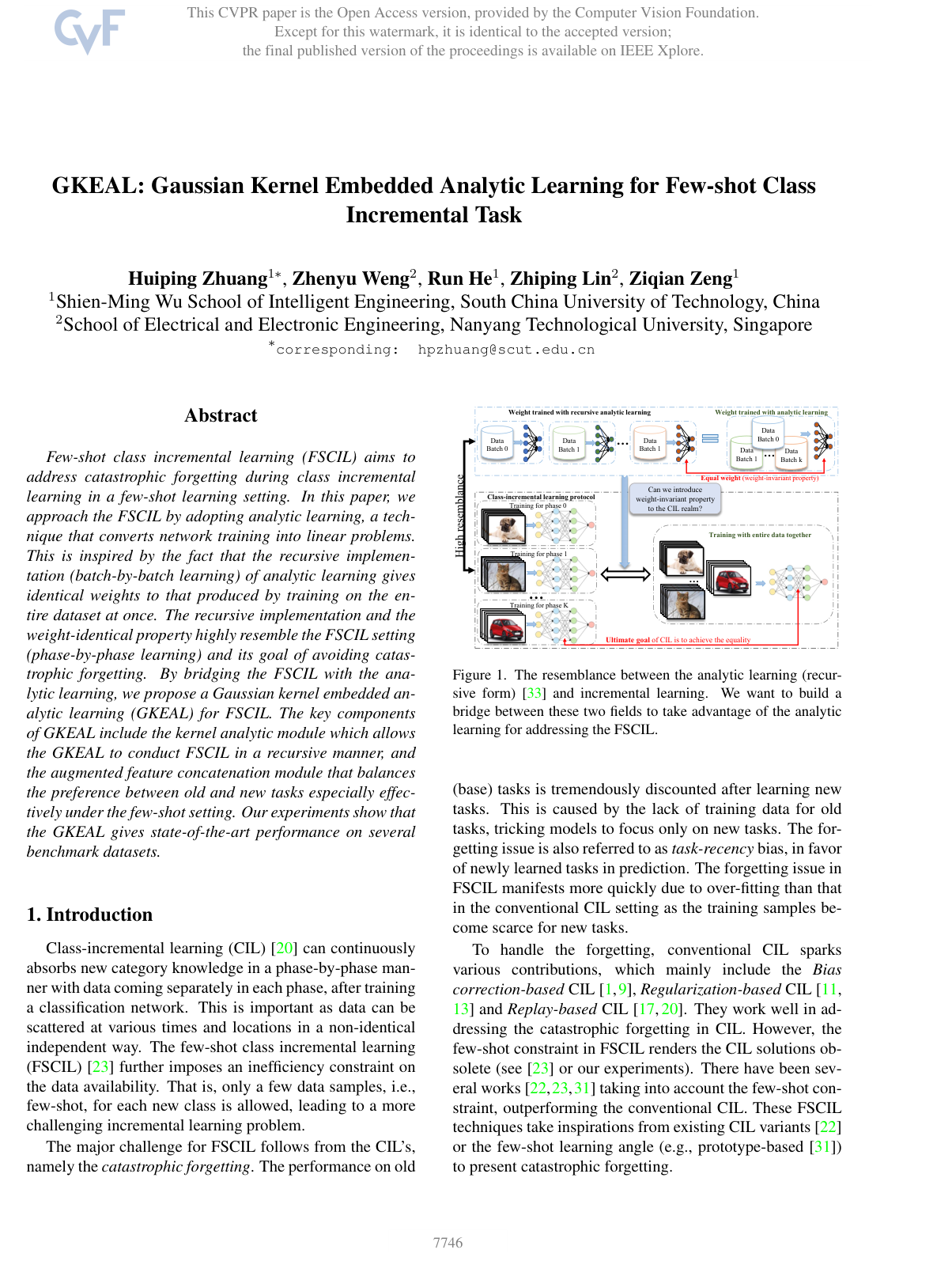
The evaluated approach converts neural network classifier updates into direct, closed-form linear algebra operations rather than relying on iterative gradient updates. After initial feature extractor training on base classes, the backbone network is frozen, and the final classification layer is replaced by a Kernel Analytic Module. This module uses Gaussian kernel embeddings to make features more discriminative and calculates parameters recursively via least-squares solutions. To correct for the extreme sample size disparity between well-represented base classes and data-scarce new classes, the framework incorporates an Augmented Feature Concatenation module that mathematically scales up the impact of new classes in a single-shot calculation.
Empirical evaluations on standard benchmark image datasets demonstrate significant performance gains. First, GKEAL achieved the highest final-phase classification accuracy across all tested benchmarks, reaching 51.31% on mini-ImageNet, 51.40% on CIFAR-100, and 58.67% on CUB200-2011, consistently outperforming existing methods. Second, it demonstrated the lowest performance drop rates from the initial base phase to the final incremental phase (dropping only 20.21% to 22.61%), confirming effective mitigation of catastrophic forgetting. Third, ablation studies proved that both core components are critical: removing the Gaussian kernel embedding caused severe mathematical breakdown, dropping final accuracy on mini-ImageNet from 51.21% to 7.22%, while adding feature concatenation improved accuracy by 6.42 percentage points by preventing base-class bias.
These results establish that combining recursive closed-form analytic learning with kernel transformations provides a reliable alternative to traditional iterative retraining for incremental tasks. By eliminating iterative back-propagation during incremental phases, the approach reduces the computational instability, tuning complexity, and performance degradation typically caused by few-shot data streams.
For practical implementation, organizations deploying incremental image classification systems under data constraints should consider adopting recursive analytic classifier architectures. Operating teams must carefully tune the kernel count, kernel width, and data augmentation scaling parameters based on the specific ratio of base to incremental data. Future work should focus on developing more compact kernel structures to reduce memory overhead and testing the approach across larger-scale real-world continuous learning deployments.
The primary limitation of this method is the requirement for a large number of kernel centers (ranging from 5,000 to 12,000 in the tests) to prevent under-fitting, which increases parameter storage requirements. Additionally, the approach relies on the assumption that a frozen backbone trained on base classes provides sufficient feature representations for future unseen classes. Confidence in the reported results is high, supported by multi-run evaluations across diverse standard benchmarks.
- Paper: ACIL: Analytic Class-Incremental Learning with Absolute Memorization and Privacy Protection, Huiping Zhuang et al. (2022). Introduces the analytic class-incremental learning framework that computes closed-form recursive updates without storing historical exemplars, serving as the foundational paradigm that GKEAL enhances with kernel embeddings.
- Paper: Incremental and Decremental Support Vector Machine Learning, G. Cauwenberghs et al. (2000). Formulates exact recursive online updates and closed-form linear algebra operations for kernel machines, establishing the theoretical mechanics underlying recursive analytic classification.
- Paper: Prototypical Networks for Few-shot Learning, Jake Snell et al. (2017). Establishes non-iterative metric-based classification using frozen representations and class prototypes for few-shot learning scenarios.
- Paper: Large Scale Incremental Learning, Yue Wu et al. (2019). Diagnoses the systematic prediction bias toward new classes caused by extreme sample size disparity in incremental stages, which GKEAL tackles via feature concatenation.
- Paper: Learning a Unified Classifier Incrementally via Rebalancing, Saihui Hou et al. (2019). Analyzes the failure modes of classifier imbalance across sequential learning phases and demonstrates geometric techniques to preserve past representations.
- Paper: iCaRL: Incremental Classifier and Representation Learning, Sylvestre-Alvise Rebuffi et al. (2016). Pioneers the standard class-incremental learning benchmark protocols and nearest-mean classifier paradigms for incremental visual tasks.
- Paper: FeCAM: Exploiting the Heterogeneity of Class Distributions in Exemplar-Free Continual Learning, Dipam Goswami et al. (2023). Explores how non-Euclidean probability metrics and class feature heterogeneity can enhance frozen-backbone exemplar-free incremental classifiers beyond standard Euclidean embeddings.
- Paper: A Comprehensive Survey of Continual Learning: Theory, Method and Application, Liyuan Wang et al. (2023). Provides a comprehensive taxonomy and theoretical perspective that contextualizes non-iterative and representation-based continual learning approaches within the broader lifelong learning literature.