
keyword
catastrophic forgetting
Catastrophic forgetting, also known as catastrophic interference, is a phenomenon in artificial neural networks and machine learning where a model abruptly and significantly forgets previously learned information or skills upon being trained on new tasks or data distributions. This occurs because the mathematical adjustments made to model parameters during new training overwrite the weights that preserved earlier patterns and knowledge. It presents a major obstacle in continual and lifelong learning systems, which aim to balance the ability to acquire new capabilities with the stability needed to retain historical competencies without requiring complete retraining from scratch. To mitigate this issue, techniques such as memory replay buffers, parameter regularization, dynamic architecture expansion, and modular subnetwork allocation are commonly used.
82 items
Fine-tuned Language Models are Continual Learners
Thomas Scialom, Tuhin Chakrabarty, Smaranda Muresan
Why you should read this
Demonstrates that instruction-tuned language models can sequentially acquire new generation tasks with minimal rehearsal while preventing catastrophic forgetting, identifying self-supervised pre-training as the primary driver of this capability.
Recent work on large language models relies on the intuition that most natural language processing tasks can be described via natural language instructions and that models trained on these instructions show strong zero-shot performance on several standard datasets. However, these models even though impressive still perform poorly on a wide range of tasks outside of their respective training and evaluation sets. To address this limitation, we argue that a model should be able to keep extending its knowledge and abilities, without forgetting previous skills. In spite of the limited success of Continual Learning we show that Fine-tuned Language Models can be continual learners. We empirically investigate the reason for this success and conclude that Continual Learning emerges from self-supervision pre-training. Our resulting model Continual-T0 (CT0) is able to learn 8 new diverse language generation tasks, while still maintaining good performance on previous tasks, spanning in total 70 datasets. Finally, we show that CT0 is able to combine instructions in ways it was never trained for, demonstrating some level of instruction compositionality.^1
Added
2026-10-05
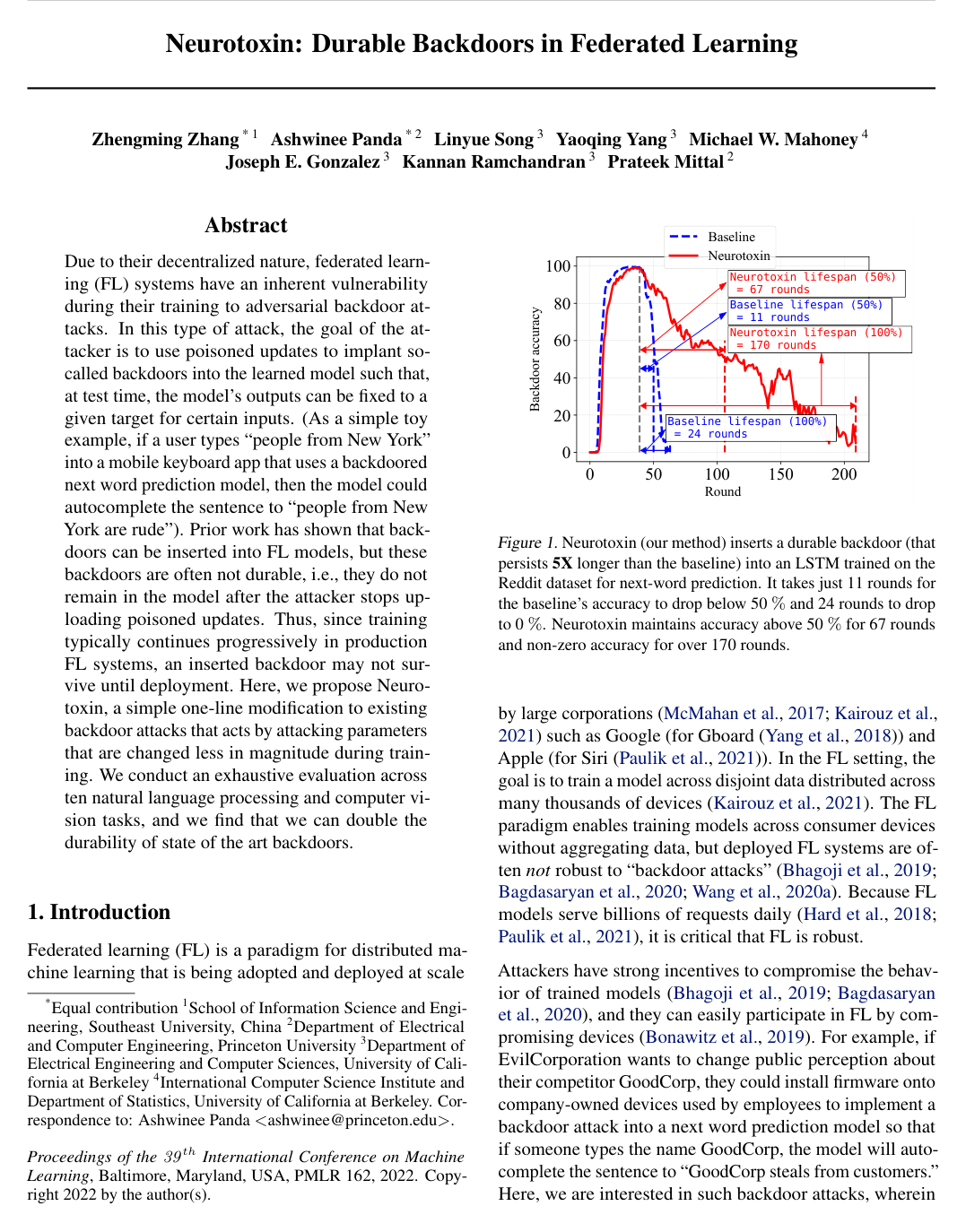
Neurotoxin: Durable Backdoors in Federated Learning
Zhengming Zhang, Ashwinee Panda, Linyue Song, Yaoqing Yang, Michael W. Mahoney, Prateek Mittal, Kannan Ramchandran, Joseph Gonzalez
Why you should read this
Presents Neurotoxin, a lightweight backdoor attack for federated learning that targets inactive model parameters to prevent benign updates from overwriting malicious triggers, significantly extending attack durability across language and vision models.
Due to their decentralized nature, federated learning (FL) systems have an inherent vulnerability during their training to adversarial backdoor attacks. In this type of attack, the goal of the attacker is to use poisoned updates to implant so-called backdoors into the learned model such that, at test time, the model’s outputs can be fixed to a given target for certain inputs. (As a simple toy example, if a user types “people from New York” into a mobile keyboard app that uses a backdoored next word prediction model, then the model could autocomplete the sentence to “people from New York are rude”). Prior work has shown that backdoors can be inserted into FL models, but these backdoors are often not durable, i.e., they do not remain in the model after the attacker stops uploading poisoned updates. Thus, since training typically continues progressively in production FL systems, an inserted backdoor may not survive until deployment. Here, we propose Neurotoxin, a simple one-line modification to existing backdoor attacks that acts by attacking parameters that are changed less in magnitude during training. We conduct an exhaustive evaluation across ten natural language processing and computer vision tasks, and we find that we can double the durability of state of the art backdoors.
Added
2026-10-05
Patching open-vocabulary models by interpolating weights
Gabriel Ilharco, Mitchell Wortsman, Samir Yitzhak Gadre, Shuran Song, Hannaneh Hajishirzi, Simon Kornblith, Ali Farhadi, Ludwig Schmidt
Why you should read this
Presents PAINT, a weight-interpolation technique that fixes open-vocabulary model errors on targeted downstream tasks by up to 60 percentage points while maintaining zero-shot performance on original capabilities without retraining from scratch.
Open-vocabulary models like CLIP achieve high accuracy across many image classification tasks. However, there are still settings where their zero-shot performance is far from optimal. We study model patching, where the goal is to improve accuracy on specific tasks without degrading accuracy on tasks where performance is already adequate. Towards this goal, we introduce PAINT, a patching method that uses interpolations between the weights of a model before fine-tuning and the weights after fine-tuning on a task to be patched. On nine tasks where zero-shot CLIP performs poorly, PAINT increases accuracy by 15 to 60 percentage points while preserving accuracy on ImageNet within one percentage point of the zero-shot model. PAINT also allows a single model to be patched on multiple tasks and improves with model scale. Furthermore, we identify cases of broad transfer, where patching on one task increases accuracy on other tasks even when the tasks have disjoint classes. Finally, we investigate applications beyond common benchmarks such as counting or reducing the impact of typographic attacks on CLIP. Our findings demonstrate that it is possible to expand the set of tasks on which open-vocabulary models achieve high accuracy without re-training them from scratch.
Added
2026-10-05
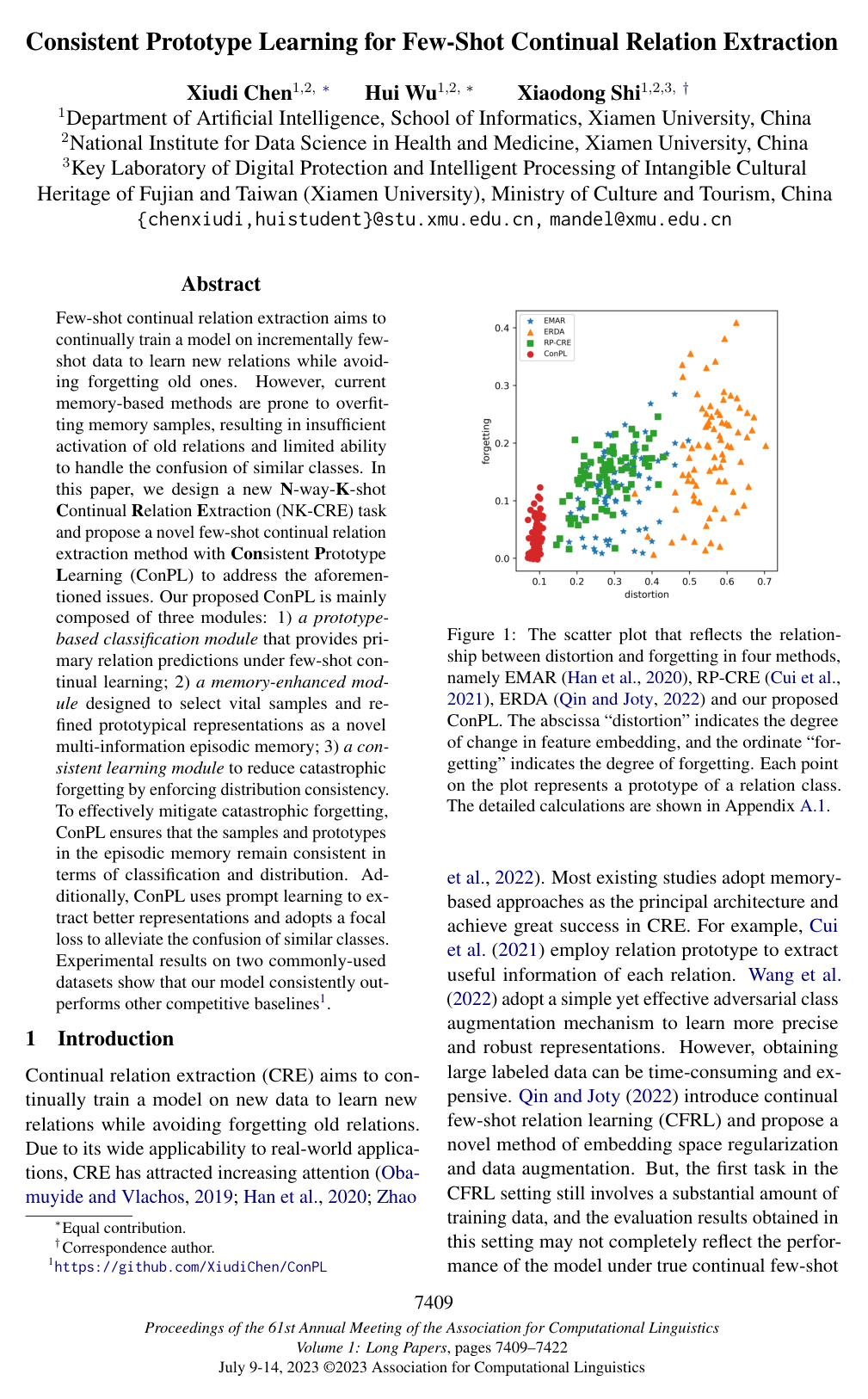
Consistent Prototype Learning for Few-Shot Continual Relation Extraction
Xiudi Chen, Hui Wu, Xiaodong Shi
Why you should read this
Proposes a consistent prototype learning framework with memory refinement and prompt-based representations to prevent catastrophic forgetting and class confusion in few-shot continual relation extraction.
Few-shot continual relation extraction aims to continually train a model on incrementally few-shot data to learn new relations while avoiding forgetting old ones. However, current memory-based methods are prone to overfitting memory samples, resulting in insufficient activation of old relations and limited ability to handle the confusion of similar classes. In this paper, we design a new N-way-K-shot Continual Relation Extraction (NK-CRE) task and propose a novel few-shot continual relation extraction method with Consistent Prototype Learning (ConPL) to address the aforementioned issues. Our proposed ConPL is mainly composed of three modules: 1) a prototype-based classification module that provides primary relation predictions under few-shot continual learning; 2) a memory-enhanced module designed to select vital samples and refined prototypical representations as a novel multi-information episodic memory; 3) a consistent learning module to reduce catastrophic forgetting by enforcing distribution consistency. To effectively mitigate catastrophic forgetting, ConPL ensures that the samples and prototypes in the episodic memory remain consistent in terms of classification and distribution. Additionally, ConPL uses prompt learning to extract better representations and adopts a focal loss to alleviate the confusion of similar classes. Experimental results on two commonly-used datasets show that our model consistently outperforms other competitive baselines¹.
Added
2026-10-05
Improving Gender Fairness of Pre-Trained Language Models without Catastrophic Forgetting
Zahra Fatemi, Chen Xing, Wenhao Liu, Caiming Xiong
Why you should read this
Presents GEnder Equality Prompt (GEEP), a prompt-tuning method that freezes base model parameters and trains dedicated profession embeddings on gender-neutral data to mitigate gender bias while preventing catastrophic forgetting on general NLP benchmarks.
Existing studies addressing gender bias of pre-trained language models, usually build a small gender-neutral data set and conduct a second phase pre-training on the model with such data. However, given the limited size and concentrated focus of the gender-neutral data, catastrophic forgetting would occur during second-phase pre-training. Forgetting information in the original training data may damage the model’s downstream performance by a large margin. In this work, we empirically show that catastrophic forgetting occurs in such methods by evaluating them with general NLP tasks in GLUE. Then, we propose a new method, GEnder Equality Prompt (GEEP), to improve gender fairness of pre-trained models with less forgetting. GEEP freezes the pre-trained model and learns gender-related prompts with gender-neutral data. Empirical results show that GEEP not only achieves SOTA performances on gender fairness tasks, but also forgets less and performs better on GLUE by a large margin.
Added
2026-10-05
Temporal-Difference Variational Continual Learning
Luckeciano Carvalho Melo, Alessandro Abate, Yarin Gal
Why you should read this
Introduces a temporal-difference-inspired variational continual learning objective that regularizes model updates using multiple past posterior estimates to prevent compounding approximation errors and reduce catastrophic forgetting.
Machine Learning models in real-world applications must continuously learn new tasks to adapt to shifts in the data-generating distribution. Yet, for Continual Learning (CL), models often struggle to balance learning new tasks (plasticity) with retaining previous knowledge (memory stability). Consequently, they are susceptible to Catastrophic Forgetting, which degrades performance and undermines the reliability of deployed systems. In the Bayesian CL literature, variational methods tackle this challenge by employing a learning objective that recursively updates the posterior distribution while constraining it to stay close to its previous estimate. Nonetheless, we argue that these methods may be ineffective due to compounding approximation errors over successive recursions. To mitigate this, we propose new learning objectives that integrate the regularization effects of multiple previous posterior estimations, preventing individual errors from dominating future posterior updates and compounding over time. We reveal insightful connections between these objectives and Temporal-Difference methods, a popular learning mechanism in Reinforcement Learning and Neuroscience. Experiments on challenging CL benchmarks show that our approach effectively mitigates Catastrophic Forgetting, outperforming strong Variational CL methods.
Added
2026-10-05
SimPO: Simple Preference Optimization with a Reference-Free Reward
Yu Meng, Mengzhou Xia, Danqi Chen
Why you should read this
Proposes SimPO, a reference-free preference optimization method that uses average sequence log probabilities and a target reward margin to outperform Direct Preference Optimization across standard benchmarks while significantly reducing memory and compute costs during language model alignment.
Direct Preference Optimization (DPO) is a widely used offline preference optimization algorithm that reparameterizes reward functions in reinforcement learning from human feedback (RLHF) to enhance simplicity and training stability. In this work, we propose SimPO, a simpler yet more effective approach. The effectiveness of SimPO is attributed to a key design: using the average log probability of a sequence as the implicit reward. This reward formulation better aligns with model generation and eliminates the need for a reference model, making it more compute and memory efficient. Additionally, we introduce a target reward margin to the Bradley-Terry objective to encourage a larger margin between the winning and losing responses, further improving the algorithm's performance. We compare SimPO to DPO and its latest variants across various state-of-the-art training setups, including both base and instruction-tuned models such as Mistral, Llama 3, and Gemma 2. We evaluate on extensive chat-based evaluation benchmarks, including AlpacaEval 2, MT-Bench, and Arena-Hard. Our results demonstrate that SimPO consistently and significantly outperforms existing approaches without substantially increasing response length. Specifically, SimPO outperforms DPO by up to 6.4 points on AlpacaEval 2 and by up to 7.5 points on Arena-Hard. Our top-performing model, built on Gemma-2-9B-it, achieves a 72.4% length-controlled win rate on AlpacaEval 2, a 59.1% win rate on Arena-Hard, and ranks 1st on Chatbot Arena among <10B models with real user votes.
Added
2026-10-05
Robust fine-tuning of zero-shot models
Mitchell Wortsman, Gabriel Ilharco, Jong Wook Kim, Mike Li, Simon Kornblith, Rebecca Roelofs, Raphael Gontijo Lopes, Hannaneh Hajishirzi, Ali Farhadi, Hongseok Namkoong, Ludwig Schmidt
Why you should read this
Introduces WiSE-FT, a simple technique that linearly interpolates the weights of zero-shot and fine-tuned models to significantly improve out-of-distribution generalization without sacrificing target accuracy or adding computational overhead.
Large pre-trained models such as CLIP or ALIGN offer consistent accuracy across a range of data distributions when performing zero-shot inference (i.e., without fine-tuning on a specific dataset). Although existing fine-tuning methods substantially improve accuracy on a given target distribution, they often reduce robustness to distribution shifts. We address this tension by introducing a simple and effective method for improving robustness while fine-tuning: ensembling the weights of the zero-shot and fine-tuned models (WiSE-FT). Compared to standard fine-tuning, WiSE-FT provides large accuracy improvements under distribution shift, while preserving high accuracy on the target distribution. On ImageNet and five derived distribution shifts, WiSE-FT improves accuracy under distribution shift by 4 to 6 percentage points (pp) over prior work while increasing ImageNet accuracy by 1.6 pp. WiSE-FT achieves similarly large robustness gains (2 to 23 pp) on a diverse set of six further distribution shifts, and accuracy gains of 0.8 to 3.3 pp compared to standard fine-tuning on commonly used transfer learning datasets. These improvements come at no additional computational cost during fine-tuning or inference.
Added
2026-10-05
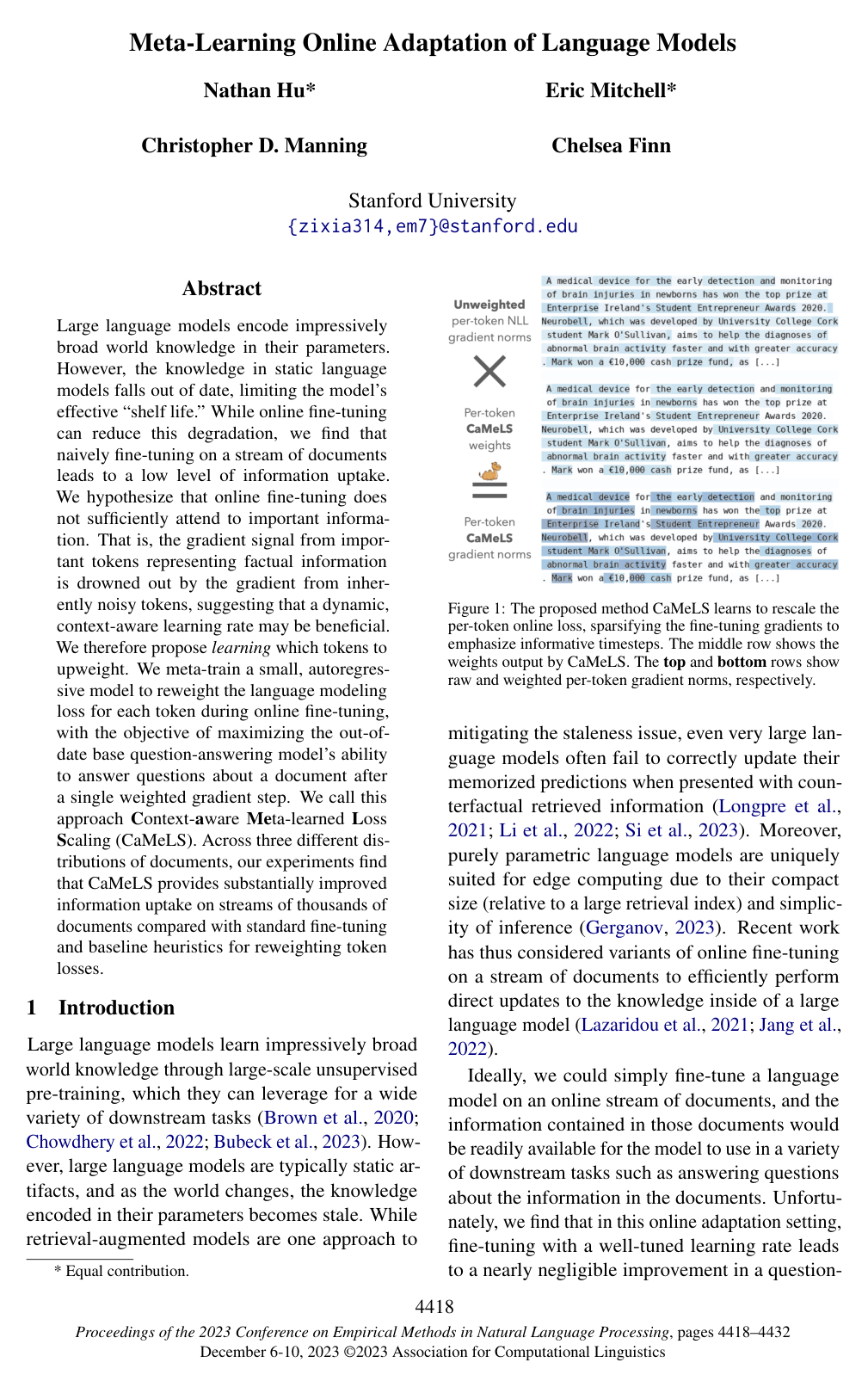
Meta-Learning Online Adaptation of Language Models
Nathan Hu, Eric Mitchell, Christopher D. Manning, Chelsea Finn
Why you should read this
Introduces Context-aware Meta-learned Loss Scaling (CaMeLS), a meta-learning method that trains a lightweight model to dynamically upweight informative tokens during online document streams, substantially boosting factual knowledge uptake in language models over standard fine-tuning.
Large language models encode impressively broad world knowledge in their parameters. However, the knowledge in static language models falls out of date, limiting the model’s effective “shelf life.” While online fine-tuning can reduce this degradation, we find that naively fine-tuning on a stream of documents leads to a low level of information uptake. We hypothesize that online fine-tuning does not sufficiently attend to important information. That is, the gradient signal from important tokens representing factual information is drowned out by the gradient from inherently noisy tokens, suggesting that a dynamic, context-aware learning rate may be beneficial. We therefore propose learning which tokens to upweight. We meta-train a small, autoregressive model to reweight the language modeling loss for each token during online fine-tuning, with the objective of maximizing the out-of-date base question-answering model’s ability to answer questions about a document after a single weighted gradient step. We call this approach Context-aware Meta-learned Loss Scaling (CaMeLS). Across three different distributions of documents, our experiments find that CaMeLS provides substantially improved information uptake on streams of thousands of documents compared with standard fine-tuning and baseline heuristics for reweighting token losses.
Added
2026-10-04
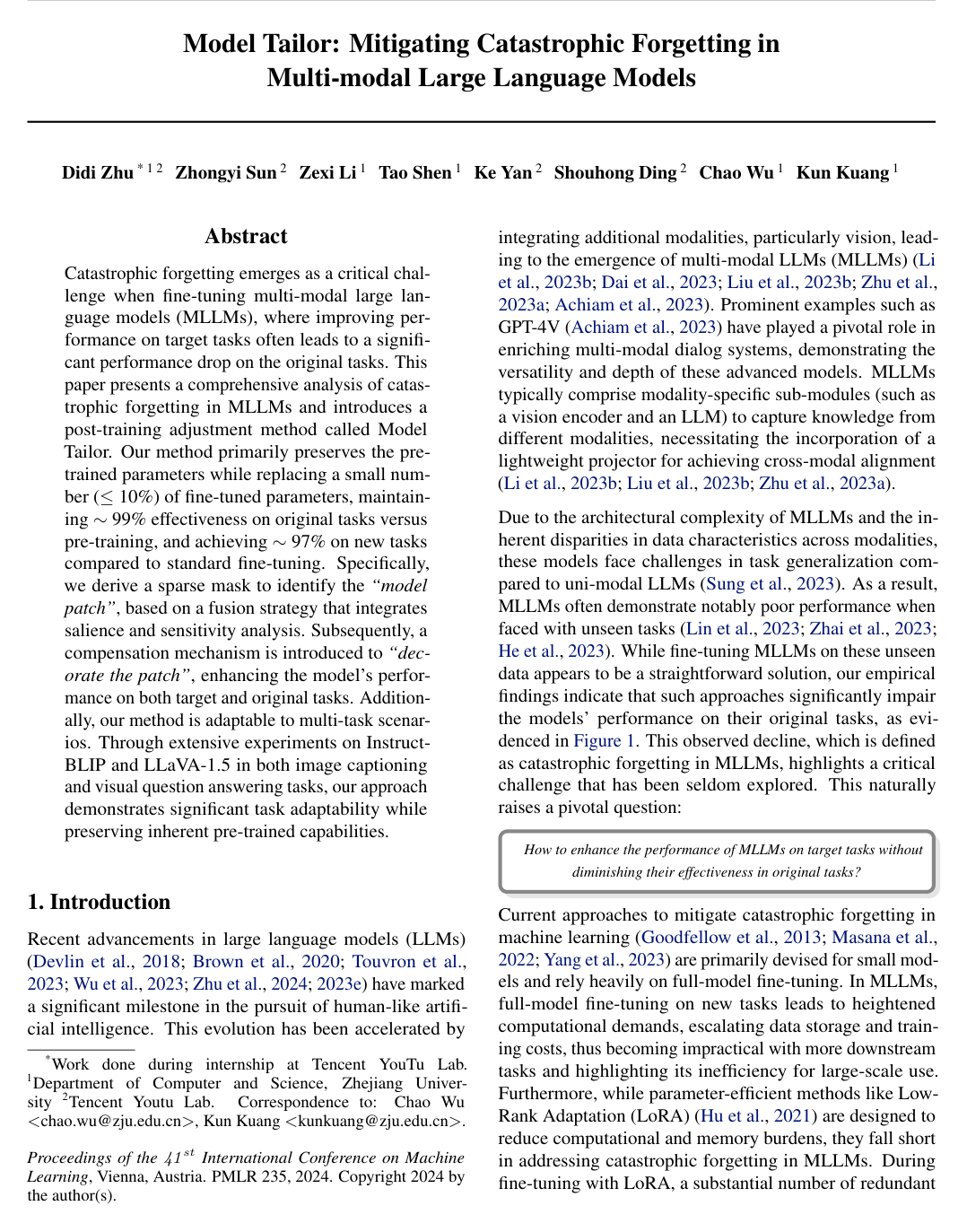
Model Tailor: Mitigating Catastrophic Forgetting in Multi-modal Large Language Models
Didi Zhu, Zhongyi Sun, Zexi Li, Tao Shen, Ke Yan, Shouhong Ding, Chao Wu, Kun Kuang
Why you should read this
Proposes Model Tailor, a parameter-efficient post-training method that updates fewer than ten percent of model parameters through sparse masking and Hessian-based compensation, preventing catastrophic forgetting in multi-modal large language models while maintaining performance on both original and target tasks.
Catastrophic forgetting emerges as a critical challenge when fine-tuning multi-modal large language models (MLLMs), where improving performance on target tasks often leads to a significant performance drop on the original tasks. This paper presents a comprehensive analysis of catastrophic forgetting in MLLMs and introduces a post-training adjustment method called Model Tailor. Our method primarily preserves the pre-trained parameters while replacing a small number (≤ 10%) of fine-tuned parameters, maintaining ~ 99% effectiveness on original tasks versus pre-training, and achieving ~ 97% on new tasks compared to standard fine-tuning. Specifically, we derive a sparse mask to identify the “model patch”, based on a fusion strategy that integrates salience and sensitivity analysis. Subsequently, a compensation mechanism is introduced to “decorate the patch”, enhancing the model’s performance on both target and original tasks. Additionally, our method is adaptable to multi-task scenarios. Through extensive experiments on Instruct-BLIP and LLaVA-1.5 in both image captioning and visual question answering tasks, our approach demonstrates significant task adaptability while preserving inherent pre-trained capabilities.
Added
2026-10-03
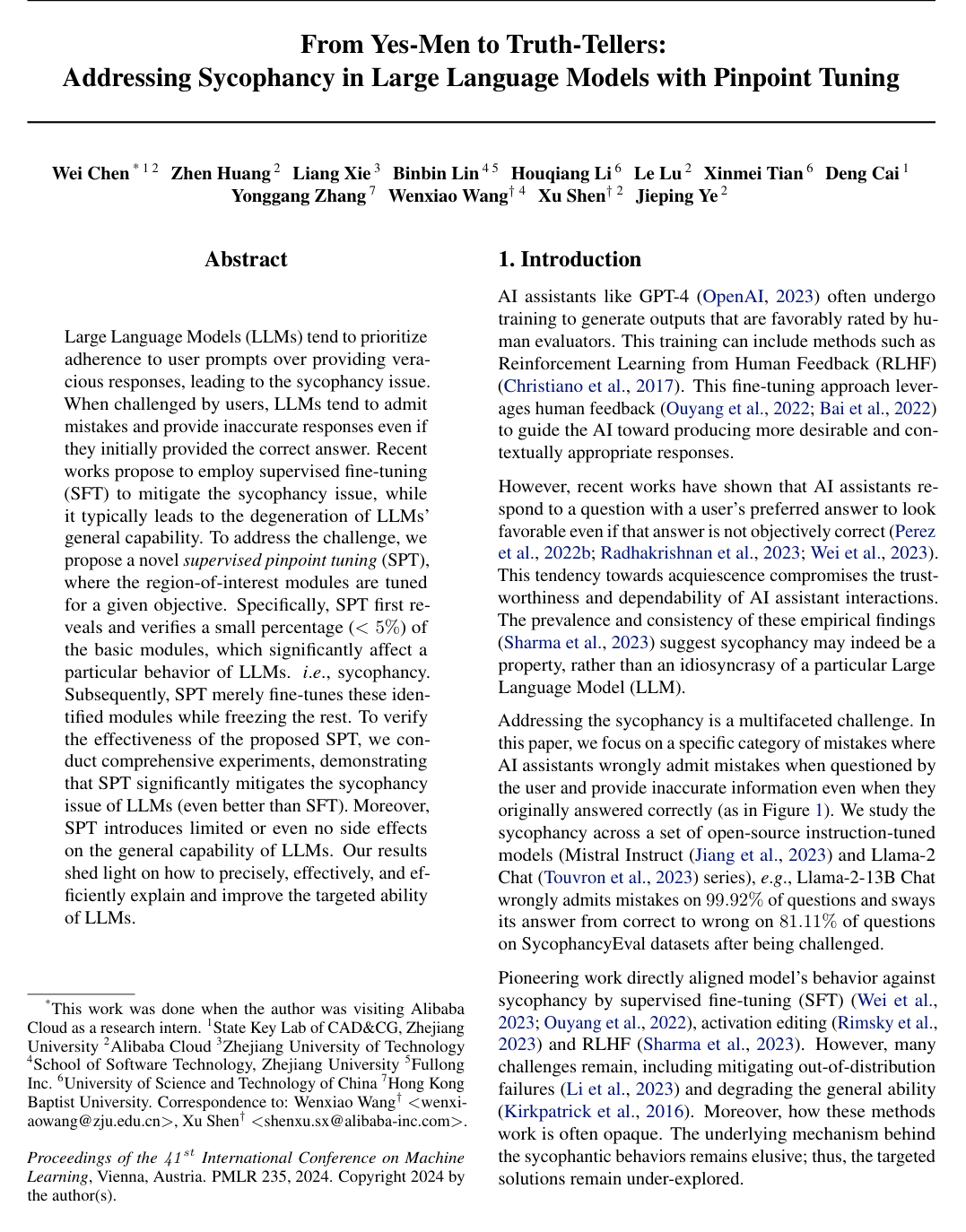
From Yes-Men to Truth-Tellers: Addressing Sycophancy in Large Language Models with Pinpoint Tuning
Wei Chen, Zhen Huang, Liang Xie, Binbin Lin, Houqiang Li, Le Lu, Xinmei Tian, Deng Cai, Yonggang Zhang, Wenxiao Wang, Xu Shen, Jieping Ye
Why you should read this
Proposes supervised pinpoint tuning to effectively eliminate sycophantic behavior in large language models by identifying and fine-tuning less than five percent of critical attention heads without degrading overall model capabilities.
Large Language Models (LLMs) tend to prioritize adherence to user prompts over providing veracious responses, leading to the sycophancy issue. When challenged by users, LLMs tend to admit mistakes and provide inaccurate responses even if they initially provided the correct answer. Recent works propose to employ supervised fine-tuning (SFT) to mitigate the sycophancy issue, while it typically leads to the degeneration of LLMs’ general capability. To address the challenge, we propose a novel supervised pinpoint tuning (SPT), where the region-of-interest modules are tuned for a given objective. Specifically, SPT first reveals and verifies a small percentage (< 5%) of the basic modules, which significantly affect a particular behavior of LLMs. i.e., sycophancy. Subsequently, SPT merely fine-tunes these identified modules while freezing the rest. To verify the effectiveness of the proposed SPT, we conduct comprehensive experiments, demonstrating that SPT significantly mitigates the sycophancy issue of LLMs (even better than SFT). Moreover, SPT introduces limited or even no side effects on the general capability of LLMs. Our results shed light on how to precisely, effectively, and efficiently explain and improve the targeted ability of LLMs.
Added
2026-10-03
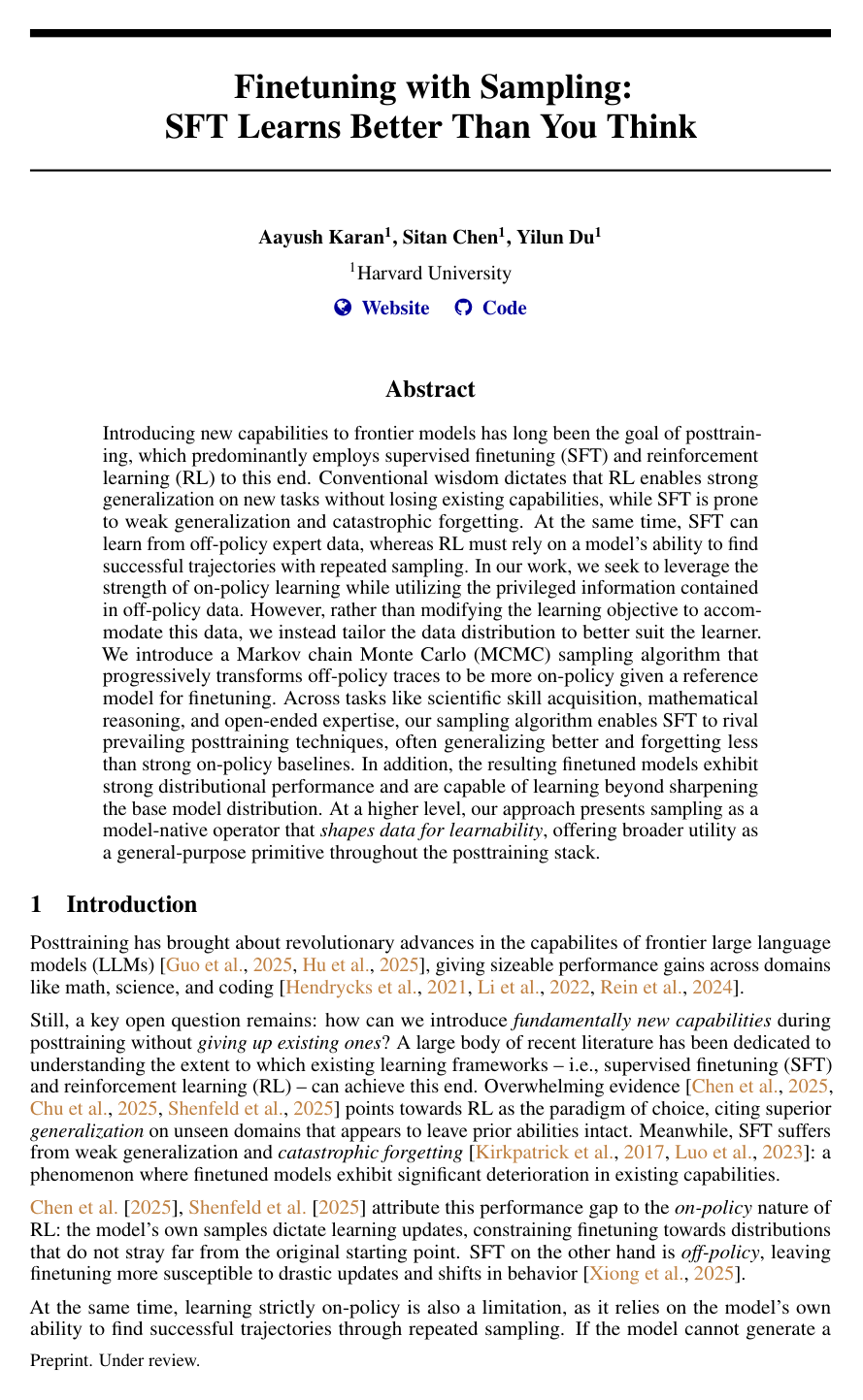
Finetuning with Sampling: SFT Learns Better Than You Think
Aayush Karan, Sitan Chen, Yilun Du
Why you should read this
Proposes an MCMC sampling algorithm that transforms off-policy expert trajectories toward a model's on-policy distribution, enabling supervised finetuning to match reinforcement learning in task generalization while mitigating catastrophic forgetting.
Introducing new capabilities to frontier models has long been the goal of posttraining, which predominantly employs supervised finetuning (SFT) and reinforcement learning (RL) to this end. Conventional wisdom dictates that RL enables strong generalization on new tasks without losing existing capabilities, while SFT is prone to weak generalization and catastrophic forgetting. At the same time, SFT can learn from off-policy expert data, whereas RL must rely on a model's ability to find successful trajectories with repeated sampling. In our work, we seek to leverage the strength of on-policy learning while utilizing the privileged information contained in off-policy data. However, rather than modifying the learning objective to accommodate this data, we instead tailor the data distribution to better suit the learner. We introduce a Markov chain Monte Carlo (MCMC) sampling algorithm that progressively transforms off-policy traces to be more on-policy given a reference model for finetuning. Across tasks like scientific skill acquisition, mathematical reasoning, and open-ended expertise, our sampling algorithm enables SFT to rival prevailing posttraining techniques, often generalizing better and forgetting less than strong on-policy baselines. In addition, the resulting finetuned models exhibit strong distributional performance and are capable of learning beyond sharpening the base model distribution. At a higher level, our approach presents sampling as a model-native operator that shapes data for learnability, offering broader utility as a general-purpose primitive throughout the posttraining stack.
Added
2026-10-03

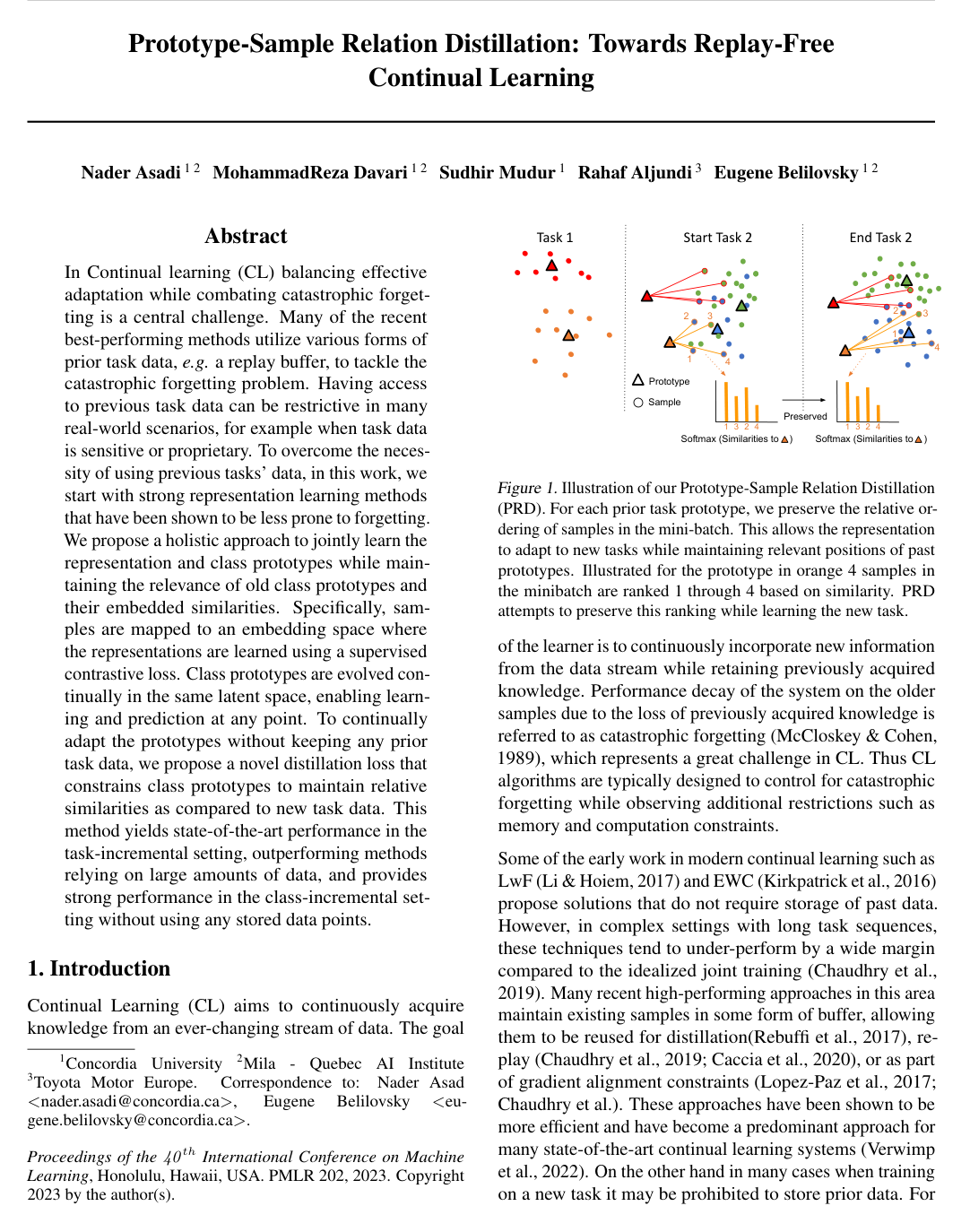
Prototype-Sample Relation Distillation: Towards Replay-Free Continual Learning
Nader Asadi, MohammadReza Davari, Sudhir P. Mudur, Rahaf Aljundi, Eugene Belilovsky
Why you should read this
Proposes a replay-free continual learning framework that prevents catastrophic forgetting by distilling the relative similarities between incoming samples and past class prototypes, outperforming memory-buffer methods without storing historical data.
In Continual learning (CL) balancing effective adaptation while combating catastrophic forgetting is a central challenge. Many of the recent best-performing methods utilize various forms of prior task data, e.g. a replay buffer, to tackle the catastrophic forgetting problem. Having access to previous task data can be restrictive in many real-world scenarios, for example when task data is sensitive or proprietary. To overcome the necessity of using previous tasks' data, in this work, we start with strong representation learning methods that have been shown to be less prone to forgetting. We propose a holistic approach to jointly learn the representation and class prototypes while maintaining the relevance of old class prototypes and their embedded similarities. Specifically, samples are mapped to an embedding space where the representations are learned using a supervised contrastive loss. Class prototypes are evolved continually in the same latent space, enabling learning and prediction at any point. To continually adapt the prototypes without keeping any prior task data, we propose a novel distillation loss that constrains class prototypes to maintain relative similarities as compared to new task data. This method yields state-of-the-art performance in the task-incremental setting, outperforming methods relying on large amounts of data, and provides strong performance in the class-incremental setting without using any stored data points.
Added
2026-10-03
Overcoming Catastrophic Forgetting During Domain Adaptation of Seq2seq Language Generation
Dingcheng Li, Zheng Chen, Eunah Cho, Jie Hao, Xiaohu Liu, Fan Xing, Chenlei Guo, Yang Liu
Why you should read this
Proposes a framework combining adaptive parameter regularization with embedding-space domain drift estimation to prevent catastrophic forgetting in sequential sequence-to-sequence language generation without storing past task data.
Seq2seq language generation models that are trained offline with multiple domains in a sequential fashion often suffer from catastrophic forgetting. Lifelong learning has been proposed to handle this problem. However, existing work such as experience replay or elastic weighted consolidation requires incremental memory space. In this work, we propose an innovative framework, RMR_DSE that leverages a recall optimization mechanism to selectively memorize important parameters of previous tasks via regularization, and uses a domain drift estimation algorithm to compensate for the drift between different domains in the embedding space. These designs enable the model to be trained on the current task while keeping the memory of previous tasks, and avoid much additional data storage. Furthermore, RMR_DSE can be combined with existing lifelong learning approaches. Our experiments on two seq2seq language generation tasks, paraphrase and dialog response generation, show that RMR_DSE outperforms state-of-the-art models by a considerable margin and greatly reduces forgetting.
Added
2026-10-03
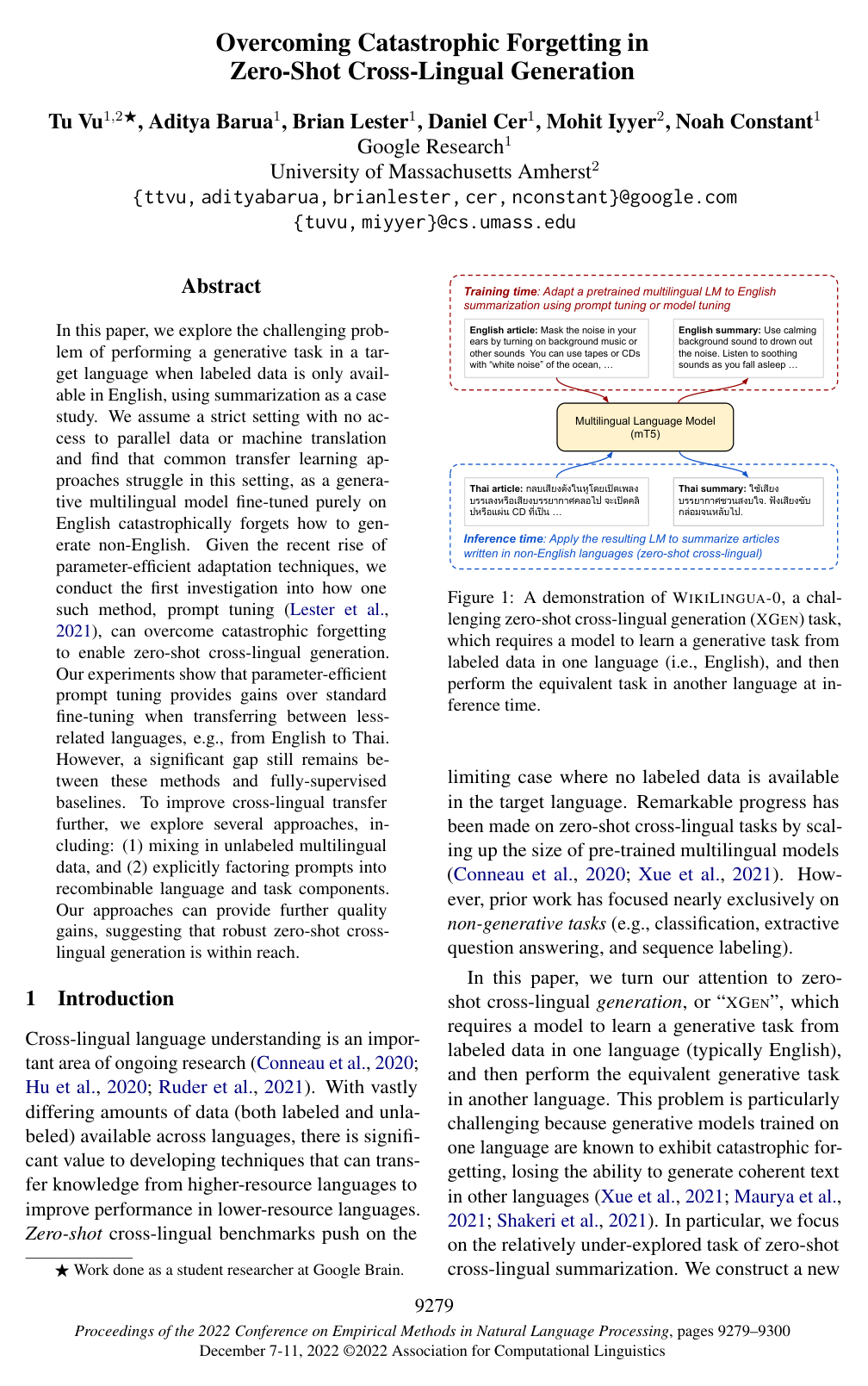
Overcoming Catastrophic Forgetting in Zero-Shot Cross-Lingual Generation
Tu Vu, Aditya Barua, Brian Lester, Daniel Cer, Mohit Iyyer, Noah Constant
Why you should read this
Proposes factorized prompt tuning and unlabeled data mixing to prevent multilingual language models from catastrophically forgetting non-English text generation capabilities when adapted only on English data.
Recent advances in speculative decoding have led to diverse perspectives among language models...
Added
2026-10-02
Wide Neural Networks Forget Less Catastrophically
Seyed-Iman Mirzadeh, Arslan Chaudhry, Dong Yin, Huiyi Hu, Razvan Pascanu, Dilan Görür, Mehrdad Farajtabar
Why you should read this
Demonstrates that increasing network width significantly reduces catastrophic forgetting in continual learning—even matching the benefits of replay buffers—and explains this phenomenon through gradient orthogonality, activation sparsity, and the lazy training regime.
A primary focus area in continual learning research is alleviating the “catastrophic forgetting” problem in neural networks by designing new algorithms that are more robust to the distribution shifts. While the recent progress in continual learning literature is encouraging, our understanding of what properties of neural networks contribute to catastrophic forgetting is still limited. To address this, instead of focusing on continual learning algorithms, in this work, we focus on the model itself and study the impact of “width” of the neural network architecture on catastrophic forgetting, and show that width has a surprisingly significant effect on forgetting. To explain this effect, we study the learning dynamics of the network from various perspectives such as gradient orthogonality, sparsity, and lazy training regime. We provide potential explanations that are consistent with the empirical results across different architectures and continual learning benchmarks.
Added
2026-10-02
Lifelong Language Pretraining with Distribution-Specialized Experts
Wuyang Chen, Yanqi Zhou, Nan Du, Yanping Huang, James Laudon, Zhifeng Chen, Claire Cui
Why you should read this
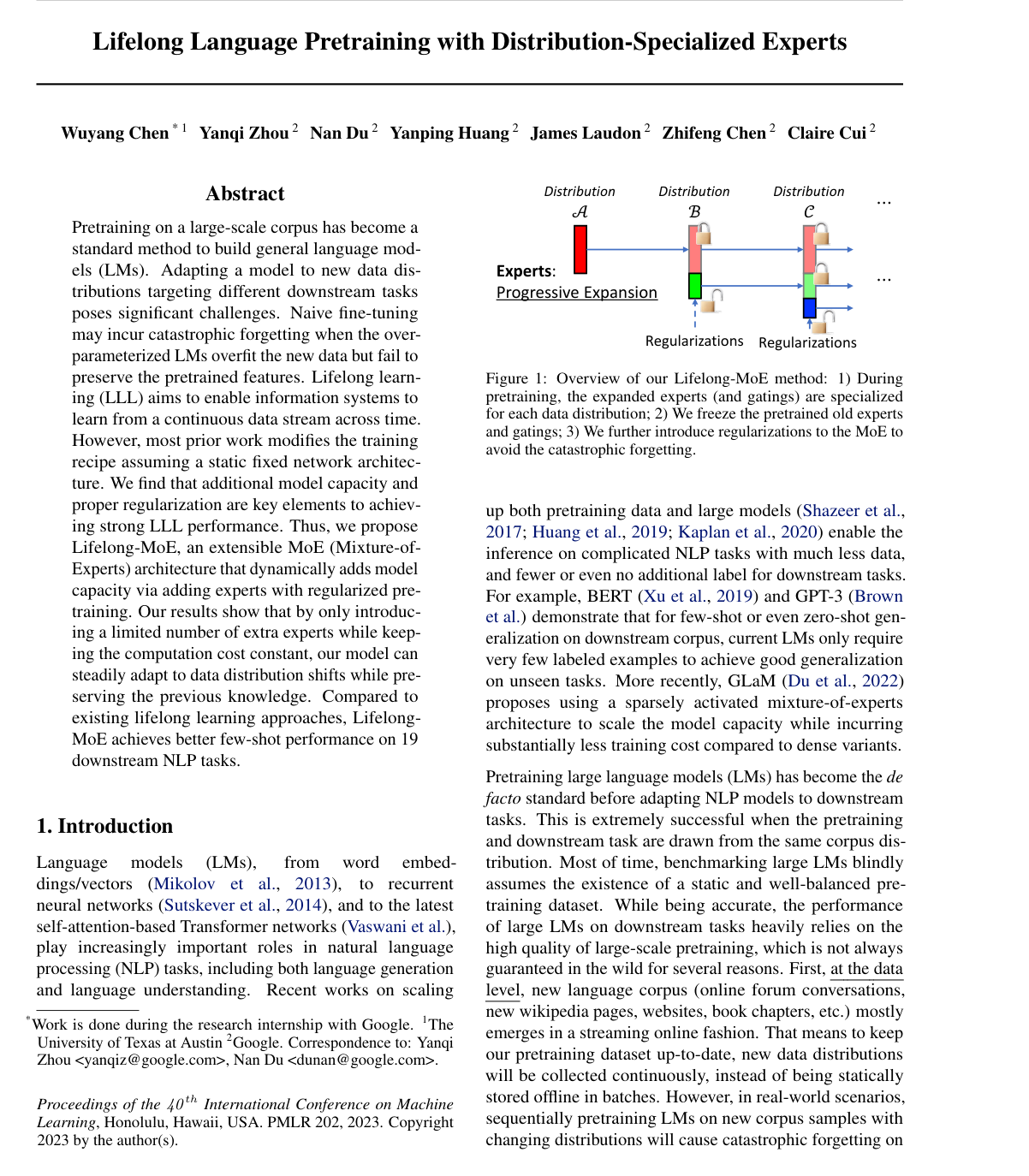
Proposes Lifelong-MoE, an extensible mixture-of-experts pretraining framework that continually adapts large language models to streaming data distributions and prevents catastrophic forgetting by progressively expanding and freezing specialized experts without increasing inference computation.
Large-scale pretrained language models have achieved great success in various natural language processing tasks. However, they still suffer from catastrophic forgetting when adapted to new domains/tasks. To address this issue, we propose Lifelong Language Pretraining with Distribution-Specialized Experts (LLP-DSE), which continually adapts a pretrained model to multiple domains using specialized expert modules while avoiding interference between them.
Added
2026-10-02
From RAG to Memory: Non-Parametric Continual Learning for Large Language Models
Bernal Jimnez Gutirrez, Yiheng Shu, Weijian Qi, Sizhe Zhou, Yu Su
Why you should read this
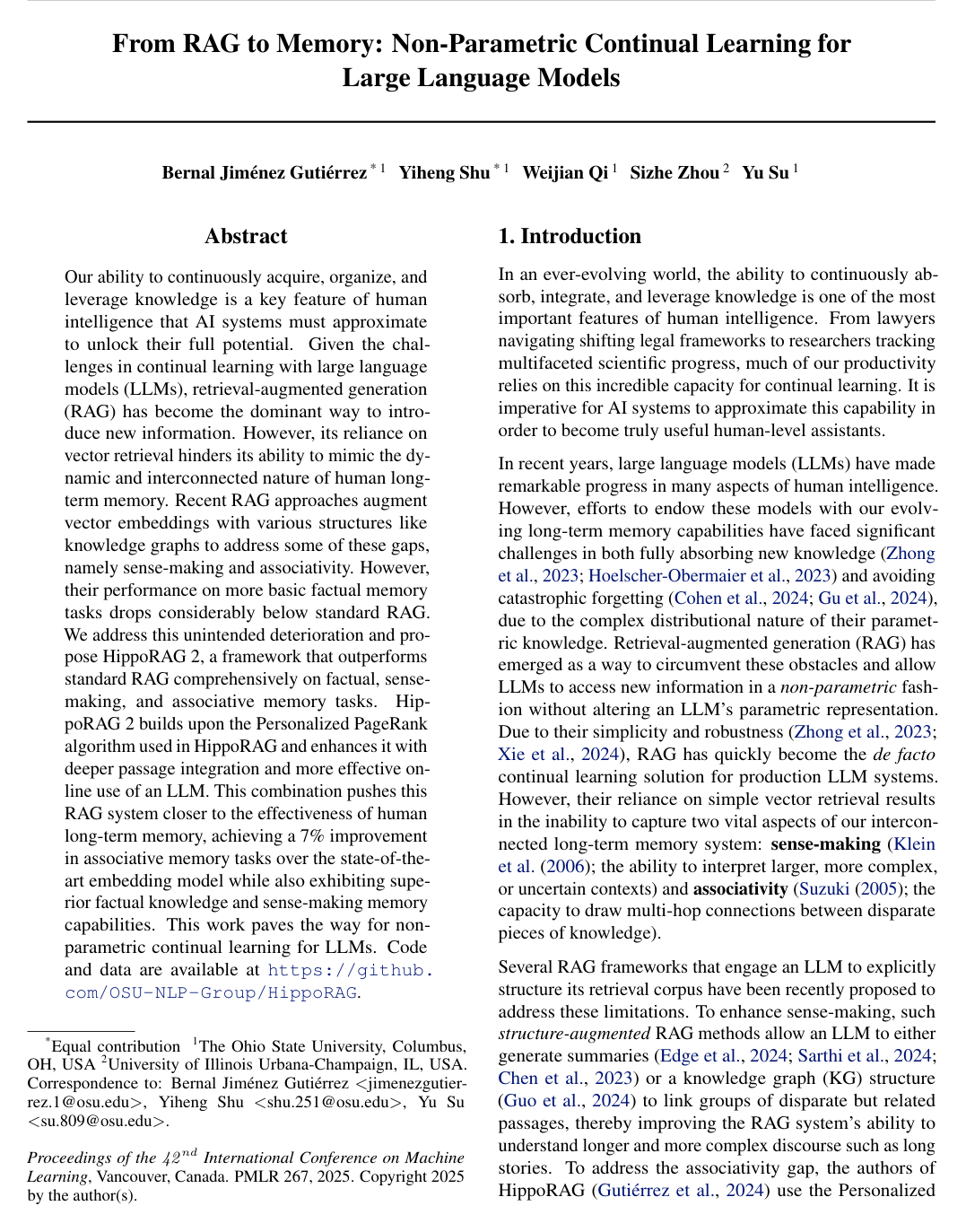
Proposes HippoRAG 2, a non-parametric continual learning framework that integrates knowledge graphs with Personalized PageRank and online language model reasoning to outperform standard retrieval-augmented generation across factual, sense-making, and associative memory tasks.
Our ability to continuously acquire, organize, and leverage knowledge is a key feature of human intelligence that AI systems must approximate to unlock their full potential. Given the challenges in continual learning with large language models (LLMs), retrieval-augmented generation (RAG) has become the dominant way to introduce new information. However, its reliance on vector retrieval hinders its ability to mimic the dynamic and interconnected nature of human long-term memory. Recent RAG approaches augment vector embeddings with various structures like knowledge graphs to address some of these gaps, namely sense-making and associativity. However, their performance on more basic factual memory tasks drops considerably below standard RAG. We address this unintended deterioration and propose HippoRAG 2, a framework that outperforms standard RAG comprehensively on factual, sense-making, and associative memory tasks. HippoRAG 2 builds upon the Personalized PageRank algorithm used in HippoRAG and enhances it with deeper passage integration and more effective online use of an LLM. This combination pushes this RAG system closer to the effectiveness of human long-term memory, achieving a 7% improvement in associative memory tasks over the state-of-the-art embedding model while also exhibiting superior factual knowledge and sense-making memory capabilities. This work paves the way for non-parametric continual learning for LLMs. Code and data are available at https://github.com/OSU-NLP-Group/HippoRAG.
Added
2026-10-01
Forget-free Continual Learning with Winning Subnetworks
Haeyong Kang, Rusty John Lloyd Mina, Sultan Rizky Hikmawan Madjid, Jaehong Yoon, Mark Hasegawa-Johnson, Sung Ju Hwang, Chang D. Yoo
Why you should read this
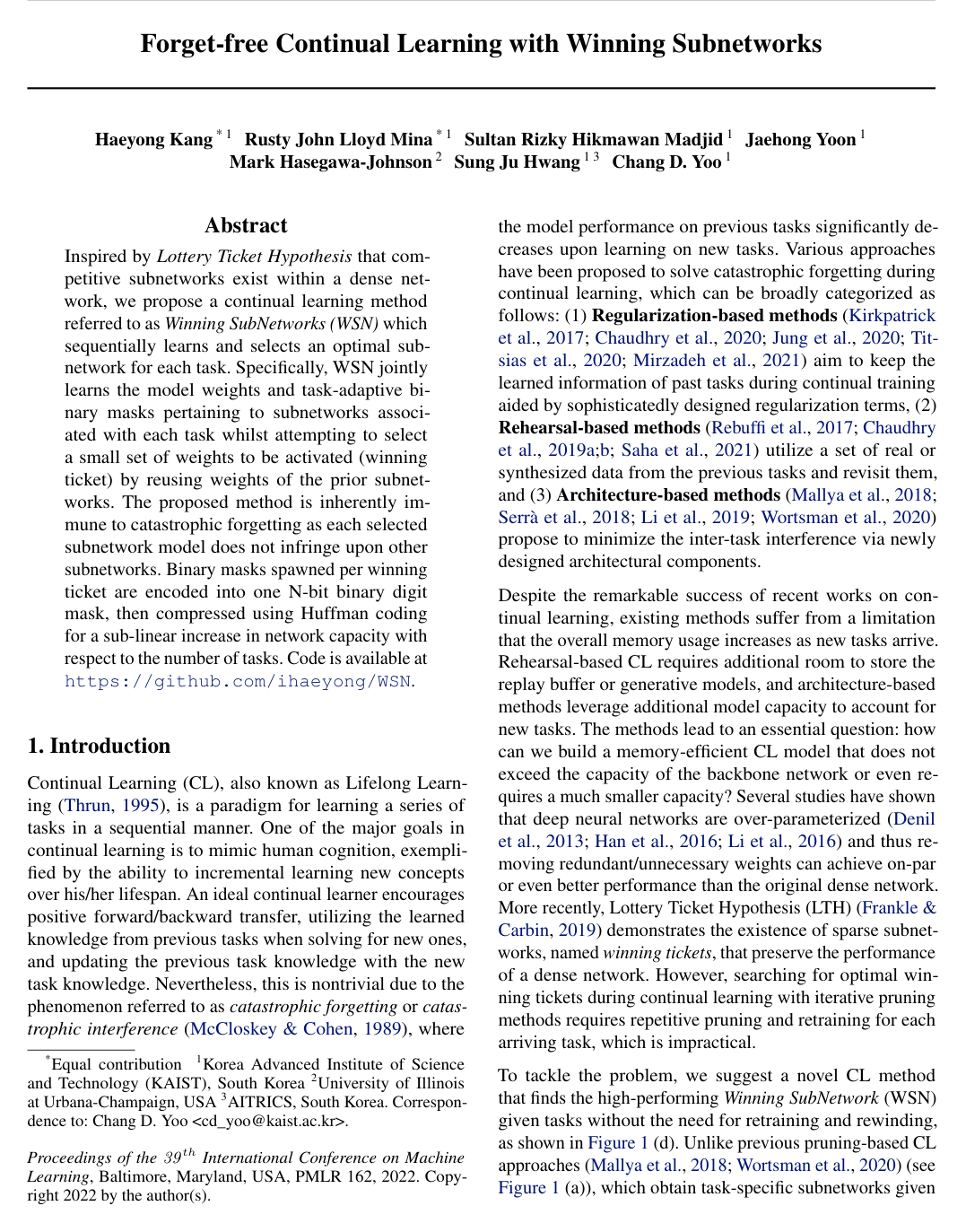
Proposes a continual learning framework that completely prevents catastrophic forgetting by isolating and reusing task-specific sparse subnetworks within a single model, compressing the resulting binary masks with Huffman coding to achieve sub-linear memory growth across sequential tasks.
Inspired by Lottery Ticket Hypothesis that competitive subnetworks exist within a dense network, we propose a continual learning method referred to as Winning SubNetworks (WSN) which sequentially learns and selects an optimal subnetwork for each task. Specifically, WSN jointly learns the model weights and task-adaptive binary masks pertaining to subnetworks associated with each task whilst attempting to select a small set of weights to be activated (winning ticket) by reusing weights of the prior subnetworks. The proposed method is inherently immune to catastrophic forgetting as each selected subnetwork model does not infringe upon other subnetworks. Binary masks spawned per winning ticket are encoded into one N-bit binary digit mask, then compressed using Huffman coding for a sub-linear increase in network capacity with respect to the number of tasks. Code is available at https://github.com/ihaeyong/WSN.
Added
2026-10-01
The CoT Collection: Improving Zero-shot and Few-shot Learning of Language Models via Chain-of-Thought Fine-Tuning
Seungone Kim, Se June Joo, Doyoung Kim, Joel Jang, Seonghyeon Ye, Jamin Shin, Minjoon Seo
Why you should read this
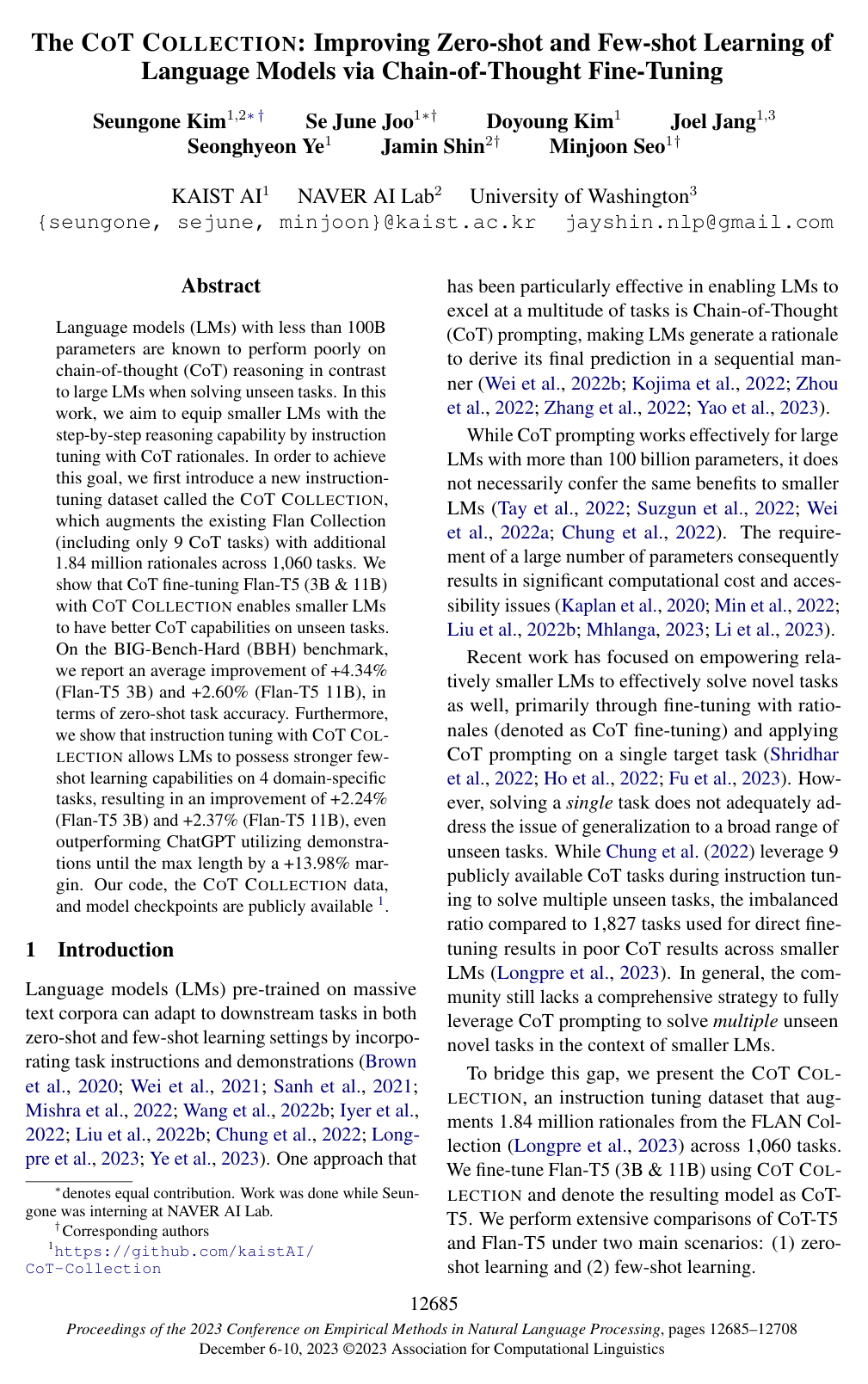
Presents the CoT Collection, an instruction-tuning dataset of 1.84 million step-by-step rationales across 1,060 tasks that enables language models under 100 billion parameters to significantly improve their zero-shot and few-shot reasoning capabilities on unseen tasks.
Language models (LMs) with less than 100B parameters are known to perform poorly on chain-of-thought (CoT) reasoning in contrast to large LMs when solving unseen tasks. In this work, we aim to equip smaller LMs with the step-by-step reasoning capability by instruction tuning with CoT rationales. In order to achieve this goal, we first introduce a new instruction-tuning dataset called the CoT Collection, which augments the existing Flan Collection (including only 9 CoT tasks) with additional 1.84 million rationales across 1,060 tasks. We show that CoT fine-tuning Flan-T5 (3B & 11B) with CoT Collection enables smaller LMs to have better CoT capabilities on unseen tasks. On the BIG-Bench-Hard (BBH) benchmark, we report an average improvement of +4.34% (Flan-T5 3B) and +2.60% (Flan-T5 11B), in terms of zero-shot task accuracy. Furthermore, we show that instruction tuning with CoT Collection allows LMs to possess stronger few-shot learning capabilities on 4 domain-specific tasks, resulting in an improvement of +2.24% (Flan-T5 3B) and +2.37% (Flan-T5 11B), even outperforming ChatGPT utilizing demonstrations until the max length by a +13.98% margin. Our code, the CoT Collection data, and model checkpoints are publicly available¹.
Added
2026-09-30