Meta-Learning Online Adaptation of Language Models
Nathan HuEric MitchellChristopher D. ManningChelsea Finn
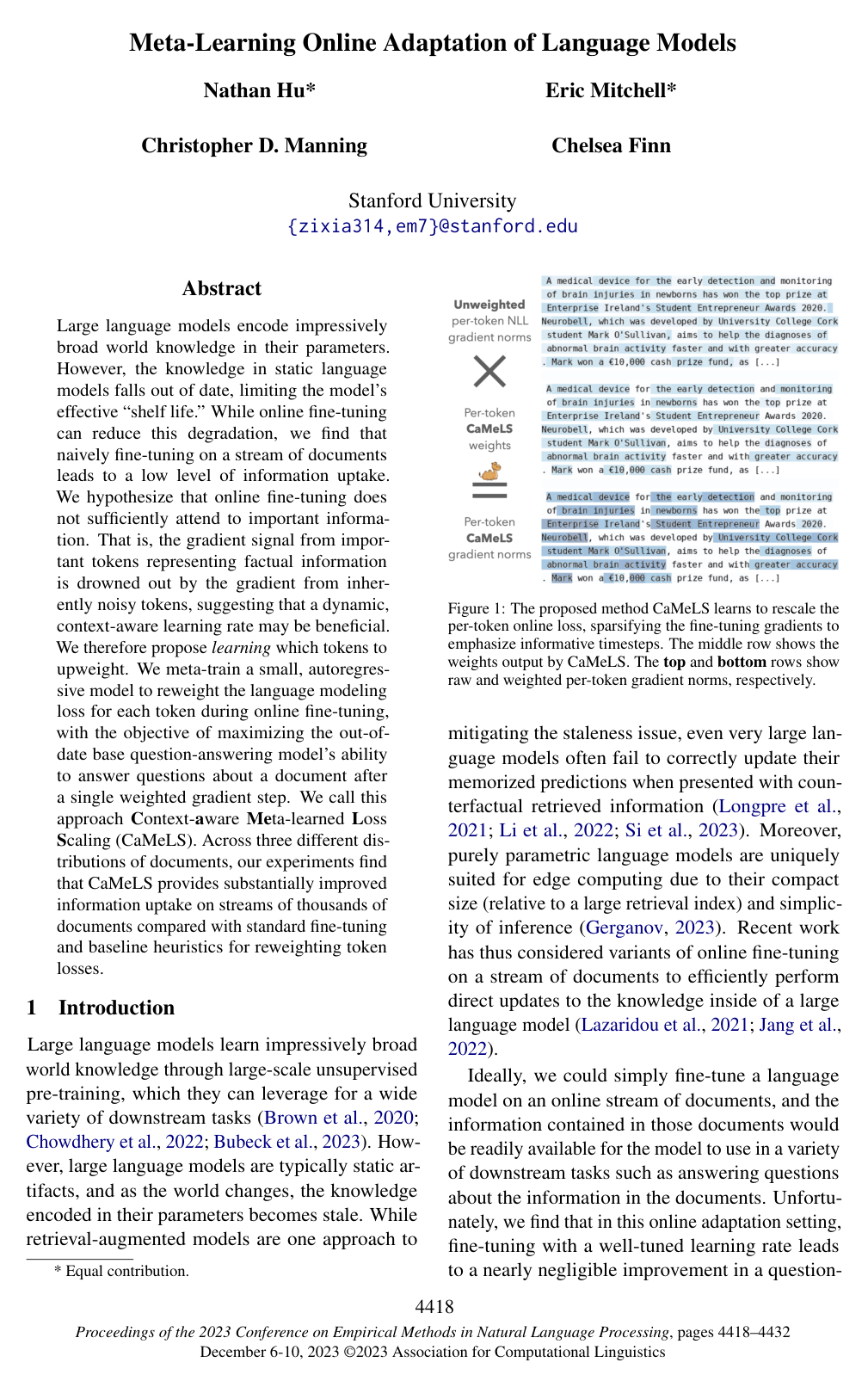
Introduces Context-aware Meta-learned Loss Scaling (CaMeLS), a meta-learning method that trains a lightweight model to dynamically upweight informative tokens during online document streams, substantially boosting factual knowledge uptake in language models over standard fine-tuning.
Large language models store extensive world knowledge within their parameters, but this information quickly becomes outdated as real-world facts change. While streaming new documents directly into models through online fine-tuning could theoretically keep them current, standard fine-tuning strategies achieve negligible improvement in retaining new facts because the standard training loss treats all words equally, allowing noisy words to drown out the learning signal from critical factual updates.
The article develops and evaluates a meta-learning method called Context-aware Meta-learned Loss Scaling, or CaMeLS, designed to automatically identify and upweight the most informative words in a text stream to improve factual retention during online model updating.
To accomplish this, the authors trained a small secondary model to dynamically assign importance weights to words in incoming texts. This secondary model was optimized through a two-step process that rewarded weight assignments enabling a lightweight stand-in language model to correctly answer downstream questions about the text after just a single update step. The authors evaluated the approach across streams containing thousands of articles from three benchmark question-answering datasets (StreamingQA, SQuAD, and ArchivalQA) using base language models ranging from smaller architectures up to a 6-billion-parameter model.
The primary finding is that the proposed method substantially outperforms standard fine-tuning and common heuristic baselines, such as keyword frequency and text-span filtering, delivering substantial relative gains in question-answering accuracy across all tested models. Crucially, the learned weighting model transfers effectively across architectures: training once on a small 82-million-parameter model successfully guided the online adaptation of a model more than 70 times larger. The weighting model also generalized across entirely different datasets without retraining. Analysis of the learned weights revealed a bimodal, context-dependent distribution that prioritizes informative parts of speech, especially proper nouns and numbers, leading to faster initial learning and longer knowledge retention without requiring substantial additional computational overhead during deployment.
These findings indicate that language models can be kept up-to-date efficiently in continuous operational settings without resorting to costly, frequent full retraining or relying exclusively on external retrieval systems. By focusing parameter updates strictly on high-value tokens, organizations can maintain parametric model accuracy on edge devices and streaming pipelines while minimizing the risk of degrading unrelated existing knowledge. Additionally, preliminary tests show the technique is complementary to retrieval-augmented generation and in-context learning, boosting the performance of both.
Organizations looking to maintain dynamic, up-to-date language models should consider adopting context-aware loss weighting rather than uniform online fine-tuning. Before wide enterprise deployment, decision-makers should run pilot programs within their specific operational domains, as the method currently requires paired document-question training examples during initial setup to teach the weighting model which facts matter. Further validation is also recommended to evaluate performance over much longer data streams and on extreme-scale models exceeding 100 billion parameters.
No sufficiently relevant recommendations were found.
No sufficiently relevant recommendations were found.