
keyword
few-shot class-incremental learning
Few-shot class-incremental learning is a machine learning paradigm in which a model continuously learns to classify new categories over sequential stages using only a few labeled training examples per novel class, while retaining the ability to recognize previously learned categories. In a typical setup, the system is initially trained on a base set of classes with abundant data to learn a rich representation space, followed by incremental sessions where novel classes are introduced with limited supervision. This paradigm bridges continual learning and few-shot learning, requiring models to overcome catastrophic forgetting of earlier knowledge while simultaneously avoiding overfitting and performance degradation caused by scarce training samples.
4 items
FeCAM: Exploiting the Heterogeneity of Class Distributions in Exemplar-Free Continual Learning
Dipam Goswami, Yuyang Liu, Bartlomiej Twardowski, Joost van de Weijer
Why you should read this
Proposes a training-free Bayes classifier based on Mahalanobis distance and covariance modeling that effectively captures heterogeneous class distributions to achieve state-of-the-art results in exemplar-free continual learning without updating the backbone network.
Exemplar-free class-incremental learning (CIL) poses several challenges since it prohibits the rehearsal of data from previous tasks and thus suffers from catastrophic forgetting. Recent approaches to incrementally learning the classifier by freezing the feature extractor after the first task have gained much attention. In this paper, we explore prototypical networks for CIL, which generate new class prototypes using the frozen feature extractor and classify the features based on the Euclidean distance to the prototypes. In an analysis of the feature distributions of classes, we show that classification based on Euclidean metrics is successful for jointly trained features. However, when learning from non-stationary data, we observe that the Euclidean metric is suboptimal and that feature distributions are heterogeneous. To address this challenge, we revisit the anisotropic Mahalanobis distance for CIL. In addition, we empirically show that modeling the feature covariance relations is better than previous attempts at sampling features from normal distributions and training a linear classifier. Unlike existing methods, our approach generalizes to both many- and few-shot CIL settings, as well as to domain-incremental settings. Interestingly, without updating the backbone network, our method obtains state-of-the-art results on several standard continual learning benchmarks. Code is available at https://github.com/dipamgoswami/FeCAM.
Added
2026-09-26
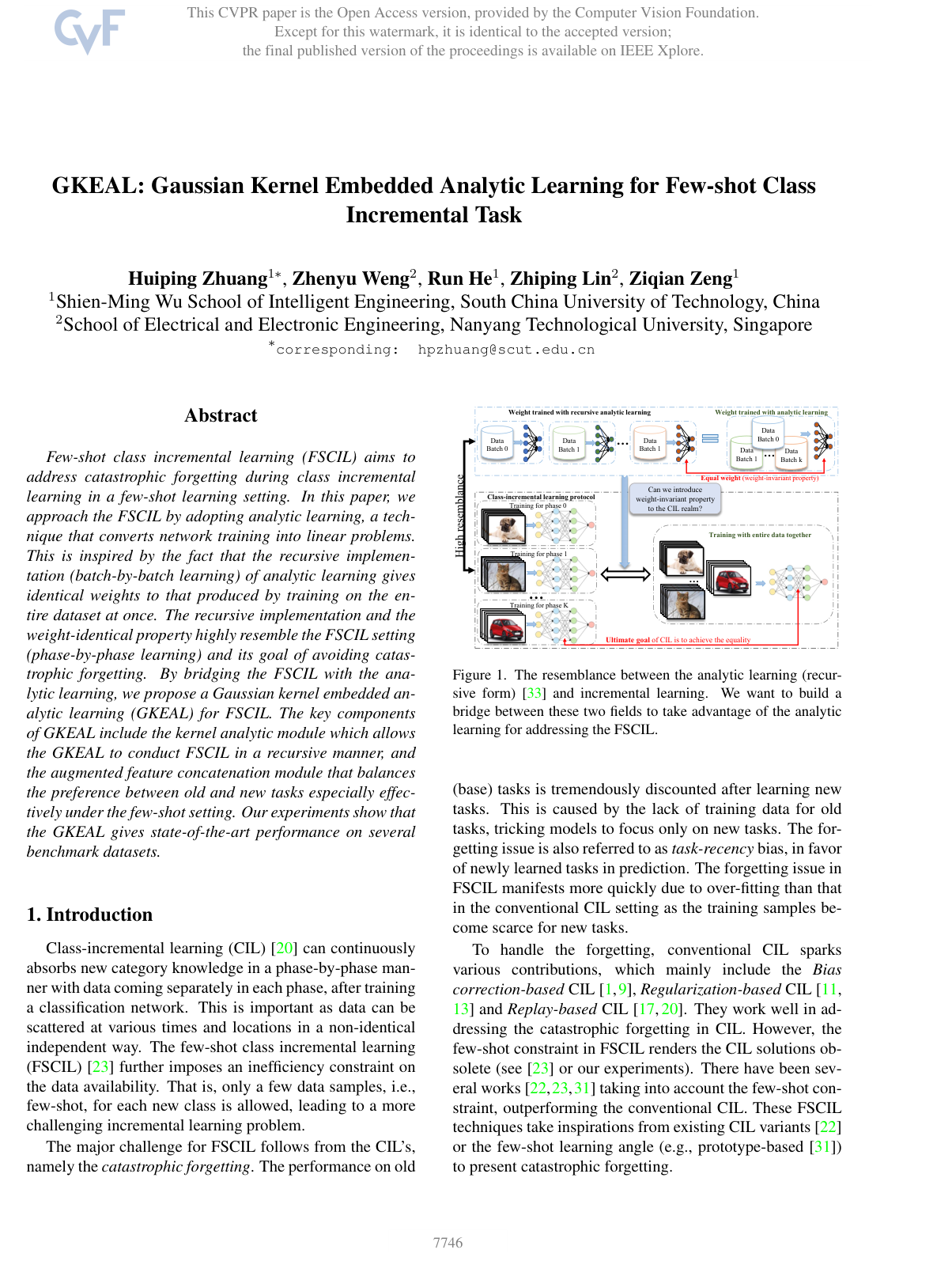
GKEAL: Gaussian Kernel Embedded Analytic Learning for Few-Shot Class Incremental Task
Huiping Zhuang, Zhenyu Weng, Run He, Zhiping Lin, Ziqian Zeng
Why you should read this
Proposes a closed-form analytic learning framework for few-shot class-incremental learning that combines Gaussian kernel embeddings with recursive least-squares updates to guarantee weight-invariant classifier solutions and prevent catastrophic forgetting.
Few-shot class incremental learning (FSCIL) aims to address catastrophic forgetting during class incremental learning in a few-shot learning setting. In this paper, we approach the FSCIL by adopting analytic learning, a technique that converts network training into linear problems. This is inspired by the fact that the recursive implementation (batch-by-batch learning) of analytic learning gives identical weights to that produced by training on the entire dataset at once. The recursive implementation and the weight-identical property highly resemble the FSCIL setting (phase-by-phase learning) and its goal of avoiding catastrophic forgetting. By bridging the FSCIL with the analytic learning, we propose a Gaussian kernel embedded analytic learning (GKEAL) for FSCIL. The key components of GKEAL include the kernel analytic module which allows the GKEAL to conduct FSCIL in a recursive manner, and the augmented feature concatenation module that balances the preference between old and new tasks especially effectively under the few-shot setting. Our experiments show that the GKEAL gives state-of-the-art performance on several benchmark datasets.
Added
2026-09-26
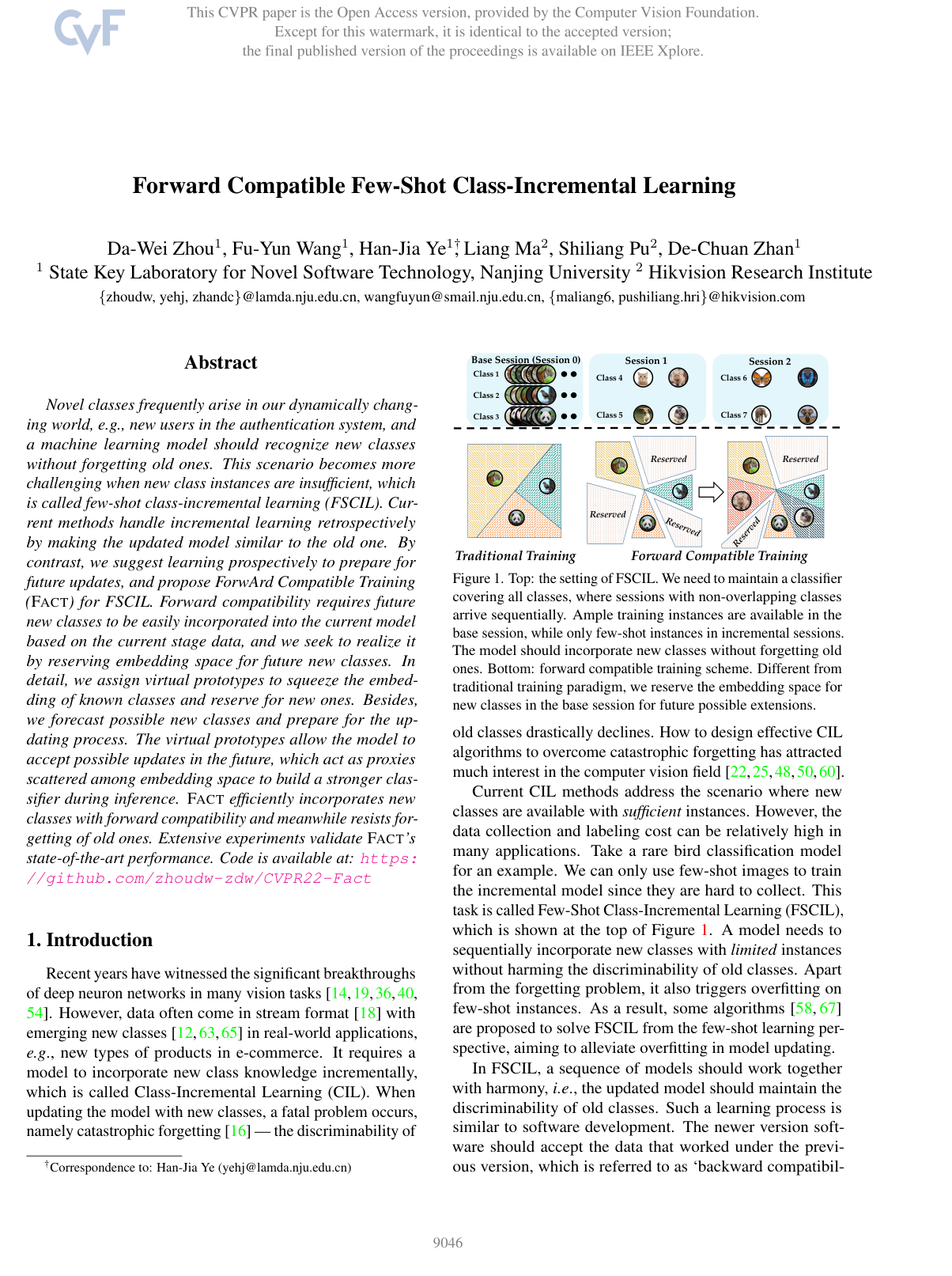
Forward Compatible Few-Shot Class-Incremental Learning
Da-Wei Zhou, Fu-Yun Wang, Han-Jia Ye, Liang Ma, Shiliang Pu, De-Chuan Zhan
Why you should read this
Proposes a forward-compatible training framework that reserves embedding space using virtual prototypes and simulated new instances during base training, enabling few-shot class-incremental models to integrate future classes without forgetting past ones.
Novel classes frequently arise in our dynamically changing world, e.g., new users in the authentication system, and a machine learning model should recognize new classes without forgetting old ones. This scenario becomes more challenging when new class instances are insufficient, which is called few-shot class-incremental learning (FSCIL). Current methods handle incremental learning retrospectively by making the updated model similar to the old one. By contrast, we suggest learning prospectively to prepare for future updates, and propose ForwArd Compatible Training (FACT) for FSCIL. Forward compatibility requires future new classes to be easily incorporated into the current model based on the current stage data, and we seek to realize it by reserving embedding space for future new classes. In detail, we assign virtual prototypes to squeeze the embedding of known classes and reserve for new ones. Besides, we forecast possible new classes and prepare for the updating process. The virtual prototypes allow the model to accept possible updates in the future, which act as proxies scattered among embedding space to build a stronger classifier during inference. FACT efficiently incorporates new classes with forward compatibility and meanwhile resists forgetting of old ones. Extensive experiments validate FACT's state-of-the-art performance. Code is available at: https://github.com/zhoudw-zdw/CVPR22-Fact
Added
2026-09-26
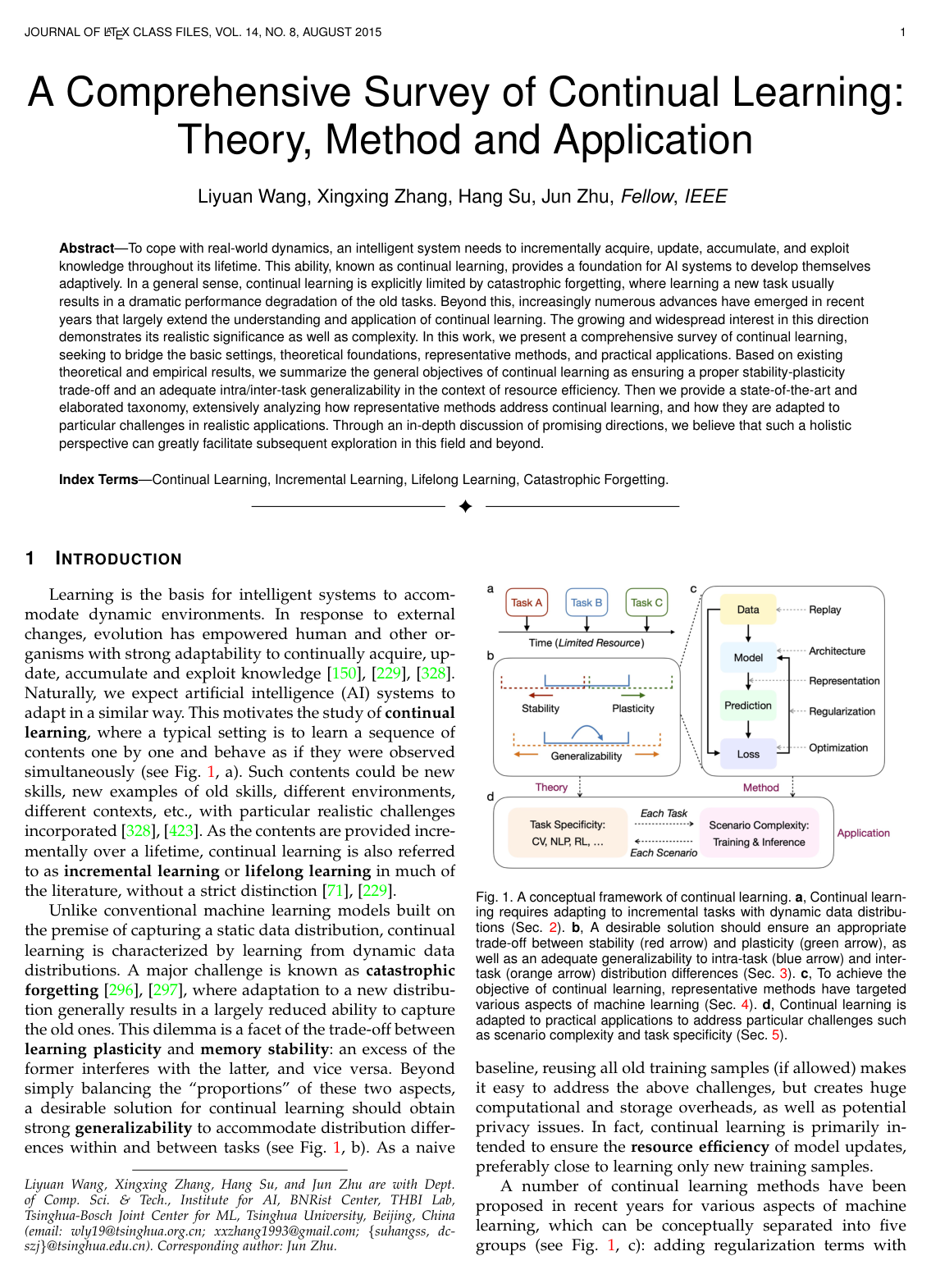
A Comprehensive Survey of Continual Learning: Theory, Method and Application
Liyuan Wang, Xingxing Zhang, Hang Su, Jun Zhu
Why you should read this
Presents a systematic taxonomy of continual learning that bridges theoretical foundations, methods for overcoming catastrophic forgetting, and practical applications across real-world dynamic environments.
To cope with real-world dynamics, an intelligent system needs to incrementally acquire, update, accumulate, and exploit knowledge throughout its lifetime. This ability, known as continual learning, provides a foundation for AI systems to develop themselves adaptively. In a general sense, continual learning is explicitly limited by catastrophic forgetting, where learning a new task usually results in a dramatic performance degradation of the old tasks. Beyond this, increasingly numerous advances have emerged in recent years that largely extend the understanding and application of continual learning. The growing and widespread interest in this direction demonstrates its realistic significance as well as complexity. In this work, we present a comprehensive survey of continual learning, seeking to bridge the basic settings, theoretical foundations, representative methods, and practical applications. Based on existing theoretical and empirical results, we summarize the general objectives of continual learning as ensuring a proper stability-plasticity trade-off and an adequate intra/inter-task generalizability in the context of resource efficiency. Then we provide a state-of-the-art and elaborated taxonomy, extensively analyzing how representative methods address continual learning, and how they are adapted to particular challenges in realistic applications. Through an in-depth discussion of promising directions, we believe that such a holistic perspective can greatly facilitate subsequent exploration in this field and beyond.
Added
2026-09-24