
Built independently by an author, for readers. Read the story and support ChapterPal

keyword

analytic learning

Analytic learning is a machine learning paradigm that computes model parameters using direct, closed-form mathematical solutions rather than iterative optimization methods such as gradient descent. By converting network training or classification objectives into linear least-squares formulations, this approach derives model weights through algebraic matrix operations. A core characteristic of analytic learning is its recursive capability, which allows parameters to be updated sequentially across successive data batches to produce weights that are mathematically identical to those obtained from training on the entire dataset at once. Consequently, analytic learning provides an efficient, non-iterative alternative to standard backpropagation while naturally preventing catastrophic forgetting in continual and incremental learning settings.

1 item
GKEAL: Gaussian Kernel Embedded Analytic Learning for Few-Shot Class Incremental Task

GKEAL: Gaussian Kernel Embedded Analytic Learning for Few-Shot Class Incremental Task

Huiping Zhuang, Zhenyu Weng, Run He, Zhiping Lin, Ziqian Zeng

OrganizationsNanyang Technological UniversitySouth China University of Technology

Why you should read this

Proposes a closed-form analytic learning framework for few-shot class-incremental learning that combines Gaussian kernel embeddings with recursive least-squares updates to guarantee weight-invariant classifier solutions and prevent catastrophic forgetting.

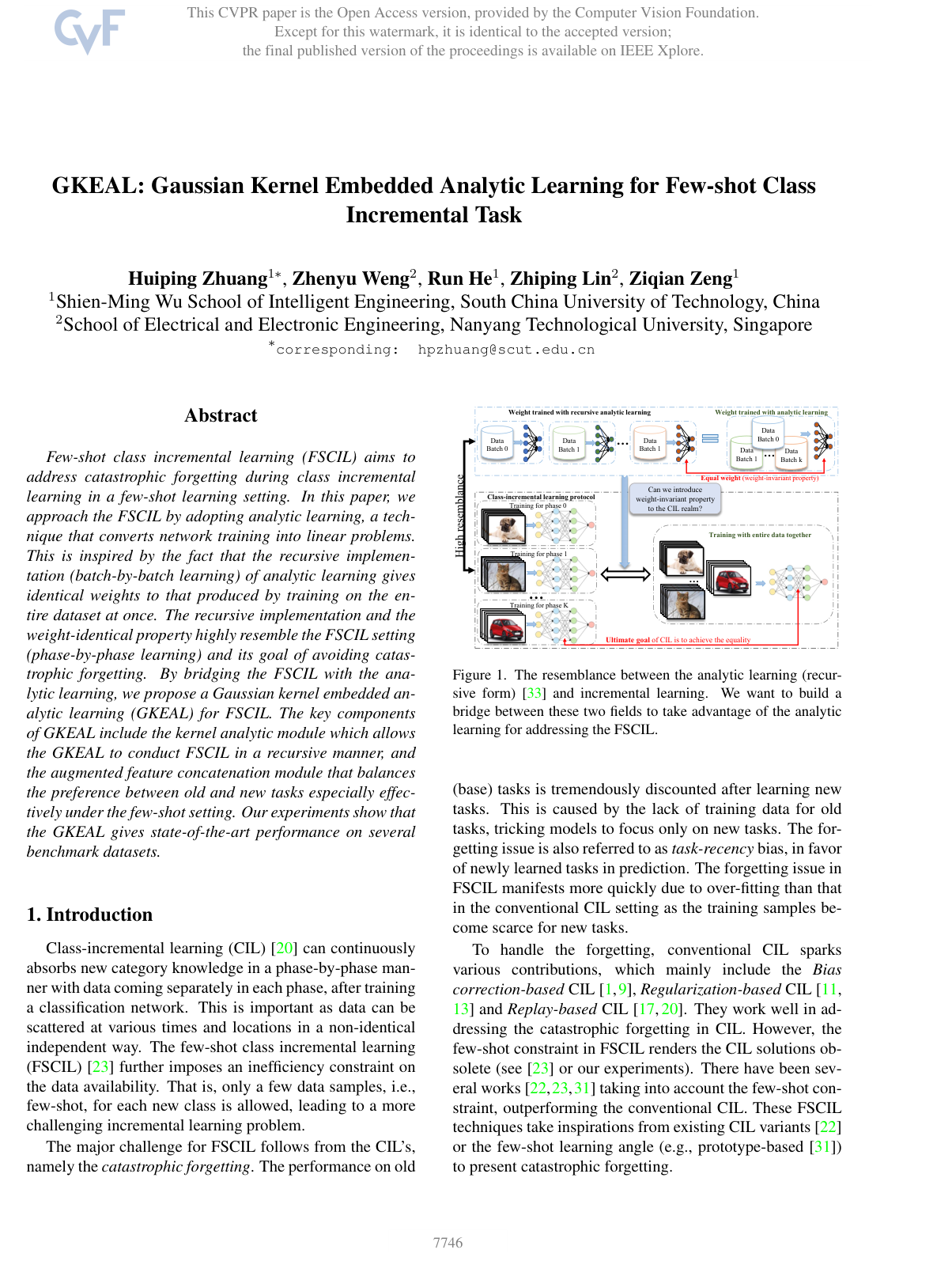
Few-shot class incremental learning (FSCIL) aims to address catastrophic forgetting during class incremental learning in a few-shot learning setting. In this paper, we approach the FSCIL by adopting analytic learning, a technique that converts network training into linear problems. This is inspired by the fact that the recursive implementation (batch-by-batch learning) of analytic learning gives identical weights to that produced by training on the entire dataset at once. The recursive implementation and the weight-identical property highly resemble the FSCIL setting (phase-by-phase learning) and its goal of avoiding catastrophic forgetting. By bridging the FSCIL with the analytic learning, we propose a Gaussian kernel embedded analytic learning (GKEAL) for FSCIL. The key components of GKEAL include the kernel analytic module which allows the GKEAL to conduct FSCIL in a recursive manner, and the augmented feature concatenation module that balances the preference between old and new tasks especially effectively under the few-shot setting. Our experiments show that the GKEAL gives state-of-the-art performance on several benchmark datasets.

Added

2026-09-26