Learning a Unified Classifier Incrementally via Rebalancing

Saihui HouXinyu PanChen Change LoyZilei WangDahua Lin

article2019CVPR1,430 citations

Proposes a unified multi-class incremental learning framework that mitigates catastrophic forgetting by combining cosine normalization, a less-forget feature constraint, and margin-based inter-class separation to correct the data imbalance between old and new classes.

Listen

Modern computer vision and artificial intelligence systems frequently encounter continuous streams of new information. Updating these models incrementally is essential to avoid retraining from scratch, which is computationally expensive and impractical. However, existing systems suffer from severe forgetting when exposed to new categories. The article identifies that this performance drop is primarily caused by an extreme data imbalance: models are trained on abundant new data while retaining only a tiny fraction of previous data. This imbalance inflates the influence of new categories, degrades previously acquired knowledge, and causes confusion between old and new classes.

The article develops and evaluates a rebalanced machine learning framework designed to train a single, unified classifier across multiple incremental phases without forgetting past categories.

The researchers evaluated their framework against standard industry benchmarks across two major image datasets: CIFAR-100 and ImageNet (both a 100-class subset and the full 1,000-class collection). The models started with half of the total categories and incrementally incorporated the remaining categories across sequences of one, two, five, and ten phases while storing only twenty representative samples per past category. The proposed architecture integrated three primary techniques: cosine normalization to equalize prediction scales, a geometric feature constraint to preserve past representations, and an inter-class margin loss to enforce clear boundaries between old and new categories.

The evaluation produced several clear findings. First, the proposed framework substantially outperformed existing state-of-the-art methods, reducing classification errors by over 6% on CIFAR-100 and by over 13% on full ImageNet over ten incremental phases. Second, error analysis confirmed that predictions remained balanced across both past and recent classes, eliminating the bias toward newer data that plagued earlier models. Third, standard neural network predictions directly matched or exceeded prototype-based nearest-mean classification, simplifying the overall system design. Fourth, ablation studies demonstrated that all three mathematical components collectively drove these performance gains, with an adaptive weighting mechanism playing a critical role in multi-phase stability.

These results demonstrate that catastrophic forgetting in unified classifiers is largely a data-imbalance issue that can be resolved geometrically rather than a structural flaw in neural networks. For organizations deploying machine learning systems, this approach lowers operational costs and update latency by removing the requirement to store legacy training data or retrain entire models from the ground up.

Organizations operating continuous-learning systems should consider adopting cosine normalization and margin-based separation into their updating pipelines. Before full deployment, teams should conduct internal pilot tests tailored to their operational constraints, noting trade-offs between memory budgets (the number of stored legacy examples) and accuracy requirements. Further development should explore optimal methods to automatically tune distillation weights across extended update cycles.

Confidence in these findings is strong given the rigorous multi-dataset validation and substantial performance margins over baselines. Nevertheless, stakeholders should note that the evaluation was bounded by image classification tasks with a fixed number of stored samples per class, meaning performance should be verified on non-vision modalities and variable-memory environments.

Cover for Learning a Unified Classifier Incrementally via Rebalancing

Abstract

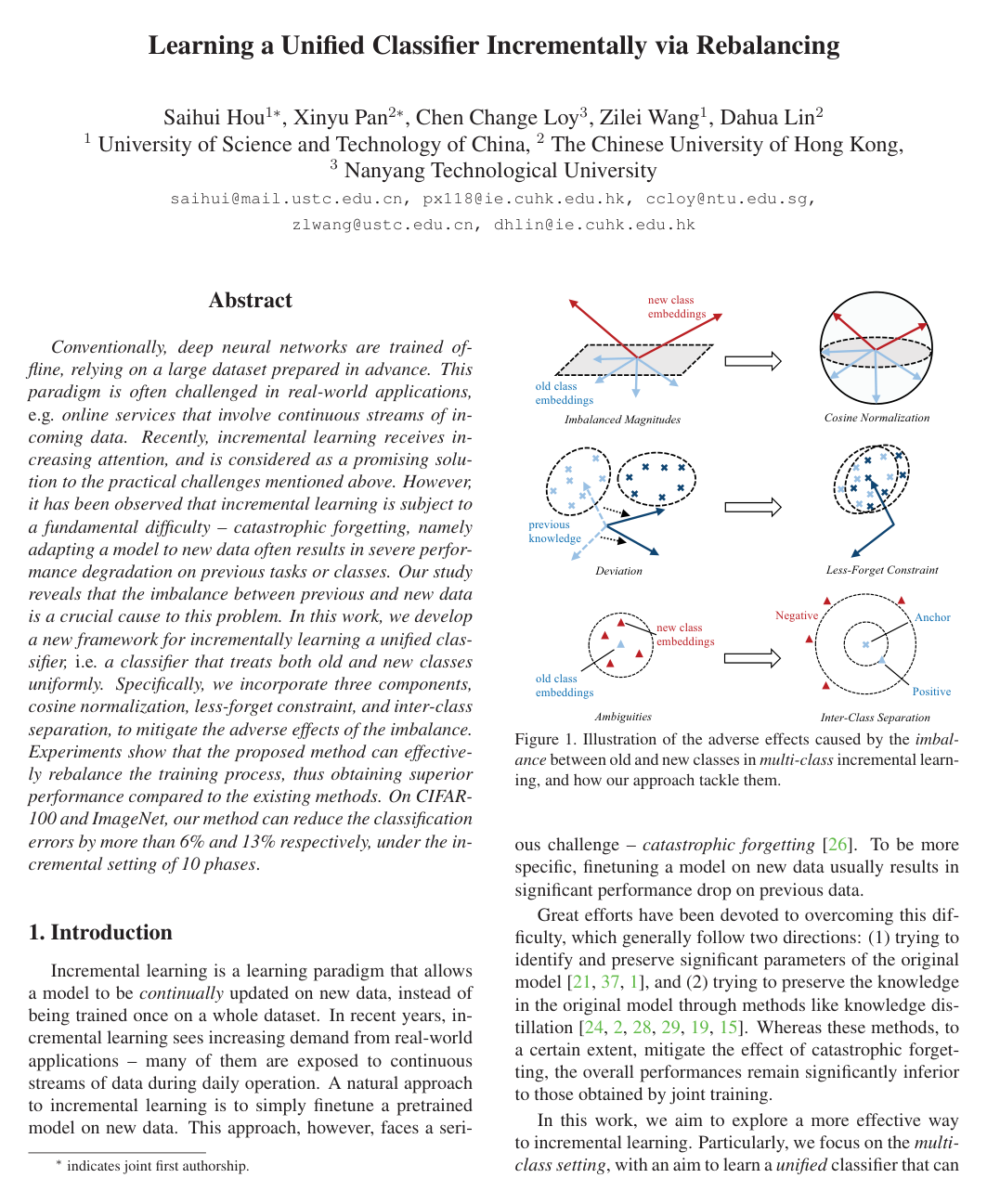
Conventionally, deep neural networks are trained offline, relying on a large dataset prepared in advance. This paradigm is often challenged in real-world applications, e.g. online services that involve continuous streams of incoming data. Recently, incremental learning receives increasing attention, and is considered as a promising solution to the practical challenges mentioned above. However, it has been observed that incremental learning is subject to a fundamental difficulty — catastrophic forgetting, namely adapting a model to new data often results in severe performance degradation on previous tasks or classes. Our study reveals that the imbalance between previous and new data is a crucial cause to this problem. In this work, we develop a new framework for incrementally learning a unified classifier, i.e. a classifier that treats both old and new classes uniformly. Specifically, we incorporate three components, cosine normalization, less-forget constraint, and inter-class separation, to mitigate the adverse effects of the imbalance. Experiments show that the proposed method can effectively rebalance the training process, thus obtaining superior performance compared to the existing methods. On CIFAR-100 and ImageNet, our method can reduce the classification errors by more than 6% and 13% respectively, under the incremental setting of 10 phases.

Table of Contents

  • 1. Introduction
  • 2. Related Work
  • 2.1. Incremental Learning
  • 2.2. Tackling Imbalance
  • 3. Our Approach
  • 3.1. Background
  • 3.2. Cosine Normalization
  • 3.3. Less-Forget Constraint
  • 3.4. Inter-Class Separation
  • 3.5. Integrated Objective
  • 4. Experiment
  • 4.1. Settings
  • 4.2. Evaluation on CIFAR100
  • 4.3. Evaluation on ImageNet
  • 4.4. Ablation Study
  • 5. Conclusion
  • Acknowledgment
  • References

Knowls

  1. Knowl 1 — Cosine Normalization for Eliminating Incremental Classifier Weight Imbalance

    model/method

    In multi-class incremental learning, standard linear classification layers produce weight vectors and biases whose magnitudes for new classes are substantially larger than those for previously learned (old) classes due to class sample imbalance. To eliminate this magnitude bias, cosine normalization is applied in the final classification layer. Given an input sample xx and a convolutional feature extractor f(⋅)f(\cdot) producing feature vector f(x)∈Rdf(x) \in \mathbb{R}^d, both the features and the class weight vectors θi∈Rd\theta_i \in \mathbb{R}^d for each class i∈Ci \in \mathcal{C} are l2l_2-normalized:

    fˉ(x)=f(x)∥f(x)∥2,θˉi=θi∥θi∥2\bar{f}(x) = \frac{f(x)}{\|f(x)\|_2}, \quad \bar{\theta}_i = \frac{\theta_i}{\|\theta_i\|_2}

    ⟨θˉi,fˉ(x)⟩=θˉiTfˉ(x)\langle \bar{\theta}_i, \bar{f}(x) \rangle = \bar{\theta}_i^T \bar{f}(x)

    The predicted class probability pi(x)p_i(x) for class ii is calculated using a learnable positive temperature/scale parameter η\eta and zero bias:

    pi(x)=exp⁡(η⟨θˉi,fˉ(x)⟩)∑j∈Cexp⁡(η⟨θˉj,fˉ(x)⟩)p_i(x) = \frac{\exp\left(\eta \langle \bar{\theta}_i, \bar{f}(x) \rangle\right)}{\sum_{j \in \mathcal{C}} \exp\left(\eta \langle \bar{\theta}_j, \bar{f}(x) \rangle\right)}

    To allow features to span both positive and negative values on the high-dimensional unit sphere, the ReLU activation in the penultimate layer is removed.

  2. Knowl 2 — Less-Forget Feature Orientation Distillation Constraint

    model/method

    To preserve previously learned geometric representations without constraining the scale of new class representations, the weight vectors of old classes Co\mathcal{C}_o are fixed to their states from the previous model (θˉi=θˉi∗\bar{\theta}_i = \bar{\theta}_i^* for all i∈Coi \in \mathcal{C}_o), and a feature orientation distillation loss is enforced. Let fˉ∗(x)\bar{f}^*(x) denote the l2l_2-normalized feature vector extracted by the frozen previous model, and fˉ(x)\bar{f}(x) denote the l2l_2-normalized feature extracted by the updated model. The less-forget distillation loss LdisG(x)L_{dis}^G(x) is formulated as:

    LdisG(x)=1−⟨fˉ∗(x),fˉ(x)⟩L_{dis}^G(x) = 1 - \langle \bar{f}^*(x), \bar{f}(x) \rangle

    Because cosine similarity is bounded in [−1,1][-1, 1], the loss is bounded in [0,2][0, 2]. This loss enforces similarity in feature orientation while ignoring feature magnitudes, allowing the network sufficient flexibility to incorporate new classes without distorting the spatial configuration of old classes.

  3. Knowl 3 — Adaptive Distillation Loss Weighting Across Incremental Phases

    equation

    To account for the varying difficulty of preserving past knowledge as the proportion of new to old classes shifts across incremental phases, the weight λ\lambda applied to the less-forget distillation loss is dynamically adjusted according to the ratio of new classes to old classes:

    λ=λbase∣Cn∣∣Co∣\lambda = \lambda_{\text{base}} \sqrt{\frac{|\mathcal{C}_n|}{|\mathcal{C}_o|}}

    where ∣Cn∣|\mathcal{C}_n| is the number of new classes introduced in the current incremental phase, ∣Co∣|\mathcal{C}_o| is the number of previously accumulated old classes, and λbase\lambda_{\text{base}} is a fixed dataset-dependent hyperparameter (set to λbase=5\lambda_{\text{base}} = 5 for CIFAR-100 and λbase=10\lambda_{\text{base}} = 10 for ImageNet).

  4. Knowl 4 — Inter-Class Separation via Anchor-to-Embedding Margin Ranking Loss

    model/method

    To prevent ambiguity and decision boundary overlap caused by new class weights clustering near old class weights, an online hard-negative margin ranking loss is applied to the reserved exemplar samples of old classes No\mathcal{N}_o. For an old sample x∈Nox \in \mathcal{N}_o with ground-truth old class embedding θˉ(x)\bar{\theta}(x) acting as the anchor-positive pair, the top-KK new class normalized embeddings θˉk\bar{\theta}_k (k∈{1,…,K}k \in \{1, \dots, K\}) that yield the highest cosine responses ⟨θˉk,fˉ(x)⟩\langle \bar{\theta}_k, \bar{f}(x) \rangle are selected online as hard negatives. The margin ranking loss is defined as:

    Lmr(x)=∑k=1Kmax⁡(m−⟨θˉ(x),fˉ(x)⟩+⟨θˉk,fˉ(x)⟩,  0)L_{mr}(x) = \sum_{k=1}^K \max\left(m - \langle \bar{\theta}(x), \bar{f}(x) \rangle + \langle \bar{\theta}_k, \bar{f}(x) \rangle, \; 0\right)

    where m>0m > 0 is a fixed margin threshold (set to m=0.5m = 0.5 and K=2K = 2). The loss operates directly on the class embedding vectors rather than sample pairs, maintaining computational efficiency without altering batch sampling.

  5. Knowl 5 — Unified Rebalancing Training Objective for Multi-Class Incremental Learning

    equation

    The overall training objective combines cosine-normalized cross-entropy classification, less-forget feature distillation, and inter-class margin ranking separation over a mini-batch N\mathcal{N} drawn from the combined dataset of new class data and reserved old class exemplars No⊂N\mathcal{N}_o \subset \mathcal{N}:

    L=1∣N∣∑x∈N(Lce(x)+λLdisG(x))+1∣No∣∑x∈NoLmr(x)L = \frac{1}{|\mathcal{N}|} \sum_{x \in \mathcal{N}} \left( L_{ce}(x) + \lambda L_{dis}^G(x) \right) + \frac{1}{|\mathcal{N}_o|} \sum_{x \in \mathcal{N}_o} L_{mr}(x)

    where:

    • Lce(x)=−∑i=1∣C∣yilog⁡(pi(x))L_{ce}(x) = -\sum_{i=1}^{|\mathcal{C}|} y_i \log(p_i(x)) is the standard cross-entropy loss evaluated with cosine-normalized softmax probabilities over all observed classes C=Co∪Cn\mathcal{C} = \mathcal{C}_o \cup \mathcal{C}_n.
    • LdisG(x)=1−⟨fˉ∗(x),fˉ(x)⟩L_{dis}^G(x) = 1 - \langle \bar{f}^*(x), \bar{f}(x) \rangle is the less-forget feature distillation loss weighted by adaptive parameter λ=λbase∣Cn∣/∣Co∣\lambda = \lambda_{\text{base}} \sqrt{|\mathcal{C}_n| / |\mathcal{C}_o|}.
    • Lmr(x)=∑k=1Kmax⁡(m−⟨θˉ(x),fˉ(x)⟩+⟨θˉk,fˉ(x)⟩,0)L_{mr}(x) = \sum_{k=1}^K \max(m - \langle \bar{\theta}(x), \bar{f}(x) \rangle + \langle \bar{\theta}_k, \bar{f}(x) \rangle, 0) is the inter-class separation margin ranking loss evaluated exclusively on the subset of old reserved samples No\mathcal{N}_o.
  6. Knowl 6 — Post-Phase Class Balance Finetuning

    model/method

    At the conclusion of each incremental phase training stage, an optional class balance finetuning (CBF) step is executed. The model is finetuned on a strictly class-balanced subset composed of the reserved exemplar samples from all observed classes (both old classes Co\mathcal{C}_o and newly learned classes Cn\mathcal{C}_n). This step further adjusts class decision boundaries using uniform sample counts per class.

  7. Knowl 7 — Multi-Class Incremental Learning Evaluation Benchmark and Setup

    experimental setup

    The framework is evaluated under class-incremental protocols where the initial model is trained on half of the total dataset classes, and the remaining half are introduced in 1, 2, 5, or 10 sequential phases:

    • CIFAR-100: 100 classes (32×3232 \times 32 images, 500 train/100 eval per class), trained using a 32-layer ResNet with SGD (batch size 128, initial learning rate 0.1 decayed by 10 at epochs 80 and 120, 160 epochs total). λbase=5\lambda_{\text{base}} = 5.
    • ImageNet: 18-layer ResNet on ImageNet-Subset (100 classes) and ImageNet-Full (1000 classes), trained with SGD (batch size 128, initial learning rate 0.1 decayed by 10 every 30 epochs, 90 epochs total). λbase=10\lambda_{\text{base}} = 10.
    • Exemplar Storage: Constant exemplar count Rper=20R_{\text{per}} = 20 samples per old class selected via herding selection.
    • Hyperparameters: Margin m=0.5m = 0.5 and top negative classes K=2K = 2 across all experiments.
  8. Knowl 8 — Multi-Class Incremental Accuracy on CIFAR-100 and ImageNet

    empirical result

    Compared to the iCaRL baseline across varying numbers of incremental phases:

    • On CIFAR-100 under a 10-phase incremental setup (5 new classes added per phase after 50 base classes), the proposed unified classifier improves final top-1 accuracy on all 100 classes by more than 6.0% (Ours-CNN achieves over 60.18% top-1 accuracy compared to iCaRL-NME at 52.57%).
    • On ImageNet-Full (1000 classes) across 10 incremental phases (50 new classes per phase after 500 base classes), the method reduces final top-1 classification error by more than 13.0% (Ours-CNN achieves 61.26% final accuracy compared to 46.72% for iCaRL-NME and 38.43% for iCaRL-CNN).
  9. Knowl 9 — Parity and Superiority of Direct CNN Predictions Over Nearest-Mean-of-Exemplars

    empirical result

    In prior incremental learning methods like iCaRL, raw network softmax predictions (iCaRL-CNN) severely underperform nearest-mean-of-exemplars classification (iCaRL-NME) because unnormalized linear layer weights are heavily biased toward new classes (e.g., on 1-phase CIFAR-100, iCaRL-CNN achieves 51.80% vs iCaRL-NME at 59.13%). By contrast, the proposed rebalancing framework produces well-calibrated classifier weights such that direct CNN predictions (Ours-CNN) equal or outperform nearest-mean-of-exemplars (Ours-NME) across all phases (e.g., on 1-phase CIFAR-100, Ours-CNN achieves 62.34% vs Ours-NME at 60.21%).

  10. Knowl 10 — Ablation of Incremental Rebalancing Components and Loss Weighting

    empirical result

    Ablation on CIFAR-100 under a 5-phase incremental setting isolates the additive effect of each component on CNN prediction accuracy:

    1. Cosine Normalization (CN) alone prevents classifier weight magnitude collapse and achieves approximately 55.65% average incremental accuracy.
    2. Adding the Less-Forget constraint (CN + LC) retains previous geometric configurations, increasing average incremental accuracy to 61.47%.
    3. Adding Inter-Class Separation (CN + LC + IS) separates old and new class embeddings, improving average incremental accuracy to 63.37%.
    4. Incorporating Class Balance Finetuning (CBF) brings the final performance to 63.42%. Additionally, using the adaptive loss weight λ=λbase∣Cn∣/∣Co∣\lambda = \lambda_{\text{base}}\sqrt{|\mathcal{C}_n|/|\mathcal{C}_o|} consistently improves accuracy over fixed loss weights λbase\lambda_{\text{base}} across 5-phase (63.42% vs 61.79%) and 10-phase (60.18% vs 57.50%) incremental learning.

Coverage note — None was omitted; all key architectural components, mathematical loss formulations, adaptive weighting strategies, training protocols, and empirical findings were included.

References

  1. 1.Rahaf Aljundi, Francesca Babiloni, Mohamed Elhoseiny, Marcus Rohrbach, and Tinne Tuytelaars. Memory aware synapses: Learning what (not) to forget. In ECCV, 2018.
  2. 2.Rahaf Aljundi, Punarjay Chakravarty, and Tinne Tuytelaars. Expert gate: Lifelong learning with a network of experts. In CVPR, 2017.
  3. 3.Francisco M Castro, Manuel Marín-Jimenez, Nicolás Guil, Cordelia Schmid, and Karteek Alahari. End-to-end incremental learning. In ECCV, 2018.
  4. 4.Gert Cauwenberghs and Tomaso Poggio. Incremental and decremental support vector machine learning. In NIPS, 2001.
  5. 5.Arslan Chaudhry, Marc’Aurelio Ranzato, Marcus Rohrbach, and Mohamed Elhoseiny. Efficient lifelong learning with a-gem. In ICLR, 2019.
  6. 6.Nitesh V Chawla, Kevin W Bowyer, Lawrence O Hall, and W Philip Kegelmeyer. Smote: synthetic minority over-sampling technique. Journal of artificial intelligence research, 16:321–357, 2002.
  7. 7.Jia Deng, Wei Dong, Richard Socher, Li-Jia Li, Kai Li, and Li Fei-Fei. Imagenet: A large-scale hierarchical image database. In CVPR, 2009.
  8. 8.Jeff Donahue, Yangqing Jia, Oriol Vinyals, Judy Hoffman, Ning Zhang, Eric Tzeng, and Trevor Darrell. Decaf: A deep convolutional activation feature for generic visual recognition. In ICML, 2014.
  9. 9.Qi Dong, Shaogang Gong, and Xiatian Zhu. Class rectification hard mining for imbalanced deep learning. In ICCV, 2017.
  10. 10.Spyros Gidaris and Nikos Komodakis. Dynamic few-shot visual learning without forgetting. In CVPR, 2018.
  11. 11.Ross Girshick, Jeff Donahue, Trevor Darrell, and Jitendra Malik. Rich feature hierarchies for accurate object detection and semantic segmentation. In CVPR, 2014.
  12. 12.Haibo He, Yang Bai, Edwardo A Garcia, and Shutao Li. Adasyn: Adaptive synthetic sampling approach for imbalanced learning. In International Joint Conference on Neural Networks, 2008.
  13. 13.Haibo He and Edwardo A Garcia. Learning from imbalanced data. IEEE Transactions on Knowledge & Data Engineering, (9):1263–1284, 2008.
  14. 14.Geoffrey Hinton, Oriol Vinyals, and Jeff Dean. Distilling the knowledge in a neural network. arXiv preprint arXiv:1503.02531, 2015.
  15. 15.Saihui Hou, Xinyu Pan, Chen Change Loy, Zilei Wang, and Dahua Lin. Lifelong learning via progressive distillation and retrospection. In ECCV, 2018.
  16. 16.Chen Huang, Yining Li, Chen Change Loy, and Xiaoou Tang. Learning deep representation for imbalanced classification. In CVPR, 2016.
  17. 17.Chen Huang, Chen Change Loy, and Xiaoou Tang. Discriminative sparse neighbor approximation for imbalanced learning. IEEE transactions on neural networks and learning systems, 29(5):1503–1513, 2018.
  18. 18.Nathalie Japkowicz and Shaju Stephen. The class imbalance problem: A systematic study. Intelligent data analysis, 6(5):429–449, 2002.
  19. 19.Heechul Jung, Jeongwoo Ju, Minju Jung, and Junmo Kim. Less-forgetful learning for domain expansion in deep neural networks. In AAAI, 2018.
  20. 20.Ronald Kemker and Christopher Kanan. Fearnet: Brain-inspired model for incremental learning. In ICLR, 2018.
  21. 21.James Kirkpatrick, Razvan Pascanu, Neil Rabinowitz, Joel Veness, Guillaume Desjardins, Andrei A Rusu, Kieran Milan, John Quan, Tiago Ramalho, Agnieszka Grabska-Barwinska, et al. Overcoming catastrophic forgetting in neural networks. Proceedings of the National Academy of Sciences, 114(13):3521–3526, 2017.
  22. 22.Alex Krizhevsky and Geoffrey Hinton. Learning multiple layers of features from tiny images. 2009.
  23. 23.Alex Krizhevsky, Ilya Sutskever, and Geoffrey E Hinton. Imagenet classification with deep convolutional neural networks. In NIPS, 2012.
  24. 24.Zhizhong Li and Derek Hoiem. Learning without forgetting. In ECCV, 2016.
  25. 25.Chunjie Luo, Jianfeng Zhan, Xiaohe Xue, Lei Wang, Rui Ren, and Qiang Yang. Cosine normalization: Using cosine similarity instead of dot product in neural networks. In International Conference on Artificial Neural Networks, 2018.
  26. 26.German I Parisi, Ronald Kemker, Jose L Part, Christopher Kanan, and Stefan Wermter. Continual lifelong learning with neural networks: A review. arXiv preprint arXiv:1802.07569, 2018.
  27. 27.Hang Qi, Matthew Brown, and David G Lowe. Low-shot learning with imprinted weights. In CVPR, 2018.
  28. 28.Amal Rannen Ep Triki, Rahaf Aljundi, Matthew Blaschko, and Tinne Tuytelaars. Encoder based lifelong learning. In ICCV, 2017.
  29. 29.Sylvestre-Alvise Rebuffi, Alexander Kolesnikov, and Christoph H Lampert. icarl: Incremental classifier and representation learning. In CVPR, 2017.
  30. 30.Stefan Ruping. Incremental learning with support vector machines. In ICDM, 2001.
  31. 31.Andrei A Rusu, Neil C Rabinowitz, Guillaume Desjardins, Hubert Soyer, James Kirkpatrick, Koray Kavukcuoglu, Razvan Pascanu, and Raia Hadsell. Progressive neural networks. arXiv preprint arXiv:1606.04671, 2016.
  32. 32.Kai Ming Ting. A comparative study of cost-sensitive boosting algorithms. In ICML, 2000.
  33. 33.Oriol Vinyals, Charles Blundell, Tim Lillicrap, Daan Wierstra, et al. Matching networks for one shot learning. In NIPS, 2016.
  34. 34.Max Welling. Herding dynamical weights to learn. In ICML, 2009.
  35. 35.Yue Wu, Yinpeng Chen, Lijuan Wang, Yuancheng Ye, Zicheng Liu, Yandong Guo, Zhengyou Zhang, and Yun Fu. Incremental classifier learning with generative adversarial networks. arXiv preprint arXiv:1802.00853, 2018.
  36. 36.Jaehong Yoon, Eunho Yang, Jeongtae Lee, and Sung Ju Hwang. Lifelong learning with dynamically expandable networks. In ICLR, 2018.
  37. 37.Friedemann Zenke, Ben Poole, and Surya Ganguli. Continual learning through synaptic intelligence. In ICML, 2017.
  38. 38.Zhi-Hua Zhou and Xu-Ying Liu. On multi-class cost-sensitive learning. In AAAI, 2006.

Citation

MLA
Hou, S., et al. “Learning a Unified Classifier Incrementally via Rebalancing”. 2019 IEEE/CVF Conference on Computer Vision and Pattern Recognition (CVPR), 2019, pp. 831–39, https://doi.org/10.1109/CVPR.2019.00092.
APA
Hou, S., Pan, X., Loy, C. C., Wang, Z., & Lin, D. (2019). Learning a Unified Classifier Incrementally via Rebalancing. 2019 IEEE/CVF Conference on Computer Vision and Pattern Recognition (CVPR), 831–839. https://doi.org/10.1109/CVPR.2019.00092
Chicago
Hou, S., X. Pan, C. C. Loy, Z. Wang, and D. Lin. 2019. “Learning a Unified Classifier Incrementally via Rebalancing”. 2019 IEEE/CVF Conference on Computer Vision and Pattern Recognition (CVPR), 831–39. https://doi.org/10.1109/CVPR.2019.00092.
Harvard
Hou, S. et al. (2019) “Learning a Unified Classifier Incrementally via Rebalancing”, 2019 IEEE/CVF Conference on Computer Vision and Pattern Recognition (CVPR). IEEE, pp. 831–839. Available at: https://doi.org/10.1109/CVPR.2019.00092.
Vancouver
1. Hou S, Pan X, Loy CC, Wang Z, Lin D (2019) Learning a Unified Classifier Incrementally via Rebalancing. In: 2019 IEEE/CVF Conference on Computer Vision and Pattern Recognition (CVPR). IEEE, pp 831–839

BibTeX

@inproceedings{Hou_2019, title={Learning a Unified Classifier Incrementally via Rebalancing}, url={http://dx.doi.org/10.1109/CVPR.2019.00092}, DOI={10.1109/cvpr.2019.00092}, booktitle={2019 IEEE/CVF Conference on Computer Vision and Pattern Recognition (CVPR)}, publisher={IEEE}, author={Hou, Saihui and Pan, Xinyu and Loy, Chen Change and Wang, Zilei and Lin, Dahua}, year={2019}, month=June, pages={831–839} }
Metadata:Crossref

Source Code

This paper has an official code repository available. Click below to access the source code.

View Repository

Access the Paper

This paper is available from its original source. Click below to access the PDF.

Open PDF
License: IEEE