Large Scale Incremental Learning

Yue WuYinpeng ChenLijuan WangYuancheng YeZicheng LiuYandong GuoYun Fu

article2019CVPR1,565 citations

Reveals that final-layer classification bias causes catastrophic forgetting in large-scale incremental learning and introduces a two-parameter linear correction that outperforms state-of-the-art methods by over 11% on ImageNet and MS-Celeb-1M.

Listen

Real-world artificial intelligence applications, such as large-scale facial recognition and visual classification systems, must continuously learn new categories over time without forgetting previously acquired knowledge. Deep neural networks typically suffer from catastrophic forgetting when past training data cannot be retained in full. While storing a small set of representative sample images from earlier categories can mitigate this issue in small setups, existing approaches experience severe accuracy degradation when scaled up to thousands of categories with visually similar classes.

The article evaluates the root causes of this scalability bottleneck and demonstrates a novel two-stage method, named Bias Correction (BiC), to correct classification errors caused by extreme data imbalance in large-scale incremental learning.

The researchers diagnosed that the primary failure in existing incremental models stems from the final classification layer, which develops a heavy systematic bias favoring newly introduced categories over data-constrained older categories. To address this, the article introduces a two-stage training strategy: the main neural network is first trained on the combined old and new image data using knowledge distillation, after which the feature representations are frozen. A simple linear correction layer with only two parameters is then optimized on a small, balanced validation subset of old and new samples to adjust the outputs of the new categories.

The empirical findings demonstrate that this lightweight correction delivers substantial performance gains, particularly at large scales. On the 1,000-class ImageNet benchmark across 10 incremental steps, the proposed method surpassed existing state-of-the-art techniques by an average of 11.1%, beating the next best method by 18.5% at the final stage. On a 10,000-class facial recognition benchmark (MS-Celeb-1M), the method outperformed prior leading approaches by an average of 13.2% and achieved an 87.98% final accuracy compared to 65.56% for the previous baseline. Furthermore, ablation experiments revealed that a 9:1 training-to-validation split on stored exemplars is optimal, and that the method remains robust regardless of whether older exemplars are selected randomly or using complex representative selection algorithms.

These results show that large-scale incremental learning can be made viable without requiring extensive retraining on historical data archives, directly reducing the computational expense, memory footprint, and storage overhead of maintaining continuous learning systems. Correcting output layer bias offers a high-impact, low-complexity solution that substantially bridges the performance gap between continuously updated models and ideal models trained on all historical data at once.

Organizations deploying large-scale visual recognition models should consider incorporating a two-stage bias correction step into their continual update pipelines. When adopting this method, engineering teams should allocate roughly 10% of their retained exemplar quota specifically for bias validation rather than model feature learning. Additionally, combining this method with standard data augmentation techniques could yield further gains during early deployment stages when class imbalances are mild.

Confidence in these findings is high given the rigorous evaluation across standard large-scale benchmarks. However, a minor performance gap remains between the proposed approach and an idealized model retrained entirely from scratch, as the method primarily targets classifier layer bias rather than residual drift within deeper feature extraction layers. Further analysis on non-visual domains and real-time streaming data represents an appropriate next step before full enterprise deployment across non-vision workloads.

Cover for Large Scale Incremental Learning

Abstract

Modern machine learning suffers from catastrophic forgetting when learning new classes incrementally. The performance dramatically degrades due to the missing data of old classes. Incremental learning methods have been proposed to retain the knowledge acquired from the old classes, by using knowledge distilling and keeping a few exemplars from the old classes. However, these methods struggle to scale up to a large number of classes. We believe this is because of the combination of two factors: (a) the data imbalance between the old and new classes, and (b) the increasing number of visually similar classes. Distinguishing between an increasing number of visually similar classes is particularly challenging, when the training data is unbalanced. We propose a simple and effective method to address this data imbalance issue. We found that the last fully connected layer has a strong bias towards the new classes, and this bias can be corrected by a linear model. With two bias parameters, our method performs remarkably well on two large datasets: ImageNet (1000 classes) and MS-Celeb-1M (10000 classes), outperforming the state-of-the-art algorithms by 11.1% and 13.2% respectively.

Table of Contents

  • 1 Introduction
  • 2 Related Work
  • 3 Baseline: Incremental Learning using Knowledge Distillation
  • 4 Diagnosis: FC Layer is Biased
  • 5 Bias Correction (BiC) Method
  • 5.1 Validation Set
  • 5.2 Bias Correction Layer
  • 6 Experiments
  • 6.1 Datasets
  • 6.2 Implementation Details
  • 6.3 Comparison on Large Datasets
  • 6.4 Comparison between Different Scales
  • 6.5 Comparison on a Small Dataset
  • 6.6 Ablation Study
  • 7 Conclusions
  • 8 Acknowledgments
  • References

Knowls

  1. Knowl 1 — Two-Stage Bias Correction Framework for Incremental Learning

    model/method

    The Bias Correction (BiC) framework addresses the class-imbalance bias in class-incremental deep learning via a two-stage training procedure at each incremental step:

    1. Stage 1 (Feature Representation and Classifier Learning): The convolutional feature extractor and the fully connected (FC) classification layer are trained jointly on a training subset containing stored exemplars of nn previously learned classes and all training samples of mm newly introduced classes. Training is guided by a combined objective of distillation loss on old classes and cross-entropy classification loss across all n+mn+m classes.

    2. Stage 2 (Bias Parameter Estimation): The convolutional feature extractor and FC layer parameters are frozen. A dedicated linear bias correction layer with two scalar parameters (α,β)(\alpha, \beta) is appended after the FC layer to scale and shift the logits corresponding to the new mm classes. These parameters are optimized using cross-entropy classification loss on an unbiased, class-balanced validation set reserved from the current step's data.

  2. Knowl 2 — Stage-1 Distillation and Classification Loss Formulation

    equation

    In Stage 1 of class-incremental training with nn old classes and mm new classes, the network is optimized by combining a knowledge distillation loss LdL_d and a softmax cross-entropy classification loss LcL_c:

    L=λLd+(1−λ)LcL = \lambda L_d + (1 - \lambda) L_c

    where λ=nn+m\lambda = \frac{n}{n+m} dynamically weights the distillation term according to the proportion of old classes (with λ=0\lambda = 0 at the initial step where n=0n=0).

    Let X^n={(x^j,y^j)}j=1Ns\hat{X}^n = \{(\hat{x}_j, \hat{y}_j)\}_{j=1}^{N_s} be the stored exemplars from the nn old classes, and Xm={(xi,yi)}i=1MX^m = \{(x_i, y_i)\}_{i=1}^M be the training samples from the mm new classes. The distillation loss LdL_d is computed over all samples x∈X^n∪Xmx \in \hat{X}^n \cup X^m:

    Ld=∑x∈X^n∪Xm∑k=1n−π^k(x)log⁡[πk(x)]L_d = \sum_{x \in \hat{X}^n \cup X^m} \sum_{k=1}^n -\hat{\pi}_k(x) \log[\pi_k(x)]

    with modified softmax probability distributions:

    π^k(x)=eo^k(x)/T∑j=1neo^j(x)/T,πk(x)=eok(x)/T∑j=1neoj(x)/T\hat{\pi}_k(x) = \frac{e^{\hat{o}_k(x)/T}}{\sum_{j=1}^n e^{\hat{o}_j(x)/T}}, \quad \pi_k(x) = \frac{e^{o_k(x)/T}}{\sum_{j=1}^n e^{o_j(x)/T}}

    where o^k(x)\hat{o}_k(x) is the logit output of class kk produced by the frozen model from the previous incremental step, ok(x)o_k(x) is the logit output of class kk produced by the current model, and TT is the temperature scaling hyperparameter (set to T=2T=2).

    The cross-entropy classification loss LcL_c is computed across all n+mn+m classes:

    Lc=∑(x,y)∈X^n∪Xm∑k=1n+m−δy=klog⁡[pk(x)]L_c = \sum_{(x,y) \in \hat{X}^n \cup X^m} \sum_{k=1}^{n+m} -\delta_{y=k} \log[p_k(x)]

    where δy=k\delta_{y=k} is the Kronecker delta indicator function and pk(x)=eok(x)∑j=1n+meoj(x)p_k(x) = \frac{e^{o_k(x)}}{\sum_{j=1}^{n+m} e^{o_j(x)}} is the predicted probability for class kk.

  3. Knowl 3 — Stage-2 Linear Bias Correction Layer and Optimization

    equation

    In Stage 2 of the BiC framework, a linear transformation is applied exclusively to the output logits of the new classes to correct the prediction bias caused by sample imbalance. Given the uncorrected logits o(x)=[o1(x),…,on+m(x)]\mathbf{o}(x) = [o_1(x), \dots, o_{n+m}(x)], the corrected logits q(x)=[q1(x),…,qn+m(x)]\mathbf{q}(x) = [q_1(x), \dots, q_{n+m}(x)] are defined as:

    qk={ok,1≤k≤nαok+β,n+1≤k≤n+mq_k = \begin{cases} o_k, & 1 \le k \le n \\ \alpha o_k + \beta, & n+1 \le k \le n+m \end{cases}

    where α,β∈R\alpha, \beta \in \mathbb{R} are two learnable scalar bias parameters shared across all mm new classes.

    With all convolutional and fully connected layer weights frozen, the parameters α\alpha and β\beta are optimized by minimizing the cross-entropy loss LbL_b on a balanced validation set:

    Lb=−∑k=1n+mδy=klog⁡[softmax(qk)]=−∑k=1n+mδy=klog⁡(eqk∑j=1n+meqj)L_b = -\sum_{k=1}^{n+m} \delta_{y=k} \log[\text{softmax}(q_k)] = -\sum_{k=1}^{n+m} \delta_{y=k} \log\left( \frac{e^{q_k}}{\sum_{j=1}^{n+m} e^{q_j}} \right)

    where δy=k\delta_{y=k} is the class indicator.

  4. Knowl 4 — Balanced Validation Set Partitioning for Bias Estimation

    model/method

    To estimate the linear bias correction parameters (α,β)(\alpha, \beta) without overfitting the feature representation, the available data at each incremental step is split into training and validation partitions before Stage 1:

    1. The stored exemplars of the nn old classes are split into a training subset trainold\text{train}_{\text{old}} and a validation subset valold\text{val}_{\text{old}}.
    2. The dataset of the mm new classes is split into a training subset trainnew\text{train}_{\text{new}} and a validation subset valnew\text{val}_{\text{new}}.

    trainold\text{train}_{\text{old}} and trainnew\text{train}_{\text{new}} are combined to train the convolutional backbone and classification layer in Stage 1. valold\text{val}_{\text{old}} and valnew\text{val}_{\text{new}} are strictly excluded from Stage 1 so that their feature-space distribution remains unbiased. In Stage 2, valold\text{val}_{\text{old}} and valnew\text{val}_{\text{new}} are constructed to be class-balanced (containing the exact same number of validation samples per class for both old and new classes) and are used solely to optimize the bias correction parameters.

  5. Knowl 5 — Empirical Evidence of Fully Connected Layer Bias in Incremental Learning

    empirical result

    Incremental learning baselines suffer severe performance degradation primarily due to parameter bias in the final fully connected (FC) classification layer rather than representation collapse alone. In an experiment on CIFAR-100 trained in 5 incremental batches of 20 classes each:

    1. The standard distillation baseline accuracy degraded from 85.05% (step 1) to 40.34% (final step on 100 classes), with the confusion matrix showing strong false predictions favoring the newest 20 classes.
    2. When freezing the feature extraction layers of the incremental baseline model and retraining only the final FC classification layer using the full original training dataset (all historical data of both old and new classes), the 100-class accuracy rose from 40.34% to 60.93%—an absolute improvement of 20.59%.

    This demonstrates that the unshared classification weights in the final layer are the primary locus of class-imbalance bias.

  6. Knowl 6 — Incremental Classification Performance on ImageNet-1000

    data/table

    Evaluation on ImageNet ILSVRC 2012 (1000 classes split into 10 incremental batches of 100 classes, with a fixed total exemplar memory of 20,000 samples using ResNet-18) demonstrates that BiC significantly outperforms prior methods as class count scales.

    Method 100 200 300 400 500 600 700 800 900 1000
    LwF 90.0 77.0 68.0 59.5 52.5 49.5 46.5 43.0 40.5 39.0
    iCaRL 90.0 83.0 77.5 70.5 63.0 57.5 53.5 50.0 48.0 44.0
    EEIL 95.0 95.5 86.0 77.5 71.0 68.0 62.0 59.8 55.0 52.0
    BiC (Ours) 94.1 92.5 89.6 89.1 85.7 83.2 80.2 77.5 75.0 73.2

    At the final 1000-class step, BiC achieves 73.2% top-1 accuracy, outperforming EEIL (52.0%) by 21.2% and iCaRL (44.0%) by 29.2%. Across all 10 incremental batches, BiC outperforms EEIL by an average of 11.1% and iCaRL by 19.7%.

  7. Knowl 7 — Large-Scale Incremental Learning on Celeb-10000

    data/table

    Evaluation on Celeb-10000 (10,000 classes selected from MS-Celeb-1M-base, split into 10 incremental batches of 1,000 classes each, using ResNet-18 and a fixed total memory of 50,000 exemplars) shows the scalability of the BiC method:

    Method 1000 2000 3000 4000 5000 6000 7000 8000 9000 10000
    iCaRL 94.31 94.26 91.09 86.88 81.06 77.45 75.29 71.34 68.78 65.56
    BiC (Ours) 95.90 96.65 96.68 96.16 95.43 94.45 93.35 91.90 90.18 87.98

    While BiC is marginally better than iCaRL in early steps (<3%), the margin widens as class count increases. At the final step (10,000 classes), BiC reaches 87.98% accuracy compared to iCaRL's 65.56% (a 22.42% advantage), yielding a 13.2% average improvement across all incremental steps.

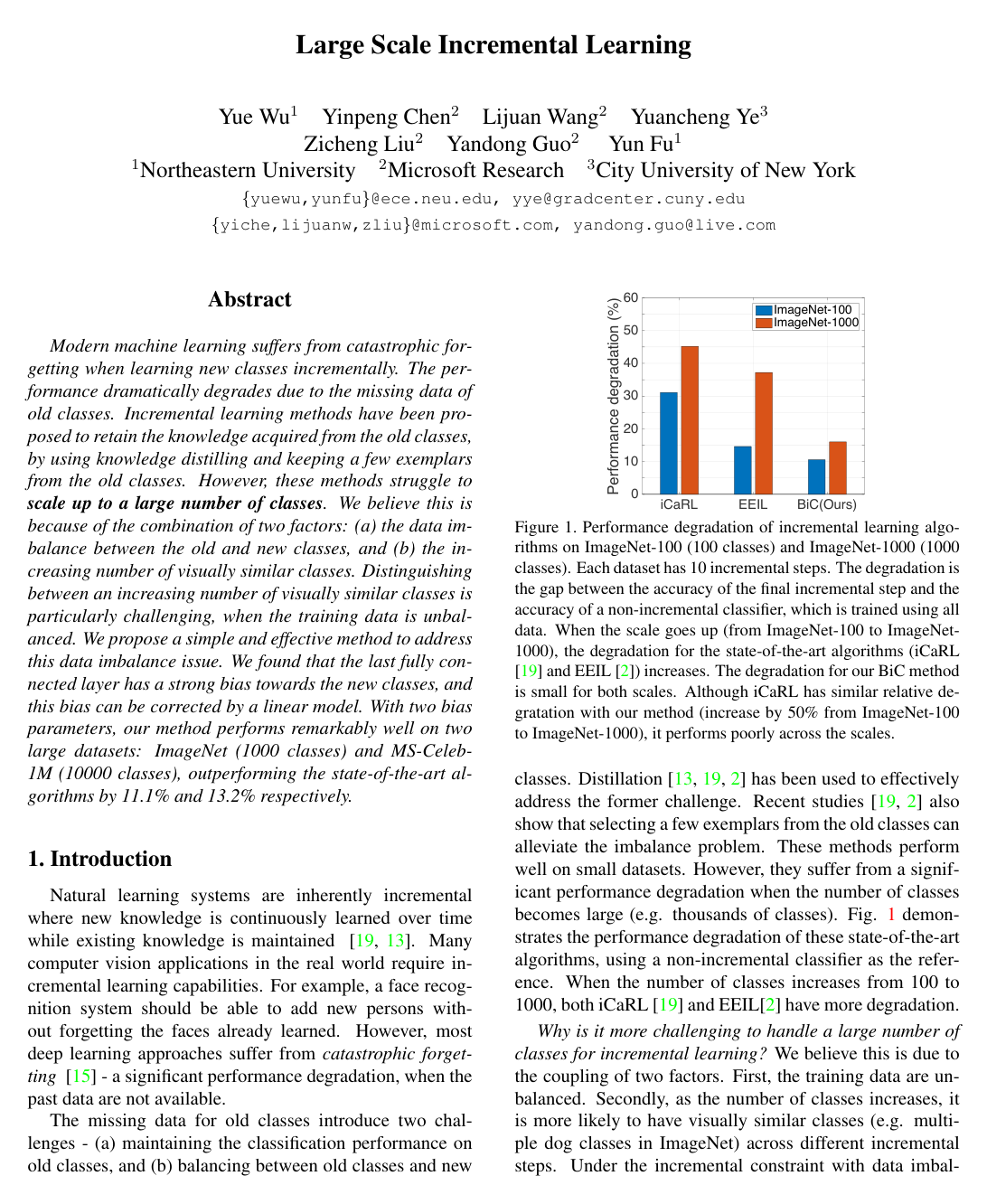
  8. Knowl 8 — Cross-Scale Performance Degradation Analysis

    empirical result

    Performance degradation is measured as the gap between the final incremental step accuracy and an upper-bound joint model trained non-incrementally on all data simultaneously. Comparing 10-step incremental setups on ImageNet-100 (100 classes) versus ImageNet-1000 (1000 classes):

    1. BiC: Degrades by 10.5% on ImageNet-100 and 16.0% on ImageNet-1000 (an increase in degradation of 5.5%).
    2. EEIL: Degrades by 15.1% on ImageNet-100 and 37.2% on ImageNet-1000 (an increase in degradation of 22.1%).
    3. iCaRL: Degrades by 31.1% on ImageNet-100 and 45.2% on ImageNet-1000 (an increase in degradation of 14.1%).

    This indicates that BiC scales more consistently than prior distillation-based methods as the number of visually similar classes and the severity of exemplar imbalance grow.

  9. Knowl 9 — Component Ablation of Distillation and Bias Correction on CIFAR-100

    data/table

    Ablation on CIFAR-100 (5 incremental batches of 20 classes, 2000 total stored exemplars) evaluates the individual contributions of classification loss (LcL_c), distillation loss (LdL_d), and bias correction layer (LbL_b):

    Variations cls loss distilling loss bias removal 20 40 60 80 100
    baseline-1 ✓ 84.40 68.30 55.10 48.52 39.83
    baseline-2 ✓ ✓ 85.05 72.22 59.41 50.43 40.34
    BiC (Ours) ✓ ✓ ✓ 84.00 74.69 67.93 61.25 56.69
    upper bound ✓ ✓ FC retrained 84.39 76.15 69.51 64.03 60.93

    Adding knowledge distillation alone (baseline-2) provides marginal improvement over pure classification loss (baseline-1) at 100 classes (40.34% vs 39.83%). Incorporating the linear bias correction layer (BiC) increases final accuracy to 56.69% (+16.35%), bringing it within 4.24% of the theoretical upper bound obtained by retraining the FC layer on all historical samples (60.93%).

  10. Knowl 10 — Sensitivity to Validation Split Ratios and Exemplar Selection Strategy

    data/table

    Ablation on CIFAR-100 (5 incremental batches of 20 classes, 2000 total exemplars) evaluates the sensitivity of BiC to the exemplar training/validation split ratio (trainold:valold\text{train}_{\text{old}} : \text{val}_{\text{old}}) and the exemplar selection method:

    Split Ratio 20 40 60 80 100
    9:1 84.00 74.69 67.93 61.25 56.69
    8:2 84.50 73.19 65.01 58.68 54.31
    7:3 84.70 71.60 63.68 58.12 53.74
    6:4 83.33 68.84 62.21 56.00 51.17
    Selection Strategy 20 40 60 80 100
    Random Selection 85.20 74.59 66.76 60.14 55.55
    iCaRL (Herding) 84.00 74.69 67.93 61.25 56.69

    A 9:1 split allocates sufficient exemplars (90%90\%) to Stage-1 feature learning while retaining enough (10%10\%) for Stage-2 bias parameter estimation; performance decreases monotonically as more exemplars are shifted to validation. Furthermore, BiC is robust to exemplar selection, with herding outperforming random selection by only 1.14% at 100 classes.

Coverage note — None was omitted; all key architectural components, mathematical formulations, diagnostic findings, empirical benchmarks (ImageNet-1000, Celeb-10000, CIFAR-100), cross-scale comparisons, and ablation studies are fully covered.

References

  1. 1.Martın Abadi, Ashish Agarwal, Paul Barham, Eugene Brevdo, Zhifeng Chen, Craig Citro, Greg S Corrado, Andy Davis, Jeffrey Dean, Matthieu Devin, et al. Tensorflow: Large-scale machine learning on heterogeneous distributed systems. arXiv preprint arXiv:1603.04467, 2016.
  2. 2.Francisco M. Castro, Manuel J. Marin-Jimenez, Nicolas Guil, Cordelia Schmid, and Karteek Alahari. End-to-end incremental learning. In The European Conference on Computer Vision (ECCV), September 2018.
  3. 3.Gert Cauwenberghs and Tomaso Poggio. Incremental and decremental support vector machine learning. In Advances in neural information processing systems, pages 409–415, 2001.
  4. 4.Ian Goodfellow, Jean Pouget-Abadie, Mehdi Mirza, Bing Xu, David Warde-Farley, Sherjil Ozair, Aaron Courville, and Yoshua Bengio. Generative adversarial nets. In Advances in neural information processing systems, pages 2672–2680, 2014.
  5. 5.Yandong Guo and Lei Zhang. One-shot face recognition by promoting underrepresented classes. 2017.
  6. 6.Yandong Guo, Lei Zhang, Yuxiao Hu, Xiaodong He, and Jianfeng Gao. MS-Celeb-1M: A dataset and benchmark for large scale face recognition. In ECCV, 2016.
  7. 7.Kaiming He, Xiangyu Zhang, Shaoqing Ren, and Jian Sun. Deep residual learning for image recognition. In Proceedings of the IEEE conference on computer vision and pattern recognition, pages 770–778, 2016.
  8. 8.Geoffrey Hinton, Oriol Vinyals, and Jeffrey Dean. Distilling the knowledge in a neural network. In NIPS Deep Learning and Representation Learning Workshop, 2015.
  9. 9.Heechul Jung, Jeongwoo Ju, Minju Jung, and Junmo Kim. Less-forgetting learning in deep neural networks. arXiv preprint arXiv:1607.00122, 2016.
  10. 10.James Kirkpatrick, Razvan Pascanu, Neil Rabinowitz, Joel Veness, Guillaume Desjardins, Andrei A Rusu, Kieran Milan, John Quan, Tiago Ramalho, Agnieszka Grabska-Barwinska, et al. Overcoming catastrophic forgetting in neural networks. Proceedings of the National Academy of Sciences, 114(13):3521–3526, 2017.
  11. 11.Alex Krizhevsky and Geoffrey Hinton. Learning multiple layers of features from tiny images. 2009.
  12. 12.Ilja Kuzborskij, Francesco Orabona, and Barbara Caputo. From n to n+ 1: Multiclass transfer incremental learning. In Proceedings of the IEEE Conference on Computer Vision and Pattern Recognition, pages 3358–3365, 2013.
  13. 13.Zhizhong Li and Derek Hoiem. Learning without forgetting. In European Conference on Computer Vision, pages 614–629. Springer, 2016.
  14. 14.David Lopez-Paz et al. Gradient episodic memory for continual learning. In Advances in Neural Information Processing Systems, pages 6470–6479, 2017.
  15. 15.Michael McCloskey and Neal J.Cohen. Catastrophic interference in connectionist networks: The sequential learning problem. Psychology of Learning and Motivation, 24:109–165, 1989.
  16. 16.Thomas Mensink, Jakob Verbeek, Florent Perronnin, and Gabriela Csurka. Distance-based image classification: Generalizing to new classes at near-zero cost. IEEE transactions on pattern analysis and machine intelligence, 35(11):2624–2637, 2013.
  17. 17.Robi Polikar, Lalita Upda, Satish S Upda, and Vasant Honavar. Learn++: An incremental learning algorithm for supervised neural networks. IEEE transactions on systems, man, and cybernetics, part C (applications and reviews), 31(4):497–508, 2001.
  18. 18.Amal Rannen Ep Triki, Rahaf Aljundi, Matthew Blaschko, and Tinne Tuytelaars. Encoder based lifelong learning. In Proceedings ICCV 2017, pages 1320–1328, 2017.
  19. 19.Sylvestre-Alvise Rebuffi, Alexander Kolesnikov, Georg Sperl, and Christoph H. Lampert. icarl: Incremental classifier and representation learning. In The IEEE Conference on Computer Vision and Pattern Recognition (CVPR), July 2017.
  20. 20.Olga Russakovsky, Jia Deng, Hao Su, Jonathan Krause, Sanjeev Satheesh, Sean Ma, Zhiheng Huang, Andrej Karpathy, Aditya Khosla, Michael Bernstein, et al. Imagenet large scale visual recognition challenge. International Journal of Computer Vision, 115(3):211–252, 2015.
  21. 21.Andrei A Rusu, Neil C Rabinowitz, Guillaume Desjardins, Hubert Soyer, James Kirkpatrick, Koray Kavukcuoglu, Razvan Pascanu, and Raia Hadsell. Progressive neural networks. arXiv preprint arXiv:1606.04671, 2016.
  22. 22.Hanul Shin, Jung Kwon Lee, Jaehong Kim, and Jiwon Kim. Continual learning with deep generative replay. In Advances in Neural Information Processing Systems, pages 2994–3003, 2017.
  23. 23.Konstantin Shmelkov, Cordelia Schmid, and Karteek Alahari. Incremental learning of object detectors without catastrophic forgetting. In Proceedings of the International Conference on Computer Vision, 2017.
  24. 24.Karen Simonyan and Andrew Zisserman. Very deep convolutional networks for large-scale image recognition. arXiv preprint arXiv:1409.1556, 2014.
  25. 25.Gan Sun, Yang Cong, Ji Liu, Lianqing Liu, Xiaowei Xu, and Haibin Yu. Lifelong metric learning. IEEE transactions on cybernetics, (99):1–12, 2018.
  26. 26.Gan Sun, Yang Cong, and Xiaowei Xu. Active lifelong learning with’ watchdog’. In Thirty-Second AAAI Conference on Artificial Intelligence, 2018.
  27. 27.Ragav Venkatesan, Hemanth Venkateswara, Sethuraman Panchanathan, and Baoxin Li. A strategy for an uncompromising incremental learner. arXiv preprint arXiv:1705.00744, 2017.
  28. 28.Tianjun Xiao, Jiaxing Zhang, Kuiyuan Yang, Yuxin Peng, and Zheng Zhang. Error-driven incremental learning in deep convolutional neural network for large-scale image classification. In Proceedings of the 22nd ACM international conference on Multimedia, pages 177–186. ACM, 2014.

Citation

MLA
Wu, Y., et al. “Large Scale Incremental Learning”. arXiv, 2019, http://arxiv.org/abs/1905.13260v1.
APA
Wu, Y., Chen, Y., Wang, L., Ye, Y., Liu, Z., Guo, Y., & Fu, Y. (2019). Large Scale Incremental Learning. arXiv. http://arxiv.org/abs/1905.13260v1
Chicago
Wu, Y., Y. Chen, L. Wang, et al. 2019. “Large Scale Incremental Learning”. arXiv. http://arxiv.org/abs/1905.13260v1.
Harvard
Wu, Y. et al. (2019) “Large Scale Incremental Learning”, arXiv [Preprint]. Available at: http://arxiv.org/abs/1905.13260v1.
Vancouver
1. Wu Y, Chen Y, Wang L, Ye Y, Liu Z, Guo Y, Fu Y (2019) Large Scale Incremental Learning. arXiv

BibTeX

@article{wu2019large,
  title = {Large Scale Incremental Learning},
  author = {Wu, Yue and Chen, Yinpeng and Wang, Lijuan and Ye, Yuancheng and Liu, Zicheng and Guo, Yandong and Fu, Yun},
  year = {2019},
  journal = {arXiv},
  url = {http://arxiv.org/abs/1905.13260v1},
  eprint = {1905.13260}
}
Metadata:arXiv

Source Code

This paper has an official code repository available. Click below to access the source code.

View Repository

Access the Paper

This paper is available from its original source. Click below to access the PDF.

Open PDF
License: IEEE