
keyword
Gaussian kernel
A Gaussian kernel, commonly referred to as a radial basis function kernel, is a mathematical function that quantifies the similarity between two data points based on their squared Euclidean distance. It is defined as the exponential of the negative squared Euclidean distance between two vectors, scaled by a tunable bandwidth or variance parameter. The function evaluates to one when two points are identical and monotonically decreases toward zero as the distance between them increases, making it a stationary and shift-invariant kernel. In machine learning and statistics, the Gaussian kernel implicitly maps input data into an infinite-dimensional reproducing kernel Hilbert space, enabling linear algorithms such as support vector machines, kernel ridge regression, and nonparametric two-sample tests to learn complex nonlinear patterns without explicitly computing coordinates in the high-dimensional feature space.
9 items
Using the Nyström Method to Speed Up Kernel Machines
Christopher K. I. Williams, Matthias Seeger
Why you should read this
Cannot be determined due to unreadable document content.
The provided text consists of corrupted character encodings and symbols, preventing the extraction of a coherent abstract.
Added
2026-10-04
License
Published with permission
GKEAL: Gaussian Kernel Embedded Analytic Learning for Few-Shot Class Incremental Task
Huiping Zhuang, Zhenyu Weng, Run He, Zhiping Lin, Ziqian Zeng
Why you should read this
Proposes a closed-form analytic learning framework for few-shot class-incremental learning that combines Gaussian kernel embeddings with recursive least-squares updates to guarantee weight-invariant classifier solutions and prevent catastrophic forgetting.
Few-shot class incremental learning (FSCIL) aims to address catastrophic forgetting during class incremental learning in a few-shot learning setting. In this paper, we approach the FSCIL by adopting analytic learning, a technique that converts network training into linear problems. This is inspired by the fact that the recursive implementation (batch-by-batch learning) of analytic learning gives identical weights to that produced by training on the entire dataset at once. The recursive implementation and the weight-identical property highly resemble the FSCIL setting (phase-by-phase learning) and its goal of avoiding catastrophic forgetting. By bridging the FSCIL with the analytic learning, we propose a Gaussian kernel embedded analytic learning (GKEAL) for FSCIL. The key components of GKEAL include the kernel analytic module which allows the GKEAL to conduct FSCIL in a recursive manner, and the augmented feature concatenation module that balances the preference between old and new tasks especially effectively under the few-shot setting. Our experiments show that the GKEAL gives state-of-the-art performance on several benchmark datasets.
Added
2026-09-26
A Kernel Two-Sample Test for Functional Data
George Wynne, Andrew B. Duncan
Why you should read this
Develops a Maximum Mean Discrepancy framework for functional data on infinite-dimensional Hilbert spaces, providing kernel bandwidth scaling rules that prevent test power from degrading as discretization mesh resolution increases.
We propose a nonparametric two-sample test procedure based on Maximum Mean Discrepancy (MMD) for testing the hypothesis that two samples of functions have the same underlying distribution, using kernels defined on function spaces. This construction is motivated by a scaling analysis of the efficiency of MMD-based tests for datasets of increasing dimension. Theoretical properties of kernels on function spaces and their associated MMD are established and employed to ascertain the efficacy of the newly proposed test, as well as to assess the effects of using functional reconstructions based on discretised function samples. The theoretical results are demonstrated over a range of synthetic and real world datasets.
Added
2026-09-26
Support Vector Clustering
Asa Ben-Hur, D. Horn, H. Siegelmann, V. Vapnik
Why you should read this
Develops a non-parametric clustering algorithm that identifies arbitrarily shaped cluster boundaries and handles outliers by computing minimal enclosing spheres in kernel-induced feature spaces.
We present a novel clustering method using the approach of support vector machines. Data points are mapped by means of a Gaussian kernel to a high dimensional feature space, where we search for the minimal enclosing sphere. This sphere, when mapped back to data space, can separate into several components, each enclosing a separate cluster of points. We present a simple algorithm for identifying these clusters. The width of the Gaussian kernel controls the scale at which the data is probed while the soft margin constant helps coping with outliers and overlapping clusters. The structure of a dataset is explored by varying the two parameters, maintaining a minimal number of support vectors to assure smooth cluster boundaries. We demonstrate the performance of our algorithm on several datasets.
Added
2026-09-24
Support Vector Data Description
DAVID M.J. TAX, ROBERT P.W. DUIN
Why you should read this
Proposes Support Vector Data Description (SVDD), a foundational method that computes a minimal enclosing hypersphere with kernel flexibility to perform one-class classification and outlier detection without requiring complete probability density estimation.
Data domain description concerns the characterization of a data set. A good description covers all target data but includes no superfluous space. The boundary of a dataset can be used to detect novel data or outliers. We will present the Support Vector Data Description (SVDD) which is inspired by the Support Vector Classifier. It obtains a spherically shaped boundary around a dataset and analogous to the Support Vector Classifier it can be made flexible by using other kernel functions. The method is made robust against outliers in the training set and is capable of tightening the description by using negative examples. We show characteristics of the Support Vector Data Descriptions using artificial and real data.
Added
2026-09-24
Exploiting the Circulant Structure of Tracking-by-Detection with Kernels
João F. Henriques, Rui Caseiro, Pedro Martins, Jorge Batista
Why you should read this
Proposes a framework that exploits the circulant structure of densely sampled subwindows to train and evaluate non-linear kernel classifiers via the Fast Fourier Transform, enabling visual tracking at hundreds of frames per second.
Recent years have seen greater interest in the use of discriminative classifiers in tracking systems, owing to their success in object detection. They are trained online with samples collected during tracking. Unfortunately, the potentially large number of samples becomes a computational burden, which directly conflicts with real-time requirements. On the other hand, limiting the samples may sacrifice performance. Interestingly, we observed that, as we add more and more samples, the problem acquires circulant structure. Using the well-established theory of Circulant matrices, we provide a link to Fourier analysis that opens up the possibility of extremely fast learning and detection with the Fast Fourier Transform. This can be done in the dual space of kernel machines as fast as with linear classifiers. We derive closed-form solutions for training and detection with several types of kernels, including the popular Gaussian and polynomial kernels. The resulting tracker achieves performance competitive with the state-of-the-art, can be implemented with only a few lines of code and runs at hundreds of frames-per-second. MATLAB code is provided in the paper (see Algorithm 1).
Added
2026-09-15
Support Vector Method for Novelty Detection
B. Schölkopf, R. C. Williamson, Alex Smola, J. Shawe-Taylor, John C. Platt
Why you should read this
Introduces the support vector method for novelty detection, which estimates the support of an unknown distribution by separating unlabeled data from the origin in a kernel feature space with direct theoretical control over the outlier fraction.
Suppose you are given some dataset drawn from an underlying probability distribution P and you want to estimate a “simple” subset S of input space such that the probability that a test point drawn from P lies outside of S equals some a priori specified ν between 0 and 1. We propose a method to approach this problem by trying to estimate a function f which is positive on S and negative on the complement. The functional form of f is given by a kernel expansion in terms of a potentially small subset of the training data; it is regularized by controlling the length of the weight vector in an associated feature space. We provide a theoretical analysis of the statistical performance of our algorithm. The algorithm is a natural extension of the support vector algorithm to the case of unlabelled data.
Added
2026-09-14
Random Features for Large-Scale Kernel Machines
Ali Rahimi, Benjamin Recht
Why you should read this
Introduces randomized feature mappings that approximate shift-invariant kernels, enabling fast linear algorithms to scale kernel methods to massive datasets with theoretical convergence guarantees.
To accelerate the training of kernel machines, we propose to map the input data to a randomized low-dimensional feature space and then apply existing fast linear methods. The features are designed so that the inner products of the transformed data are approximately equal to those in the feature space of a user specified shift-invariant kernel. We explore two sets of random features, provide convergence bounds on their ability to approximate various radial basis kernels, and show that in large-scale classification and regression tasks linear machine learning algorithms applied to these features outperform state-of-the-art large-scale kernel machines.
Added
2026-09-10
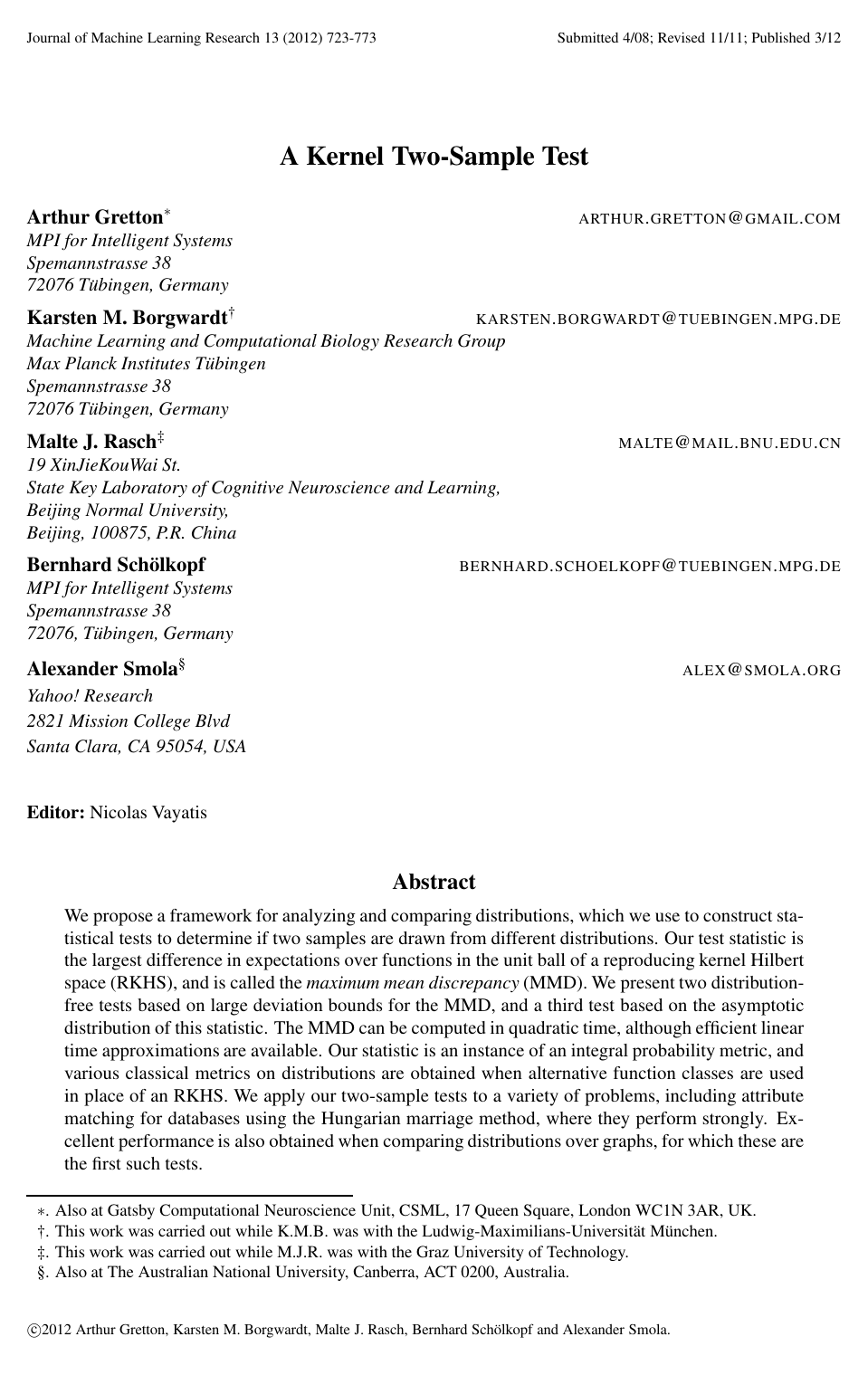
A Kernel Two-Sample Test
Arthur Gretton, Karsten M. Borgwardt, Malte J. Rasch, Bernhard Schölkopf, Alexander Smola
Why you should read this
Introduces Maximum Mean Discrepancy (MMD), establishing a non-parametric kernel framework to determine whether two samples originate from different probability distributions across high-dimensional and structured data without density estimation.
We propose a framework for analyzing and comparing distributions, which we use to construct statistical tests to determine if two samples are drawn from different distributions. Our test statistic is the largest difference in expectations over functions in the unit ball of a reproducing kernel Hilbert space (RKHS), and is called the maximum mean discrepancy (MMD). We present two distribution-free tests based on large deviation bounds for the MMD, and a third test based on the asymptotic distribution of this statistic. The MMD can be computed in quadratic time, although efficient linear time approximations are available. Our statistic is an instance of an integral probability metric, and various classical metrics on distributions are obtained when alternative function classes are used in place of an RKHS. We apply our two-sample tests to a variety of problems, including attribute matching for databases using the Hungarian marriage method, where they perform strongly. Excellent performance is also obtained when comparing distributions over graphs, for which these are the first such tests.
Added
2026-09-09
