
Built independently by an author, for readers. Read the story and support ChapterPal

keyword

task-recency bias

Task-recency bias refers to the tendency of a machine learning model trained sequentially over time to favor recently learned classes or tasks over earlier ones during inference. In continual and incremental learning settings, models encounter new data distributions or distinct categories in successive stages, often without complete access to previous training data. Because model parameters and classification layers are repeatedly updated using only current or limited rehearsal data, the classifier assigns disproportionately larger weights and higher output probabilities to the newest classes. This systematic imbalance degrades performance on historical tasks, directly contributing to catastrophic forgetting and disrupting the balance between retaining past knowledge and integrating new information.

1 item
GKEAL: Gaussian Kernel Embedded Analytic Learning for Few-Shot Class Incremental Task

GKEAL: Gaussian Kernel Embedded Analytic Learning for Few-Shot Class Incremental Task

Huiping Zhuang, Zhenyu Weng, Run He, Zhiping Lin, Ziqian Zeng

OrganizationsNanyang Technological UniversitySouth China University of Technology

Why you should read this

Proposes a closed-form analytic learning framework for few-shot class-incremental learning that combines Gaussian kernel embeddings with recursive least-squares updates to guarantee weight-invariant classifier solutions and prevent catastrophic forgetting.

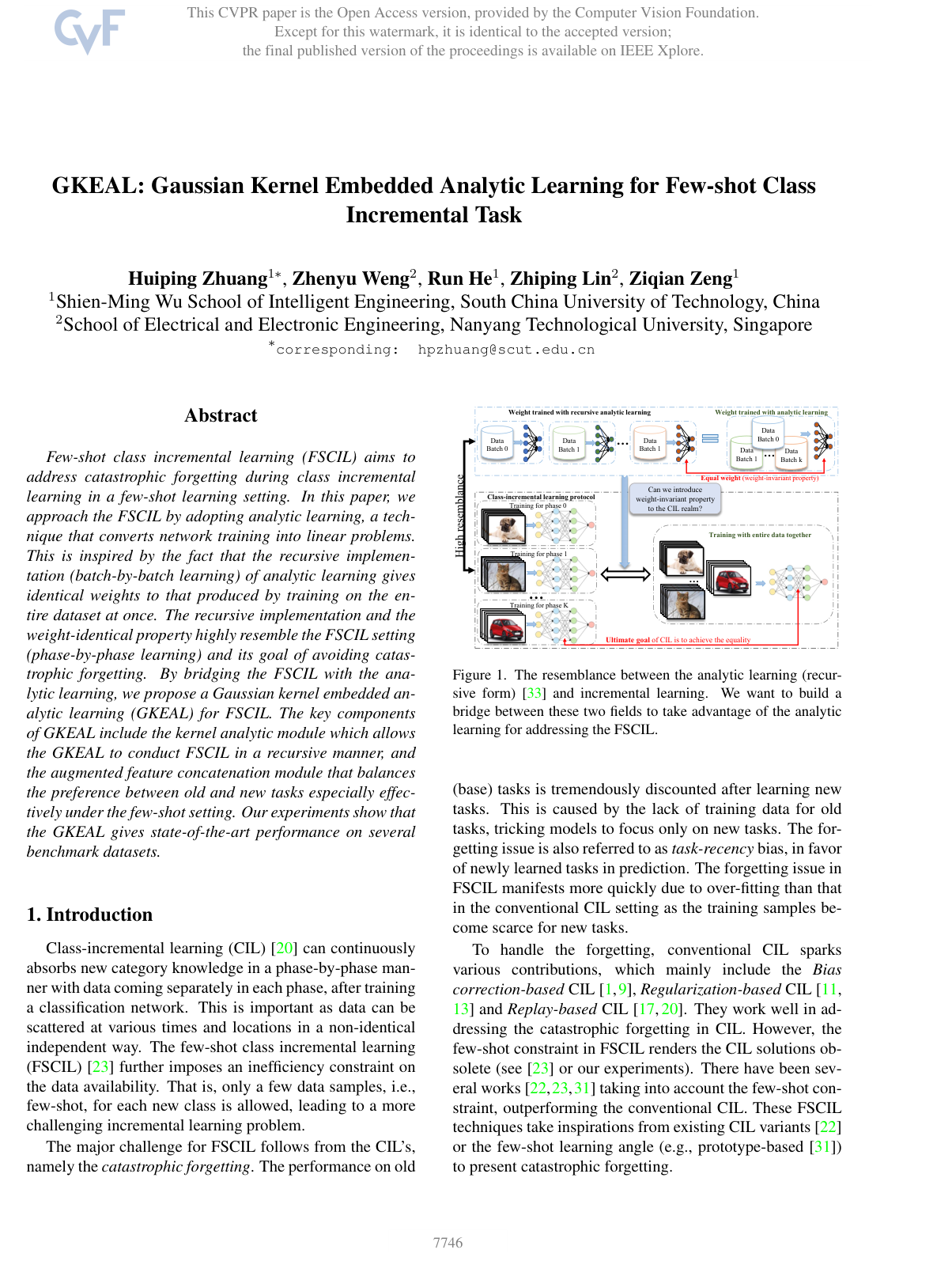
Few-shot class incremental learning (FSCIL) aims to address catastrophic forgetting during class incremental learning in a few-shot learning setting. In this paper, we approach the FSCIL by adopting analytic learning, a technique that converts network training into linear problems. This is inspired by the fact that the recursive implementation (batch-by-batch learning) of analytic learning gives identical weights to that produced by training on the entire dataset at once. The recursive implementation and the weight-identical property highly resemble the FSCIL setting (phase-by-phase learning) and its goal of avoiding catastrophic forgetting. By bridging the FSCIL with the analytic learning, we propose a Gaussian kernel embedded analytic learning (GKEAL) for FSCIL. The key components of GKEAL include the kernel analytic module which allows the GKEAL to conduct FSCIL in a recursive manner, and the augmented feature concatenation module that balances the preference between old and new tasks especially effectively under the few-shot setting. Our experiments show that the GKEAL gives state-of-the-art performance on several benchmark datasets.

Added

2026-09-26