Multisample Flow Matching: Straightening Flows with Minibatch Couplings
Aram-Alexandre PooladianHeli Ben-HamuCarles Domingo-EnrichBrandon AmosYaron LipmanRicky T. Q. Chen
Proposes Multisample Flow Matching, a simulation-free training framework that couples minibatch data and noise distributions to straighten probability paths, reducing gradient variance during training and enabling faster generative sampling with fewer model evaluations.
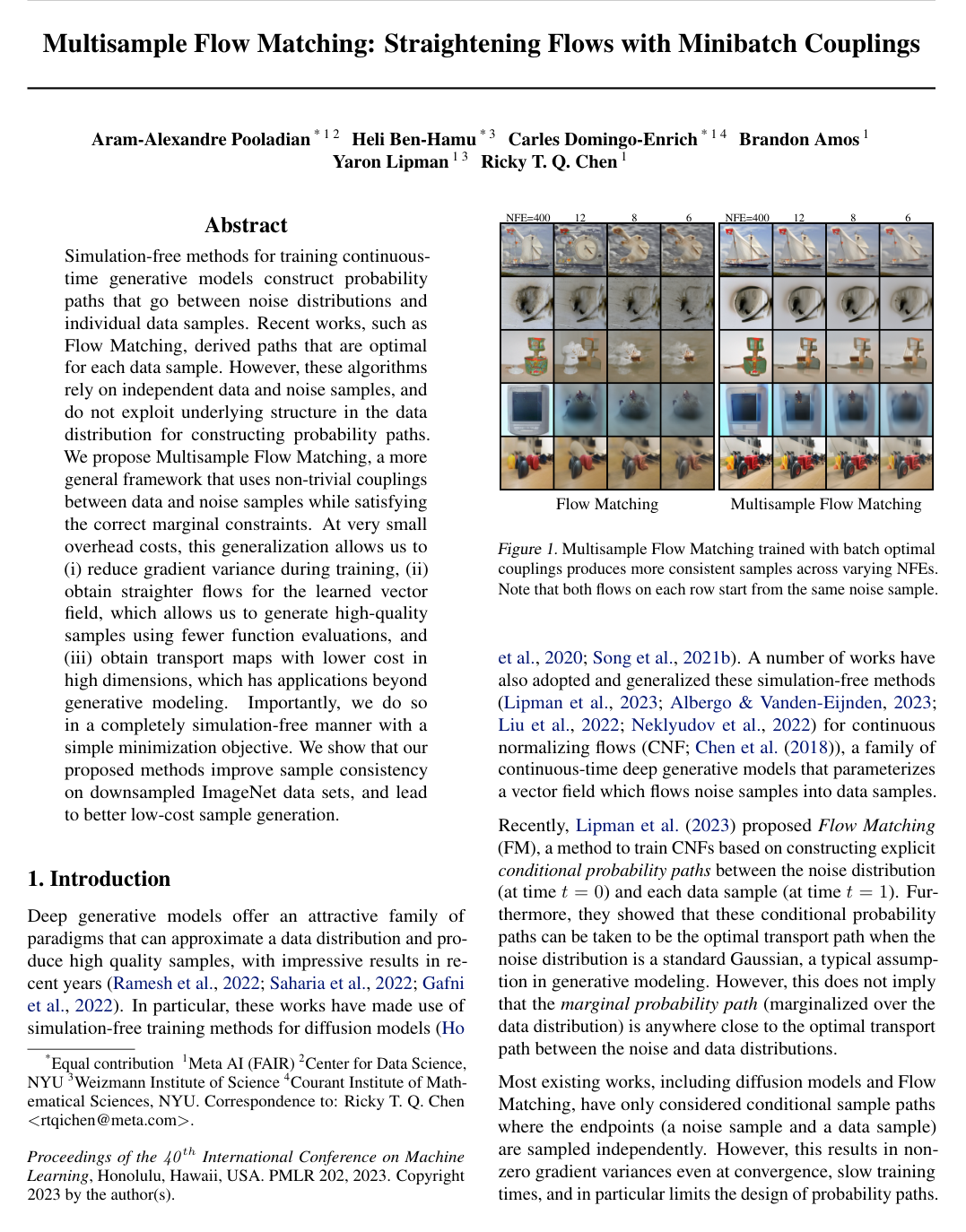
Continuous-time generative models, such as continuous normalizing flows and diffusion models, generate high-quality data by transforming random noise into realistic samples. However, standard methods pair noise and data independently during training. This independent sampling creates curved, tangled transformation paths, inflates gradient variance during optimization, and requires computationally expensive numerical simulations to generate individual samples.
The article introduces Multisample Flow Matching, a generalized simulation-free training framework designed to construct straighter, more efficient probability paths. The core objective is to evaluate whether coupling mini-batches of noise and data samples using optimal transport principles can accelerate training, reduce sample generation cost, and preserve the underlying data distributions.
The authors evaluated the framework across synthetic benchmarks and standard high-dimensional image datasets, including downsampled 32x32 and 64x64 ImageNet. The approach pairs batches of noise and data using techniques such as Batch Optimal Transport, Batch Entropic Optimal Transport, and faster ranking-based stable couplings. By formulating the training objective over joint distributions, the framework avoids costly adversarial min-max optimization and simulation during training while mathematically ensuring the target data distribution is preserved exactly.
The findings show substantial operational improvements over standard Flow Matching and diffusion models. In image generation benchmarks, the proposed batch couplings reduced the required sampling compute by 30% to 60% while achieving equivalent image quality, adding only a 0.8% to 4% computational overhead to training time. Batch-coupled models also exhibited significantly lower gradient variance, leading to faster training convergence. Furthermore, in high-dimensional synthetic transport problems with unknown cost functions, the method outperformed static mappings by correctly matching the true target distributions with low transport costs.
These performance gains allow machine learning deployments to significantly cut inference latency and computational expenses in production without degrading sample fidelity. Additionally, the approach provides a viable, computationally efficient tool for high-dimensional optimal transport problems in biological data modeling and computer vision. Because ranking-based stable couplings matched the performance of full optimal transport solvers at lower computational complexity, organizations can deploy this framework using lightweight pairing algorithms.
Organizations training continuous generative models should adopt mini-batch coupling strategies to reduce production inference costs and training times. Future research should evaluate scaling these couplings to full-resolution images, test their behavior across broader multi-modal applications, and explore optimal coupling methods when pairing across distributed multi-GPU environments.
- Paper: Flow Matching for Generative Modeling, Yaron Lipman et al. (2023). This paper establishes the foundational Flow Matching framework for continuous normalizing flows that Multisample Flow Matching directly generalizes by introducing minibatch couplings.
- Paper: Flow Straight and Fast: Learning to Generate and Transfer Data with Rectified Flow, Xingchao Liu et al. (2023). This work introduces Rectified Flow to straighten generative trajectories via ODE-based velocity matching, providing essential context on trajectory straightening in simulation-free continuous generative modeling.
- Paper: Matching Normalizing Flows and Probability Paths on Manifolds, Heli Ben-Hamu et al. (2022). This paper introduces simulation-free probability path matching for continuous normalizing flows, foundational to the vector field regression techniques extended by multisample formulations.
- Paper: Score-Based Generative Modeling through Stochastic Differential Equations, Yang Song et al. (2021). This foundational work formulates continuous-time generative models via stochastic and ordinary differential equations, providing the underlying continuous-time probability path paradigm used in Flow Matching.
- Paper: On the Complexity of Approximating Multimarginal Optimal Transport, Tianyi Lin et al. (2022). This paper analyzes the computational complexity and algorithms of optimal transport couplings across distributions, which underpins the use of minibatch couplings to minimize transport costs.
- Paper: Stochastic Interpolants: A Unifying Framework for Flows and Diffusions, Michael S. Albergo et al. (2025). This framework unifies flow matching and diffusion bridges using stochastic interpolants over arbitrary finite-time boundary distributions, extending the continuous velocity field constructions of Multisample Flow Matching.
- Paper: SE(3)-Stochastic Flow Matching for Protein Backbone Generation, Avishek Joey Bose et al. (2024). This work extends flow matching and optimal transport path straightening to non-Euclidean SE(3) manifolds for 3D protein structure generation.
- Paper: Mean Flows for One-step Generative Modeling, Zhengyang Geng et al. (2025). This work builds on straight-line flow matching paths by parameterizing average velocity fields across intervals to achieve fast one-step generation.
- Paper: Adjoint Matching: Fine-tuning Flow and Diffusion Generative Models with Memoryless Stochastic Optimal Control, Carles Domingo-Enrich et al. (2025). This paper applies stochastic optimal control principles to fine-tune continuous flow matching models according to target preference distributions.
- Paper: Fast Point Cloud Generation with Straight Flows, Lemeng Wu et al. (2023). This work applies straightened flow trajectories and distillation techniques to achieve low-latency generative modeling of 3D point clouds.
- Paper: Variational Flow Maps: Make Some Noise for One-Step Conditional Generation, Abbas Mammadov et al. (2026). This work develops variational noise adapters for flow maps to enable one-step conditional generation in inverse problems.
- Paper: Context-weighted Discrete Flow Matching, Daniil Cherniavskii et al. (2026). This work extends flow matching principles to discrete sequence domains by incorporating context-weighted token dynamics.