On the Complexity of Approximating Multimarginal Optimal Transport
Tianyi LinNhat HoMarco CuturiMichael I. Jordan
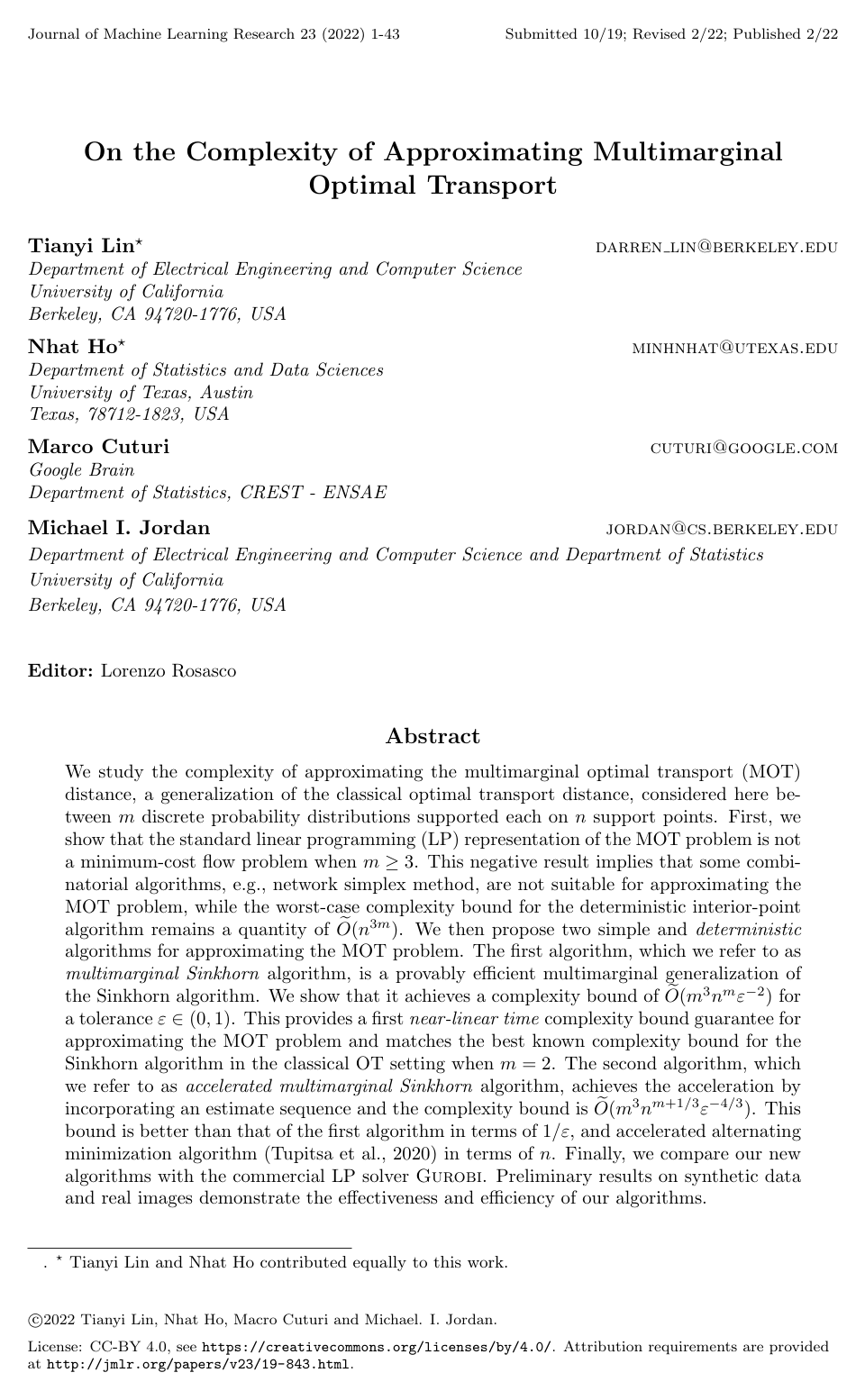
Establishes the computational limits of discrete multimarginal optimal transport and introduces near-linear time Sinkhorn-based algorithms with rigorous complexity bounds that scale efficiently to multiple probability distributions.
Multimarginal optimal transport provides a mathematical foundation for simultaneously aligning or matching multiple probability distributions. This framework has become increasingly critical across diverse fields, including economics, fluid dynamics, physics, and modern machine learning applications such as generative adversarial networks, domain adaptation, and computing free-support Wasserstein barycenters. However, scaling these methods presents severe computational challenges because discrete representations across several distributions involve an exponential number of decision variables, causing standard optimization techniques to become computationally impractical.
The article aims to evaluate the fundamental computational complexity of the multimarginal optimal transport problem and demonstrate provably efficient deterministic approximation algorithms. Specifically, the authors analyze the underlying network structure of the standard linear programming formulation and establish rigorous computational complexity bounds for two newly designed approximation algorithms.
To establish these properties, the authors conduct a theoretical structural reduction by linking the linear programming form of multimarginal transport to multidimensional matching problems. They then develop two deterministic algorithms utilizing entropy regularization, which smooths the dual optimization problem: the multimarginal Sinkhorn algorithm, incorporating a greedy coordinate selection rule, and an accelerated variant using Nesterov estimate sequences and monotone search steps. Both algorithms are paired with a specialized rank-one tensor rounding scheme to map regularized outputs back to exact feasibility. The authors validate their theoretical findings through numerical experiments on both synthetic image data and real handwritten digit datasets, benchmarking performance against the standard commercial linear programming solver Gurobi.
The article establishes several key findings regarding structure, efficiency, and practical execution. First, the standard linear programming representation of multimarginal optimal transport is not a minimum-cost flow problem when matching three or more distributions, demonstrating that fast combinatorial network simplex methods cannot be applied and leaving standard interior-point solvers with poor worst-case complexity scaling. Second, the proposed multimarginal Sinkhorn algorithm achieves the first near-linear time computational complexity bound with respect to the total number of variable combinations, making its dependence on support size mathematically unimprovable in general settings. Third, the accelerated multimarginal Sinkhorn algorithm improves runtime dependence on target approximation precision at the expense of a slightly higher dependence on support size. Finally, empirical evaluations show that both proposed methods significantly outperform commercial solvers, with standard solvers running out of memory on high-resolution image benchmarks while the new algorithms successfully compute high-quality approximations.
These findings provide clear guidelines for managing computational cost and performance across large-scale optimization tasks. Decision-makers should recognize that classical commercial linear programming solvers are fundamentally ill-suited for multi-distribution transport problems involving three or more marginals. Instead, selecting the appropriate approximation algorithm depends on the operational accuracy requirements: the standard multimarginal Sinkhorn algorithm is ideal for applications tolerating moderate precision on large support grids, such as computer vision and image processing, whereas the accelerated variant is superior for high-precision scientific or economic applications.
Organizations implementing multi-distribution alignment should transition away from general-purpose linear programming software toward entropy-regularized Sinkhorn frameworks. Before broad deployment, development teams should pilot these methods and explore parallelized or distributed computing implementations, which are particularly valuable for mitigating the gradient computation overhead in the accelerated algorithm. Further technical exploration should focus on integrating low-rank tensor decompositions and explicit sparsity penalties to reduce memory demands and recover sparse transport plans.
Confidence in the mathematical complexity bounds and convergence guarantees is high, as the theoretical analysis rests on rigorous optimization proofs. Readers should note, however, that the general multimarginal transport problem remains inherently subject to the curse of dimensionality as the number of distributions grows, and the present algorithms assume discrete, balanced probability measures with dense support. Caution is warranted when applying these baseline algorithms to unbalanced or continuous mass distributions without further dimension-reduction or problem-specific structural simplifications.
- Paper: On the Efficiency of Entropic Regularized Algorithms for Optimal Transport, Tianyi Lin et al. (2022). It analyzes the computational complexity and accelerated first-order optimization schemes for entropic regularized Sinkhorn algorithms in classical optimal transport, establishing the foundational theoretical bounds and accelerated techniques generalized by this work.
- Paper: Sinkhorn Distances: Lightspeed Computation of Optimal Transportation Distances, Marco Cuturi (2013). It introduces the entropic regularization formulation and matrix-scaling Sinkhorn algorithm that serve as the core basis for multimarginal Sinkhorn approximations.
- Paper: Computational Optimal Transport, Gabriel Peyré et al. (2018). It provides a comprehensive overview of computational optimal transport, including Kantorovich linear programs, entropic regularization, and foundational multimarginal formulations.
No sufficiently relevant recommendations were found.