
keyword
optimal transport maps
An optimal transport map is a deterministic function that transforms one probability distribution into another while minimizing the total cost of moving the probability mass according to a specified cost function. Originating in the classical Monge formulation of optimal transport, this map assigns each point in a source distribution directly to a point in a target distribution so that the push-forward of the source measure precisely matches the target measure. Unlike relaxed transport plans that allow probability mass from a single source location to be split among multiple destinations, a transport map provides a deterministic point-to-point assignment. Under standard regularity conditions, such as continuous source distributions evaluated under a squared Euclidean distance cost, a unique optimal transport map exists and can be expressed as the gradient of a convex potential function, providing foundational utility across probability theory, geometry, and generative machine learning.
2 items
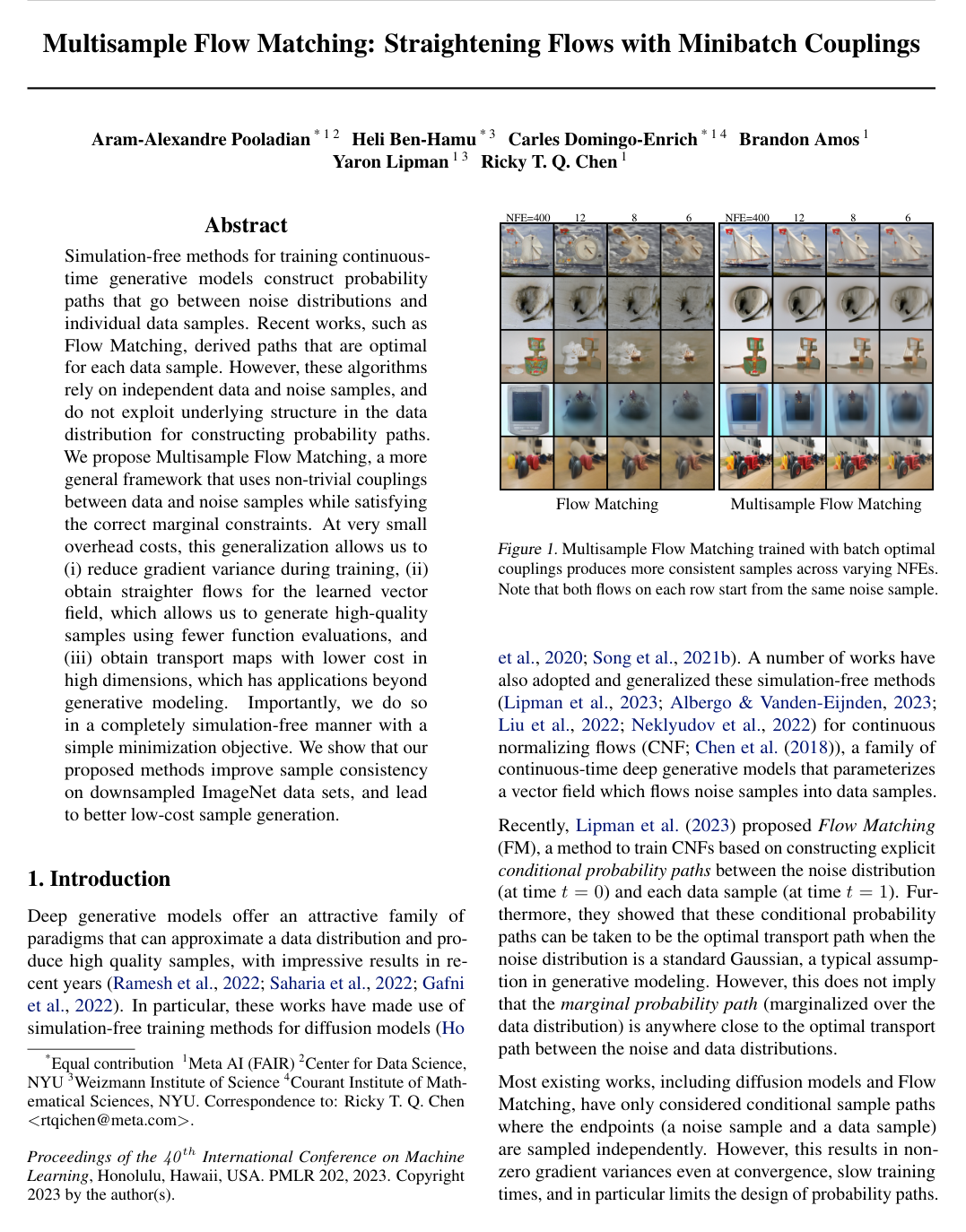
Multisample Flow Matching: Straightening Flows with Minibatch Couplings
Aram-Alexandre Pooladian, Heli Ben-Hamu, Carles Domingo-Enrich, Brandon Amos, Yaron Lipman, Ricky T. Q. Chen
Why you should read this
Proposes Multisample Flow Matching, a simulation-free training framework that couples minibatch data and noise distributions to straighten probability paths, reducing gradient variance during training and enabling faster generative sampling with fewer model evaluations.
Simulation-free methods for training continuous-time generative models construct probability paths that go between noise distributions and individual data samples. Recent works, such as Flow Matching, derived paths that are optimal for each data sample. However, these algorithms rely on independent data and noise samples, and do not exploit underlying structure in the data distribution for constructing probability paths. We propose Multisample Flow Matching, a more general framework that uses non-trivial couplings between data and noise samples while satisfying the correct marginal constraints. At very small overhead costs, this generalization allows us to (i) reduce gradient variance during training, (ii) obtain straighter flows for the learned vector field, which allows us to generate high-quality samples using fewer function evaluations, and (iii) obtain transport maps with lower cost in high dimensions, which has applications beyond generative modeling. Importantly, we do so in a completely simulation-free manner with a simple minimization objective. We show that our proposed methods improve sample consistency on downsampled ImageNet data sets, and lead to better low-cost sample generation.
Added
2026-09-28
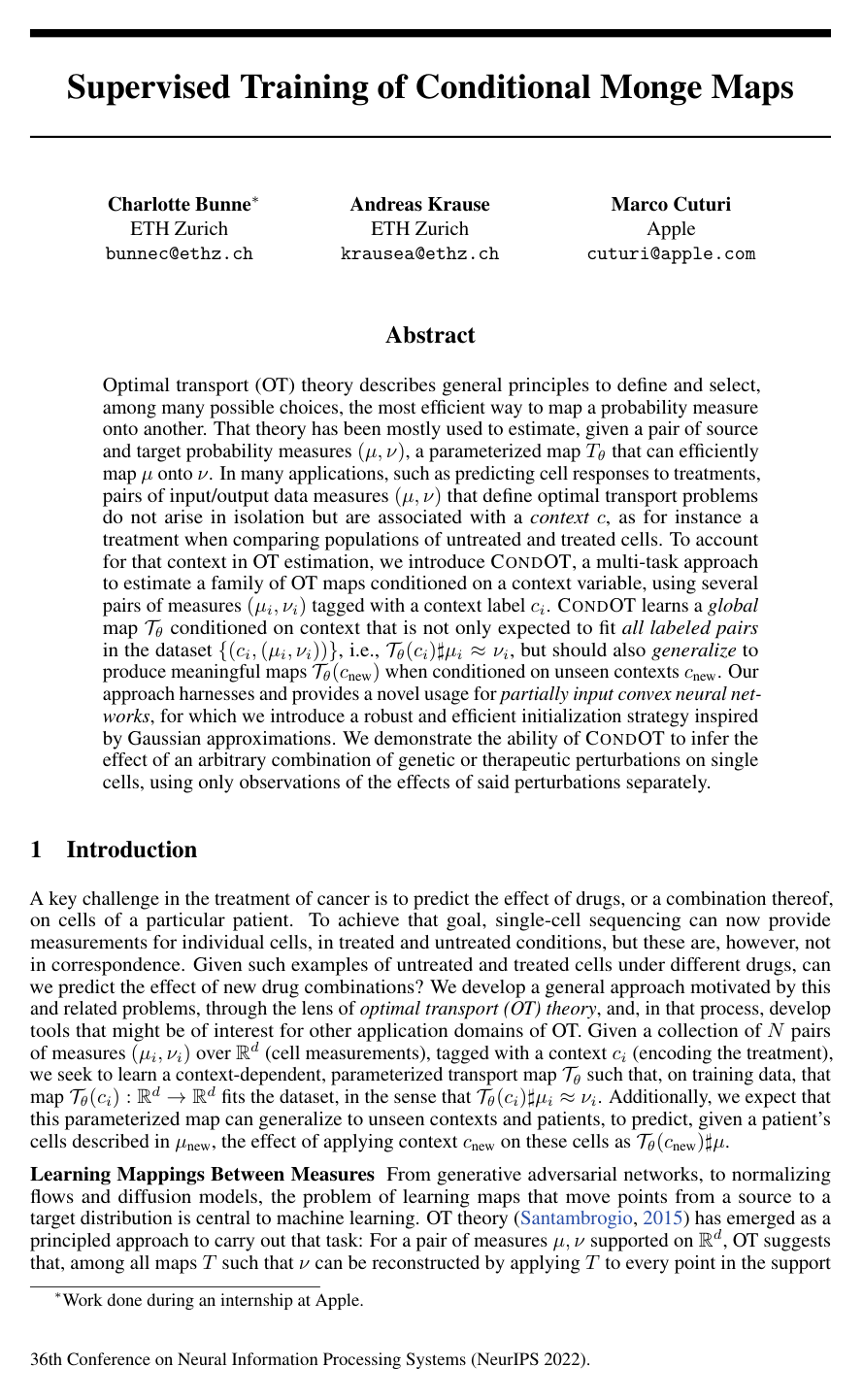
Supervised Training of Conditional Monge Maps
Charlotte Bunne, Andreas Krause, Marco Cuturi
Why you should read this
Introduces CONDOT, a neural optimal transport framework using partially input convex neural networks to learn context-conditioned Monge maps across probability measures, enabling accurate prediction of cellular responses to unseen drug and genetic perturbation combinations.
Added
2026-09-26