
keyword
continuous normalizing flows
A continuous normalizing flow is a generative modeling framework that transforms a simple base probability distribution into a complex data distribution over continuous time using ordinary differential equations. Unlike discrete normalizing flows that apply a fixed sequence of discrete invertible layers, continuous normalizing flows model transformation trajectories as smooth paths governed by a learned, time-dependent vector field parameterized by a neural network. By integrating this vector field along continuous trajectories, the model computes exact likelihoods using the instantaneous change of variables theorem, which requires only the trace of the Jacobian matrix rather than its computationally expensive determinant. This continuous-time formulation provides flexible, invertible mappings for tasks such as density estimation, deterministic sampling, and generative modeling across Euclidean spaces and manifolds without requiring restricted neural network architectures.
4 items
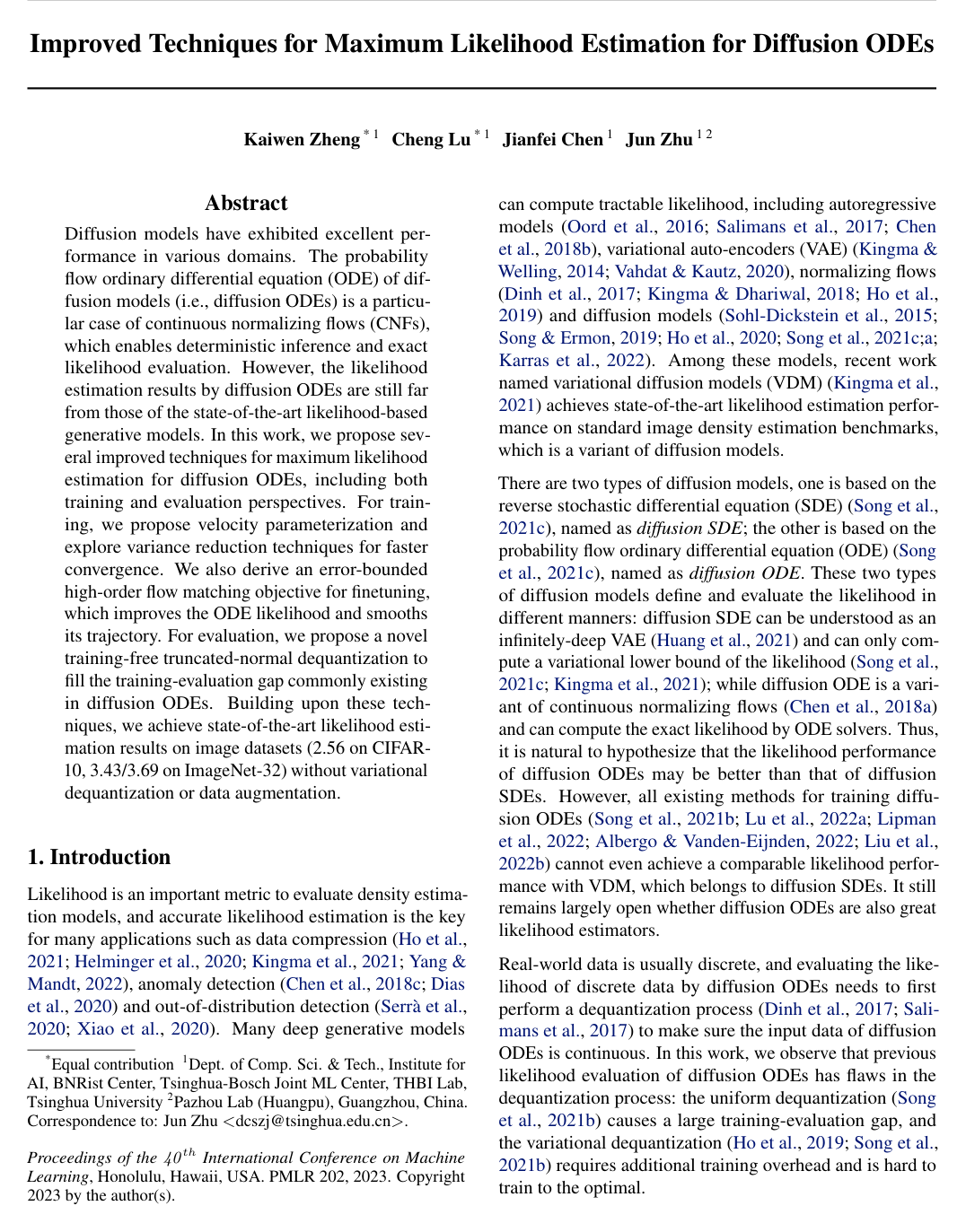
Improved Techniques for Maximum Likelihood Estimation for Diffusion ODEs
Kaiwen Zheng, Cheng Lu, Jianfei Chen, Jun Zhu
Why you should read this
Proposes a suite of training and evaluation techniques—including velocity parameterization, high-order flow matching finetuning, and training-free truncated-normal dequantization—that enables diffusion ODEs to achieve state-of-the-art exact likelihood estimation without variational dequantization or data augmentation.
Diffusion models have exhibited excellent performance in various domains. The probability flow ordinary differential equation (ODE) of diffusion models (i.e., diffusion ODEs) is a particular case of continuous normalizing flows (CNFs), which enables deterministic inference and exact likelihood evaluation. However, the likelihood estimation results by diffusion ODEs are still far from those of the state-of-the-art likelihood-based generative models. In this work, we propose several improved techniques for maximum likelihood estimation for diffusion ODEs, including both training and evaluation perspectives. For training, we propose velocity parameterization and explore variance reduction techniques for faster convergence. We also derive an error-bounded high-order flow matching objective for finetuning, which improves the ODE likelihood and smooths its trajectory. For evaluation, we propose a novel training-free truncated-normal dequantization to fill the training-evaluation gap commonly existing in diffusion ODEs. Building upon these techniques, we achieve state-of-the-art likelihood estimation results on image datasets (2.56 on CIFAR-10, 3.43/3.69 on ImageNet-32) without variational dequantization or data augmentation.
Added
2026-10-03
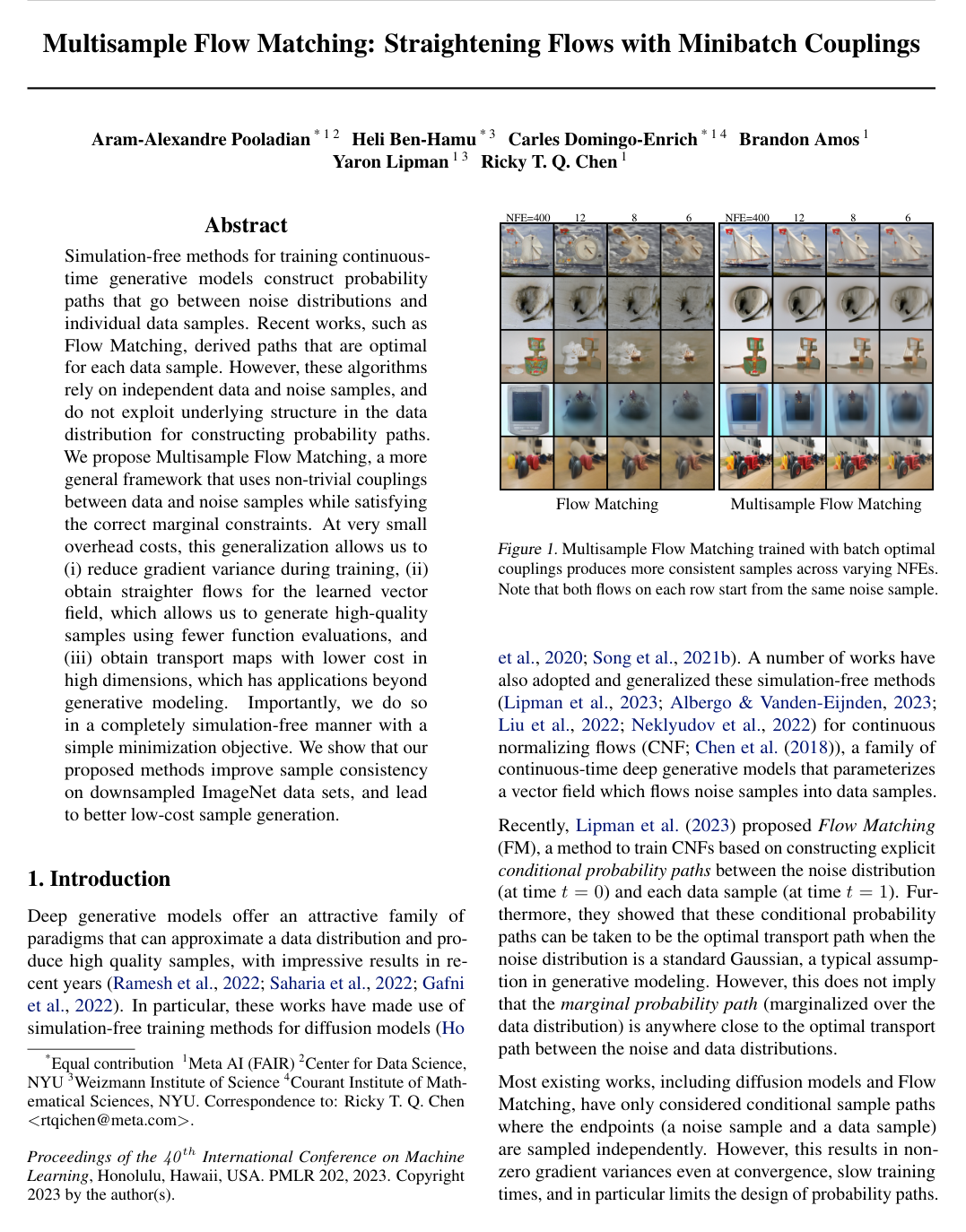
Multisample Flow Matching: Straightening Flows with Minibatch Couplings
Aram-Alexandre Pooladian, Heli Ben-Hamu, Carles Domingo-Enrich, Brandon Amos, Yaron Lipman, Ricky T. Q. Chen
Why you should read this
Proposes Multisample Flow Matching, a simulation-free training framework that couples minibatch data and noise distributions to straighten probability paths, reducing gradient variance during training and enabling faster generative sampling with fewer model evaluations.
Simulation-free methods for training continuous-time generative models construct probability paths that go between noise distributions and individual data samples. Recent works, such as Flow Matching, derived paths that are optimal for each data sample. However, these algorithms rely on independent data and noise samples, and do not exploit underlying structure in the data distribution for constructing probability paths. We propose Multisample Flow Matching, a more general framework that uses non-trivial couplings between data and noise samples while satisfying the correct marginal constraints. At very small overhead costs, this generalization allows us to (i) reduce gradient variance during training, (ii) obtain straighter flows for the learned vector field, which allows us to generate high-quality samples using fewer function evaluations, and (iii) obtain transport maps with lower cost in high dimensions, which has applications beyond generative modeling. Importantly, we do so in a completely simulation-free manner with a simple minimization objective. We show that our proposed methods improve sample consistency on downsampled ImageNet data sets, and lead to better low-cost sample generation.
Added
2026-09-28
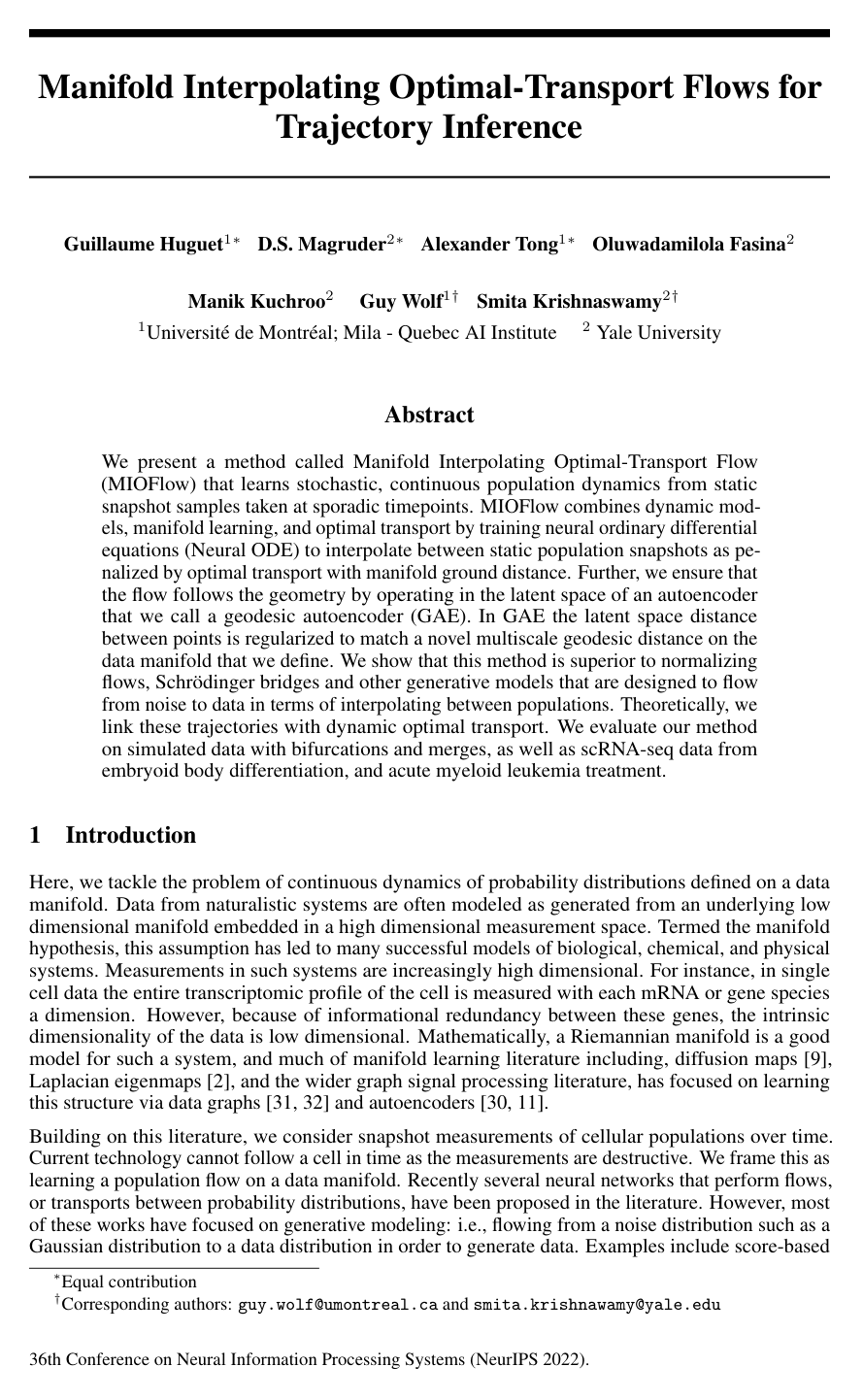
Manifold Interpolating Optimal-Transport Flows for Trajectory Inference
Guillaume Huguet, Daniel Sumner Magruder, Alexander Tong, Oluwadamilola Fasina, Manik Kuchroo, Guy Wolf, Smita Krishnaswamy
Why you should read this
Develops MIOFlow, a framework combining neural ordinary differential equations and optimal transport to reconstruct continuous biological trajectories from static snapshot measurements while respecting intrinsic data geometry.
We present a method called Manifold Interpolating Optimal-Transport Flow (MIOFlow) that learns stochastic, continuous population dynamics from static snapshot samples taken at sporadic timepoints. MIOFlow combines dynamic models, manifold learning, and optimal transport by training neural ordinary differential equations (Neural ODE) to interpolate between static population snapshots as penalized by optimal transport with manifold ground distance. Further, we ensure that the flow follows the geometry by operating in the latent space of an autoencoder that we call a geodesic autoencoder (GAE). In GAE the latent space distance between points is regularized to match a novel multiscale geodesic distance on the data manifold that we define. We show that this method is superior to normalizing flows, Schrödinger bridges and other generative models that are designed to flow from noise to data in terms of interpolating between populations. Theoretically, we link these trajectories with dynamic optimal transport. We evaluate our method on simulated data with bifurcations and merges, as well as scRNA-seq data from embryoid body differentiation, and acute myeloid leukemia treatment.
Added
2026-09-26
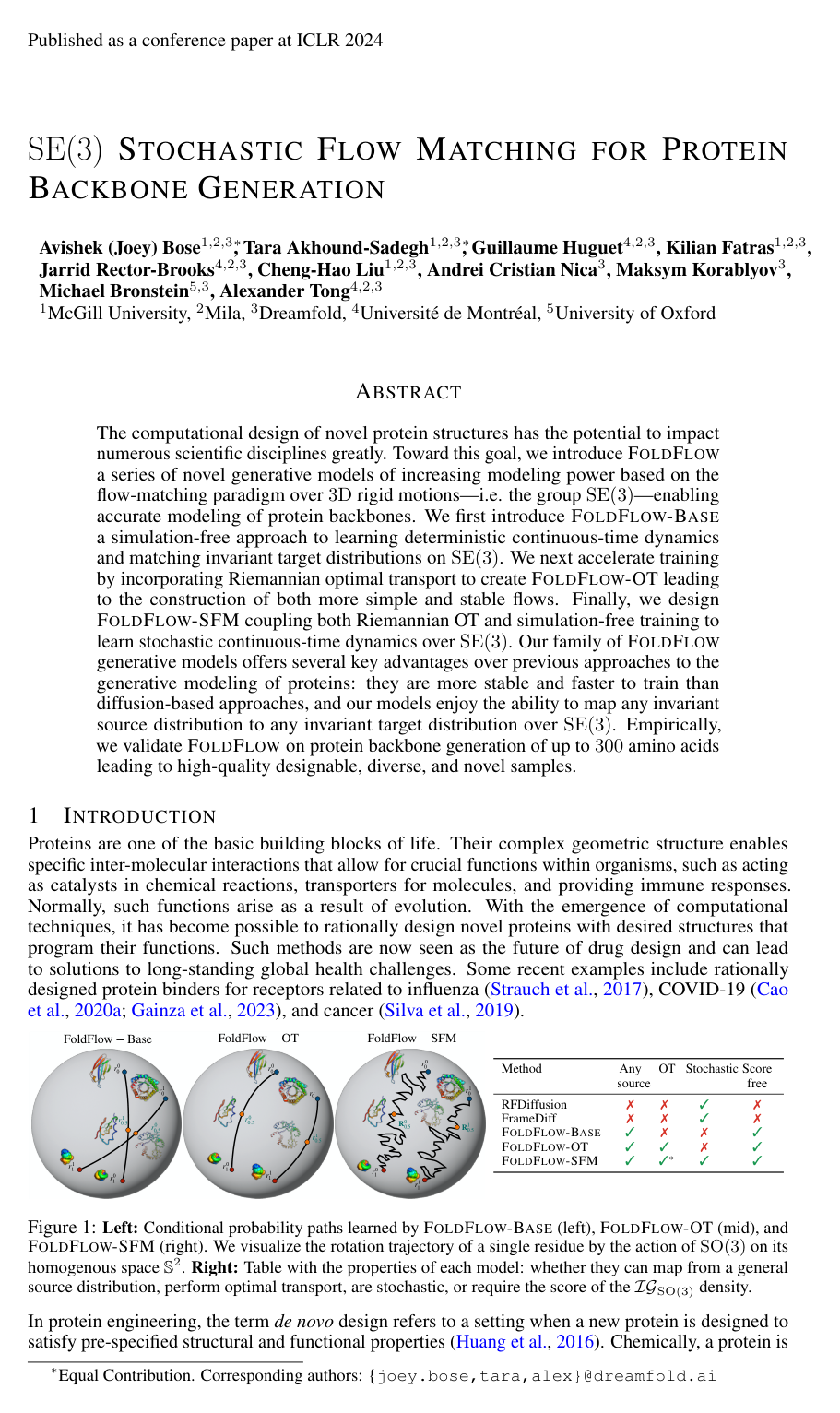
SE(3)-Stochastic Flow Matching for Protein Backbone Generation
Avishek Joey Bose, Tara Akhound-Sadegh, Guillaume Huguet, Kilian Fatras, Jarrid Rector-Brooks, Cheng-Hao Liu, Andrei Cristian Nica, Maksym Korablyov, Michael M. Bronstein, Alexander Tong
Why you should read this
Introduces FoldFlow, a generative framework combining SE(3) flow matching and Riemannian optimal transport to produce designable, diverse protein backbones with faster training and greater stability than diffusion models.
The computational design of novel protein structures has the potential to impact numerous scientific disciplines greatly. Toward this goal, we introduce FoldFlow, a series of novel generative models of increasing modeling power based on the flow-matching paradigm over rigid motions -- i.e. the group -- enabling accurate modeling of protein backbones. We first introduce FoldFlow-Base, a simulation-free approach to learning deterministic continuous-time dynamics and matching invariant target distributions on . We next accelerate training by incorporating Riemannian optimal transport to create FoldFlow-OT, leading to the construction of both more simple and stable flows. Finally, we design FoldFlow-SFM, coupling both Riemannian OT and simulation-free training to learn stochastic continuous-time dynamics over . Our family of FoldFlow, generative models offers several key advantages over previous approaches to the generative modeling of proteins: they are more stable and faster to train than diffusion-based approaches, and our models enjoy the ability to map any invariant source distribution to any invariant target distribution over . Empirically, we validate FoldFlow, on protein backbone generation of up to amino acids leading to high-quality designable, diverse, and novel samples.
Added
2026-09-26