Built independently by an author, for readers. Read the story and support ChapterPal

keyword

minibatch couplings

Minibatch couplings are joint probability distributions formed over finite subsets, or minibatches, of samples drawn from two distinct probability distributions to establish structured pairings between them. In generative modeling and computational optimal transport, this approach replaces independent random sampling by computing an optimal or near-optimal transport plan locally within each training minibatch, often through algorithms such as linear assignment or entropy-regularized transport. By pairing source points, such as noise vectors, with target data points in a coordinated manner rather than independently, minibatch couplings produce straighter probability trajectories, reduce gradient variance during training, and approximate continuous optimal transport maps with minimal computational overhead.

1 item

Multisample Flow Matching: Straightening Flows with Minibatch Couplings

Multisample Flow Matching: Straightening Flows with Minibatch Couplings

Aram-Alexandre Pooladian, Heli Ben-Hamu, Carles Domingo-Enrich, Brandon Amos, Yaron Lipman, Ricky T. Q. Chen

OrganizationsMetaNew York UniversityWeizmann Institute of Science

Why you should read this

Proposes Multisample Flow Matching, a simulation-free training framework that couples minibatch data and noise distributions to straighten probability paths, reducing gradient variance during training and enabling faster generative sampling with fewer model evaluations.

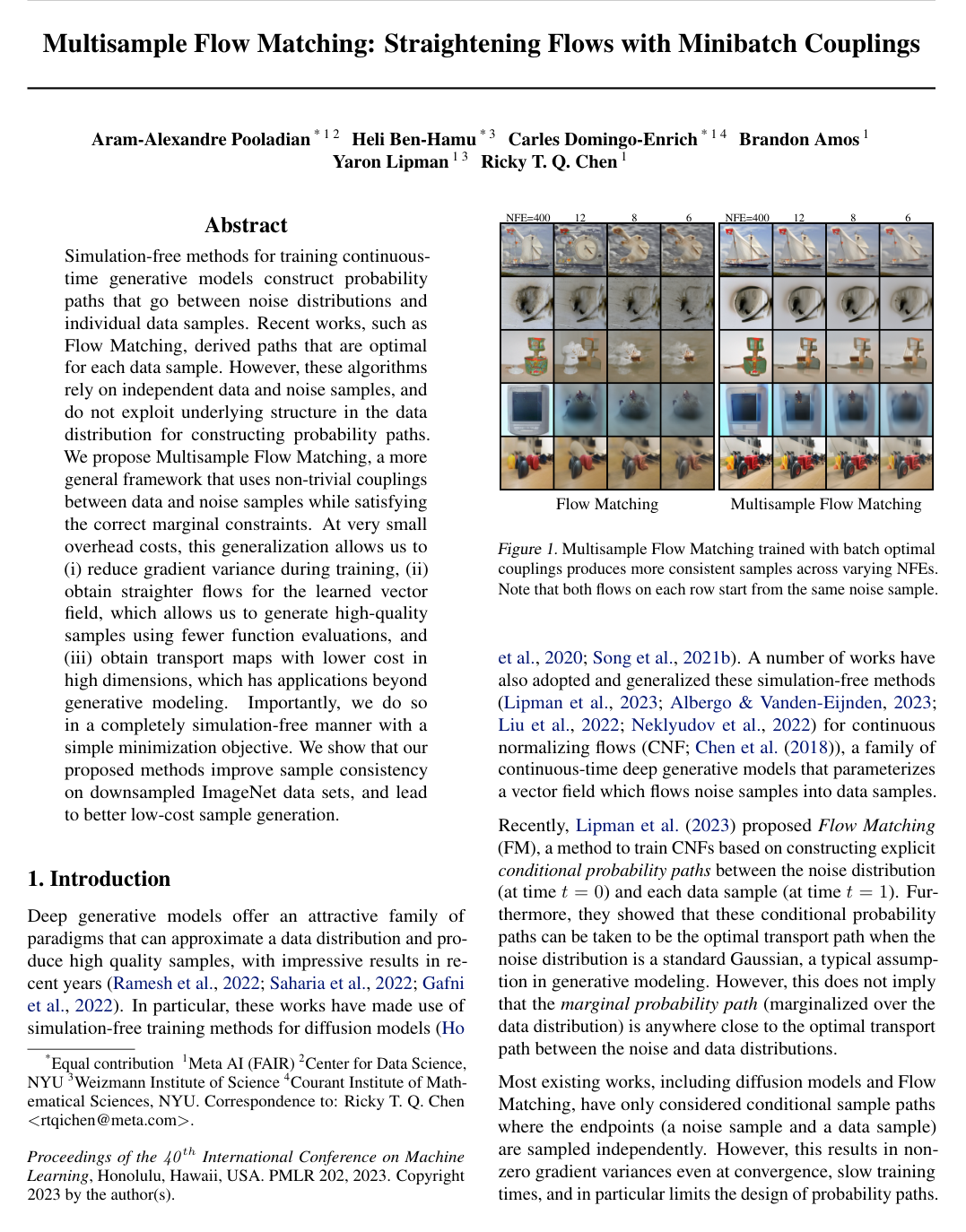
Simulation-free methods for training continuous-time generative models construct probability paths that go between noise distributions and individual data samples. Recent works, such as Flow Matching, derived paths that are optimal for each data sample. However, these algorithms rely on independent data and noise samples, and do not exploit underlying structure in the data distribution for constructing probability paths. We propose Multisample Flow Matching, a more general framework that uses non-trivial couplings between data and noise samples while satisfying the correct marginal constraints. At very small overhead costs, this generalization allows us to (i) reduce gradient variance during training, (ii) obtain straighter flows for the learned vector field, which allows us to generate high-quality samples using fewer function evaluations, and (iii) obtain transport maps with lower cost in high dimensions, which has applications beyond generative modeling. Importantly, we do so in a completely simulation-free manner with a simple minimization objective. We show that our proposed methods improve sample consistency on downsampled ImageNet data sets, and lead to better low-cost sample generation.

Added

2026-09-28