
keyword
surface reconstruction
Surface reconstruction is the computational process of recovering and generating a continuous three-dimensional surface representation of an object or environment from discrete, incomplete, or unorganized spatial measurements. These inputs typically include unorganized point clouds, range scans, depth maps, multi-view photographs, or volumetric imaging data acquired through sensors and optical devices. The process transforms raw, discrete measurements into coherent geometric models, such as polygonal triangle meshes, parametric surfaces, or continuous implicit representations like signed distance functions and occupancy fields. Methodologies span classical geometric meshing, volumetric fusion, and level-set extraction, as well as modern neural implicit and differentiable rendering frameworks that learn geometric fields directly from visual observations. Surface reconstruction is a fundamental task across computer vision, computer graphics, robotics, medical imaging, reverse engineering, and digital preservation.
21 items
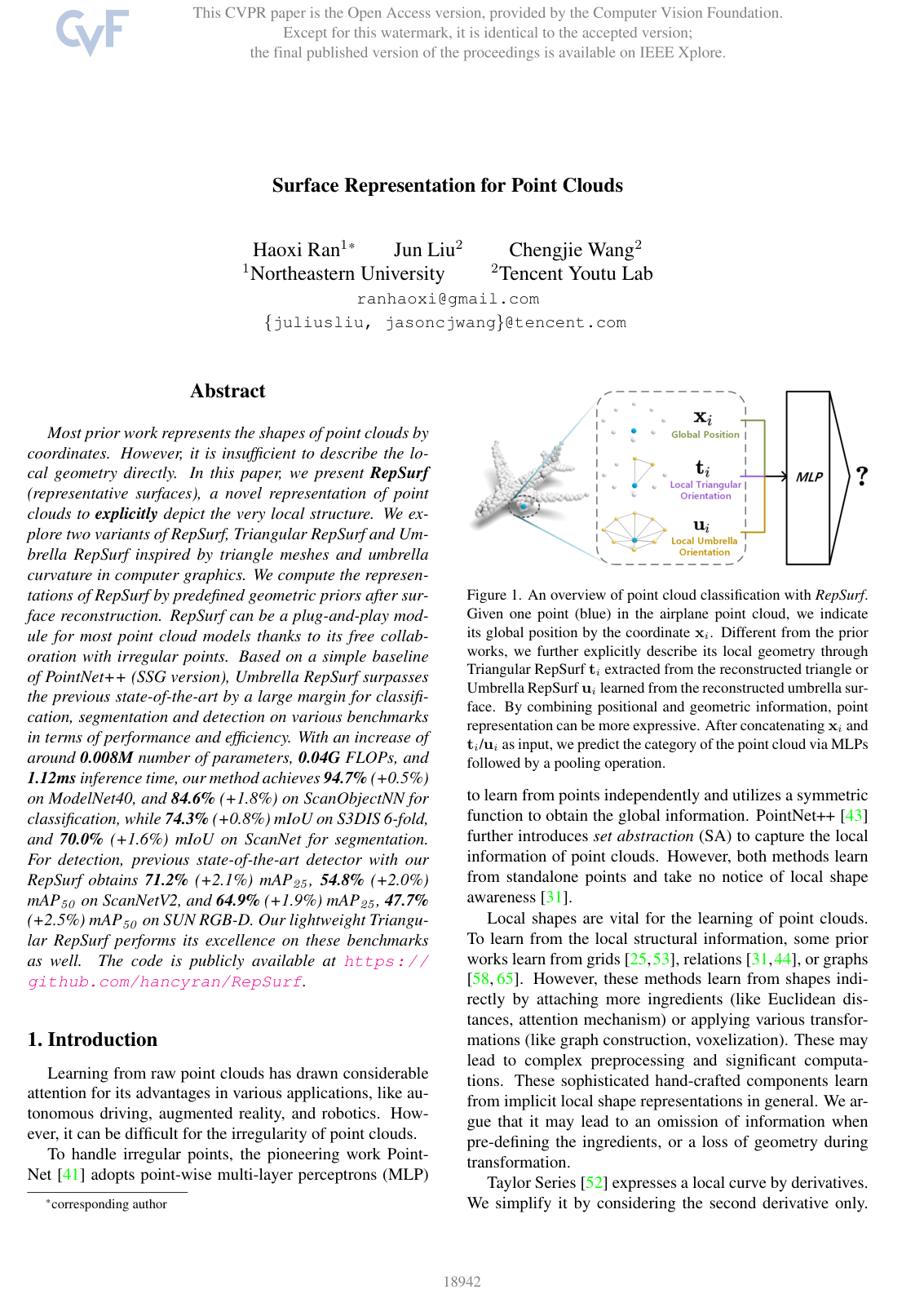
Surface Representation for Point Clouds
Haoxi Ran, Jun Liu, Chengjie Wang
Why you should read this
Proposes RepSurf, a lightweight, plug-and-play surface representation that explicitly models local geometry using graphics-inspired triangle and umbrella primitives to boost accuracy across 3D classification, segmentation, and detection tasks with negligible computational overhead.
Most prior work represents the shapes of point clouds by coordinates. However, it is insufficient to describe the local geometry directly. In this paper, we present RepSurf (representative surfaces), a novel representation of point clouds to explicitly depict the very local structure. We explore two variants of RepSurf, Triangular RepSurf and Umbrella RepSurf inspired by triangle meshes and umbrella curvature in computer graphics. We compute the representations of RepSurf by predefined geometric priors after surface reconstruction. RepSurf can be a plug-and-play module for most point cloud models thanks to its free collaboration with irregular points. Based on a simple baseline of PointNet++ (SSG version), Umbrella RepSurf surpasses the previous state-of-the-art by a large margin for classification, segmentation and detection on various benchmarks in terms of performance and efficiency. With an increase of around 0.008M number of parameters, 0.04G FLOPs, and 1.12ms inference time, our method achieves 94.7% (+0.5%) on ModelNet40, and 84.6% (+1.8%) on ScanObjectNN for classification, while 74.3% (+0.8%) mIoU on S3DIS 6-fold, and 70.0% (+1.6%) mIoU on ScanNet for segmentation. For detection, previous state-of-the-art detector with our RepSurf obtains 71.2% (+2.1%) mAP25, 54.8% (+2.0%) mAP50 on ScanNetV2, and 64.9% (+1.9%) mAP25, 47.7% (+2.5%) mAP50 on SUN RGB-D. Our lightweight Triangular RepSurf performs its excellence on these benchmarks as well. The code is publicly available at https://github.com/hancyran/RepSurf.
Added
2026-10-05
One-2-3-45: Any Single Image to 3D Mesh in 45 Seconds without Per-Shape Optimization
Minghua Liu, Chao Xu, Haian Jin, Linghao Chen, Mukund Varma T., Zexiang Xu, Hao Su
Why you should read this
Develops a feed-forward approach that reconstructs consistent 360-degree textured 3D meshes from a single image in 45 seconds, bypassing costly per-shape optimization by integrating view-conditioned 2D diffusion with generalizable neural surface reconstruction.
Single image 3D reconstruction is an important but challenging task that requires extensive knowledge of our natural world. Many existing methods solve this problem by optimizing a neural radiance field under the guidance of 2D diffusion models but suffer from lengthy optimization time, 3D inconsistency results, and poor geometry. In this work, we propose a novel method that takes a single image of any object as input and generates a full 360-degree 3D textured mesh in a single feed-forward pass. Given a single image, we first use a view-conditioned 2D diffusion model, Zero123, to generate multi-view images for the input view, and then aim to lift them up to 3D space. Since traditional reconstruction methods struggle with inconsistent multi-view predictions, we build our 3D reconstruction module upon an SDF-based generalizable neural surface reconstruction method and propose several critical training strategies to enable the reconstruction of 360-degree meshes. Without costly optimizations, our method reconstructs 3D shapes in significantly less time than existing methods. Moreover, our method favors better geometry, generates more 3D consistent results, and adheres more closely to the input image. We evaluate our approach on both synthetic data and in-the-wild images and demonstrate its superiority in terms of both mesh quality and runtime. In addition, our approach can seamlessly support the text-to-3D task by integrating with off-the-shelf text-to-image diffusion models.
Added
2026-10-05
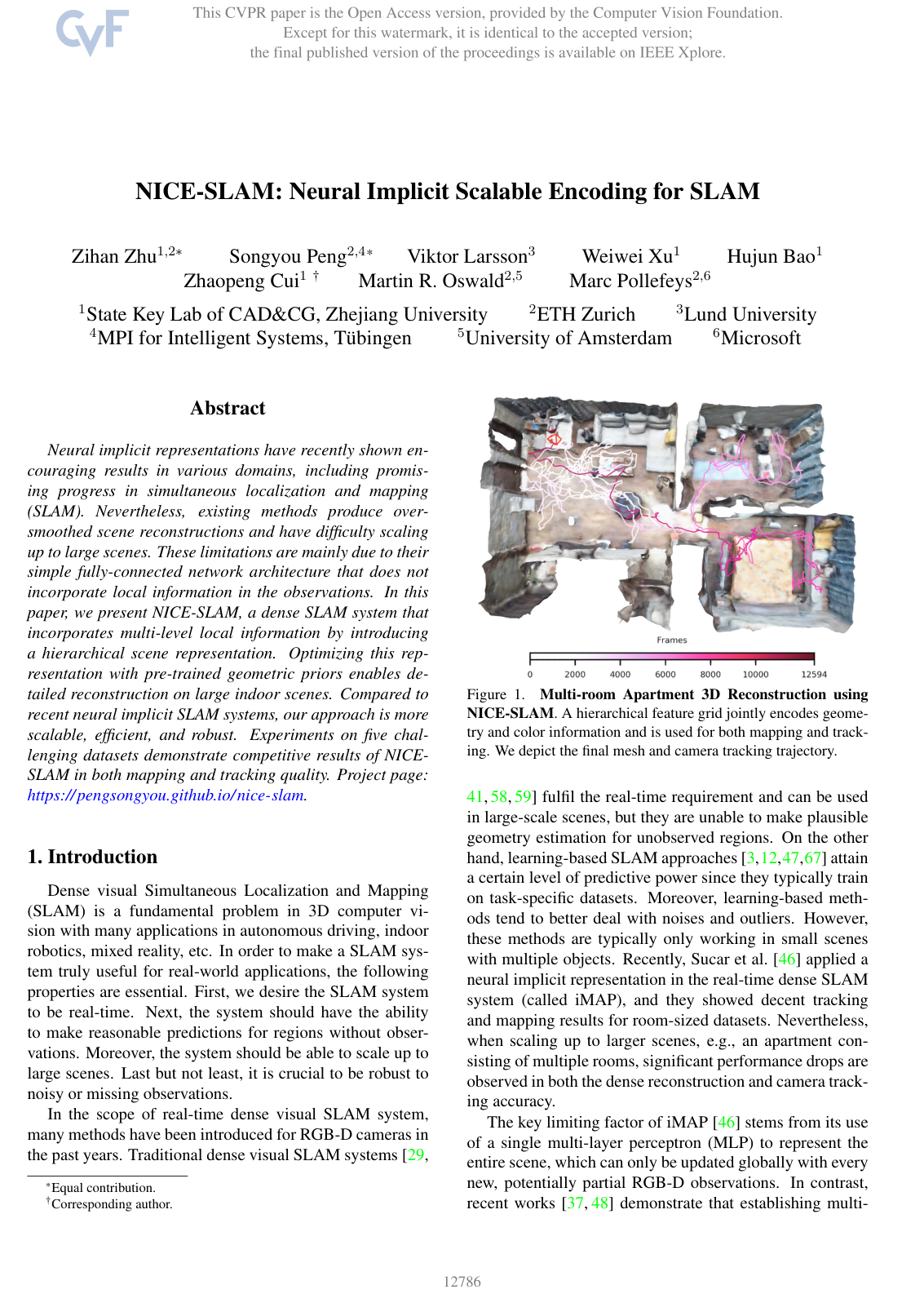
NICE-SLAM: Neural Implicit Scalable Encoding for SLAM
Zihan Zhu, Songyou Peng, Viktor Larsson, Weiwei Xu, Hujun Bao, Zhaopeng Cui, Martin R. Oswald, Marc Pollefeys
Why you should read this
Introduces a real-time dense visual SLAM system that combines hierarchical grid encodings with pretrained neural implicit decoders to achieve scalable, highly detailed 3D mapping and accurate camera tracking across large indoor environments.
Neural implicit representations have recently shown encouraging results in various domains, including promising progress in simultaneous localization and mapping (SLAM). Nevertheless, existing methods produce over-smoothed scene reconstructions and have difficulty scaling up to large scenes. These limitations are mainly due to their simple fully-connected network architecture that does not incorporate local information in the observations. In this paper, we present NICE-SLAM, a dense SLAM system that incorporates multi-level local information by introducing a hierarchical scene representation. Optimizing this representation with pre-trained geometric priors enables detailed reconstruction on large indoor scenes. Compared to recent neural implicit SLAM systems, our approach is more scalable, efficient, and robust. Experiments on five challenging datasets demonstrate competitive results of NICE-SLAM in both mapping and tracking quality. Project page: https://pengsongyou.github.io/nice-slam.
Added
2026-10-04
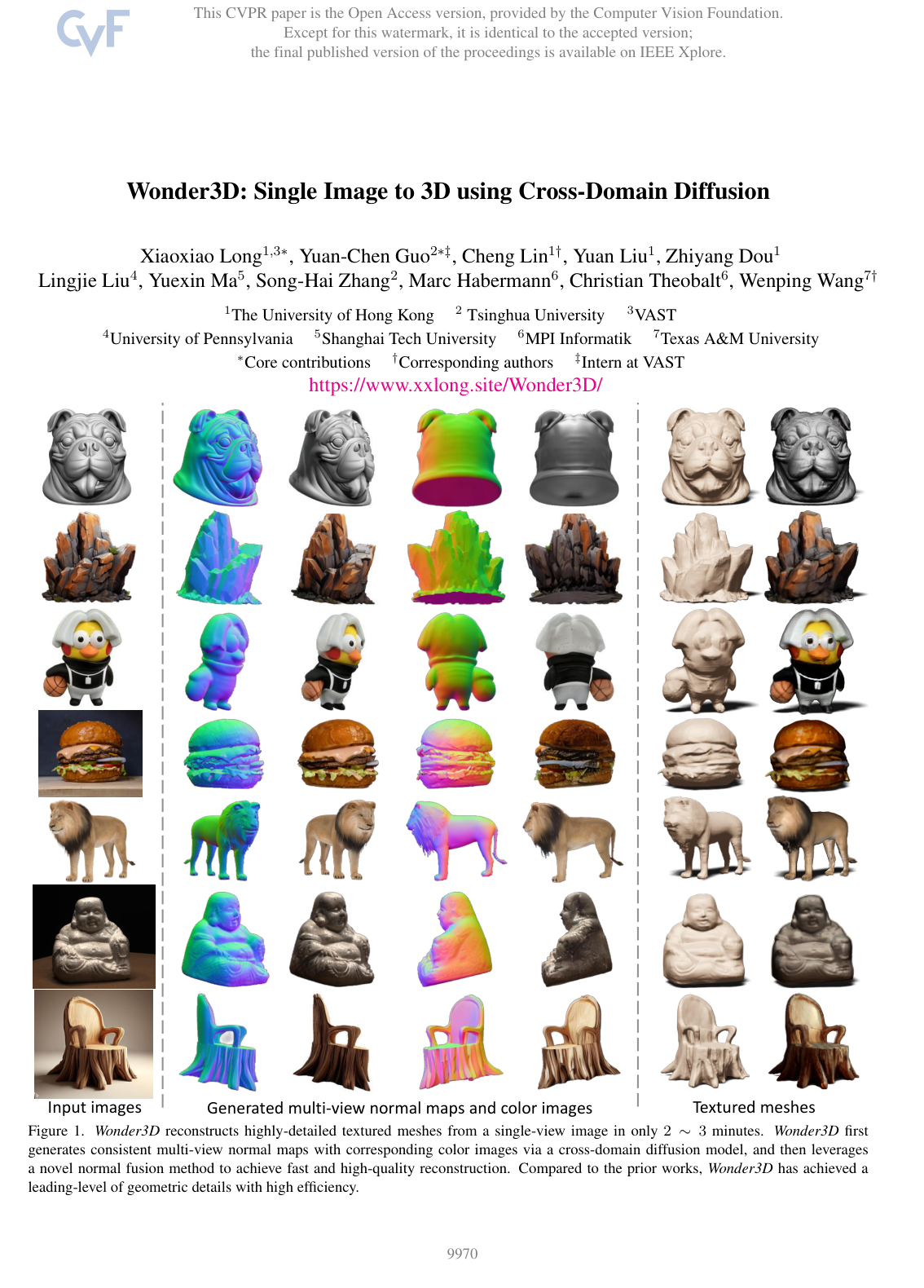
Wonder3D: Single Image to 3D Using Cross-Domain Diffusion
Xiaoxiao Long, Yuan-Chen Guo, Cheng Lin, Yuan Liu, Zhiyang Dou, Lingjie Liu, Yuexin Ma, Song-Hai Zhang, Marc Habermann, Christian Theobalt, Wenping Wang
Why you should read this
Proposes a cross-domain diffusion framework that jointly generates consistent multi-view normal maps and color images to extract detailed, high-fidelity 3D meshes from a single image in just two to three minutes.
In this work, we introduce Wonder3D, a novel method for efficiently generating high-fidelity textured meshes from single-view images. Recent methods based on Score Distillation Sampling (SDS) have shown the potential to recover 3D geometry from 2D diffusion priors, but they typically suffer from time-consuming per-shape optimization and inconsistent geometry. In contrast, certain works directly produce 3D information via fast network inferences, but their results are often of low quality and lack geometric details. To holistically improve the quality, consistency, and efficiency of single-view reconstruction tasks, we propose a cross-domain diffusion model that generates multi-view normal maps and the corresponding color images. To ensure the consistency of generation, we employ a multi-view cross-domain attention mechanism that facilitates information exchange across views and modalities. Lastly, we introduce a geometry-aware normal fusion algorithm that extracts high-quality surfaces from the multi-view 2D representations in only 2 ∼ 3 minutes. Our extensive evaluations demonstrate that our method achieves high-quality reconstruction results, robust generalization, and good efficiency compared to prior works.
Added
2026-09-26
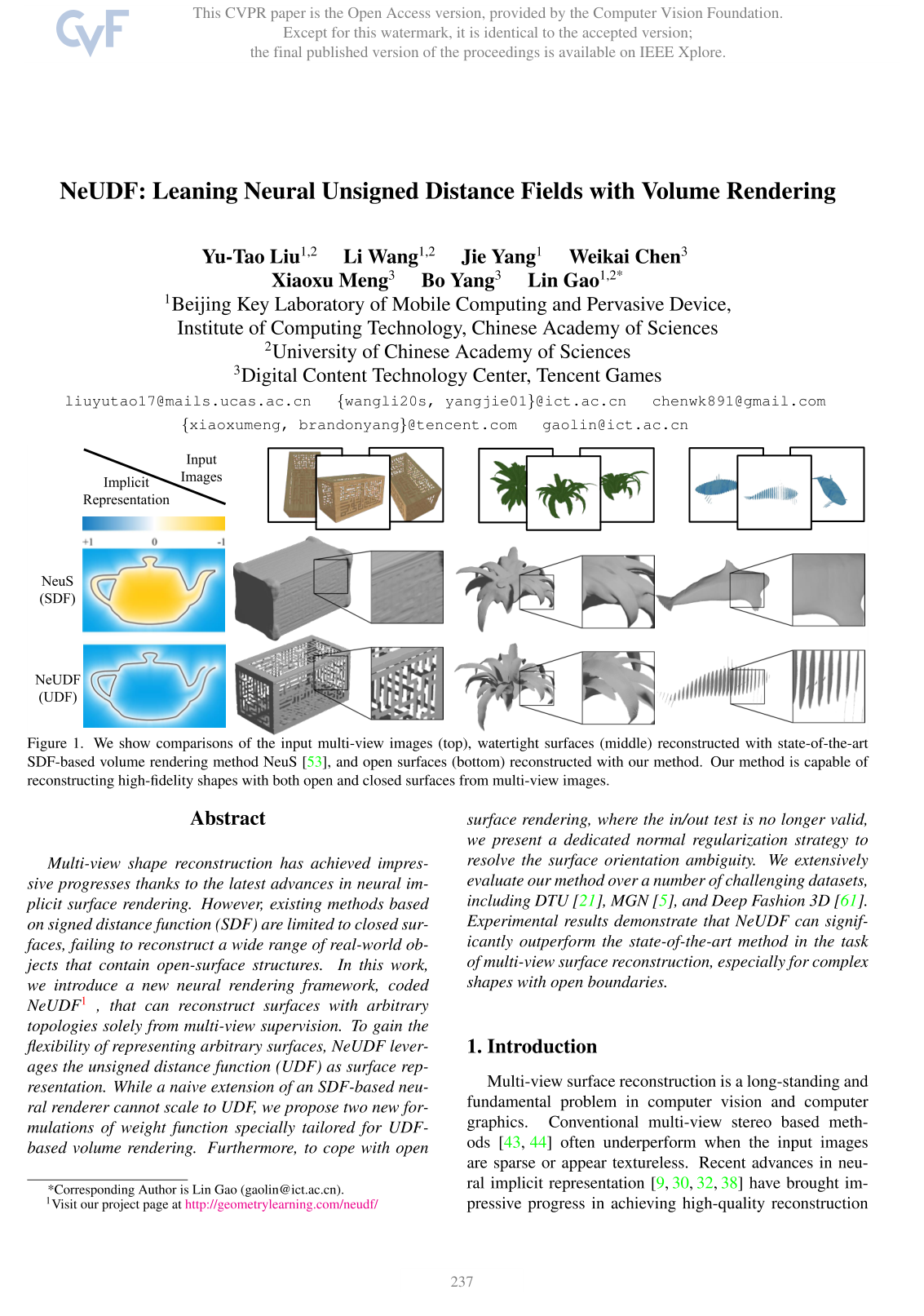
NeUDF: Leaning Neural Unsigned Distance Fields with Volume Rendering
Yu-Tao Liu, Li Wang, Jie Yang, Weikai Chen, Xiaoxu Meng, Bo Yang, Lin Gao
Why you should read this
Proposes an unbiased volume rendering framework tailored for unsigned distance fields, enabling high-fidelity 3D reconstruction of open and non-watertight surfaces solely from multi-view 2D images.
Multi-view shape reconstruction has achieved impressive progresses thanks to the latest advances in neural implicit surface rendering. However, existing methods based on signed distance function (SDF) are limited to closed surfaces, failing to reconstruct a wide range of real-world objects that contain open-surface structures. In this work, we introduce a new neural rendering framework, coded NeUDF , that can reconstruct surfaces with arbitrary topologies solely from multi-view supervision. To gain the flexibility of representing arbitrary surfaces, NeUDF leverages the unsigned distance function (UDF) as surface representation. While a naive extension of an SDF-based neural renderer cannot scale to UDF, we propose two new formulations of weight function specially tailored for UDF-based volume rendering. Furthermore, to cope with open surface rendering, where the in/out test is no longer valid, we present a dedicated normal regularization strategy to resolve the surface orientation ambiguity. We extensively evaluate our method over a number of challenging datasets, including DTU [21], MGN [5], and Deep Fashion 3D [61]. Experimental results demonstrate that NeUDF can significantly outperform the state-of-the-art method in the task of multi-view surface reconstruction, especially for complex shapes with open boundaries.
Added
2026-09-26
HF-NeuS: Improved Surface Reconstruction Using High-Frequency Details
Yiqun Wang, Ivan Skorokhodov, Peter Wonka
Why you should read this
Presents a neural surface reconstruction framework that recovers fine geometric details without 3D supervision by decomposing signed distance functions into base and displacement fields and applying spatially adaptive optimization.
Neural rendering can be used to reconstruct implicit representations of shapes without 3D supervision. However, current neural surface reconstruction methods have difficulty learning high-frequency geometry details, so the reconstructed shapes are often over-smoothed. We develop HF-NeuS, a novel method to improve the quality of surface reconstruction in neural rendering. We follow recent work to model surfaces as signed distance functions (SDFs). First, we offer a derivation to analyze the relationship between the SDF, the volume density, the transparency function, and the weighting function used in the volume rendering equation and propose to model transparency as a transformed SDF. Second, we observe that attempting to jointly encode high-frequency and low-frequency components in a single SDF leads to unstable optimization. We propose to decompose the SDF into base and displacement functions with a coarse-to-fine strategy to increase the high-frequency details gradually. Finally, we design an adaptive optimization strategy that makes the training process focus on improving those regions near the surface where the SDFs have artifacts. Our qualitative and quantitative results show that our method can reconstruct fine-grained surface details and obtain better surface reconstruction quality than the current state of the art. Code available at https://github.com/yiqun-wang/HFS.
Added
2026-09-26
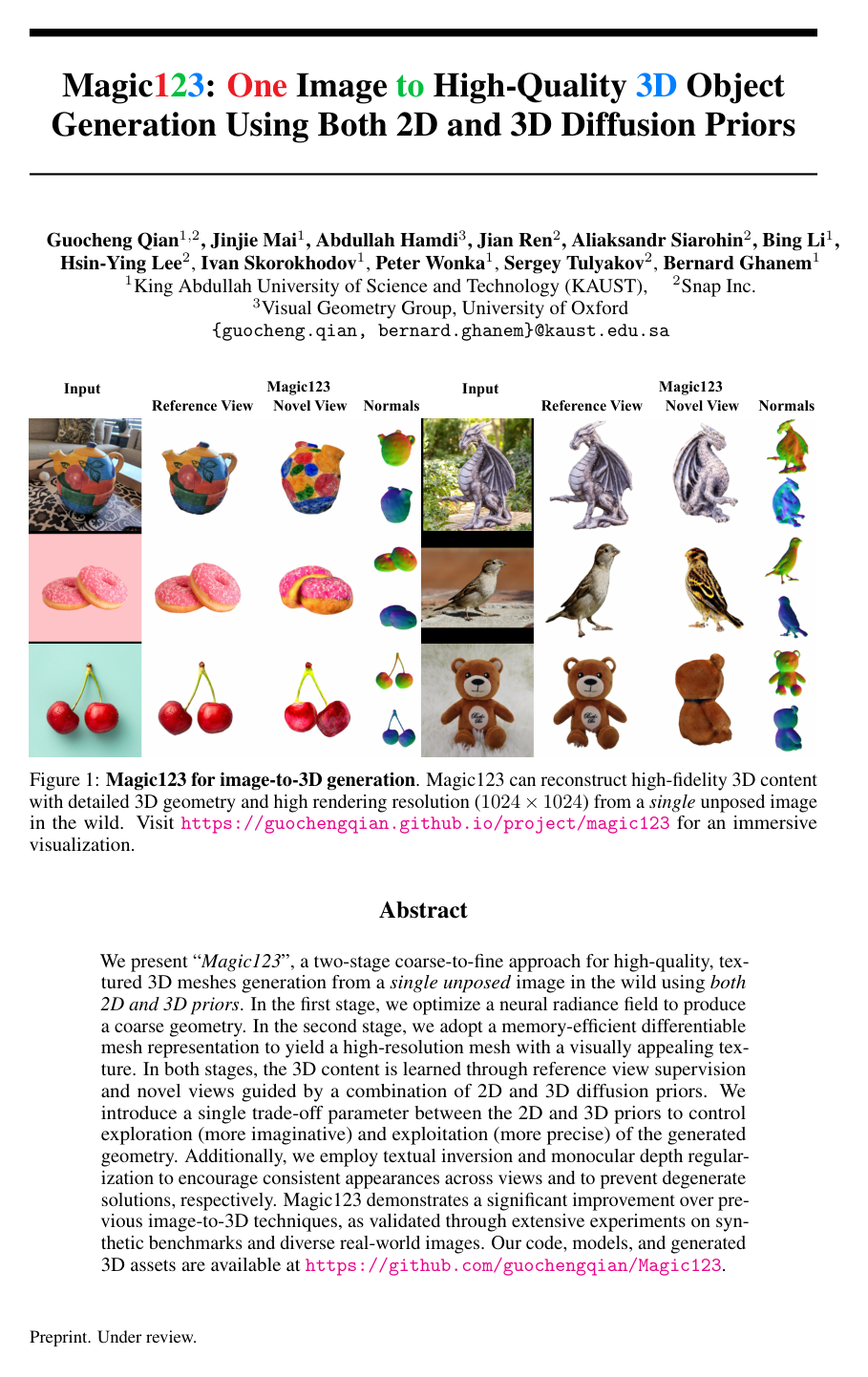
Magic123: One Image to High-Quality 3D Object Generation Using Both 2D and 3D Diffusion Priors
Guocheng Qian, Jinjie Mai, Abdullah Hamdi, Jian Ren, Aliaksandr Siarohin, Bing Li, Hsin-Ying Lee, Ivan Skorokhodov, Peter Wonka, Sergey Tulyakov, Bernard Ghanem
Why you should read this
Introduces Magic123, a coarse-to-fine framework that combines 2D and 3D diffusion priors to generate high-quality, textured 3D meshes from a single unposed image with controllable trade-offs between geometric precision and novel-view imagination.
We present Magic123, a two-stage coarse-to-fine approach for high-quality, textured 3D meshes generation from a single unposed image in the wild using both2D and 3D priors. In the first stage, we optimize a neural radiance field to produce a coarse geometry. In the second stage, we adopt a memory-efficient differentiable mesh representation to yield a high-resolution mesh with a visually appealing texture. In both stages, the 3D content is learned through reference view supervision and novel views guided by a combination of 2D and 3D diffusion priors. We introduce a single trade-off parameter between the 2D and 3D priors to control exploration (more imaginative) and exploitation (more precise) of the generated geometry. Additionally, we employ textual inversion and monocular depth regularization to encourage consistent appearances across views and to prevent degenerate solutions, respectively. Magic123 demonstrates a significant improvement over previous image-to-3D techniques, as validated through extensive experiments on synthetic benchmarks and diverse real-world images. Our code, models, and generated 3D assets are available at this https URL.
Added
2026-09-26
Surface Reconstruction from Point Clouds by Learning Predictive Context Priors
Baorui Ma, Yu-Shen Liu, Matthias Zwicker, Zhizhong Han
Why you should read this
Presents a surface reconstruction framework that learns test-time predictive query displacements to flexibly query pre-trained local signed distance functions, achieving accurate 3D geometry without requiring ground truth normals or distances.
Surface reconstruction from point clouds is vital for 3D computer vision. State-of-the-art methods leverage large datasets to first learn local context priors that are represented as neural network-based signed distance functions (SDFs) with some parameters encoding the local contexts. To reconstruct a surface at a specific query location at inference time, these methods then match the local reconstruction target by searching for the best match in the local prior space (by optimizing the parameters encoding the local context) at the given query location. However, this requires the local context prior to generalize to a wide variety of unseen target regions, which is hard to achieve. To resolve this issue, we introduce Predictive Context Priors by learning Predictive Queries for each specific point cloud at inference time. Specifically, we first train a local context prior using a large point cloud dataset similar to previous techniques. For surface reconstruction at inference time, however, we specialize the local context prior into our Predictive Context Prior by learning Predictive Queries, which predict adjusted spatial query locations as displacements of the original locations. This leads to a global SDF that fits the specific point cloud the best. Intuitively, the query prediction enables us to flexibly search the learned local context prior over the entire prior space, rather than being restricted to the fixed query locations, and this improves the generalizability. Our method does not require ground truth signed distances, normals, or any additional procedure of signed distance fusion across overlapping regions. Our experimental results in surface reconstruction for single shapes or complex scenes show significant improvements over the state-of-the-art under widely used benchmarks. Code and data are available at https://github.com/mabaorui/PredictableContextPrior.
Added
2026-09-26
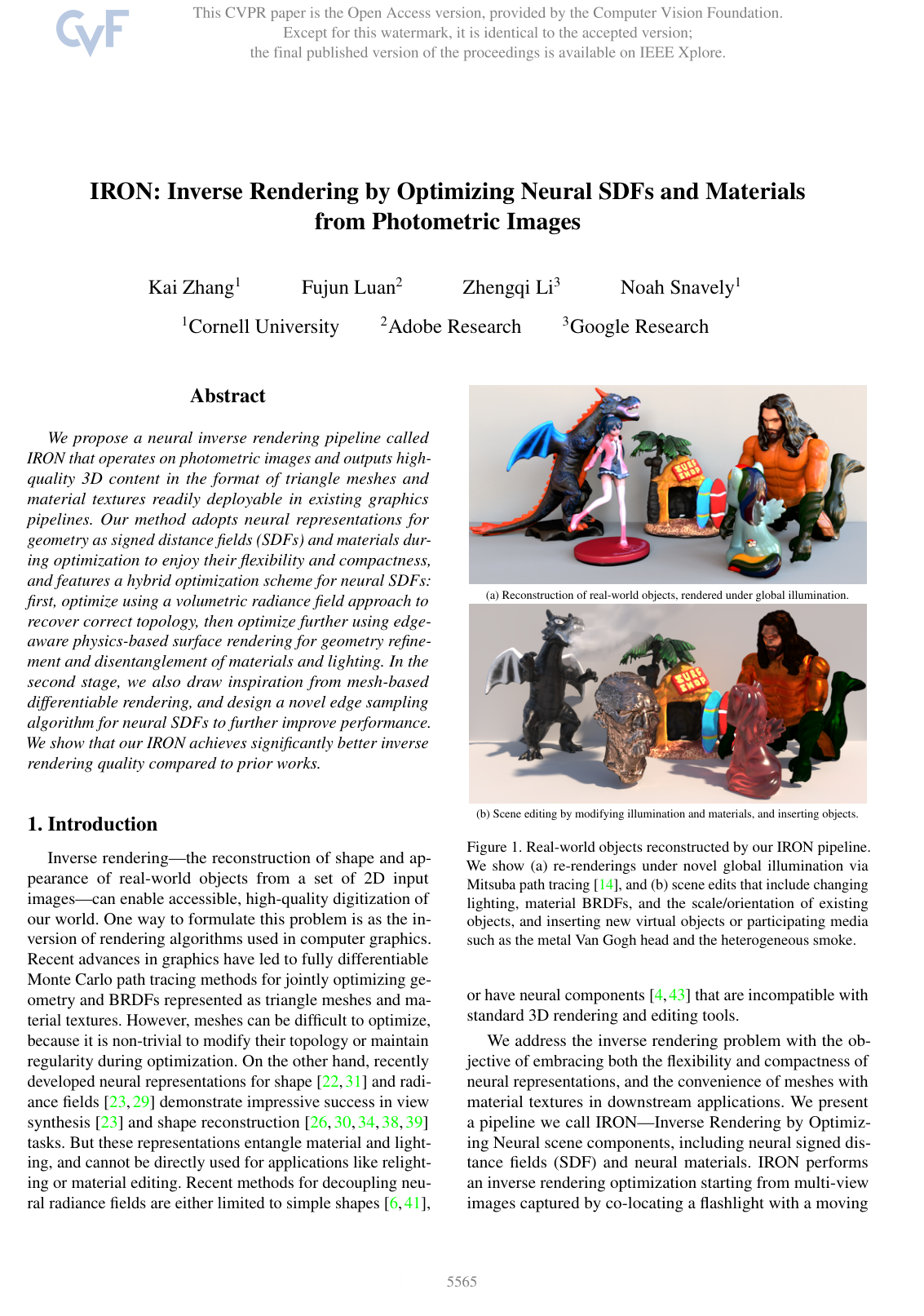
IRON: Inverse Rendering by Optimizing Neural SDFs and Materials from Photometric Images
Kai Zhang, Fujun Luan, Zhengqi Li, Noah Snavely
Why you should read this
Proposes a hybrid inverse rendering framework that couples volumetric neural signed distance fields with edge-aware physics-based surface rendering to reconstruct high-fidelity textured meshes directly compatible with standard graphics engines.
We propose a neural inverse rendering pipeline called IRON that operates on photometric images and outputs high-quality 3D content in the format of triangle meshes and material textures readily deployable in existing graphics pipelines. Our method adopts neural representations for geometry as signed distance fields (SDFs) and materials during optimization to enjoy their flexibility and compactness, and features a hybrid optimization scheme for neural SDFs: first, optimize using a volumetric radiance field approach to recover correct topology, then optimize further using edge-aware physics-based surface rendering for geometry refinement and disentanglement of materials and lighting. In the second stage, we also draw inspiration from mesh-based differentiable rendering, and design a novel edge sampling algorithm for neural SDFs to further improve performance. We show that our IRON achieves significantly better inverse rendering quality compared to prior works.
Added
2026-09-26
Volume Rendering of Neural Implicit Surfaces
Lior Yariv, Jiatao Gu, Yoni Kasten, Yaron Lipman
Why you should read this
Proposes a neural volume rendering approach that derives volume density directly from a signed distance function, enabling high-fidelity 3D surface reconstruction and unsupervised disentanglement of shape and appearance from multiview images.
Neural volume rendering became increasingly popular recently due to its success in synthesizing novel views of a scene from a sparse set of input images. So far, the geometry learned by neural volume rendering techniques was modeled using a generic density function. Furthermore, the geometry itself was extracted using an arbitrary level set of the density function leading to a noisy, often low fidelity reconstruction. The goal of this paper is to improve geometry representation and reconstruction in neural volume rendering. We achieve that by modeling the volume density as a function of the geometry. This is in contrast to previous work modeling the geometry as a function of the volume density. In more detail, we define the volume density function as Laplace's cumulative distribution function (CDF) applied to a signed distance function (SDF) representation. This simple density representation has three benefits: (i) it provides a useful inductive bias to the geometry learned in the neural volume rendering process; (ii) it facilitates a bound on the opacity approximation error, leading to an accurate sampling of the viewing ray. Accurate sampling is important to provide a precise coupling of geometry and radiance; and (iii) it allows efficient unsupervised disentanglement of shape and appearance in volume rendering. Applying this new density representation to challenging scene multiview datasets produced high quality geometry reconstructions, outperforming relevant baselines. Furthermore, switching shape and appearance between scenes is possible due to the disentanglement of the two.
Added
2026-09-25
Mesh optimization
Hugues Hoppe, T. DeRose, T. Duchamp, J. McDonald, W. Stuetzle
Why you should read this
Develops an energy-minimization framework that jointly optimizes mesh connectivity and vertex positions to accurately fit 3D point sets while reducing geometric complexity, recovering sharp features for both surface reconstruction and mesh simplification.
We present a method for solving the following problem: Given a set of data points scattered in three dimensions and an initial triangular mesh M0, produce a mesh M, of the same topological type as M0, that fits the data well and has a small number of vertices. Our approach is to minimize an energy function that explicitly models the competing desires of conciseness of representation and fidelity to the data. We show that mesh optimization can be effectively used in at least two applications: surface reconstruction from unorganized points, and mesh simplification (the reduction of the number of vertices in an initially dense mesh of triangles).
Added
2026-09-24
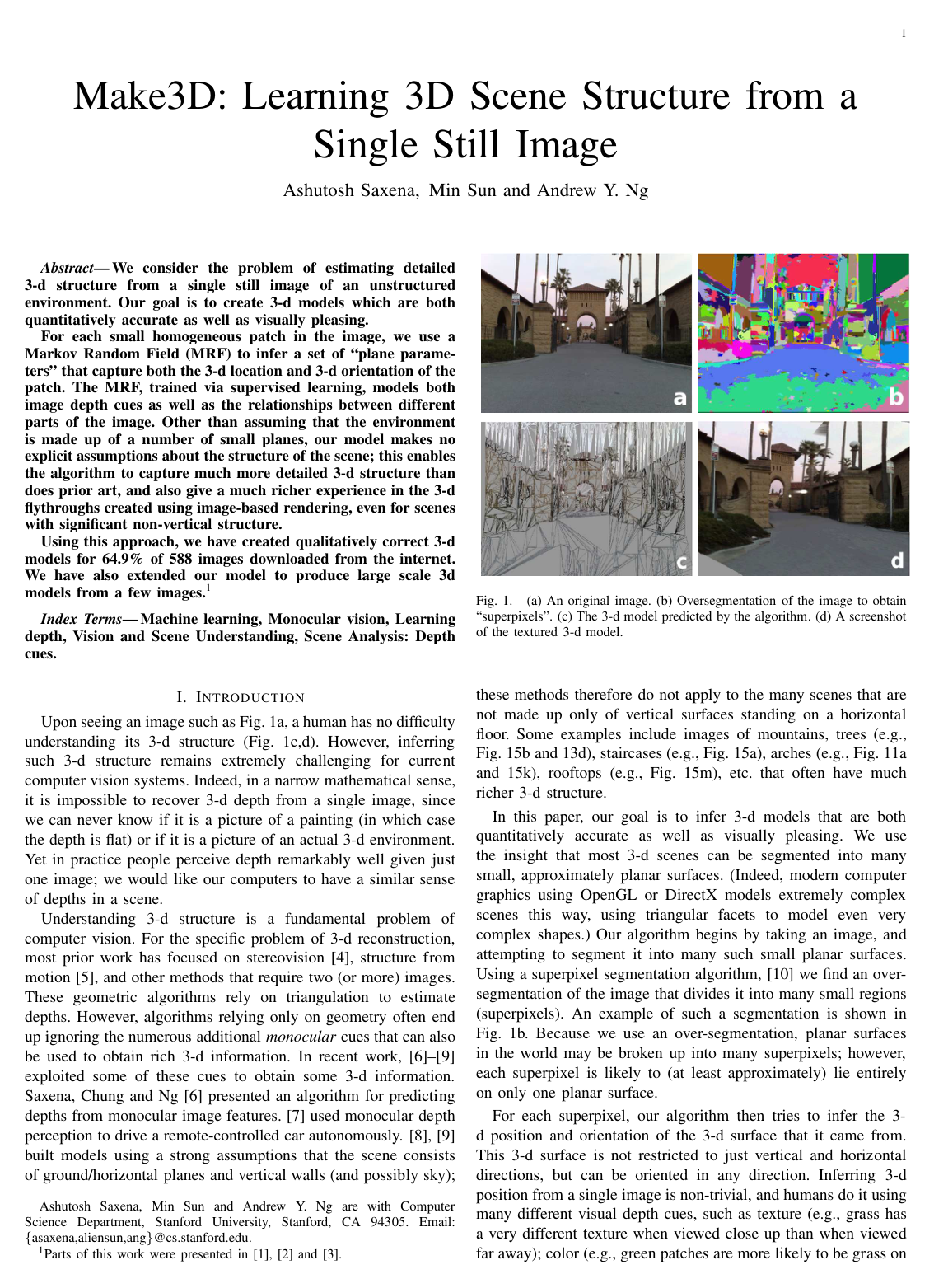
Make3D: Learning 3D Scene Structure from a Single Still Image
Ashutosh Saxena, Min Sun, A. Ng
Why you should read this
Presents a supervised learning framework using Markov Random Fields over superpixel plane parameters to reconstruct accurate and visually compelling 3D scene models directly from single still images.
Abstract—We consider the problem of estimating detailed 3-d structure from a single still image of an unstructured environment. Our goal is to create 3-d models which are both quantitatively accurate as well as visually pleasing. For each small homogenous patch in the image, we use a Markov Random Field (MRF) to infer a set of "plane parameters" that capture both the 3-d location and 3-d orientation of the patch. The MRF, trained via supervised learning, models both image depth cues as well as the relationships between different parts of the image. Other than assuming that the environment is made up of a number of small planes, our model makes no explicit assumptions about the structure of the scene; this enables the algorithm to capture much more detailed 3-d structure than does prior art, and also give a much richer experience in the 3-d flythroughs created using image-based rendering, even for scenes with significant non-vertical structure. Using this approach, we have created qualitatively correct 3-d models for 64.9% of 588 images downloaded from the internet. We have also extended our model to produce large scale 3d models from a few images.¹
Added
2026-09-24
Zippered polygon meshes from range images
Greg Turk, M. Levoy
Why you should read this
Presents an incremental pipeline that aligns, zippers, and averages multiple overlapping range scans to reconstruct complete, topologically consistent 3D polygonal meshes of complex objects with minimal memory overhead.
Range imaging offers an inexpensive and accurate means for digitizing the shape of three-dimensional objects. Because most objects self occlude, no single range image suffices to describe the entire object. We present a method for combining a collection of range images into a single polygonal mesh that completely describes an object to the extent that it is visible from the outside. The steps in our method are: 1) align the meshes with each other using a modified iterated closest-point algorithm, 2) zipper together adjacent meshes to form a continuous surface that correctly captures the topology of the object, and 3) compute local weighted averages of surface positions on all meshes to form a consensus surface geometry. Our system differs from previous approaches in that it is incremental; scans are acquired and combined one at a time. This approach allows us to acquire and combine large numbers of scans with minimal storage overhead. Our largest models contain up to 360,000 triangles. All the steps needed to digitize an object that requires up to 10 range scans can be performed using our system with five minutes of user interaction and a few hours of compute time. We show two models created using our method with range data from a commercial rangefinder that employs laser stripe technology.
Added
2026-09-24
MVSNet: Depth Inference for Unstructured Multi-view Stereo
Yao Yao, Zixin Luo, Shiwei Li, Tian Fang, Long Quan
Why you should read this
Proposes an end-to-end deep learning network that reconstructs dense 3D geometry from arbitrary multi-view images using differentiable homography warping and variance-based cost volumes, dramatically improving reconstruction speed and accuracy over traditional multi-view stereo methods.
We present an end-to-end deep learning architecture for depth map inference from multi-view images. In the network, we first extract deep visual image features, and then build the 3D cost volume upon the reference camera frustum via the differentiable homography warping. Next, we apply 3D convolutions to regularize and regress the initial depth map, which is then refined with the reference image to generate the final output. Our framework flexibly adapts arbitrary N-view inputs using a variance-based cost metric that maps multiple features into one cost feature. The proposed MVSNet is demonstrated on the large-scale indoor DTU dataset. With simple post-processing, our method not only significantly outperforms previous state-of-the-arts, but also is several times faster in runtime. We also evaluate MVSNet on the complex outdoor Tanks and Temples dataset, where our method ranks first before April 18, 2018 without any fine-tuning, showing the strong generalization ability of MVSNet.
Added
2026-09-24
Accurate, Dense, and Robust Multiview Stereopsis
Yasutaka Furukawa, Jean Ponce
Why you should read this
Presents a patch-based multiview stereo algorithm (PMVS) that reconstructs highly accurate, dense 3D surface meshes from calibrated images without requiring bounding volume initializations or artificial smoothing.
This paper proposes a novel algorithm for calibrated multi-view stereopsis that outputs a (quasi) dense set of rectangular patches covering the surfaces visible in the input images. This algorithm does not require any initialization in the form of a bounding volume, and it detects and discards automatically outliers and obstacles. It does not perform any smoothing across nearby features, yet is currently the top performer in terms of both coverage and accuracy for four of the six benchmark datasets presented in [20]. The keys to its performance are effective techniques for enforcing local photometric consistency and global visibility constraints. Stereopsis is implemented as a match, expand, and filter procedure, starting from a sparse set of matched keypoints, and repeatedly expanding these to nearby pixel correspondences before using visibility constraints to filter away false matches. A simple but effective method for turning the resulting patch model into a mesh appropriate for image-based modeling is also presented. The proposed approach is demonstrated on various datasets including objects with fine surface details, deep concavities, and thin structures, outdoor scenes observed from a restricted set of viewpoints, and “crowded” scenes where moving obstacles appear in different places in multiple images of a static structure of interest.
Source
https://vigir.missouri.edu/~gdesouza/Research/Conference_CDs/IEEE_CVPR_2007/data/papers/0278.pdfAdded
2026-09-24
A Comparison and Evaluation of Multi-View Stereo Reconstruction Algorithms
S. Seitz, B. Curless, J. Diebel, D. Scharstein, R. Szeliski
Why you should read this
Establishes a standardized benchmark and evaluation methodology for multi-view stereo reconstruction by providing calibrated image datasets with high-precision laser-scanned ground truth alongside a comprehensive algorithmic taxonomy.
This paper presents a quantitative comparison of several multi-view stereo reconstruction algorithms. Until now, the lack of suitable calibrated multi-view image datasets with known ground truth (3D shape models) has prevented such direct comparisons. In this paper, we first survey multi-view stereo algorithms and compare them qualitatively using a taxonomy that differentiates their key properties. We then describe our process for acquiring and calibrating multi-view image datasets with high-accuracy ground truth and introduce our evaluation methodology. Finally, we present the results of our quantitative comparison of state-of-the-art multi-view stereo reconstruction algorithms on six benchmark datasets. The datasets, evaluation details, and instructions for submitting new models are available online at http://vision.middlebury.edu/mview.
Added
2026-09-14
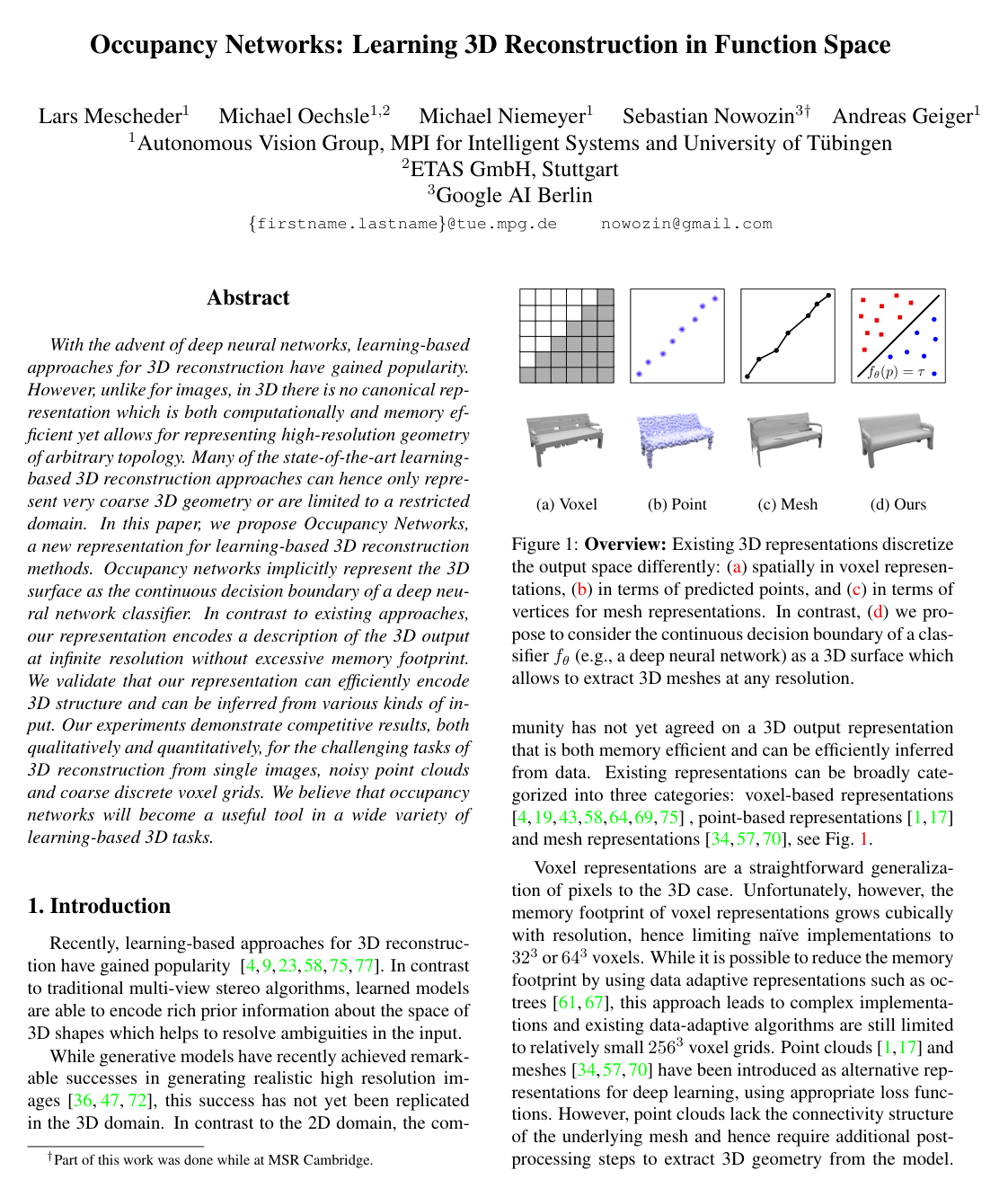
Occupancy Networks: Learning 3D Reconstruction in Function Space
Lars Mescheder, Michael Oechsle, Michael Niemeyer, Sebastian Nowozin, Andreas Geiger
Why you should read this
Proposes Occupancy Networks, a continuous implicit representation that models 3D surfaces as neural network decision boundaries, enabling memory-efficient 3D reconstruction of arbitrary topologies at infinite resolution from images, point clouds, or voxels.
With the advent of deep neural networks, learning-based approaches for 3D reconstruction have gained popularity. However, unlike for images, in 3D there is no canonical representation which is both computationally and memory efficient yet allows for representing high-resolution geometry of arbitrary topology. Many of the state-of-the-art learning-based 3D reconstruction approaches can hence only represent very coarse 3D geometry or are limited to a restricted domain. In this paper, we propose Occupancy Networks, a new representation for learning-based 3D reconstruction methods. Occupancy networks implicitly represent the 3D surface as the continuous decision boundary of a deep neural network classifier. In contrast to existing approaches, our representation encodes a description of the 3D output at infinite resolution without excessive memory footprint. We validate that our representation can efficiently encode 3D structure and can be inferred from various kinds of input. Our experiments demonstrate competitive results, both qualitatively and quantitatively, for the challenging tasks of 3D reconstruction from single images, noisy point clouds and coarse discrete voxel grids. We believe that occupancy networks will become a useful tool in a wide variety of learning-based 3D tasks.
Added
2026-09-11
Surface reconstruction from unorganized points
Hugues Hoppe, Tony DeRose, Tom Duchamp, John McDonald, Werner Stuetzle
Why you should read this
Presents a foundational method for reconstructing 3D surfaces of arbitrary topology and boundary configurations from unorganized point clouds by estimating a signed distance function through consistently oriented local tangent planes and extracting the resulting zero-set mesh.
We describe and demonstrate an algorithm that takes as input an unorganized set of points {x1, . . . , xn} ⊂ IR3 on or near an unknown manifold M, and produces as output a simplicial surface that approximates M. Neither the topology, the presence of boundaries, nor the geometry of M are assumed to be known in advance — all are inferred automatically from the data. This problem naturally arises in a variety of practical situations such as range scanning an object from multiple view points, recovery of biological shapes from two-dimensional slices, and interactive surface sketching.
Added
2026-09-11
Shape Modeling with Front Propagation: A Level Set Approach
R. Malladi, J. Sethian, B. Vemuri
Why you should read this
Develops a level set framework for shape recovery that naturally handles topological changes like splitting and merging to reconstruct complex, branching structures from noisy images without relying on close initialization.
Developing shape models is an important aspect of computer vision research. Geometric and differential properties of the surface can be computed from shape models. They also aid the tasks of object representation and recognition. In this paper we present an innovative new approach for shape modeling which, while retaining important features of the existing methods, overcomes most of their limitations. Our technique can be applied to model arbitrarily complex shapes, shapes with protrusions, and to situations where no a priori assumption about the object’s topology can be made. A single instance of our model, when presented with an image having more than one object of interest, has the ability to split freely to represent each object. Our method is based on the level set ideas developed by Osher & Sethian to follow propagating solid/liquid interfaces with curvature-dependent speeds. The interface (front) is a closed, nonintersecting, hypersurface flowing along its gradient field with constant speed or a speed that depends on the curvature. We move the interface by solving a “Hamilton-Jacobi” type equation written for a function in which the interface is a particular level set. A speed function synthesized from the image is used to stop the interface in the vicinity of the object boundaries. The resulting equations of motion are solved by numerical techniques borrowed from the technology of hyperbolic conservation laws. An added advantage of this scheme is that it can easily be extended to any number of space dimensions. The efficacy of the scheme is demonstrated with numerical experiments on synthesized images and noisy medical images.
Source
https://math.berkeley.edu/~sethian/2006/Papers/sethianmalladivemuritopologyindependent1993.pdfAdded
2026-09-11
A volumetric method for building complex models from range images
Brian Curless, Marc Levoy
Why you should read this
Introduces a foundational volumetric method that integrates multiple noisy range scans into a cumulative weighted signed distance function, using space carving to produce complete, watertight 3D surface models with least-squares optimality.
A number of techniques have been developed for reconstructing surfaces by integrating groups of aligned range images. A desirable set of properties for such algorithms includes: incremental updating, representation of directional uncertainty, the ability to fill gaps in the reconstruction, and robustness in the presence of outliers. Prior algorithms possess subsets of these properties. In this paper, we present a volumetric method for integrating range images that possesses all of these properties. Our volumetric representation consists of a cumulative weighted signed distance function. Working with one range image at a time, we first scan-convert it to a distance function, then combine this with the data already acquired using a simple additive scheme. To achieve space efficiency, we employ a run-length encoding of the volume. To achieve time efficiency, we resample the range image to align with the voxel grid and traverse the range and voxel scanlines synchronously. We generate the final manifold by extracting an isosurface from the volumetric grid. We show that under certain assumptions, this isosurface is optimal in the least squares sense. To fill gaps in the model, we tessellate over the boundaries between regions seen to be empty and regions never observed. Using this method, we are able to integrate a large number of range images (as many as 70) yielding seamless, high-detail models of up to 2.6 million triangles.
Added
2026-09-11