NeUDF: Leaning Neural Unsigned Distance Fields with Volume Rendering
Yu-Tao LiuLi WangJie YangWeikai ChenXiaoxu MengBo YangLin Gao
Proposes an unbiased volume rendering framework tailored for unsigned distance fields, enabling high-fidelity 3D reconstruction of open and non-watertight surfaces solely from multi-view 2D images.
Reconstructing high-fidelity three-dimensional shapes from multi-view photographs is a core capability for digital content creation, virtual environments, and physical asset modeling. While neural implicit rendering has recently advanced the field, standard techniques rely on representations such as signed distance functions, which assume objects are watertight solids with distinct internal and external spaces. Consequently, these systems fail when applied to real-world objects featuring open, non-watertight surfaces—such as garments, foliage, hollowed structures, or thin sheets.
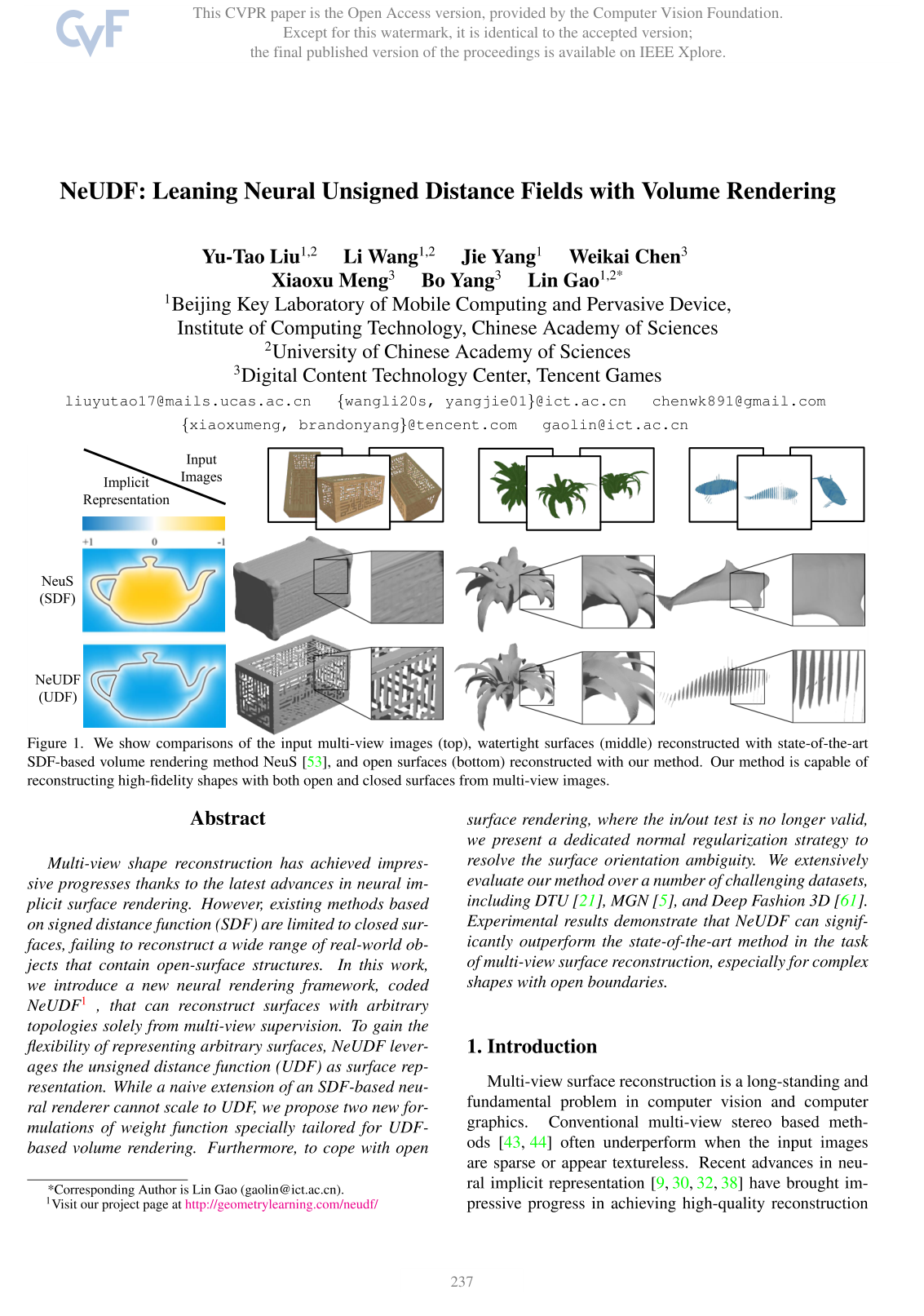
The article introduces and evaluates NeUDF, a neural volume rendering framework designed to reconstruct surfaces of arbitrary topologies, including open and closed structures, directly from calibrated two-dimensional multi-view images without requiring direct three-dimensional supervision.
To achieve this, the authors adapt unsigned distance fields—which measure absolute Euclidean distance to the nearest surface—to volume rendering. Because naively applying signed rendering formulations to unsigned fields causes severe geometric artifacts and false surfaces, the framework introduces three tailored components: an unbiased and occlusion-aware rendering weight function, a balanced importance sampling strategy, and a normal regularization method that stabilizes numerical gradients near surfaces. The approach was evaluated against leading multi-view stereo and neural implicit baselines across challenging benchmarks, including Deep Fashion 3D, Multi-Garment Net, and DTU, alongside real-world video captures of open objects.
The experimental findings show that NeUDF establishes a new state of the art for non-watertight shape modeling while remaining fully competitive on traditional closed shapes. On open-surface garment benchmarks, NeUDF reduced reconstruction error (measured by Chamfer distance) by approximately 28% to 50% compared to leading neural rendering baselines like NeuS, NeuralWarp, and IDR, while completely eliminating the artificial closures and joined surfaces typical of signed methods. Ablation experiments demonstrated that each component—unbiased weighting, balanced sampling, and normal regularization—is vital; omitting normal regularization, for instance, nearly doubles the reconstruction error under extreme lighting variations.
These results demonstrate that machine learning systems can accurately capture complex thin and open geometries from standard photographs, removing the requirement for strict closed-surface geometric priors. For organizations handling three-dimensional digitization, this reduces pipeline risks, manual cleanup costs, and the operational timelines typically needed to model intricate assets such as clothing or architectural scans.
Organizations developing three-dimensional digitization pipelines should consider adopting unsigned distance formulations when their workflows involve open boundaries, hollow geometries, or thin sheets. For broader deployment, teams should conduct pilot evaluations to assess trade-offs between surface smoothness and fine high-frequency details caused by normal regularization.
Confidence in these findings is strong across structured datasets and real-object captures, though users should note operational boundaries: the current framework does not model transparent materials, struggles when surface sections are severely occluded from view, and requires subsequent polygon-extraction algorithms that can introduce secondary approximation errors.
- Paper: NeuS: Learning Neural Implicit Surfaces by Volume Rendering for Multi-view Reconstruction, Peng Wang et al. (2021). NeuS establishes the foundational formulation for rendering neural implicit surfaces with volume rendering, which NeUDF directly adapts and redesigns to support unsigned distance functions.
- Paper: Volume Rendering of Neural Implicit Surfaces, Lior Yariv et al. (2021). VolSDF provides the mathematical groundwork for converting signed distance fields into volume densities for multi-view neural rendering.
- Paper: NeRF: Representing Scenes as Neural Radiance Fields for View Synthesis, Ben Mildenhall et al. (2020). NeRF introduces the coordinate-based neural radiance field and differentiable volume rendering formulation underpinning implicit 3D scene reconstruction.
- Paper: DeepSDF: Learning Continuous Signed Distance Functions for Shape Representation, Jeong Joon Park et al. (2019). DeepSDF pioneers continuous neural distance fields for representing 3D shapes, introducing the implicit distance paradigm that NeUDF extends to open surfaces.
- Paper: 2D Gaussian Splatting for Geometrically Accurate Radiance Fields, Binbin Huang et al. (2024). 2D Gaussian Splatting advances explicit planar surface rendering to overcome the computational bottlenecks and thin-surface reconstruction challenges encountered in neural implicit volume rendering.