Magic123: One Image to High-Quality 3D Object Generation Using Both 2D and 3D Diffusion Priors
Guocheng QianJinjie MaiAbdullah HamdiJian RenAliaksandr SiarohinBing LiHsin-Ying LeeIvan SkorokhodovPeter WonkaSergey Tulyakov
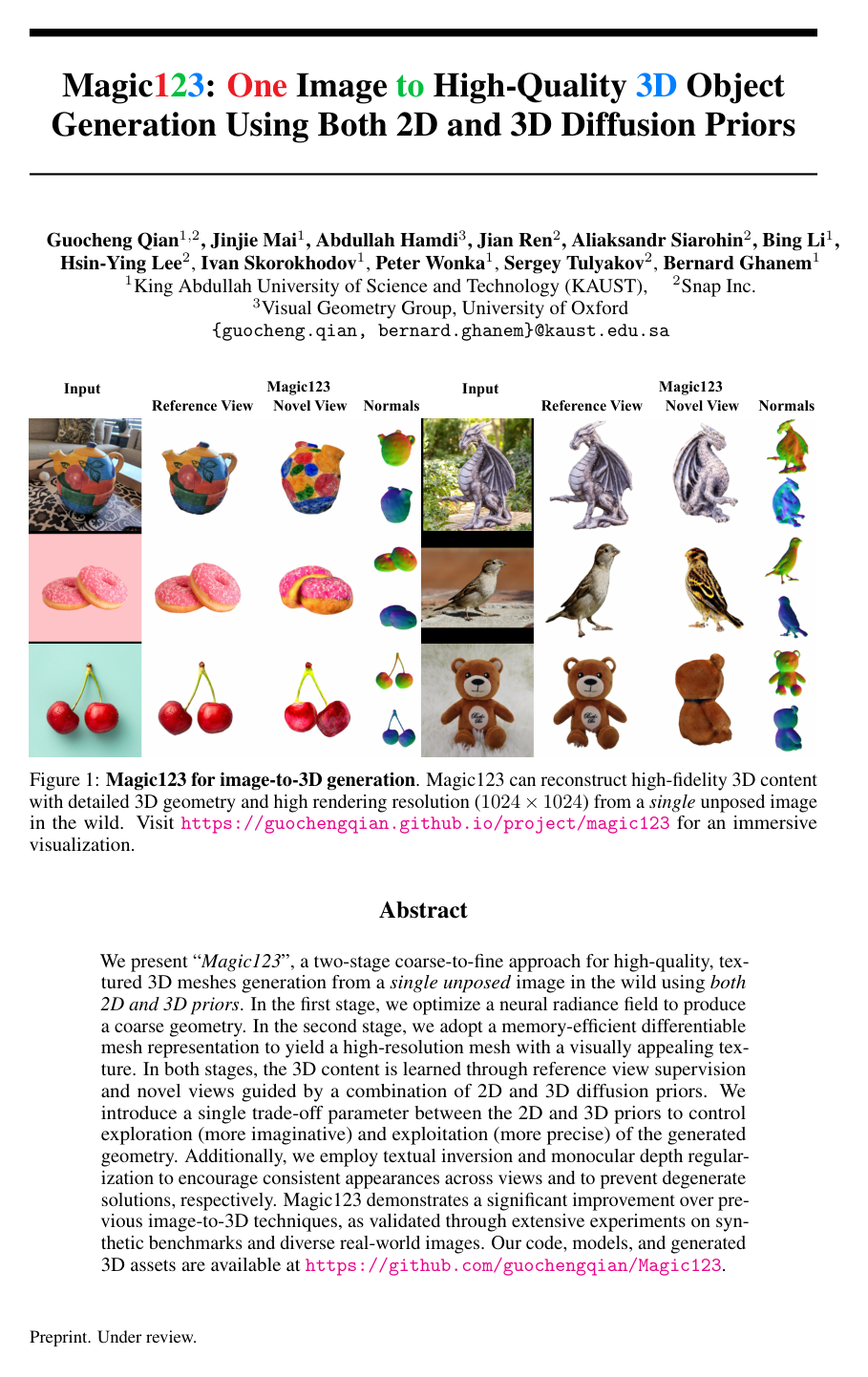
Introduces Magic123, a coarse-to-fine framework that combines 2D and 3D diffusion priors to generate high-quality, textured 3D meshes from a single unposed image with controllable trade-offs between geometric precision and novel-view imagination.
Generating high-quality 3D digital assets from a single standard 2D image remains a major technical challenge. While human vision intuitively interprets spatial depth and volume, computational models struggle due to a scarcity of comprehensive 3D training data and the heavy memory costs associated with rendering detailed objects. Current automated solutions typically rely either on broad 2D image knowledge, which can generate imaginative but geometrically distorted outputs, or specialized 3D models, which enforce strict structural rules but fail to generalize to uncommon objects.
The article demonstrates a new framework, Magic123, designed to generate high-resolution, textured 3D meshes from a single unposed reference image. Its primary objective is to balance realistic imaginative visual generation with strict 3D physical consistency by simultaneously uniting 2D and 3D guidance.
The framework operates in a two-stage, coarse-to-fine sequence. In the coarse initial stage, it generates a basic 3D structure using a neural volume representation. In the fine second stage, it converts this volume into a memory-efficient mesh grid that enables rendering at eight times higher resolution (up to 1024x1024 pixels) while optimizing geometry and surface color separately. Throughout both stages, novel viewing angles are supervised simultaneously by a general 2D image generator (Stable Diffusion) and a viewpoint-conditioned 3D diffusion model (Zero-1-to-3). The overall approach was evaluated against leading baseline methods across both synthetic and real-world image datasets using standard perceptual, structural, and consistency metrics.
The evaluation revealed several key findings. First, combining 2D and 3D guidance delivered state-of-the-art performance across all benchmark datasets, consistently outperforming existing single-model methods in image fidelity, perceptual similarity, and multi-view consistency. Second, the authors found that controlling the balance between 2D and 3D priors using a single weighting ratio successfully regulates the trade-off between structural exploration and geometric accuracy. A balanced default ratio of 1.0 reliably produced identity-preserving, detailed models without requiring custom per-object adjustments. Third, the two-stage pipeline proved essential for resolution and fidelity: the second mesh stage refined textures and cleaned up surface noise that is typically present in volumetric models, while keeping computational memory demands manageable.
These results indicate that 3D content creation workflows can achieve high visual fidelity and automation without requiring massive native 3D training datasets or manual 3D modeling. For digital production and virtual asset development, this capability reduces asset creation turnaround times and manual labor costs. Strategically, it bridges the gap between open-domain generative image intelligence and precise geometric modeling.
Organizations evaluating automated 3D generation should adopt joint 2D-3D guidance frameworks rather than single-prior models. Practitioners should use the balanced baseline ratio for standard automated workflows, while tuning the weighting toward 2D guidance when prioritizing imaginative detail or toward 3D guidance when reconstructing standard, common geometric objects. Future developmental work should incorporate automated camera pose estimation to remove manual alignment requirements and refine loss functions to reduce texture over-saturation in high-resolution outputs.
The results remain subject to specific operational limitations. The pipeline assumes the input image is taken from a front-facing perspective, meaning inputs captured from unusual elevation angles or steep overhead perspectives can produce incorrect geometries unless manually adjusted. Additionally, the system depends on the accuracy of upstream preprocessing tools for object segmentation and depth estimation, meaning initial segmentation errors will degrade the final 3D asset.
- Paper: Zero-1-to-3: Zero-shot One Image to 3D Object, Ruoshi Liu et al. (2023). Zero-1-to-3 introduces the viewpoint-conditioned 2D diffusion model that serves as the essential 3D prior guiding novel view synthesis in Magic123.
- Paper: DreamFusion: Text-to-3D using 2D Diffusion, Ben Poole et al. (2023). DreamFusion pioneers Score Distillation Sampling (SDS) to optimize 3D neural representations using 2D diffusion priors, forming the baseline optimization formulation adapted by Magic123.
- Paper: Magic3D: High-Resolution Text-to-3D Content Creation, Chen-Hsuan Lin et al. (2022). Magic3D establishes the two-stage coarse-to-fine framework transitioning from NeRF volume optimization to high-resolution differentiable mesh extraction and refinement that Magic123 builds upon.
- Paper: ProlificDreamer: High-Fidelity and Diverse Text-to-3D Generation with Variational Score Distillation, Zhengyi Wang et al. (2023). ProlificDreamer advances score distillation principles for high-fidelity 3D generation, providing key theoretical and practical context for refining diffusion-guided 3D models.
- Paper: NeRF: Representing Scenes as Neural Radiance Fields for View Synthesis, Ben Mildenhall et al. (2020). NeRF provides the foundational neural volumetric representation and differentiable volume rendering equations optimized in the initial coarse stage of Magic123.
- Paper: SyncDreamer: Generating Multiview-consistent Images from a Single-view Image, Yuan Liu et al. (2024). SyncDreamer extends single-image 3D generation by introducing synchronized multi-view diffusion with 3D-aware attention to eliminate the multi-view inconsistencies observed in independent per-view distillation methods like Magic123.
- Paper: Free3D: Consistent Novel View Synthesis Without 3D Representation, Chuanxia Zheng et al. (2024). Free3D builds on the task of novel view synthesis from single images by enforcing cross-view consistency via ray-conditioned normalization without relying on per-instance 3D optimization.
- Paper: LRM: Large Reconstruction Model for Single Image to 3D, Yicong Hong et al. (2024). LRM advances single-image 3D generation beyond per-scene optimization frameworks like Magic123 into feed-forward, highly scalable transformer-based 3D reconstruction.
- Paper: Structured 3D Latents for Scalable and Versatile 3D Generation, Jianfeng Xiang et al. (2025). TRELLIS generalizes 3D generation by learning unified structured 3D latents that decode directly into meshes, radiance fields, or Gaussian splats, surpassing earlier coarse-to-fine distillation pipelines.
- Paper: Text-to-3D using Gaussian Splatting, Zilong Chen et al. (2024). GSGEN transitions the multi-prior distillation strategy used in NeRF/mesh pipelines to explicit 3D Gaussian Splatting for faster rendering and reduced geometric artifacts.