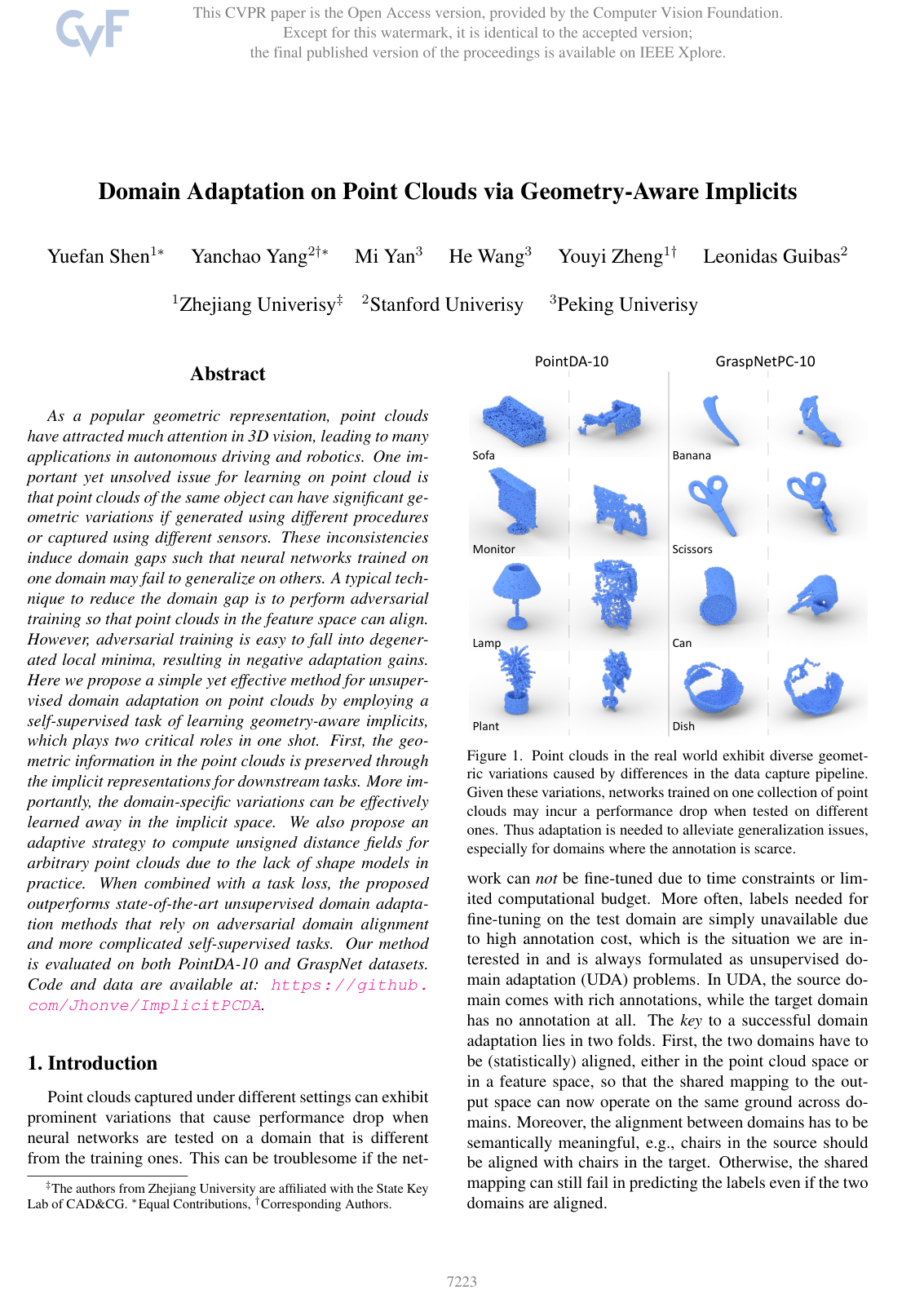
Domain Adaptation on Point Clouds via Geometry-Aware Implicits

Yuefan ShenYanchao YangMi YanHe WangYouyi ZhengLeonidas J. Guibas

article2022CVPR54 citations

Introduces a self-supervised domain adaptation framework for 3D point clouds that learns geometry-aware implicit functions through adaptive unsigned distance fields to align domain features without relying on unstable adversarial training.

Listen

Three-dimensional point clouds are essential geometric data representations used in robotics and autonomous navigation. However, deploying machine learning models in real-world settings presents a significant challenge: point clouds captured by different sensors or under varying conditions exhibit geometric discrepancies and noise. These domain gaps cause models trained on labeled synthetic or specific sensor data to fail when transferred to unannotated target environments. Traditional unsupervised domain adaptation methods rely heavily on adversarial alignment, which frequently distorts underlying shapes and degrades performance, or on handcrafted prediction tasks that struggle with unaligned and heavily occluded scans.

The article demonstrates an unsupervised domain adaptation framework that uses self-supervised learning of implicit geometric representations to align differing point cloud datasets. The primary objective is to preserve underlying object geometry while naturally learning away sensor-specific noise and variations, enabling high classification accuracy on unlabeled target domains without manual annotations.

The authors designed a dual-pathway neural network architecture that jointly optimizes a supervised classification loss on labeled source data and a self-supervised implicit reconstruction loss across both source and target domains. To overcome the lack of complete 3D surface meshes in real-world scans, the approach introduces an adaptive unsigned distance field that calculates dynamic clamping thresholds based on local point densities. The framework also incorporates geometry-preserving data augmentations, such as affinity-aware jittering and random partial masking, and uses an iterative self-paced pseudo-labeling stage. The system was evaluated on two multi-domain benchmarks: the standard PointDA-10 dataset (spanning synthetic CAD models and reconstructed indoor scenes) and GraspNetPC-10, a newly constructed benchmark containing unaligned, noisy real-world depth scans from Kinect and RealSense sensors.

The experimental findings show that the proposed method establishes state-of-the-art accuracy across all tested settings. On the PointDA-10 benchmark, the method achieved an overall accuracy of 73.2%, outperforming existing adversarial and self-supervised baselines. On the more challenging GraspNetPC-10 benchmark, the framework achieved an average classification accuracy of 84.4%, surpassing the prior leading technique by more than 10 percentage points. Furthermore, implicit reconstructions confirmed that the adaptive distance calculations effectively prevent the geometric distortion seen in fixed-threshold distance baselines, producing clean feature clustering across domains.

These results indicate that self-supervised implicit geometric modeling provides a more stable and accurate alternative to adversarial training for 3D domain adaptation. For engineering and deployment teams, this approach significantly reduces the cost and time associated with manually annotating point clouds for every new sensor deployment or operating environment, lowering deployment risks for robotic perception and autonomous systems.

Organizations developing 3D perception pipelines should consider adopting implicit geometry-based self-supervised tasks over purely adversarial feature matching when transferring models from simulation to reality or across different sensor platforms. Future work should focus on designing specialized datasets with controllable, disentangled geometric variables to isolate higher-level shape variations from low-level sensor artifacts, as well as evaluating the pipeline on dense LiDAR applications. Users should note that while the method proves robust to occlusions and varying point densities, performance still depends on maintaining basic geometric structure in the source and target observations.

Cover for Domain Adaptation on Point Clouds via Geometry-Aware Implicits

Abstract

As a popular geometric representation, point clouds have attracted much attention in 3D vision, leading to many applications in autonomous driving and robotics. One important yet unsolved issue for learning on point cloud is that point clouds of the same object can have significant geometric variations if generated using different procedures or captured using different sensors. These inconsistencies induce domain gaps such that neural networks trained on one domain may fail to generalize on others. A typical technique to reduce the domain gap is to perform adversarial training so that point clouds in the feature space can align. However, adversarial training is easy to fall into degenerated local minima, resulting in negative adaptation gains. Here we propose a simple yet effective method for unsupervised domain adaptation on point clouds by employing a self-supervised task of learning geometry-aware implicits, which plays two critical roles in one shot. First, the geometric information in the point clouds is preserved through the implicit representations for downstream tasks. More importantly, the domain-specific variations can be effectively learned away in the implicit space. We also propose an adaptive strategy to compute unsigned distance fields for arbitrary point clouds due to the lack of shape models in practice. When combined with a task loss, the proposed outperforms state-of-the-art unsupervised domain adaptation methods that rely on adversarial domain alignment and more complicated self-supervised tasks. Our method is evaluated on both PointDA-10 and GraspNet datasets. Code and data are available at: https://github.com/Jhonve/ImplicitPCDA.

Table of Contents

  • 1. Introduction
  • 2. Related Work
  • 2.1. Deep Learning on Point Clouds
  • 2.2. Unsupervised Domain Adaptation
  • 2.3. Self-Supervised Learning on Point Clouds
  • 3. Method
  • 3.1. Self-Supervised Geometry-Aware Implicit
  • 3.1.1 Adaptive Unsigned Distance of Point Cloud
  • 3.1.2 Point Cloud Augmentation
  • 3.2. Self-Paced Self-Training
  • 3.3. Overall Loss
  • 4. Experiments
  • 4.1. Datasets
  • 4.2. Implementation Details
  • 4.3. Implicit Reconstruction
  • 4.4. Unsupervised Domain Adaptation
  • 5. Discussion
  • References

Knowls

  1. Knowl 1 — Dual-Pathway Point Cloud UDA Framework via Geometry-Aware Implicits

    model/method

    Unsupervised domain adaptation (UDA) on 3D point clouds transfers classification capability from a labeled source domain Ds={(Pis,Yis)}i=1Ns\mathcal{D}^s = \{(P_i^s, Y_i^s)\}_{i=1}^{N_s} to an unlabeled target domain Dt={Pit}i=1Nt\mathcal{D}^t = \{P_i^t\}_{i=1}^{N_t}, where each P∈RN×3P \in \mathbb{R}^{N \times 3} is a point cloud with NN 3D coordinates.

    The framework consists of a shared feature encoder Φ\Phi, a main classification head Ψm\Psi_m, and a self-supervised implicit decoder Ψs\Psi_s:

    1. Main Classification Pathway: The encoder extracts a global latent feature vector c=Φ(P)c = \Phi(P), and the classifier Ψm\Psi_m outputs class prediction probabilities Y^=(Ψm∘Φ)(P)=Ψm(c)\hat{Y} = (\Psi_m \circ \Phi)(P) = \Psi_m(c). It is trained using supervised cross-entropy on Ds\mathcal{D}^s.

    2. Self-Supervised Implicit Pathway: The same encoder Φ\Phi provides the geometric latent c=Φ(P)c = \Phi(P) to the implicit decoder Ψs\Psi_s. Given query coordinates q∈R3q \in \mathbb{R}^3 randomly sampled within the unit bounding volume Q⊂R3Q \subset \mathbb{R}^3, the decoder predicts the continuous unsigned distance fP(q)=Ψs(q,c)f_P(q) = \Psi_s(q, c) from qq to the underlying continuous object surface of PP. This pathway is optimized across both source Ds\mathcal{D}^s and target Dt\mathcal{D}^t point clouds.

    By enforcing implicit geometric distance field prediction across domains through the shared encoder Φ\Phi, domain-specific sampling variations and sensor artifacts are eliminated while preserving semantic shape geometry.

  2. Knowl 2 — Adaptive Unsigned Distance Field for Unstructured Point Clouds

    model/method

    Training implicit surface functions directly on raw point clouds without CAD meshes causes nearest-neighbor approximations to yield erroneously large distances near surfaces due to point sparsity and irregular sampling. The Adaptive Unsigned Distance (AUD) field corrects for this by introducing an object-specific clamping threshold computed from local spatial density.

    For a point cloud P={pj}j=1N⊂R3P = \{p_j\}_{j=1}^N \subset \mathbb{R}^3:

    1. The local affinity djd_j of each point pj∈Pp_j \in P is defined as the mean Euclidean distance to its MM nearest neighbors in PP: dj=1M∑m=1M∥pm−pj∥2d_j = \frac{1}{M} \sum_{m=1}^M \|p_m - p_j\|_2

    2. The adaptive clamping threshold dMd_M for PP is the average local affinity over all NN points: dM=1N∑j=1Ndjd_M = \frac{1}{N} \sum_{j=1}^N d_j

    3. For any spatial query point q∈R3q \in \mathbb{R}^3, the adaptive unsigned distance field dP(q)d_P(q) is defined as: dP(q)={∥q−p∗(q)∥2if ∥q−p∗(q)∥2>dM0otherwised_P(q) = \begin{cases} \|q - p^*(q)\|_2 & \text{if } \|q - p^*(q)\|_2 > d_M \\ 0 & \text{otherwise} \end{cases} where p∗(q)=arg⁡min⁡p∈P∥q−p∥2p^*(q) = \arg\min_{p \in P} \|q - p\|_2 is the nearest neighbor of query point qq in PP.

    4. The self-supervised implicit reconstruction loss over a set of ∣Q∣|Q| sampled query points is: LI=1∣Q∣∑q∈Q∣fP(q)−dP(q)∣\mathcal{L}_I = \frac{1}{|Q|} \sum_{q \in Q} |f_P(q) - d_P(q)| where fP(q)=Ψs(q,Φ(P))f_P(q) = \Psi_s(q, \Phi(P)) is the distance predicted by implicit decoder Ψs\Psi_s given encoder representation Φ(P)\Phi(P).

  3. Knowl 3 — Affinity-Aware Jittering and Random Masking Augmentation

    model/method

    To make implicit representation learning robust to variable point counts and partial occlusions:

    1. Affinity-Aware Jittering: When padding point clouds with fewer than NN points (e.g., N=1024N=1024), duplicate points or uniform perturbations distort the local distance structure. For each point pj∈Pp_j \in P, using its local affinity dj=1M∑m=1M∥pm−pj∥2d_j = \frac{1}{M} \sum_{m=1}^M \|p_m - p_j\|_2 with MM nearest neighbors, jittered padding points are generated by adding random offsets sampled uniformly from [−dj2,dj2]3\left[-\frac{d_j}{2}, \frac{d_j}{2}\right]^3. This preserves local geometric density across sparse and dense regions.

    2. Random Masking Latent Consistency: To handle partial scans caused by self-occlusions, a local spherical neighborhood of radius rm∼U(0.1,0.3)r_m \sim \mathcal{U}(0.1, 0.3) around a randomly selected point in PP is dropped, yielding a masked point cloud P^\hat{P}. A consistency loss enforces invariant global implicit latents: LM=∥Φ(P)−Φ(P^)∥2\mathcal{L}_M = \|\Phi(P) - \Phi(\hat{P})\|_2 where Φ\Phi is the point cloud encoder.

  4. Knowl 4 — Joint Optimization Objective with Self-Paced Self-Training

    equation

    The total training loss L\mathcal{L} for unsupervised domain adaptation on point clouds is formulated as: L=LI+αLM+βLclss+μLclst\mathcal{L} = \mathcal{L}_I + \alpha \mathcal{L}_M + \beta \mathcal{L}_{cls}^s + \mu \mathcal{L}_{cls}^t

    where:

    • LI=1∣Q∣∑q∈Q∣fP(q)−dP(q)∣\mathcal{L}_I = \frac{1}{|Q|} \sum_{q \in Q} |f_P(q) - d_P(q)| is the adaptive unsigned distance field regression loss on source and target point clouds.
    • LM=∥Φ(P)−Φ(P^)∥2\mathcal{L}_M = \|\Phi(P) - \Phi(\hat{P})\|_2 is the random masking representation consistency loss.
    • Lclss=−1Ns∑i=1Ns∑j=1JYi,jslog⁡(Ψm(Φ(Pis))j)\mathcal{L}_{cls}^s = -\frac{1}{N_s} \sum_{i=1}^{N_s} \sum_{j=1}^J Y_{i,j}^s \log\left(\Psi_m(\Phi(P_i^s))_j\right) is the supervised categorical cross-entropy on NsN_s labeled source point clouds over JJ semantic classes, where Yi,js∈{0,1}Y_{i,j}^s \in \{0, 1\} is the ground-truth indicator.
    • Lclst=−1Nt∑i=1Nt(∑j=1JY^i,jtlog⁡(Ψm(Φ(Pit))j)+γ∥Y^it∥1)\mathcal{L}_{cls}^t = -\frac{1}{N_t} \sum_{i=1}^{N_t} \left( \sum_{j=1}^J \hat{Y}_{i,j}^t \log\left(\Psi_m(\Phi(P_i^t))_j\right) + \gamma \|\hat{Y}_i^t\|_1 \right) is the self-paced self-training (SPST) loss on NtN_t unlabeled target point clouds, where Y^i,jt\hat{Y}_{i,j}^t denotes pseudo-labels determined via nonlinear integer programming and γ\gamma regulates target sample selection thresholding.
    • α,β,μ\alpha, \beta, \mu are loss balancing hyperparameters (typically α=100\alpha = 100, β=1.0\beta = 1.0, and β=μ=0\beta = \mu = 0 during an initial self-supervised implicit pre-training phase).
  5. Knowl 5 — GraspNetPC-10 Benchmark for Unaligned Sim-to-Real and Real-to-Real UDA

    experimental setup

    GraspNetPC-10 is an unsupervised domain adaptation benchmark constructed from the GraspNet dataset to assess point cloud domain adaptation under sim-to-real and real-to-real sensor shifts without canonical object alignment.

    The benchmark comprises 10 common object classes across three distinct domains:

    1. Synthetic Domain (Syn): 12,000 synthetic point clouds rendered from 3D CAD models placed in virtual scenes.
    2. Kinect2 Domain (Kin): Real-world raw depth scans captured with a Microsoft Kinect2 camera, segmented into 10,973 training point clouds and 2,560 test point clouds.
    3. Intel RealSense Domain (RS): Real-world raw depth scans captured with an Intel RealSense camera, segmented into 10,698 training point clouds and 2,560 test point clouds.

    Unlike PointDA-10 (where objects have aligned gravity axes), point clouds in GraspNetPC-10 have arbitrary 3D orientations, varying degrees of partial occlusion, and sensor-dependent noise patterns. Each point cloud is normalized to a unit bounding box and sampled/padded to 1024 points.

  6. Knowl 6 — Classification Performance on the PointDA-10 Benchmark

    data/table

    PointDA-10 evaluates point cloud UDA across ModelNet (M), ShapeNet (S), and ScanNet (S*) on 10 shared categories. Accuracy values (%) are averaged over 3 random seeds (±\pm SEM):

    Methods M→\rightarrowS M→\rightarrowS* S→\rightarrowM S→\rightarrowS* S*→\rightarrowM S*→\rightarrowS Avg.
    Supervised (Upper Bound) 93.9±0.293.9 \pm 0.2 78.4±0.678.4 \pm 0.6 96.2±0.196.2 \pm 0.1 78.4±0.678.4 \pm 0.6 96.2±0.196.2 \pm 0.1 93.9±0.293.9 \pm 0.2 89.5
    Baseline (w/o adapt.) 83.3±0.783.3 \pm 0.7 43.8±2.343.8 \pm 2.3 75.5±1.875.5 \pm 1.8 42.5±1.442.5 \pm 1.4 63.8±3.963.8 \pm 3.9 64.2±0.864.2 \pm 0.8 62.2
    DANN 74.8±2.874.8 \pm 2.8 42.1±0.642.1 \pm 0.6 57.5±0.457.5 \pm 0.4 50.9±1.050.9 \pm 1.0 43.7±2.943.7 \pm 2.9 71.6±1.071.6 \pm 1.0 56.8
    PointDAN 83.9±0.383.9 \pm 0.3 44.8±1.444.8 \pm 1.4 63.3±1.163.3 \pm 1.1 45.7±0.745.7 \pm 0.7 43.6±2.043.6 \pm 2.0 56.4±1.556.4 \pm 1.5 56.3
    RS 79.9±0.879.9 \pm 0.8 46.7±4.846.7 \pm 4.8 75.2±2.075.2 \pm 2.0 51.4±3.951.4 \pm 3.9 71.8±2.371.8 \pm 2.3 71.2±2.871.2 \pm 2.8 66.0
    DefRec+PCM 81.7±0.681.7 \pm 0.6 51.8±0.351.8 \pm 0.3 78.6±0.778.6 \pm 0.7 54.5±0.354.5 \pm 0.3 73.7±1.673.7 \pm 1.6 71.1±1.471.1 \pm 1.4 68.6
    GAST (SSL only) 83.9±0.283.9 \pm 0.2 56.7±0.356.7 \pm 0.3 76.4±0.276.4 \pm 0.2 55.0±0.255.0 \pm 0.2 73.4±0.373.4 \pm 0.3 72.2±0.272.2 \pm 0.2 69.5
    GAST (+ SPST) 84.8±0.184.8 \pm 0.1 59.8±0.259.8 \pm 0.2 80.8±0.680.8 \pm 0.6 56.7±0.256.7 \pm 0.2 81.1±0.881.1 \pm 0.8 74.9±0.574.9 \pm 0.5 73.0
    Ours (SSL only) 85.8±0.385.8 \pm 0.3 55.3±0.355.3 \pm 0.3 77.2±0.477.2 \pm 0.4 55.4±0.555.4 \pm 0.5 73.8±0.673.8 \pm 0.6 72.4±1.072.4 \pm 1.0 70.0
    Ours (+ SPST) 86.2±0.2\mathbf{86.2} \pm 0.2 58.6±0.158.6 \pm 0.1 81.4±0.4\mathbf{81.4} \pm 0.4 56.9±0.2\mathbf{56.9} \pm 0.2 81.5±0.5\mathbf{81.5} \pm 0.5 74.4±0.674.4 \pm 0.6 73.2\mathbf{73.2}

    The geometry-aware implicit alignment method achieves 70.0% average accuracy without self-paced self-training (SPST), outperforming prior self-supervised techniques (DefRec+PCM at 68.6%, GAST at 69.5%), and reaches 73.2% with SPST, establishing state-of-the-art domain adaptation performance on PointDA-10.

  7. Knowl 7 — Classification Performance on the GraspNetPC-10 Benchmark

    data/table

    GraspNetPC-10 tests adaptation across synthetic (Syn), Kinect2 (Kin), and RealSense (RS) domains with uncanonicalized object orientations. Classification accuracies (%) are averaged over 3 random seeds (±\pm SEM):

    Methods Syn.→\rightarrowKin. Syn.→\rightarrowRS. Kin.→\rightarrowRS. RS.→\rightarrowKin. Avg.
    Supervised (Upper Bound) 97.2±0.897.2 \pm 0.8 95.6±0.495.6 \pm 0.4 95.6±0.395.6 \pm 0.3 97.2±0.497.2 \pm 0.4 96.4
    Baseline (w/o adapt.) 61.3±1.061.3 \pm 1.0 54.4±0.954.4 \pm 0.9 53.4±1.353.4 \pm 1.3 68.5±0.568.5 \pm 0.5 59.4
    DANN 78.6±0.378.6 \pm 0.3 70.3±0.570.3 \pm 0.5 46.1±2.246.1 \pm 2.2 67.9±0.367.9 \pm 0.3 65.7
    PointDAN 77.0±0.277.0 \pm 0.2 72.5±0.372.5 \pm 0.3 65.9±1.265.9 \pm 1.2 82.3±0.582.3 \pm 0.5 74.4
    RS 67.3±0.467.3 \pm 0.4 58.6±0.858.6 \pm 0.8 55.7±1.555.7 \pm 1.5 69.6±0.469.6 \pm 0.4 62.8
    DefRec+PCM 80.7±0.180.7 \pm 0.1 70.5±0.470.5 \pm 0.4 65.1±0.365.1 \pm 0.3 77.7±1.277.7 \pm 1.2 73.5
    GAST (SSL only) 69.8±0.469.8 \pm 0.4 61.3±0.361.3 \pm 0.3 58.7±1.058.7 \pm 1.0 70.6±0.370.6 \pm 0.3 65.1
    GAST (+ SPST) 81.3±1.881.3 \pm 1.8 72.3±0.872.3 \pm 0.8 61.3±0.961.3 \pm 0.9 80.1±0.580.1 \pm 0.5 73.8
    Ours (SSL only) 81.2±0.381.2 \pm 0.3 73.1±0.273.1 \pm 0.2 66.4±0.566.4 \pm 0.5 82.6±0.482.6 \pm 0.4 75.8
    Ours (+ SPST) 94.6±0.4\mathbf{94.6} \pm 0.4 80.5±0.2\mathbf{80.5} \pm 0.2 76.8±0.4\mathbf{76.8} \pm 0.4 85.9±0.3\mathbf{85.9} \pm 0.3 84.4\mathbf{84.4}

    On unaligned point cloud data, orientation-prediction self-supervision (GAST) drops to 65.1% (SSL only). The implicit representation alignment method achieves 75.8% without SPST and 84.4% with SPST, exceeding the closest prior method (PointDAN at 74.4%, DefRec+PCM at 73.5%, GAST+SPST at 73.8%) across all four adaptation directions.

  8. Knowl 8 — Geometric Reconstruction Fidelity via Adaptive Unsigned Clamping

    empirical result

    When implicit surface reconstructions are sampled by selecting query points satisfying predicted distance fP(q)<ϵf_P(q) < \epsilon from 200,000200,000 points in the unit cube [−1,1]3[-1, 1]^3:

    1. Without Adaptive Clamping (w/o AUD): Using raw nearest-neighbor distance with a fixed global threshold distorts geometry significantly. At distance tolerance ϵ=3×10⁻²\epsilon = 3 \times 10^{-2}, reconstructions exhibit severe structural degradation (Chamfer distances between 0.0990.099 and 0.3860.386). Even when increasing tolerance to ϵ=6×10⁻²\epsilon = 6 \times 10^{-2}, Chamfer distances remain elevated (0.0480.048 to 0.1130.113) with visible topological defects.

    2. With Adaptive Clamping (AUD): Incorporating the local-affinity threshold dM=1N∑j=1Ndjd_M = \frac{1}{N} \sum_{j=1}^N d_j into distance supervision produces faithful surface zero-crossings at ϵ=3×10⁻²\epsilon = 3 \times 10^{-2}, lowering Chamfer distances to between 0.0310.031 and 0.0660.066 across both PointDA-10 and GraspNetPC-10 shapes.

  9. Knowl 9 — Limitation on Disentangling Semantic Variations from Geometric Discrepancies

    limitation

    Learning geometry-aware implicit functions effectively eliminates low-level sensor noise, irregular sampling, and partial occlusion discrepancies across domains. However, the approach is designed for geometric surface consistency and does not explicitly separate intra-class high-level shape variations (e.g., distinct semantic sub-types of chairs or tables) from domain-generating geometric factors. Addressing high-level shape divergence without supervision requires benchmarks offering controllable and disentangled factors of geometric variation.

Coverage note — None was omitted; all contributed models, equations, augmentations, benchmarks, experimental tables, ablation findings, and discussion limitations are fully represented.

References

  1. 1.Idan Achituve, Haggai Maron, and Gal Chechik. Self-supervised learning for domain adaptation on point clouds. In Proceedings of the IEEE/CVF Winter Conference on Applications of Computer Vision, pages 123–133, 2021. 2, 3, 6, 7, 8
  2. 2.Antonio Alliegro, Davide Boscaini, and Tatiana Tommasi. Joint supervised and self-supervised learning for 3d real world challenges. In 2020 25th International Conference on Pattern Recognition (ICPR), pages 6718–6725. IEEE, 2021. 3
  3. 3.Konstantinos Bousmalis, Nathan Silberman, David Dohan, Dumitru Erhan, and Dilip Krishnan. Unsupervised pixel-level domain adaptation with generative adversarial networks. In Proceedings of the IEEE/CVF Conference on Computer Vision and Pattern Recognition, pages 3722–3731, 2017. 2
  4. 4.Adriano Cardace, Riccardo Spezialetti, Pierluigi Zama Ramirez, Samuele Salti, and Luigi Di Stefano. Refrec: Pseudo-labels refinement via shape reconstruction for unsupervised 3d domain adaptation. In 2021 International Conference on 3D Vision (3DV), pages 331–341. IEEE, 2021. 3
  5. 5.Angel X Chang, Thomas Funkhouser, Leonidas Guibas, Pat Hanrahan, Qixing Huang, Zimo Li, Silvio Savarese, Manolis Savva, Shuran Song, Hao Su, et al. Shapenet: An information-rich 3d model repository. arXiv preprint arXiv:1512.03012, 2015. 6
  6. 6.Zhiqin Chen and Hao Zhang. Learning implicit fields for generative shape modeling. In Proceedings of the IEEE/CVF Conference on Computer Vision and Pattern Recognition, pages 5939–5948, 2019. 3, 4
  7. 7.Angela Dai, Angel X Chang, Manolis Savva, Maciej Halber, Thomas Funkhouser, and Matthias Nießner. Scannet: Richly-annotated 3d reconstructions of indoor scenes. In Proceedings of the IEEE/CVF Conference on Computer Vision and Pattern Recognition, pages 5828–5839, 2017. 6
  8. 8.Hehe Fan, Xiaojun Chang, Wanyue Zhang, Yi Cheng, and Ying Sun. Self-supervised global-local structure modeling for point cloud domain adaptation with reliable voted pseudo labels. In Proceedings of the IEEE/CVF Conference on Computer Vision and Pattern Recognition, 2022. 3
  9. 9.Hao-Shu Fang, Chenxi Wang, Minghao Gou, and Cewu Lu. Graspnet-1billion: A large-scale benchmark for general object grasping. In Proceedings of the IEEE/CVF Conference on Computer Vision and Pattern Recognition, pages 11444–11453, 2020. 2, 6
  10. 10.Yaroslav Ganin, Evgeniya Ustinova, Hana Ajakan, Pascal Germain, Hugo Larochelle, Franc¸ois Laviolette, Mario Marchand, and Victor Lempitsky. Domain-adversarial training of neural networks. The journal of machine learning research, 17(1):2096–2030, 2016. 2, 6, 7, 8
  11. 11.Judy Hoffman, Eric Tzeng, Taesung Park, Jun-Yan Zhu, Phillip Isola, Kate Saenko, Alexei Efros, and Trevor Darrell. Cycada: Cycle-consistent adversarial domain adaptation. In International conference on machine learning, pages 1989–1998. PMLR, 2018. 2
  12. 12.Guoliang Kang, Lu Jiang, Yi Yang, and Alexander G Hauptmann. Contrastive adaptation network for unsupervised domain adaptation. In Proceedings of the IEEE/CVF Conference on Computer Vision and Pattern Recognition, pages 4893–4902, 2019. 2
  13. 13.Dong-Hyun Lee et al. Pseudo-label: The simple and efficient semi-supervised learning method for deep neural networks. In Workshop on challenges in representation learning, ICML, volume 3, page 896, 2013. 5
  14. 14.Mingsheng Long, Yue Cao, Zhangjie Cao, Jianmin Wang, and Michael I Jordan. Transferable representation learning with deep adaptation networks. IEEE transactions on pattern analysis and machine intelligence, 41(12):3071–3085, 2018. 2
  15. 15.Xiaoyuan Luo, Shaolei Liu, Kexue Fu, Manning Wang, and Zhijian Song. A learnable self-supervised task for unsupervised domain adaptation on point clouds. arXiv preprint arXiv:2104.05164, 2021. 3
  16. 16.Fabio Maria Carlucci, Lorenzo Porzi, Barbara Caputo, Elisa Ricci, and Samuel Rota Bulo. Autodial: Automatic domain alignment layers. In Proceedings of the IEEE/CVF International Conference on Computer Vision, pages 5067–5075, 2017. 2
  17. 17.Lars Mescheder, Michael Oechsle, Michael Niemeyer, Sebastian Nowozin, and Andreas Geiger. Occupancy networks: Learning 3d reconstruction in function space. In Proceedings of the IEEE/CVF Conference on Computer Vision and Pattern Recognition, pages 4460–4470, 2019. 4
  18. 18.Jeong Joon Park, Peter Florence, Julian Straub, Richard Newcombe, and Steven Lovegrove. Deepsdf: Learning continuous signed distance functions for shape representation. In Proceedings of the IEEE/CVF Conference on Computer Vision and Pattern Recognition, pages 165–174, 2019. 3
  19. 19.Omid Poursaeed, Tianxing Jiang, Han Qiao, Nayun Xu, and Vladimir G Kim. Self-supervised learning of point clouds via orientation estimation. In 2020 International Conference on 3D Vision (3DV), pages 1018–1028. IEEE, 2020. 3
  20. 20.Charles R Qi, Hao Su, Kaichun Mo, and Leonidas J Guibas. Pointnet: Deep learning on point sets for 3d classification and segmentation. In Proceedings of the IEEE/CVF Conference on Computer Vision and Pattern Recognition, pages 652–660, 2017. 2
  21. 21.Charles R Qi, Li Yi, Hao Su, and Leonidas J Guibas. Pointnet++: Deep hierarchical feature learning on point sets in a metric space. arXiv preprint arXiv:1706.02413, 2017. 2
  22. 22.Can Qin, Haoxuan You, Lichen Wang, C-C Jay Kuo, and Yun Fu. Pointdan: A multi-scale 3d domain adaption network for point cloud representation. Advances in Neural Information Processing Systems, 32:7192–7203, 2019. 2, 4, 6, 7, 8
  23. 23.Artem Rozantsev, Mathieu Salzmann, and Pascal Fua. Beyond sharing weights for deep domain adaptation. IEEE transactions on pattern analysis and machine intelligence, 41(4):801–814, 2018. 2
  24. 24.Kuniaki Saito, Yoshitaka Ushiku, and Tatsuya Harada. Asymmetric tri-training for unsupervised domain adaptation. In International Conference on Machine Learning, pages 2988–2997. PMLR, 2017. 2
  25. 25.Kuniaki Saito, Kohei Watanabe, Yoshitaka Ushiku, and Tatsuya Harada. Maximum classifier discrepancy for unsupervised domain adaptation. In Proceedings of the IEEE/CVF Conference on Computer Vision and Pattern Recognition, pages 3723–3732, 2018. 2
  26. 26.Khaled Saleh, Ahmed Abobakr, Mohammed Attia, Julie Iskander, Darius Nahavandi, Mohammed Hossny, and Saeid Nahvandi. Domain adaptation for vehicle detection from bird’s eye view lidar point cloud data. In Proceedings of the IEEE/CVF International Conference on Computer Vision Workshops, pages 0–0, 2019. 3
  27. 27.Jonathan Sauder and Bjarne Sievers. Self-supervised deep learning on point clouds by reconstructing space. arXiv preprint arXiv:1901.08396, 2019. 3, 6, 7, 8
  28. 28.Yuefan Shen, Yanchao Yang, Youyi Zheng, C. Karen Liu, and Leonidas J. Guibas. Dcl: Differential contrastive learning for geometry-aware depth synthesis. IEEE Robotics and Automation Letters, 7(2):4845–4852, 2022. 2
  29. 29.Ashish Shrivastava, Tomas Pfister, Oncel Tuzel, Joshua Susskind, Wenda Wang, and Russell Webb. Learning from simulated and unsupervised images through adversarial training. In Proceedings of the IEEE/CVF Conference on Computer Vision and Pattern Recognition, pages 2107–2116, 2017. 2
  30. 30.Eric Tzeng, Judy Hoffman, Kate Saenko, and Trevor Darrell. Adversarial discriminative domain adaptation. In Proceedings of the IEEE/CVF Conference on Computer Vision and Pattern Recognition, pages 7167–7176, 2017. 2
  31. 31.Laurens Van der Maaten and Geoffrey Hinton. Visualizing data using t-sne. Journal of machine learning research, 9(11), 2008. 8
  32. 32.He Wang, Zetian Jiang, Li Yi, Kaichun Mo, Hao Su, and Leonidas J Guibas. Rethinking sampling in 3d point cloud generative adversarial networks. arXiv preprint arXiv:2006.07029, 2020. 2
  33. 33.Yue Wang, Yongbin Sun, Ziwei Liu, Sanjay E Sarma, Michael M Bronstein, and Justin M Solomon. Dynamic graph cnn for learning on point clouds. Acm Transactions On Graphics (tog), 38(5):1–12, 2019. 2, 6
  34. 34.Zhirong Wu, Shuran Song, Aditya Khosla, Fisher Yu, Linguang Zhang, Xiaoou Tang, and Jianxiong Xiao. 3d shapenets: A deep representation for volumetric shapes. In Proceedings of the IEEE/CVF Conference on Computer Vision and Pattern Recognition, pages 1912–1920, 2015. 6
  35. 35.Jihan Yang, Shaoshuai Shi, Zhe Wang, Hongsheng Li, and Xiaojuan Qi. St3d: Self-training for unsupervised domain adaptation on 3d object detection. In Proceedings of the IEEE/CVF Conference on Computer Vision and Pattern Recognition, pages 10368–10378, 2021. 3
  36. 36.Li Yi, Boqing Gong, and Thomas Funkhouser. Complete & label: A domain adaptation approach to semantic segmentation of lidar point clouds. In Proceedings of the IEEE/CVF Conference on Computer Vision and Pattern Recognition, pages 15363–15373, 2021. 3
  37. 37.Hengshuang Zhao, Li Jiang, Jiaya Jia, Philip HS Torr, and Vladlen Koltun. Point transformer. In Proceedings of the IEEE/CVF International Conference on Computer Vision, pages 16259–16268, 2021. 2
  38. 38.Sicheng Zhao, Yezhen Wang, Bo Li, Bichen Wu, Yang Gao, Pengfei Xu, Trevor Darrell, and Kurt Keutzer. epointda: An end-to-end simulation-to-real domain adaptation framework for lidar point cloud segmentation. arXiv preprint arXiv:2009.03456, 2, 2020. 2
  39. 39.Jun-Yan Zhu, Taesung Park, Phillip Isola, and Alexei A Efros. Unpaired image-to-image translation using cycleconsistent adversarial networks. In Proceedings of the IEEE/CVF International Conference on Computer Vision, pages 2223–2232, 2017. 2, 3
  40. 40.Longkun Zou, Hui Tang, Ke Chen, and Kui Jia. Geometryaware self-training for unsupervised domain adaptation on object point clouds. In Proceedings of the IEEE/CVF International Conference on Computer Vision, pages 6403–6412, 2021. 2, 3, 5, 6, 7, 8
  41. 41.Yang Zou, Zhiding Yu, BVK Kumar, and Jinsong Wang. Unsupervised domain adaptation for semantic segmentation via class-balanced self-training. In Proceedings of the European conference on computer vision (ECCV), pages 289–305, 2018. 5, 6

Citation

MLA
Shen, Y., et al. “Domain Adaptation on Point Clouds via Geometry-Aware Implicits”. 2022 IEEE/CVF Conference on Computer Vision and Pattern Recognition (CVPR), 2022, pp. 7213–22, https://doi.org/10.1109/CVPR52688.2022.00708.
APA
Shen, Y., Yang, Y., Yan, M., Wang, H., Zheng, Y., & Guibas, L. (2022). Domain Adaptation on Point Clouds via Geometry-Aware Implicits. 2022 IEEE/CVF Conference on Computer Vision and Pattern Recognition (CVPR), 7213–7222. https://doi.org/10.1109/CVPR52688.2022.00708
Chicago
Shen, Y., Y. Yang, M. Yan, H. Wang, Y. Zheng, and L. Guibas. 2022. “Domain Adaptation on Point Clouds via Geometry-Aware Implicits”. 2022 IEEE/CVF Conference on Computer Vision and Pattern Recognition (CVPR), 7213–22. https://doi.org/10.1109/CVPR52688.2022.00708.
Harvard
Shen, Y. et al. (2022) “Domain Adaptation on Point Clouds via Geometry-Aware Implicits”, 2022 IEEE/CVF Conference on Computer Vision and Pattern Recognition (CVPR). IEEE, pp. 7213–7222. Available at: https://doi.org/10.1109/CVPR52688.2022.00708.
Vancouver
1. Shen Y, Yang Y, Yan M, Wang H, Zheng Y, Guibas L (2022) Domain Adaptation on Point Clouds via Geometry-Aware Implicits. In: 2022 IEEE/CVF Conference on Computer Vision and Pattern Recognition (CVPR). IEEE, pp 7213–7222

BibTeX

@inproceedings{Shen_2022, title={Domain Adaptation on Point Clouds via Geometry-Aware Implicits}, url={http://dx.doi.org/10.1109/CVPR52688.2022.00708}, DOI={10.1109/cvpr52688.2022.00708}, booktitle={2022 IEEE/CVF Conference on Computer Vision and Pattern Recognition (CVPR)}, publisher={IEEE}, author={Shen, Yuefan and Yang, Yanchao and Yan, Mi and Wang, He and Zheng, Youyi and Guibas, Leonidas}, year={2022}, month=June, pages={7213–7222} }
Metadata:Crossref

Access the Paper

This paper is available from its original source. Click below to access the PDF.

Open PDF
License: IEEE