3D-VField: Adversarial Augmentation of Point Clouds for Domain Generalization in 3D Object Detection
Alexander LehnerStefano GasperiniAlvaro Marcos-RamiroMichael SchmidtMohammad-Ali Nikouei MahaniNassir NavabBenjamin BusamFederico Tombari
Proposes 3D-VField, a sensor-aware data augmentation framework that deforms point clouds along sensor view rays using adversarially learned vector fields to improve 3D object detection generalization on out-of-domain and rare object geometries, supported by a new crash scenario dataset.
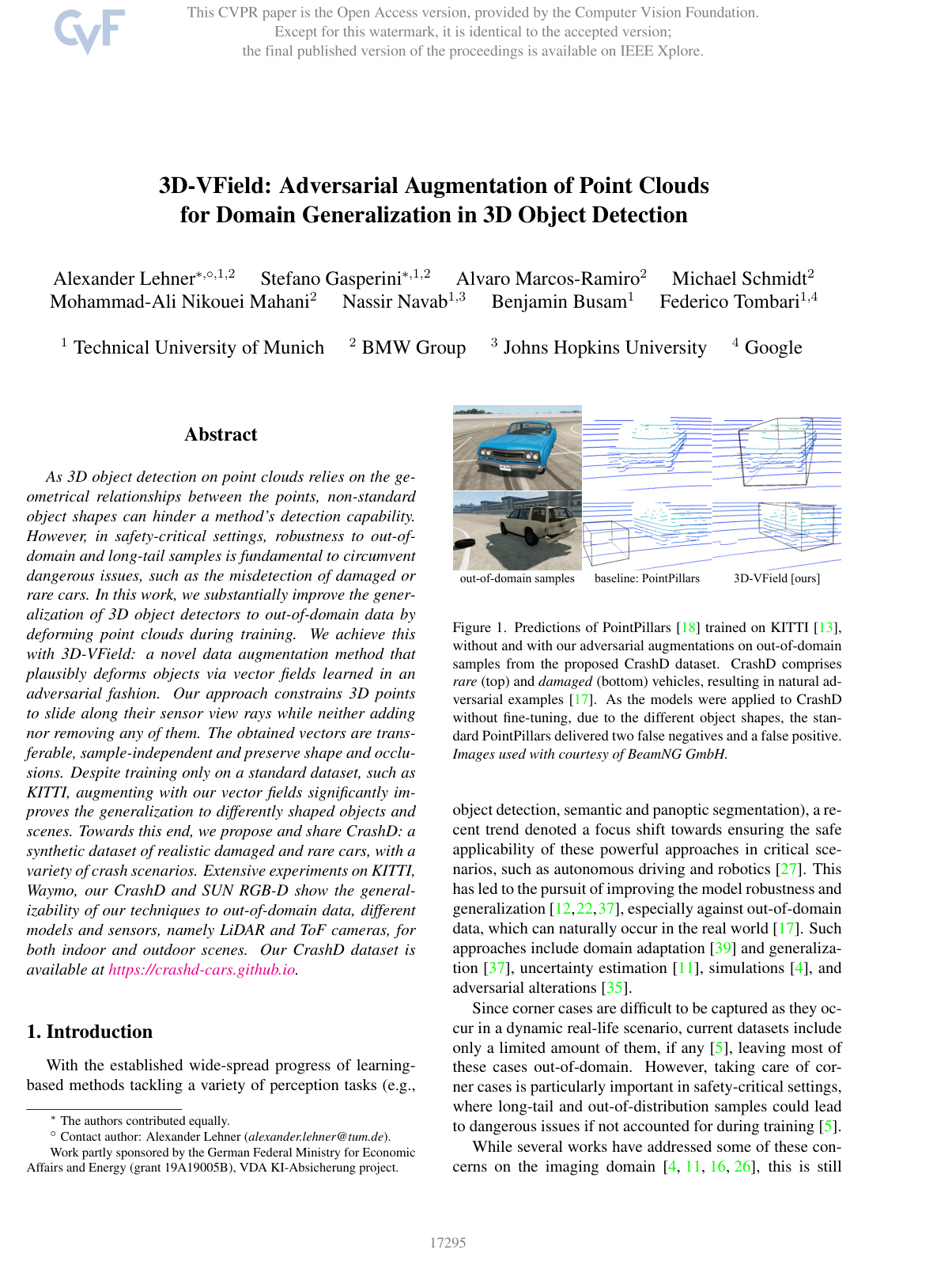
Three-dimensional object detection using spatial point cloud sensors, such as light detection and ranging (LiDAR), is critical for the safety of autonomous driving and robotics. Standard detection models rely heavily on learned geometric point relationships and frequently fail when encountering non-standard, rare, or damaged vehicles. Because rare real-world edge cases are sparsely represented in standard training sets, these natural variations act as adversarial samples that produce dangerous false negatives and false positives in deployment.
The article introduces and evaluates 3D-VField, a sensor-aware data augmentation framework designed to improve the generalization of 3D object detectors to unseen and out-of-domain environments. The method generates plausible, transferable geometric deformations during model training without adding or removing points, and it introduces CrashD, a public synthetic dataset featuring damaged and rare vehicles, to benchmark out-of-domain detection robustness.
The authors train sample-independent 3D vector fields using adversarial learning against detection networks, optimizing vectors that shift points while constraining movements strictly along the sensor's line of sight and smoothing shifts across adjacent surfaces. To evaluate real-world transferability, detectors trained on the standard German KITTI dataset were tested without fine-tuning on diverse out-of-domain targets: the real-world United States Waymo Open Dataset, the synthetic CrashD dataset containing 46,936 clean and damaged vehicles across 15,340 scenes, and indoor benchmark data.
The evaluation yielded several key findings. First, existing detectors experience severe performance degradation on non-standard objects; on the baseline PointPillars model, average precision dropped from 65.20% on normal clean vehicles to 22.48% on rare crashed vehicles. Second, training models with 3D-VField significantly improved out-of-domain detection accuracy, achieving a 9% relative gain over standard training on the Waymo dataset and raising detection of rare crashed vehicles on CrashD to 30.37% without sacrificing in-domain accuracy on KITTI. Third, combining 3D-VField with existing domain adaptation techniques tripled detection accuracy on the most challenging rare crash cases compared to the baseline detector. Finally, the approach proved architecture-agnostic, consistently enhancing performance across multiple distinct 3D detection architectures including PointPillars, Second, and Part-A2.
These findings demonstrate that perception failures on rare or deformed shapes stem from training distribution gaps that cannot be solved by standard geometric augmentations like flips or rotations alone. Plausible, sensor-constrained synthetic deformations provide a practical, low-cost training strategy to reduce high-stakes perception risks in autonomous systems. Furthermore, the results indicate that data augmentation and target domain adaptation are complementary, offering substantial safety enhancements when paired.
Engineering and safety teams should integrate sensor-aware adversarial point cloud augmentations into existing perception training pipelines to improve corner-case detection. Organizations developing autonomous systems should also incorporate structured out-of-domain benchmarks, such as the public CrashD dataset, into their safety verification workflows to systematically audit detector robustness against damaged and atypical vehicles before road deployment.
Confidence in these findings is high across standard autonomous driving benchmarks and distinct sensor modalities. However, limitations remain: the core evaluation transfers models trained in Germany (KITTI) to simulated crashes (CrashD) and US driving conditions (Waymo), meaning performance gains may vary in dynamic real-world crash scenes featuring unpredictable physical debris and severe structural occlusions.
- Paper: PV-RCNN: Point-Voxel Feature Set Abstraction for 3D Object Detection, Shaoshuai Shi et al. (2019). This paper establishes the foundational voxel-point hybrid representation for 3D LiDAR detection, establishing the core architectural paradigms that 3D-VField aims to generalize across unseen domains.
- Paper: PointRCNN: 3D Object Proposal Generation and Detection From Point Cloud, Shaoshuai Shi et al. (2019). It introduces two-stage proposal generation directly from raw 3D point clouds, serving as a primary baseline architecture evaluated under adversarial deformation in 3D-VField.
- Paper: VoxelNet: End-to-End Learning for Point Cloud Based 3D Object Detection, Yin Zhou et al. (2017). It formulates the end-to-end voxel feature encoding framework for point-cloud detection, providing the baseline geometric learning mechanisms whose out-of-domain brittleness 3D-VField addresses.
- Paper: PointNet: Deep Learning on Point Sets for 3D Classification and Segmentation, Charles R. Qi et al. (2017). It provides the seminal deep learning architecture for directly processing unordered 3D point sets, supplying the essential foundation for point-based spatial feature extraction.
- Paper: Synthesizing Robust Adversarial Examples, Anish Athalye et al. (2017). This work introduces differentiable 3D adversarial synthesis across transformations, motivating the use of sensor-aware geometric vector fields to generate adversarial samples.
- Paper: Natural Adversarial Examples, Dan Hendrycks et al. (2019). It demonstrates how naturally occurring, non-standard visual variations function as natural adversarial examples that induce out-of-distribution detector failures.
- Paper: Domain Generalization: A Survey, Kaiyang Zhou et al. (2021). It surveys the core methodologies of domain generalization, contextualizing why data augmentation that expands training diversity is crucial for handling unseen domain shifts.
- Paper: Domain Adaptive Faster R-CNN for Object Detection in the Wild, Yuhua Chen et al. (2018). It formalizes adversarial domain adaptation for object detection under distribution shifts, which 3D-VField builds upon and pairs with geometric augmentation.
- Paper: Center-based 3D Object Detection and Tracking, Tianwei Yin et al. (2020). It presents anchor-free, center-based 3D object detection, representing modern standard LiDAR perception architectures tested against domain variations.
- Paper: 3D Semantic Segmentation with Submanifold Sparse Convolutional Networks, Benjamin Graham et al. (2017). It develops submanifold sparse convolutions, which underpin the efficient 3D convolutional backbones evaluated in 3D-VField's benchmark experiments.
- Paper: Adversarial Style Augmentation for Domain Generalized Urban-Scene Segmentation, Zhun Zhong et al. (2022). This paper extends adversarial domain generalization strategies by dynamically synthesizing adversarial feature styles for urban-scene segmentation.
- Paper: Learning Local Displacements for Point Cloud Completion, Yida Wang et al. (2022). It applies local point displacement learning toward reconstructing complete 3D object geometries and occluded scenes from partial scans.
- Paper: BEVFusion: Multi-Task Multi-Sensor Fusion with Unified Bird's-Eye View Representation, Zhijian Liu et al. (2022). It advances robust 3D perception architectures by unifying LiDAR point clouds and multi-view camera inputs in an efficient shared bird's-eye view representation.
- Paper: SoftGroup for 3D Instance Segmentation on Point Clouds, Thang Vu et al. (2022). It advances 3D point cloud understanding by introducing soft grouping to prevent propagation of local geometric classification errors during instance segmentation.
- Paper: WildDet3D: Scaling Promptable 3D Detection in the Wild, Weikai Huang et al. (2026). It broadens 3D detection to open-category 'in the wild' real-world environments using scaled, diverse multimodal datasets and promptable models.