Center-based 3D Object Detection and Tracking
Tianwei YinXingyi ZhouPhilipp Krähenbühl
Proposes CenterPoint, an anchor-free framework that detects 3D objects as center points and simplifies tracking to closest-point matching, achieving state-of-the-art results on the nuScenes and Waymo Open Dataset benchmarks.
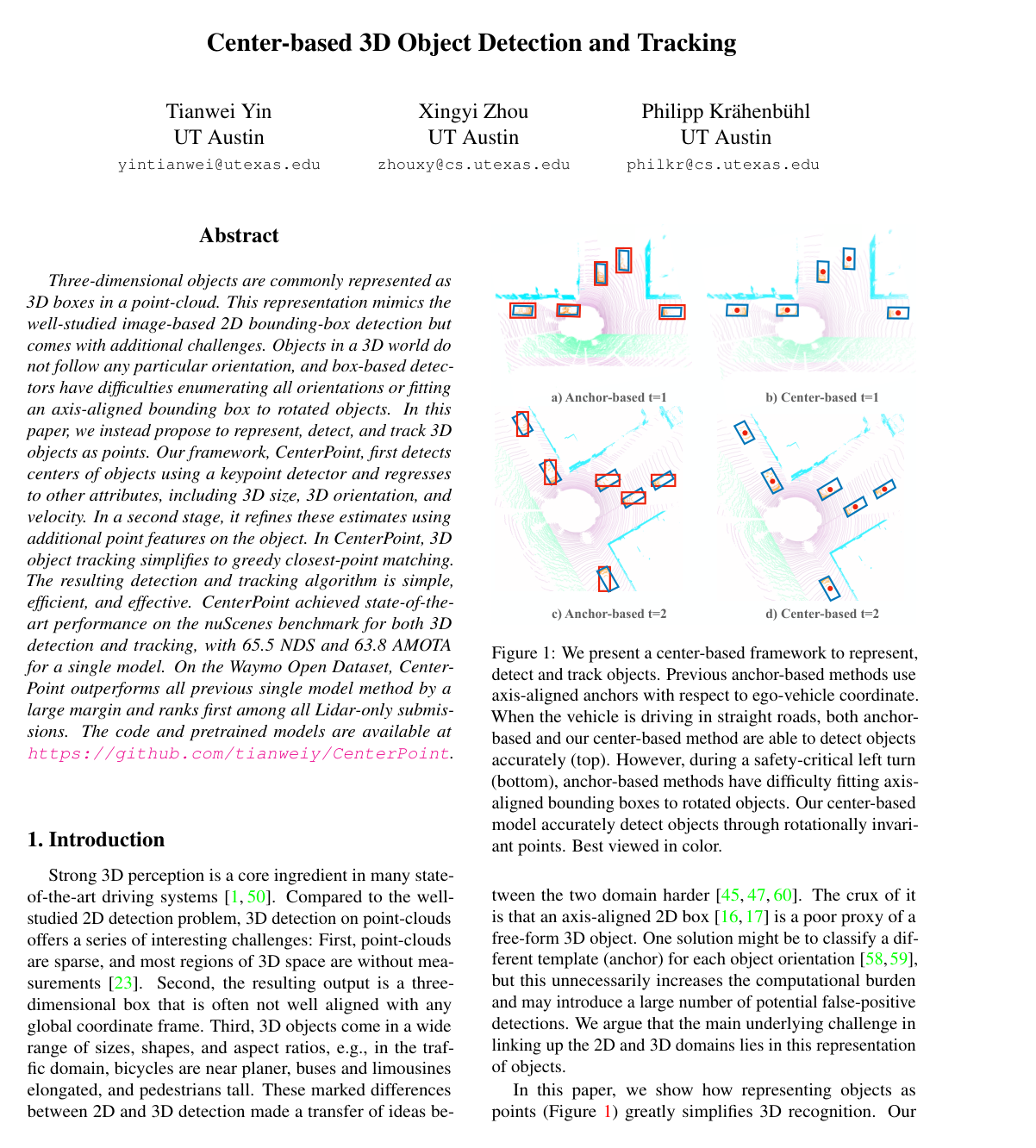
Reliable 3D perception is vital for autonomous driving systems to safely navigate complex environments. Traditional methods attempt to adapt two-dimensional bounding box techniques by aligning boxes to a fixed grid. However, three-dimensional objects in real driving situations can point in any direction, causing standard box-based detectors to struggle during critical maneuvers like turns or when handling objects of unusual shapes and sizes.
The article evaluates CenterPoint, a framework designed to represent, detect, and track 3D objects as orientation-free points rather than rigid bounding boxes. The objective is to demonstrate that a point-centered representation simplifies 3D recognition and tracking while delivering higher accuracy and lower computational overhead.
The authors tested this approach using large-scale automotive benchmark datasets, specifically the Waymo Open Dataset and the nuScenes dataset. The framework first identifies object center points and predicts attributes such as size, orientation, and velocity from an overhead view. An optional lightweight second stage refines these estimates by checking point features across the faces of the predicted 3D bounding box. Tracking is conducted simply by matching estimated object velocities across consecutive frames using closest-point distance matching, avoiding complex filtering systems.
The findings show that switching from box-based templates to a center-based representation improves detection accuracy by roughly 3 to 4 points across standard metrics. On the Waymo benchmark, CenterPoint surpassed previous single-model methods, achieving a 7.1% accuracy gain for vehicles and a 10.6% gain for pedestrians. For multi-object tracking, the framework outperformed prior state-of-the-art approaches by 8.8 points on nuScenes and by up to 50% on Waymo. Furthermore, the tracking module adds only 1 millisecond of computation, allowing the overall system to operate near real time at 11 to 16 frames per second.
These results demonstrate that point-based representations remove the heavy computational burdens and false positives associated with complex box alignment. The framework significantly enhances safety-critical performance, particularly for rotated objects, small objects like traffic cones, and elongated vehicles. The reduction in tracking complexity from dedicated Kalman filters to nearest-neighbor matching allows organizations to lower latency and compute costs without sacrificing tracking precision.
Engineering and perception teams developing autonomous vehicle systems should consider transitioning from anchor-based bounding boxes to point-based detection architectures. Adopting lightweight point-based tracking can immediately reduce compute pipelines. Where maximum precision is necessary and high-density sensor data is available, deploying the two-stage refinement module provides a favorable balance of higher accuracy with less than 10% additional computational cost.
The article notes limitations depending on sensor density. The two-stage refinement module provided significant gains on dense sensor data but showed no improvement on sparser 32-beam point clouds. Additionally, point-grid quantization can constrain refinement for very small objects like pedestrians on lower-resolution configurations. Nonetheless, given consistent top rankings across major public benchmarks, confidence in the framework's core detection and tracking performance remains high.
- Paper: Objects as Points, Xingyi Zhou et al. (2019). Objects as Points establishes the underlying keypoint-based object detection formulation that the source paper adapts and extends to 3D bounding boxes and tracking.
- Paper: nuScenes: A Multimodal Dataset for Autonomous Driving, Holger Caesar et al. (2019). nuScenes provides the primary multimodal autonomous driving benchmark and evaluation metrics upon which the source paper measures and validates its state-of-the-art performance.
- Paper: ByteTrack: Multi-Object Tracking by Associating Every Detection Box, Yifu Zhang et al. (2021). ByteTrack extends tracking principles by associating every detection box including low-score ones, building directly upon the detection and tracking paradigms established in frameworks like CenterPoint.