PointRCNN: 3D Object Proposal Generation and Detection From Point Cloud
Shaoshuai ShiXiaogang WangHongsheng Li
Proposes PointRCNN, a two-stage 3D object detection framework that generates accurate proposals directly from raw point clouds through bottom-up foreground segmentation and canonical box refinement, eliminating the need for voxelization or 2D projections.
In autonomous driving and robotics, reliable 3D object detection from raw LiDAR point clouds remains difficult because the data are irregular and sparse, while the space of possible object positions and orientations is large. Prior approaches often project clouds into bird’s-eye or frontal views, voxelize them, or rely on 2D image detectors to crop regions, all of which discard geometric detail or inherit errors from the 2D stage.
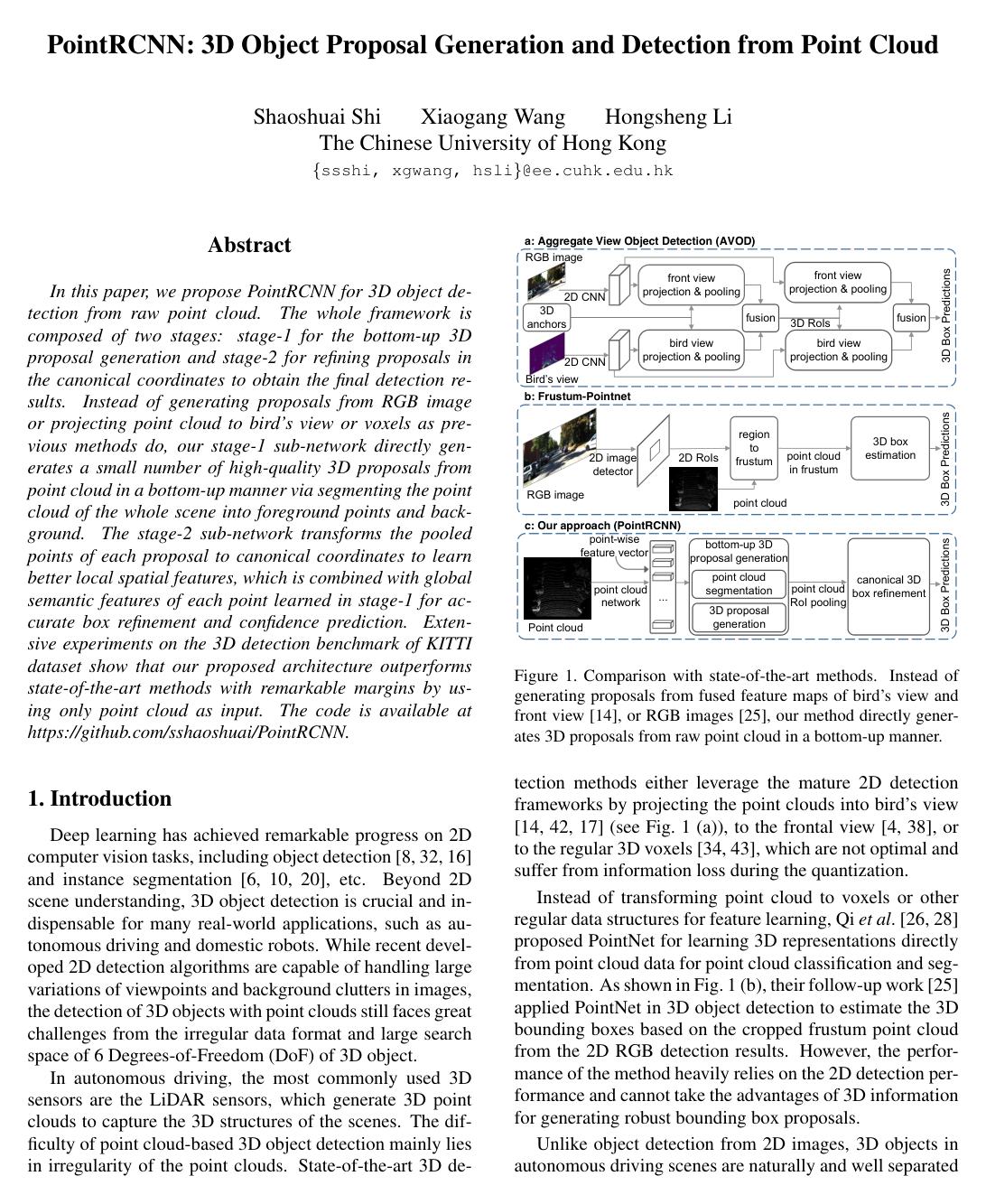
This paper introduces PointRCNN, a two-stage detector that operates directly on unordered point clouds. The first stage segments the entire scene into foreground and background points and simultaneously produces a modest set of oriented 3D box proposals from the foreground points. The second stage pools the points and learned features inside each proposal, transforms them into a canonical coordinate frame aligned with the proposal, and refines the box coordinates and objectness score by fusing local spatial geometry with the global semantic features already computed in stage one. Both stages employ a bin-based regression loss that classifies coarse location or angle bins and then regresses residuals inside the chosen bin.
On the official KITTI test benchmark the method records the highest published accuracy among single-modality (LiDAR-only) entries at the time of submission: 85.94 % / 75.76 % / 68.32 % average precision for cars at the easy, moderate, and hard difficulty levels, together with leading numbers for cyclists. With only 300 proposals it reaches 98.2 % recall at a 0.5 IoU threshold on the validation set, markedly higher than earlier anchor-based or image-guided proposal generators. Ablation experiments confirm that the canonical transformation, the stage-one segmentation features, and the full bin-based loss each contribute several points of accuracy.
These gains matter because they demonstrate that high-quality 3D proposals can be obtained without image fusion or dense voxel grids, lowering both computational cost and the risk of missing objects visible only in 3D. The resulting detections are therefore more robust for downstream planning and safety systems. The framework still shows a modest gap versus multi-sensor methods on small, sparsely observed classes such as pedestrians, and all reported numbers come from a single urban driving dataset.
Further validation on additional LiDAR collections, together with targeted improvements for distant or occluded objects, would strengthen before large-scale deployment.
- Paper: PointNet: Deep Learning on Point Sets for 3D Classification and Segmentation, Charles R. Qi et al. (2017). PointNet established the foundational architecture for processing unordered point sets directly with deep learning, which the source method adapts for bottom-up 3D object proposal generation.
- Paper: PointNet++: Deep Hierarchical Feature Learning on Point Sets in a Metric Space, C. Qi et al. (2017). PointNet++ introduced hierarchical feature learning on point clouds to handle local neighborhoods and density variations, serving as a key methodological stepping stone for the source's multi-stage refinement.
- Paper: VoxelNet: End-to-End Learning for Point Cloud Based 3D Object Detection, Yin Zhou et al. (2017). VoxelNet pioneered end-to-end 3D object detection from raw LiDAR point clouds, providing the primary problem formulation and benchmark context that the source improves upon with its proposal-and-refinement approach.
- Paper: Multi-view 3D Object Detection Network for Autonomous Driving, Xiaozhi Chen et al. (2017). Multi-view 3D detection networks established standard two-stage object localization frameworks on the KITTI benchmark, directly preceding the source's point-cloud-only proposal and refinement pipeline.
- Paper: Fast R-CNN, Ross B. Girshick (2015). Fast R-CNN popularized multi-stage proposal refinement and region-of-interest pooling for object detection, concepts that the source directly translates from 2D image grids into raw 3D point cloud coordinates.
- Paper: KPConv: Flexible and Deformable Convolution for Point Clouds, Hugues Thomas et al. (2019). KPConv extends direct point-cloud processing beyond proposal generation to flexible, deformable convolutions capable of handling large-scale 3D scene segmentation.