Natural Adversarial Examples
Dan HendrycksKevin ZhaoSteven BasartJacob SteinhardtDawn Song
article2019CVPR2,039 citations
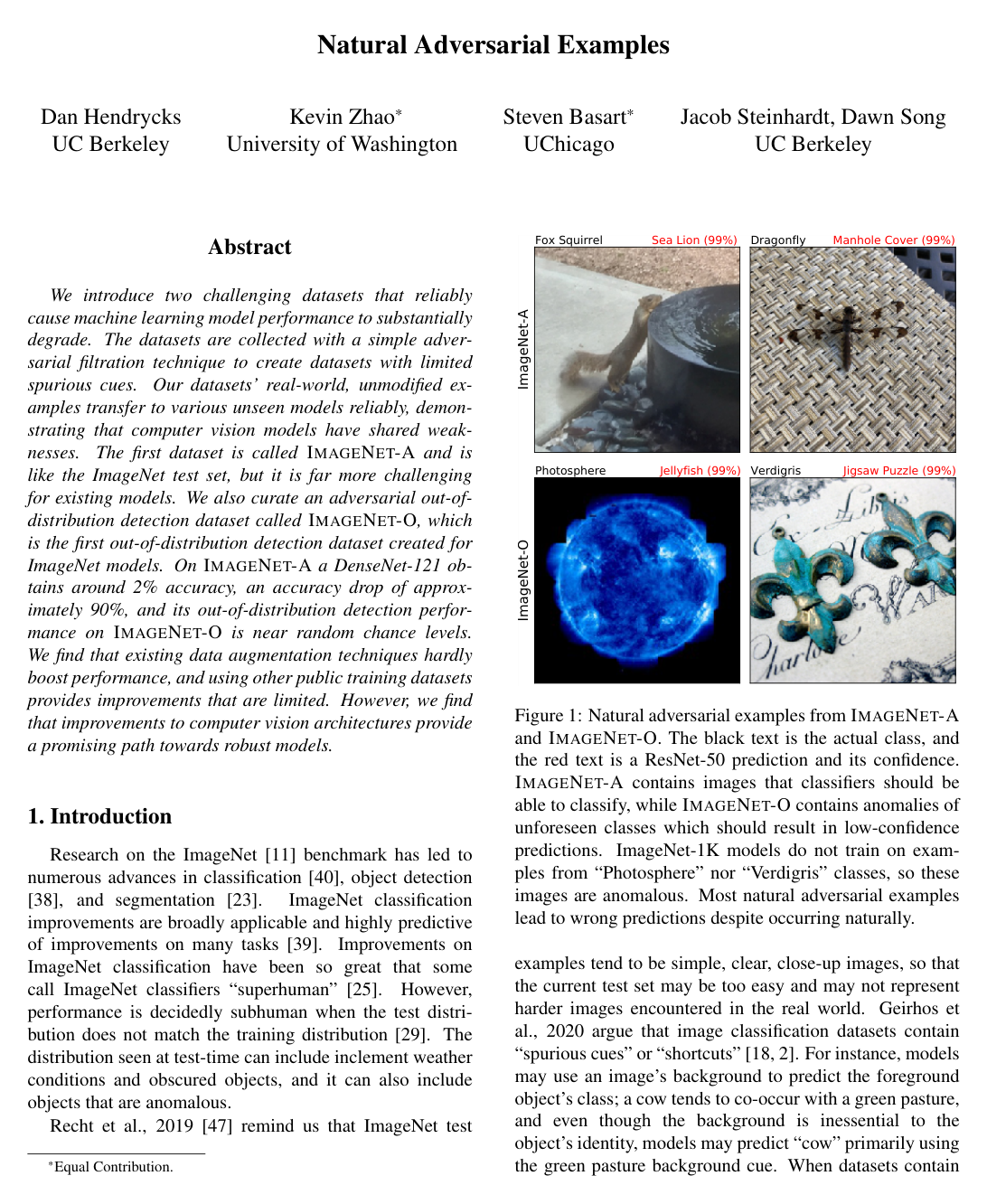
Introduces ImageNet-A and ImageNet-O, two benchmarks of unmodified real-world images that expose shared blind spots in computer vision models by causing severe performance drops without synthetic pixel perturbations.
- Paper: Benchmarking Neural Network Robustness to Common Corruptions and Perturbations, Dan Hendrycks et al. (2019). Introduces foundational benchmarks (ImageNet-C and ImageNet-P) and methodology for systematically evaluating computer vision robustness under distribution shifts that ImageNet-A and ImageNet-O directly build upon.
- Paper: Explaining and Harnessing Adversarial Examples, Ian J. Goodfellow et al. (2015). Establishes the foundational principles of adversarial examples and vulnerability transfer across models that motivate the study of naturally occurring adversarial examples.
- Paper: Intriguing properties of neural networks, Christian Szegedy et al. (2014). Discovered the susceptibility of deep neural networks to adversarial failure modes and cross-model transferability, framing the core vulnerability investigated by this paper.
- Paper: Enhancing The Reliability of Out-of-distribution Image Detection in Neural Networks, Shiyu Liang et al. (2018). Provides the out-of-distribution detection formulations and baseline metrics that ImageNet-O is curated to challenge and evaluate.
- Paper: ImageNet-trained CNNs are biased towards texture; increasing shape bias improves accuracy and robustness, Robert Geirhos et al. (2018). Demonstrates the reliance of standard vision models on texture shortcuts over semantic shapes, explaining why unmodified natural images easily mislead classifiers.
- Paper: Towards Deep Learning Models Resistant to Adversarial Attacks, A. Ma̧dry et al. (2017). Formalizes robust optimization and demonstrates the limits of standard defenses against transfer attacks, informing the paper's investigation into architectural robustness.
- Paper: ImageNet Large Scale Visual Recognition Challenge, Olga Russakovsky et al. (2014). Presents the original ImageNet dataset and classification task definitions from which the ImageNet-A and ImageNet-O benchmarks are derived.
- Paper: Deep neural networks are easily fooled: High confidence predictions for unrecognizable images, Anh Nguyen et al. (2014). Shows that neural networks assign overconfident predictions to out-of-distribution inputs, directly establishing the out-of-distribution vulnerability evaluated by ImageNet-O.
- Paper: The Many Faces of Robustness: A Critical Analysis of Out-of-Distribution Generalization, Dan Hendrycks et al. (2021). Extends the study of real-world out-of-distribution failures by curating multi-modal distribution shift benchmarks (like ImageNet-R) and assessing mitigation strategies.
- Paper: Shortcut learning in deep neural networks, Robert Geirhos et al. (2020). Synthesizes empirical findings from natural adversarial examples into a unified theoretical framework explaining why deep networks rely on superficial shortcuts.
- Paper: Self-Training With Noisy Student Improves ImageNet Classification, Qizhe Xie et al. (2019). Evaluates semi-supervised self-training with Noisy Student directly against the challenging ImageNet-A benchmark introduced in this paper to prove robustness gains.
- Paper: Energy-based Out-of-distribution Detection, Weitang Liu et al. (2020). Proposes energy-based scores to overcome the dramatic out-of-distribution detection failures highlighted on datasets like ImageNet-O.
- Paper: Adversarial Examples Are Not Bugs, They Are Features, Andrew Ilyas et al. (2019). Provides a complementary feature-based perspective explaining why natural, unmodified images can function as transferable adversarial examples.
- Paper: Reliable evaluation of adversarial robustness with an ensemble of diverse parameter-free attacks, Francesco Croce et al. (2020). Develops a standardized evaluation suite (AutoAttack) to provide reliable robustness benchmarking following the failures uncovered by ImageNet-A.
- Paper: Supervised Contrastive Learning, Prannay Khosla et al. (2020). Applies supervised contrastive learning to improve representation quality and benchmark performance against out-of-distribution corruptions.
- Paper: Masked Autoencoders Are Scalable Vision Learners, Kaiming He et al. (2022). Demonstrates that scalable self-supervised pre-training using masked autoencoders substantially strengthens downstream representation robustness.