CLIP is Also an Efficient Segmenter: A Text-Driven Approach for Weakly Supervised Semantic Segmentation
Yuqi LinMinghao ChenWenxiao WangBoxi WuKe LiBinbin LinHaifeng LiuXiaofei He
Presents CLIP-ES, a training-free framework that adapts frozen CLIP models with softmax-modified GradCAM, text-driven prompt strategies, and real-time attention refinement to generate high-quality pseudo segmentation masks tenfold faster than traditional multi-stage weakly supervised methods.
Semantic segmentation—identifying and outlining specific objects within digital images at the pixel level—is critical for computer vision applications but traditionally demands labor-intensive, expensive pixel-by-pixel manual annotations. Weakly supervised semantic segmentation addresses this bottleneck by training models using only image-level tags. However, conventional weak supervision pipelines require complex, multi-stage workflows that train separate classification models and refinement networks, resulting in high computational costs, prolonged training cycles, and noisy object boundaries.
The article evaluates whether a frozen, pre-trained vision-language model (Contrastive Language-Image Pre-training, or CLIP) can directly generate high-quality segmentation masks without task-specific training, and it demonstrates a streamlined framework called CLIP-ES that improves accuracy and efficiency across the entire segmentation pipeline.
The evaluation tests the proposed approach on standard benchmark datasets, including PASCAL VOC 2012 (over 10,500 training images) and MS COCO 2014 (over 82,000 training images). Instead of fine-tuning the base model, the framework leverages the zero-shot capabilities of a Vision Transformer-based CLIP model, applying targeted modifications to gradient-based localization, text prompt engineering, attention-based refinement, and downstream loss calculations.
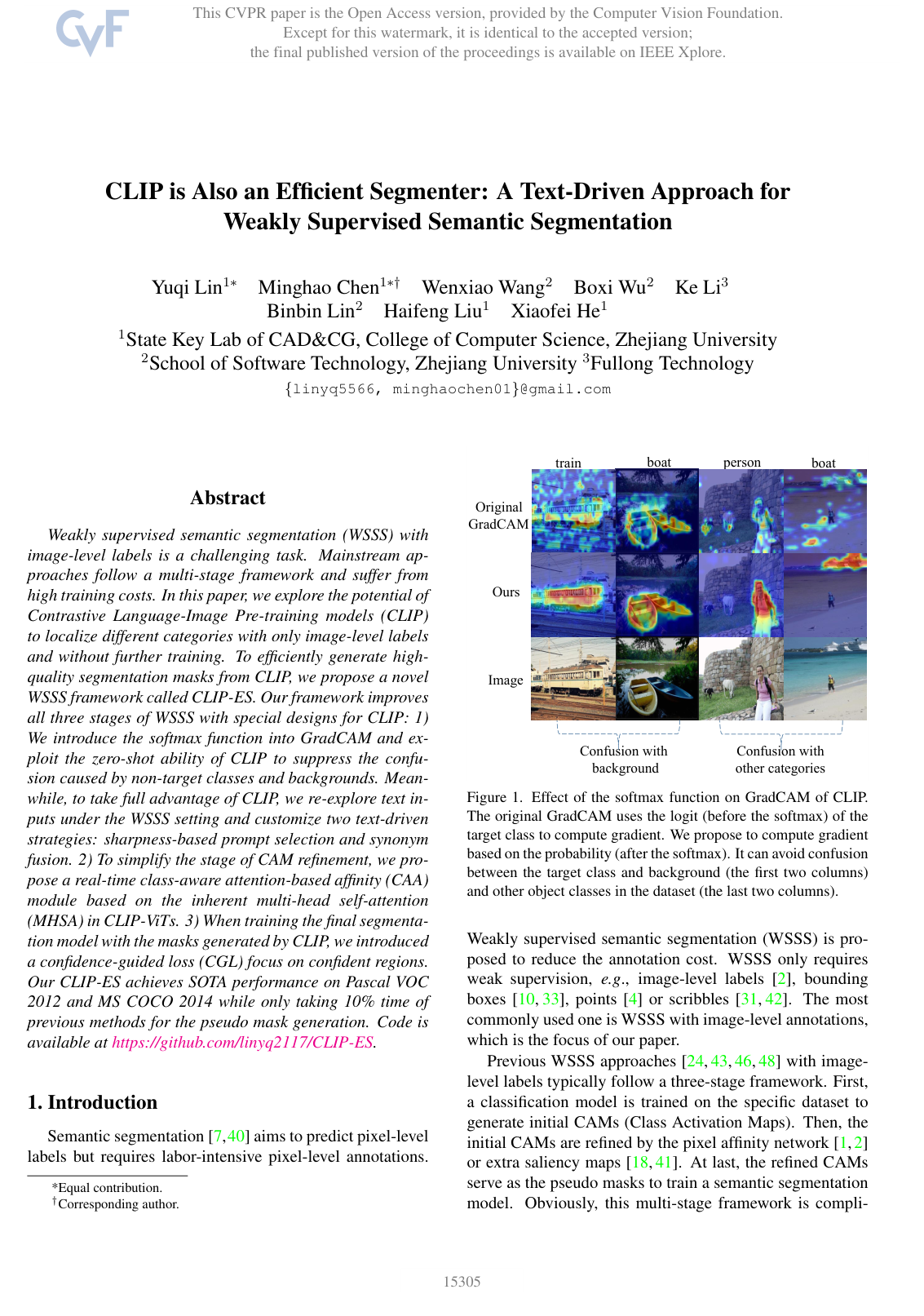
The analysis yields four primary findings. First, modifying gradient activation maps with a softmax function and a defined background category set resolves class confusion, boosting initial activation quality from 49.4% to 58.6% mean Intersection over Union (mIoU) on PASCAL VOC. Second, task-specific text engineering—specifically selecting low-dispersion prompts and fusing synonyms—significantly sharpens localization, improving person category segmentation from 43.6% to 51.6% mIoU. Third, the real-time Class-Aware Attention-based Affinity module refines activation maps to 75.0% mIoU when paired with standard post-processing, eliminating the need to train a dedicated affinity network. Finally, the overall framework generates pseudo-segmentation masks in 0.6 hours using 2 GB of memory—representing a more than tenfold reduction in time and memory compared to leading multi-stage baselines requiring 6 to 77 hours and 18 GB—while establishing state-of-the-art segmentation accuracy of 73.8% mIoU on PASCAL VOC and 45.4% on MS COCO.
These findings indicate that organizations can drastically reduce compute costs, hardware requirements, and development timelines for dense visual recognition tasks by repurposing foundation models rather than training multi-stage architectures from scratch. The results challenge standard practices by showing that single-prompt selection and single-scale inference outperform traditional prompt ensembling and multi-scale aggregation in multi-label segmentation contexts.
Decision-makers should consider adopting training-free vision-language feature extraction for weak supervision pipelines to accelerate model deployment and lower labeling expenses. When implementing this approach, teams should utilize text-driven background suppression and confidence-guided loss functions to filter out boundary noise automatically. Future technical efforts should focus on refining the framework for crowded scenes, occlusions, and very small objects, where performance bottlenecks persist.
Confidence in the reported efficiency and accuracy gains is high within the tested benchmark environments. However, leaders should note that the system's localization relies on semantic representations learned during large-scale pre-training, which may exhibit lower fidelity when applied to highly specialized domain vocabularies or severe object occlusions.
- Paper: Learning Transferable Visual Models From Natural Language Supervision, Alec Radford et al.. Introduces the CLIP vision-language foundation model whose frozen representations, contrastive objective, and zero-shot capabilities form the core basis of CLIP-ES.
- Paper: ReCo: Retrieve and Co-segment for Zero-shot Transfer, Gyungin Shin et al. (2022). Pioneers zero-shot semantic segmentation using pre-trained CLIP representations and visual correspondence, establishing the foundation for dense text-driven localization without pixel annotations.
- Paper: Self-supervised Image-specific Prototype Exploration for Weakly Supervised Semantic Segmentation, Qi Chen et al. (2022). Establishes techniques for refining class activation maps and exploring foreground-background prototypes in weakly supervised semantic segmentation directly benchmarked by CLIP-ES.
- Paper: DualCoOp: Fast Adaptation to Multi-Label Recognition with Limited Annotations, Ximeng Sun et al. (2022). Demonstrates prompt optimization and class-specific spatial feature aggregation using frozen CLIP models for multi-label recognition.
- Paper: Regional Semantic Contrast and Aggregation for Weakly Supervised Semantic Segmentation, Tianfei Zhou et al. (2022). Addresses boundary under-activation and multi-stage overhead in weakly supervised segmentation via regional semantic contrast.
- Paper: Segmenter: Transformer for Semantic Segmentation, Robin Strudel et al. (2021). Introduces pure Vision Transformer architectures for semantic segmentation that underpin the ViT-based feature extractors utilized in CLIP-ES.
- Paper: DeepLab: Semantic Image Segmentation with Deep Convolutional Nets, Atrous Convolution, and Fully Connected CRFs, Liang-Chieh Chen et al. (2016). Provides the foundational DeepLab architecture and dense CRF post-processing widely utilized to refine pseudo-labels in weakly supervised pipelines.
- Paper: CLIP as RNN: Segment Countless Visual Concepts without Training Endeavor, Shuyang Sun et al. (2024). Builds on training-free segmentation with frozen CLIP by introducing a recurrent query-filtering mechanism to segment arbitrary concepts.
- Paper: Alpha-CLIP: A CLIP Model Focusing on Wherever you Want, Zeyi Sun et al. (2024). Extends CLIP's dense spatial capabilities by incorporating an auxiliary alpha channel to directly focus attention on specific regions and masks.
- Paper: Token Contrast for Weakly-Supervised Semantic Segmentation, Lixiang Ru et al. (2023). Advances single-stage weakly supervised semantic segmentation by introducing token contrast to mitigate over-smoothing in Vision Transformers.
- Paper: Out-of-Candidate Rectification for Weakly Supervised Semantic Segmentation, Zesen Cheng et al. (2023). Directly tackles label noise and erroneous class activations in weakly supervised segmentation through out-of-candidate rectification loss functions.
- Paper: Vision-Language Models for Vision Tasks: A Survey, Jingyi Zhang et al. (2023). Provides a comprehensive survey that contextualizes CLIP-based dense prediction and transfer learning methods within the broader vision-language literature.
- Paper: AnomalyCLIP: Object-agnostic Prompt Learning for Zero-shot Anomaly Detection, Qihang Zhou et al. (2024). Applies CLIP-driven zero-shot dense localization and tailored attention mechanisms to pixel-level anomaly segmentation.
- Paper: Open3DIS: Open-Vocabulary 3D Instance Segmentation with 2D Mask Guidance, Phuc D. A. Nguyen et al. (2024). Extends 2D vision-language segmentation principles into open-vocabulary 3D instance segmentation using multi-view 2D mask guidance.