
keyword
language supervision
Language supervision is a machine learning training paradigm in which models learn representations, particularly for visual tasks, directly from descriptive natural language text rather than from fixed categorical labels. Instead of restricting target outputs to a predefined set of discrete classes, models are trained to align visual data with free-form text in a shared embedding space, frequently using contrastive learning or cross-modal grounding objectives. By leveraging the semantic richness and scale of textual descriptions, language supervision enables models to acquire broad, open-vocabulary understanding and transfer effectively to various downstream visual tasks under zero-shot or few-shot conditions without requiring task-specific re-annotation.
3 items
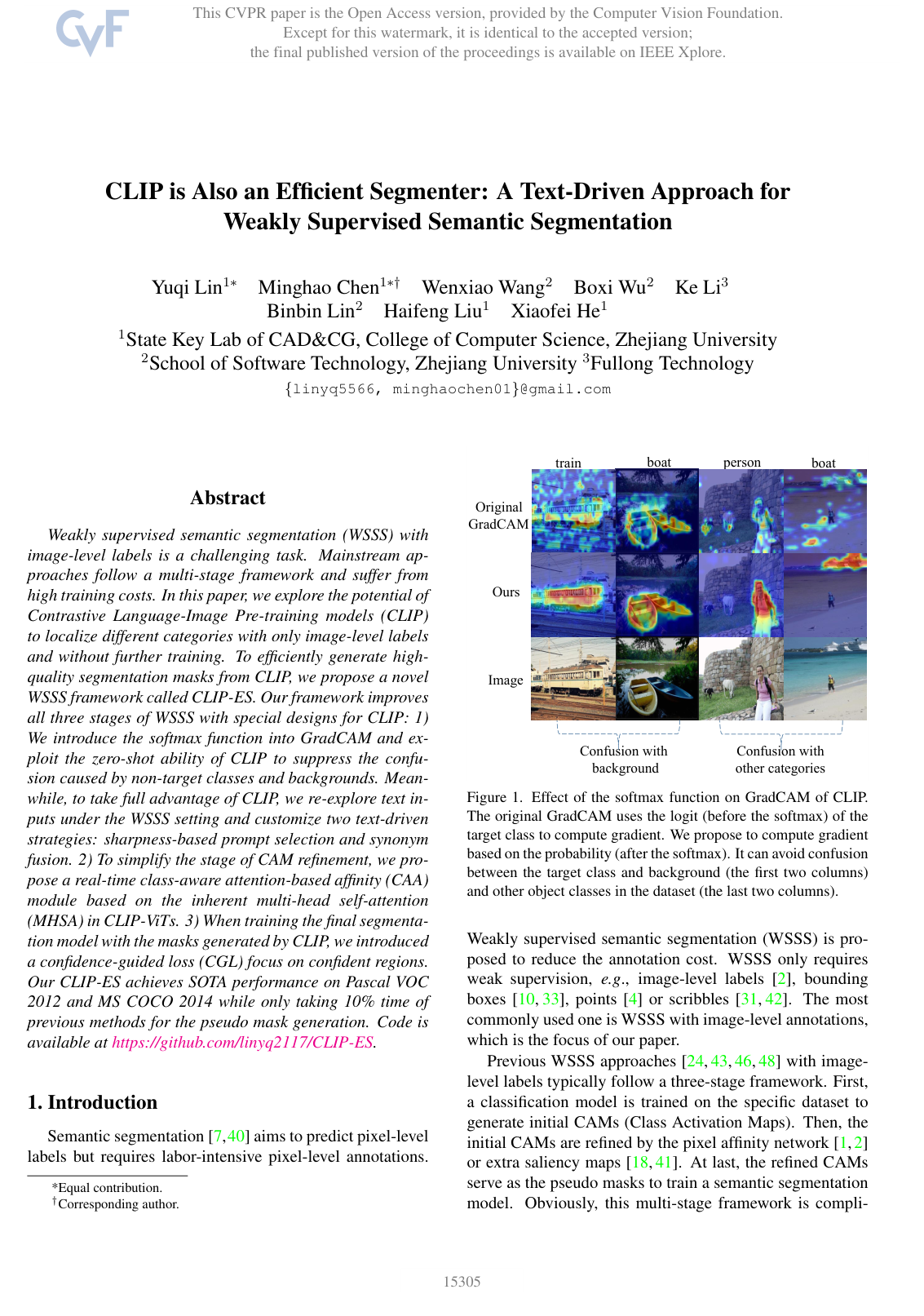
CLIP is Also an Efficient Segmenter: A Text-Driven Approach for Weakly Supervised Semantic Segmentation
Yuqi Lin, Minghao Chen, Wenxiao Wang, Boxi Wu, Ke Li, Binbin Lin, Haifeng Liu, Xiaofei He
Why you should read this
Presents CLIP-ES, a training-free framework that adapts frozen CLIP models with softmax-modified GradCAM, text-driven prompt strategies, and real-time attention refinement to generate high-quality pseudo segmentation masks tenfold faster than traditional multi-stage weakly supervised methods.
Weakly supervised semantic segmentation (WSSS) with image-level labels is a challenging task. Mainstream approaches follow a multi-stage framework and suffer from high training costs. In this paper, we explore the potential of Contrastive Language-Image Pre-training models (CLIP) to localize different categories with only image-level labels and without further training. To efficiently generate high-quality segmentation masks from CLIP, we propose a novel WSSS framework called CLIP-ES. Our framework improves all three stages of WSSS with special designs for CLIP: 1) We introduce the softmax function into GradCAM and exploit the zero-shot ability of CLIP to suppress the confusion caused by non-target classes and backgrounds. Meanwhile, to take full advantage of CLIP, we re-explore text inputs under the WSSS setting and customize two text-driven strategies: sharpness-based prompt selection and synonym fusion. 2) To simplify the stage of CAM refinement, we propose a real-time class-aware attention-based affinity (CAA) module based on the inherent multi-head self-attention (MHSA) in CLIP-ViTs. 3) When training the final segmentation model with the masks generated by CLIP, we introduced a confidence-guided loss (CGL) focus on confident regions. Our CLIP-ES achieves SOTA performance on Pascal VOC 2012 and MS COCO 2014 while only taking 10% time of previous methods for the pseudo mask generation. Code is available at https://github.com/linyq2117/CLIP-ES.
Added
2026-09-26
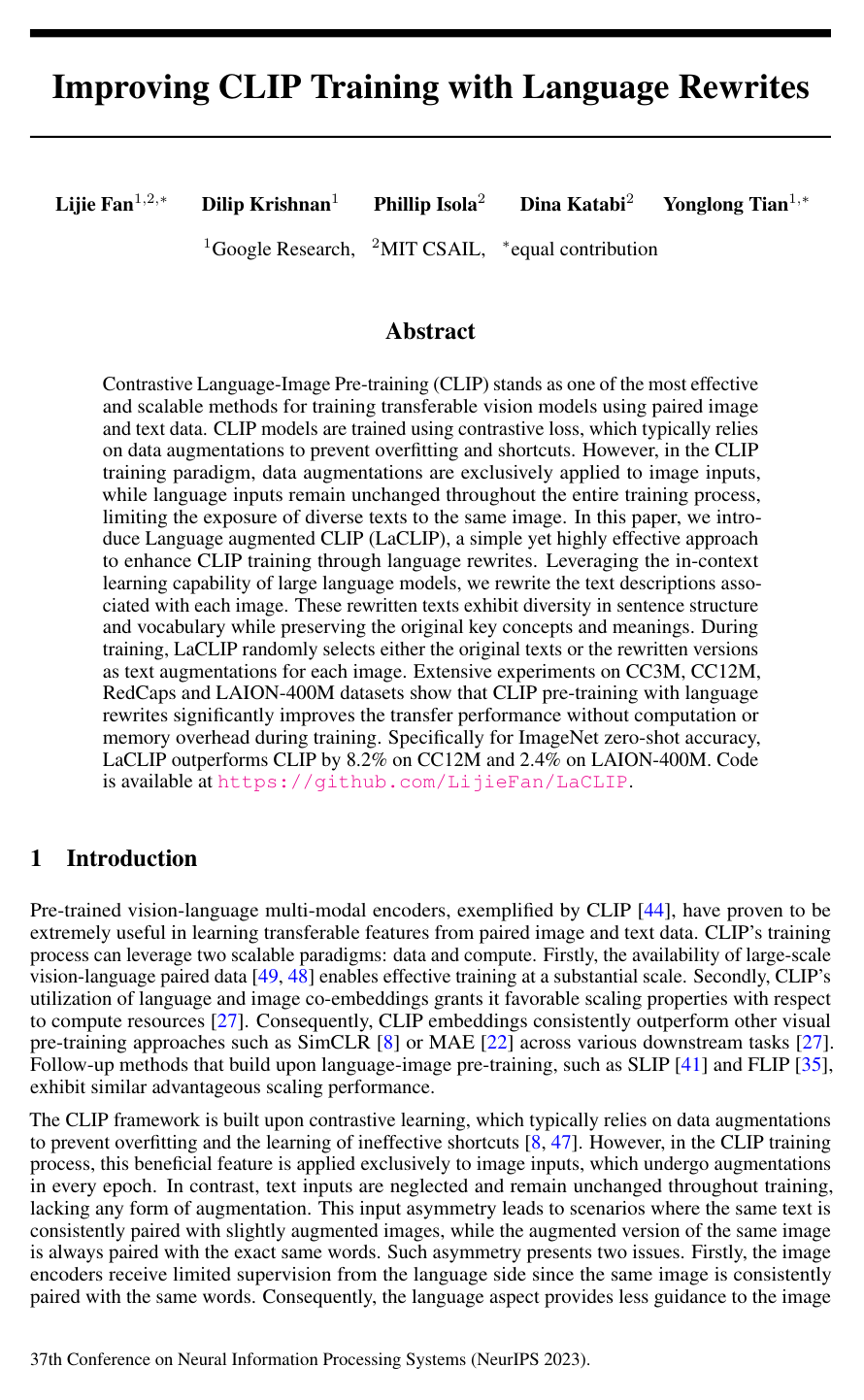
Improving CLIP Training with Language Rewrites
Lijie Fan, Dilip Krishnan, Phillip Isola, Dina Katabi, Yonglong Tian
Why you should read this
Introduces LaCLIP, a simple strategy that uses large language models to generate diverse text augmentations during contrastive pre-training, substantially increasing zero-shot transfer accuracy across vision-language benchmarks without incurring extra training overhead.
Contrastive Language-Image Pre-training (CLIP) stands as one of the most effective and scalable methods for training transferable vision models using paired image and text data. CLIP models are trained using contrastive loss, which typically relies on data augmentations to prevent overfitting and shortcuts. However, in the CLIP training paradigm, data augmentations are exclusively applied to image inputs, while language inputs remain unchanged throughout the entire training process, limiting the exposure of diverse texts to the same image. In this paper, we introduce Language augmented CLIP (LaCLIP), a simple yet highly effective approach to enhance CLIP training through language rewrites. Leveraging the in-context learning capability of large language models, we rewrite the text descriptions associated with each image. These rewritten texts exhibit diversity in sentence structure and vocabulary while preserving the original key concepts and meanings. During training, LaCLIP randomly selects either the original texts or the rewritten versions as text augmentations for each image. Extensive experiments on CC3M, CC12M, RedCaps and LAION-400M datasets show that CLIP pre-training with language rewrites significantly improves the transfer performance without computation or memory overhead during training. Specifically for ImageNet zero-shot accuracy, LaCLIP outperforms CLIP by 8.2% on CC12M and 2.4% on LAION-400M. Code is available at this https URL.
Added
2026-09-26
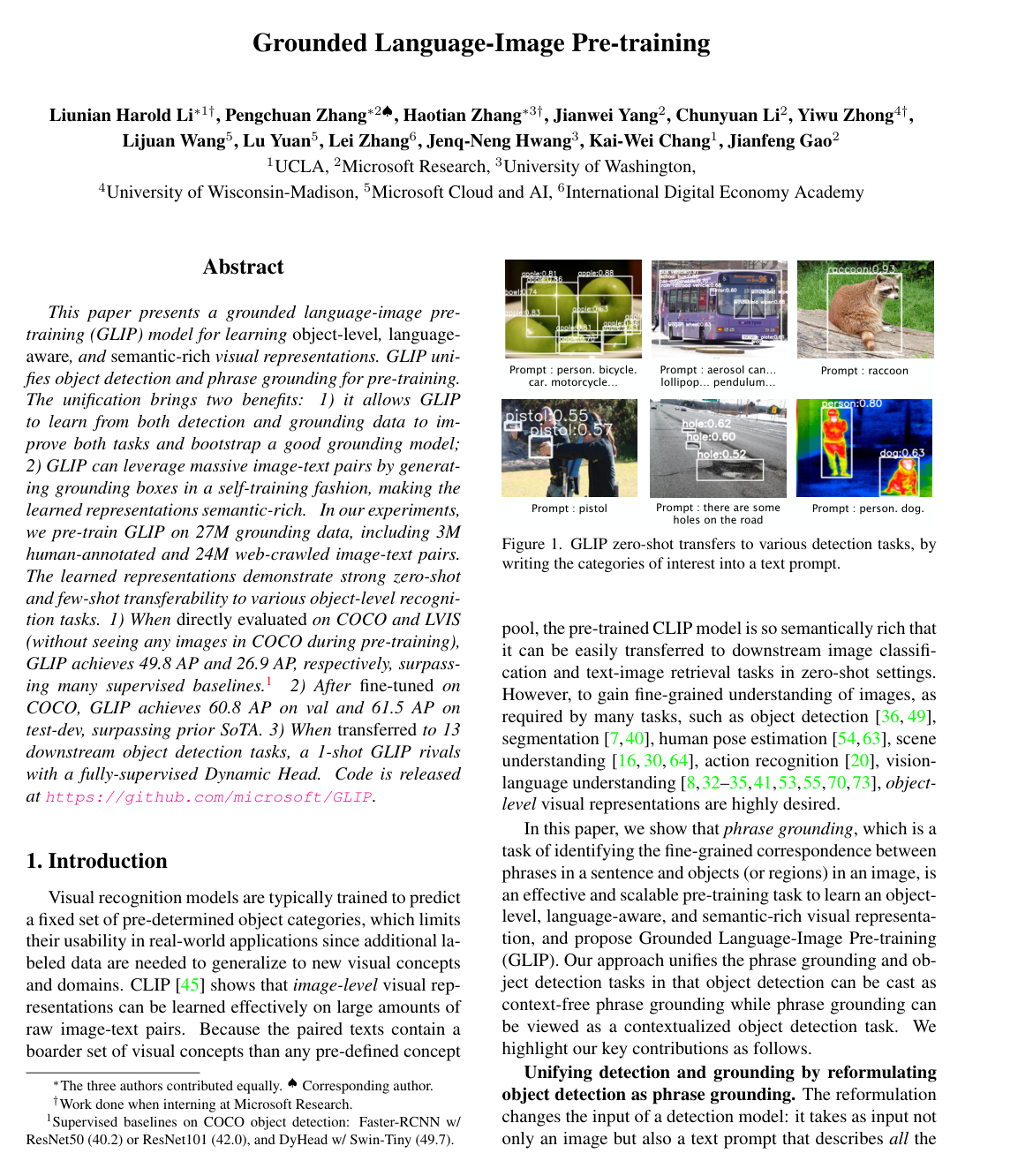
Grounded Language-Image Pre-training
Liunian Harold Li, Pengchuan Zhang, Haotian Zhang, Jianwei Yang, Chunyuan Li, Yiwu Zhong, Lijuan Wang, Lu Yuan, Lei Zhang, Jenq–Neng Hwang, Kai-Wei Chang, Jianfeng Gao
Why you should read this
Unifies object detection and phrase grounding, allowing models to identify and localize objects based on free-form language.
This paper presents a grounded language-image pre-training (GLIP) model for learning object-level, language-aware, and semantic-rich visual representations. GLIP unifies object detection and phrase grounding for pre-training. The unification brings two benefits: 1) it allows GLIP to learn from both detection and grounding data to improve both tasks and bootstrap a good grounding model; 2) GLIP can leverage massive image-text pairs by generating grounding boxes in a self-training fashion, making the learned representation semantic-rich. In our experiments, we pre-train GLIP on 27M grounding data, including 3M human-annotated and 24M web-crawled image-text pairs. The learned representations demonstrate strong zero-shot and few-shot transferability to various object-level recognition tasks. 1) When directly evaluated on COCO and LVIS (without seeing any images in COCO during pre-training), GLIP achieves 49.8 AP and 26.9 AP, respectively, surpassing many supervised baselines. 2) After fine-tuned on COCO, GLIP achieves 60.8 AP on val and 61.5 AP on test-dev, surpassing prior SoTA. 3) When transferred to 13 downstream object detection tasks, a 1-shot GLIP rivals with a fully-supervised Dynamic Head. Code is released at https://github.com/microsoft/GLIP.
Added
2026-01-28