CLIP as RNN: Segment Countless Visual Concepts without Training Endeavor
Shuyang SunRunjia LiPhilip TorrXiuye GuSiyang Li
Presents a training-free recurrent framework that leverages frozen CLIP models to iteratively refine mask proposals and filter non-existent text queries, setting new state-of-the-art benchmarks in zero-shot open-vocabulary semantic and referring segmentation without sacrificing vocabulary breadth.
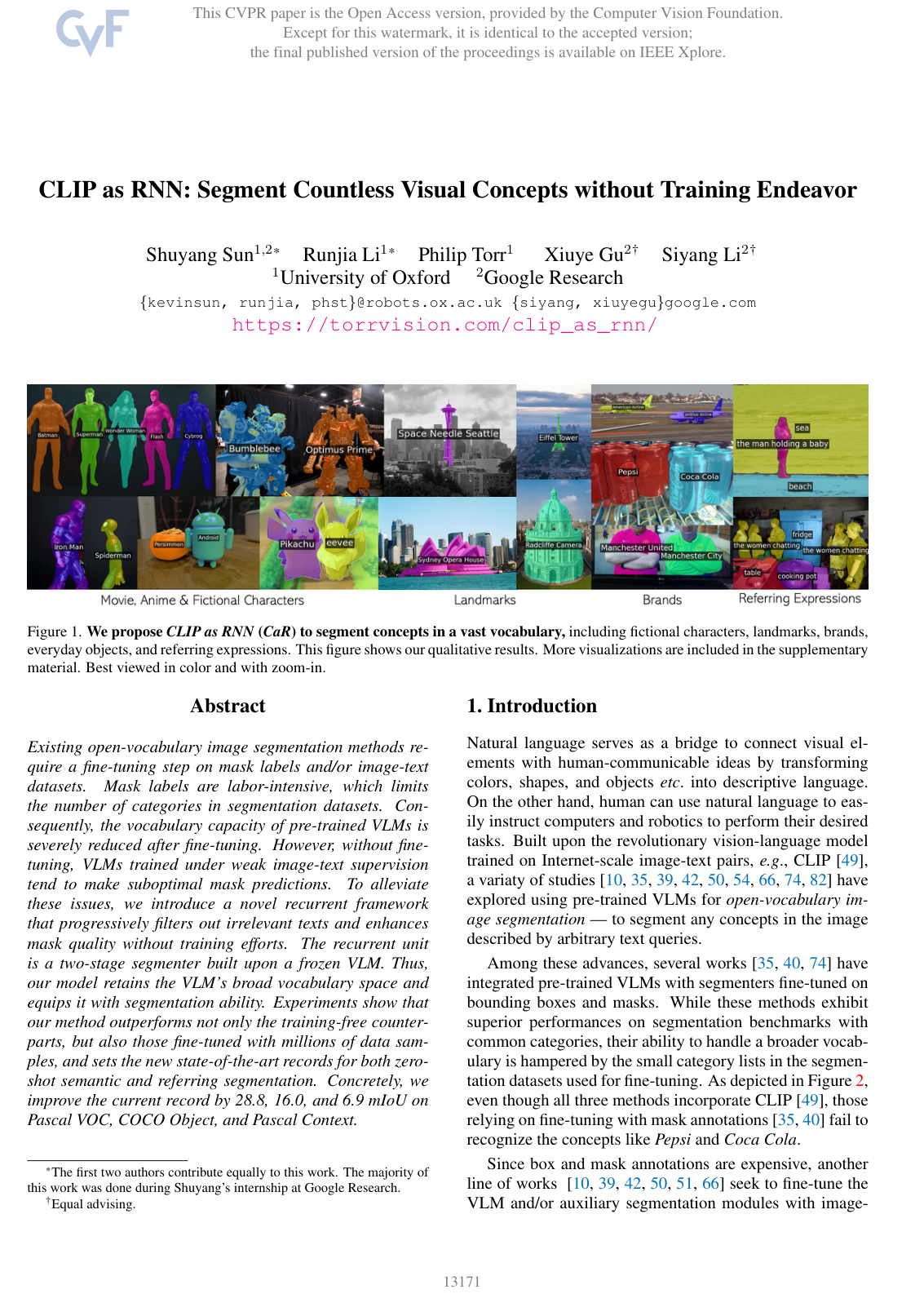
Modern computer vision increasingly requires systems to segment arbitrary visual concepts described by natural language, known as open-vocabulary segmentation. However, standard methods require fine-tuning pre-trained vision-language models on task-specific mask annotations or massive image-text datasets. This fine-tuning process is labor-intensive and dramatically degrades the extensive vocabulary inherited from base models, restricting their recognition capabilities on diverse concepts such as specific brands, landmarks, and fine-grained categories.
The article demonstrates that high-quality visual segmentation can be achieved directly from frozen pre-trained vision-language models without any fine-tuning or extra training. The primary objective is to evaluate whether a recurrent architecture can iteratively align textual queries with visual image features to eliminate irrelevant concepts and generate precise segmentation masks.
To accomplish this, the authors designed a training-free framework called CLIP as RNN. The framework processes an input image and a list of unrestricted text queries through an iterative two-stage cycle using frozen model weights. In each recurrent step, a proposal generator creates candidate visual masks, and a classifier evaluates visual-textual alignment using visual prompts (such as background blur and red circles) to progressively filter out unmatched or nonexistent queries. The process repeats until the query set stabilizes, followed by standard boundary refinement. The methodology was evaluated across eight standard semantic and referring segmentation benchmarks.
Across zero-shot semantic segmentation benchmarks, the proposed method achieved major performance gains without fine-tuning. Compared to existing training-free techniques, it improved mean Intersection-over-Union by 28.8 points on Pascal VOC, 16.0 points on COCO Object, and 6.9 points on Pascal Context. Notably, it also outperformed competing approaches that had been fine-tuned on tens to hundreds of millions of images, surpassing the top fine-tuned baseline by 12.6 points on Pascal VOC and 4.6 points on COCO Object. On referring expression benchmarks, the method established new state-of-the-art zero-shot accuracy across RefCOCO, RefCOCO+, and RefCOCOg, and created a competitive zero-shot baseline for referring video segmentation.
These findings prove that costly data collection, annotation, and model retraining pipelines are not strictly necessary for advanced visual segmentation. By retaining the original weights of foundation models, organizations can preserve extensive open vocabularies while lowering computational overhead and engineering complexity. The approach operated efficiently on a single standard graphics processor, requiring minimal memory and execution time.
Organizations developing computer vision applications should consider adopting recurrent inference pipelines before investing in expensive fine-tuning workflows for open-vocabulary tasks. For production implementations requiring maximum edge precision, integrating optional post-processing segmenters can yield additional boundary accuracy.
The evidence presented provides high confidence in the framework's effectiveness across common semantic and referring segmentation datasets. However, the source notes that the model exhibits reduced sensitivity when segmenting broad contextual background regions (such as "stuff" categories like sky or grass) because foundation models encounter these concepts less frequently during initial training.
- Paper: Learning Transferable Visual Models From Natural Language Supervision, Alec Radford et al.. This foundational work introduces CLIP, the core vision-language model whose frozen representations and visual-text alignment form the direct basis of the source paper's recurrent segmentation architecture.
- Paper: Learning Mask-aware CLIP Representations for Zero-Shot Segmentation, Siyu Jiao et al. (2023). This paper examines how frozen CLIP handles candidate mask proposals in zero-shot segmentation, identifying the proposal-insensitivity challenge that the source paper directly overcomes with recurrent prompt-based alignment.
- Paper: ReCo: Retrieve and Co-segment for Zero-shot Transfer, Gyungin Shin et al. (2022). Understanding ReCo's use of frozen vision-language models for zero-shot pixel-level segmentation provides key context for evaluating training-free cross-modal mask extraction.
- Paper: Open Vocabulary Semantic Segmentation with Patch Aligned Contrastive Learning, Jishnu Mukhoti et al. (2023). This paper highlights the gap between CLIP's global image-text alignment and local patch-level segmentation needs, motivating the training-free recurrent refinement proposed in the source.
- Paper: Per-Pixel Classification is Not All You Need for Semantic Segmentation, Bowen Cheng et al. (2021). This work establishes the mask-classification paradigm for segmentation, which serves as a conceptual foundation for proposal-based open-vocabulary segmentation.
- Paper: DINOv2: Learning Robust Visual Features without Supervision, Maxime Oquab et al. (2023). DINOv2 demonstrates high-quality, dense visual features extracted from self-supervised vision transformers that frequently supply initial candidate proposals in zero-shot segmentation frameworks.
- Paper: GSVA: Generalized Segmentation via Multimodal Large Language Models, Zhuofan Xia et al. (2024). This paper extends open-vocabulary and referring segmentation to handle complex multiple-target and empty-query scenarios using multimodal large language models and foundation segmentation backbones.
- Paper: Prismatic VLMs: Investigating the Design Space of Visually-Conditioned Language Models, Siddharth Karamcheti et al. (2024). This study systematically investigates multimodal vision-language model design choices, including the explicit benefits of keeping vision backbones frozen and combining complementary representations.
- Paper: VisionZip: Longer is Better but Not Necessary in Vision Language Models, Senqiao Yang et al. (2025). This research optimizes inference-time visual token processing in vision-language models, providing an avenue for improving computational efficiency in recurrent vision-language systems.