
keyword
panoptic segmentation
Panoptic segmentation is a computer vision task that unifies semantic segmentation and instance segmentation into a single, comprehensive framework for scene understanding. In this task, every pixel in an image is assigned a semantic category label as well as an instance identifier when applicable, ensuring that the entire visual scene is fully parsed without overlapping segments. The target categories are divided into stuff classes, which represent amorphous and uncountable background regions such as sky, roads, and vegetation, and thing classes, which represent distinct and countable foreground objects such as people and vehicles. By combining the pixel-level classification of background regions with the individualized delineation of specific objects, panoptic segmentation produces a coherent, globally consistent representation of an image, typically evaluated using the panoptic quality metric.
18 items
LISA: Reasoning Segmentation via Large Language Model
Xin Lai, Zhuotao Tian, Yukang Chen, Yanwei Li, Yuhui Yuan, Shu Liu, Jiaya Jia
Why you should read this
Introduces the task of reasoning segmentation alongside LISA, an end-to-end multimodal architecture that decodes special text tokens into binary masks to segment targets specified by implicit, knowledge-intensive user instructions.
Although perception systems have made remarkable advancements in recent years, they still rely on explicit human instruction or pre-defined categories to identify the target objects before executing visual recognition tasks. Such systems cannot actively reason and comprehend implicit user intention. In this work, we propose a new segmentation task — reasoning segmentation. The task is designed to output a segmentation mask given a complex and implicit query text. Furthermore, we establish a benchmark comprising over one thousand image-instruction-mask data samples, incorporating intricate reasoning and world knowledge for evaluation purposes. Finally, we present LISA: large Language Instructed Segmentation Assistant, which inherits the language generation capabilities of multimodal Large Language Models (LLMs) while also possessing the ability to produce segmentation masks. We expand the original vocabulary with a <SEG> token and propose the embedding-as-mask paradigm to unlock the segmentation capability. Remarkably, LISA can handle cases involving complex reasoning and world knowledge. Also, it demonstrates robust zero-shot capability when trained exclusively on reasoning-free datasets. In addition, fine-tuning the model with merely 239 reasoning segmentation data samples results in further performance enhancement. Both quantitative and qualitative experiments show our method effectively unlocks new reasoning segmentation capabilities for multimodal LLMs. Code, models, and data are available at github.com/dvlab-research/LISA.
Added
2026-10-05
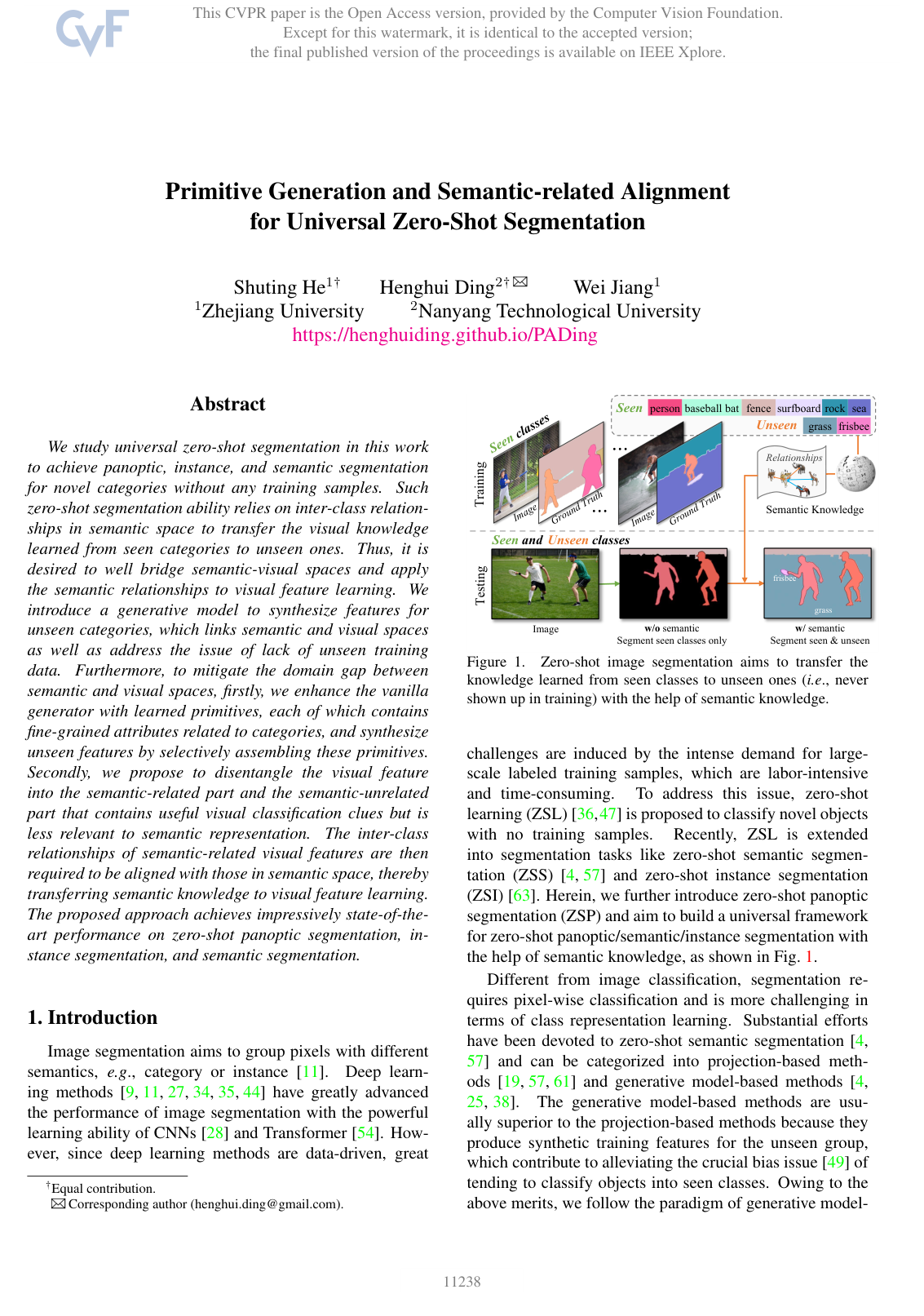
Primitive Generation and Semantic-Related Alignment for Universal Zero-Shot Segmentation
Shuting He, Henghui Ding, Wei Jiang
Why you should read this
Proposes PADing, a unified universal zero-shot segmentation framework that bridges the cross-modal domain gap by assembling learned fine-grained primitives to synthesize unseen visual features and aligning their semantic-related components with linguistic class relationships.
We study universal zero-shot segmentation in this work to achieve panoptic, instance, and semantic segmentation for novel categories without any training samples. Such zero-shot segmentation ability relies on inter-class relationships in semantic space to transfer the visual knowledge learned from seen categories to unseen ones. Thus, it is desired to well bridge semantic and visual spaces and apply the semantic relationships to visual feature learning. We introduce a generative model to synthesize features for unseen categories, which links semantic and visual spaces as well as addresses the issue of lack of unseen training data. Furthermore, to mitigate the domain gap between semantic and visual spaces, firstly, we enhance the vanilla generator with learned primitives, each of which contains fine-grained attributes related to categories, and synthesize unseen features by selectively assembling these primitives. Secondly, we propose to disentangle the visual feature into the semantic-related part and the semantic-unrelated part that contains useful visual classification clues but is less relevant to semantic representation. The inter-class relationships of semantic-related visual features are then required to be aligned with those in semantic space, thereby transferring semantic knowledge to visual feature learning. The proposed approach achieves impressively state-of-the-art performance on zero-shot panoptic segmentation, instance segmentation, and semantic segmentation.
Added
2026-09-26
Learning Mask-aware CLIP Representations for Zero-Shot Segmentation
Siyu Jiao, Yunchao Wei, Yaowei Wang, Yao Zhao, Humphrey Shi
Why you should read this
Proposes a mask-aware fine-tuning strategy that makes pre-trained CLIP sensitive to region-level proposals without adding new parameters or sacrificing zero-shot transferability, substantially boosting unseen-class segmentation accuracy across standard benchmarks.
Recently, pre-trained vision-language models have been increasingly used to tackle the challenging zero-shot segmentation task. Typical solutions follow the paradigm of first generating mask proposals and then adopting CLIP to classify them. To maintain the CLIP's zero-shot transferability, previous practices favour to freeze CLIP during training. However, in the paper, we reveal that CLIP is insensitive to different mask proposals and tends to produce similar predictions for various mask proposals of the same image. This insensitivity results in numerous false positives when classifying mask proposals. This issue mainly relates to the fact that CLIP is trained with image-level supervision. To alleviate this issue, we propose a simple yet effective method, named Mask-aware Fine-tuning (MAFT). Specifically, Image-Proposals CLIP Encoder (IP-CLIP Encoder) is proposed to handle arbitrary numbers of image and mask proposals simultaneously. Then, mask-aware loss and self-distillation loss are designed to fine-tune IP-CLIP Encoder, ensuring CLIP is responsive to different mask proposals while not sacrificing transferability. In this way, mask-aware representations can be easily learned to make the true positives stand out. Notably, our solution can seamlessly plug into most existing methods without introducing any new parameters during the fine-tuning process. We conduct extensive experiments on the popular zero-shot benchmarks. With MAFT, the performance of the state-of-the-art methods is promoted by a large margin: 50.4% (+ 8.2%) on COCO, 81.8% (+ 3.2%) on Pascal-VOC, and 8.7% (+4.3%) on ADE20K in terms of mIoU for unseen classes. Code is available at github.com/jiaosiyu1999/MAFT.git.
Added
2026-09-26
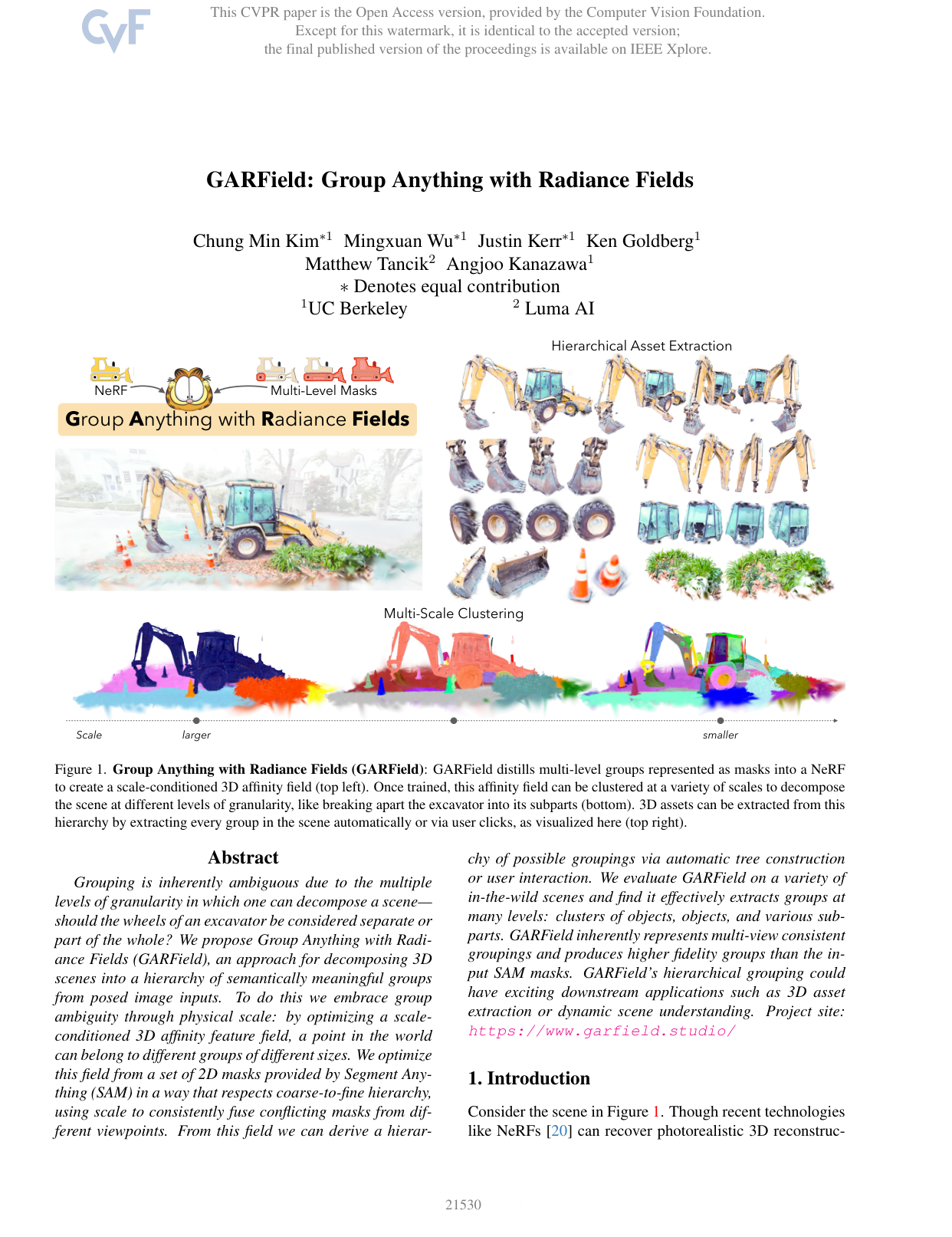
GARField: Group Anything with Radiance Fields
Chung Min Kim, Mingxuan Wu, Justin Kerr, Ken Goldberg, Matthew Tancik, Angjoo Kanazawa
Why you should read this
Proposes a 3D scale-conditioned affinity field that distills multi-level 2D segmentations from SAM into Neural Radiance Fields, enabling automatic and view-consistent hierarchical decomposition of complex 3D scenes for asset extraction and interactive segmentation.
Grouping is inherently ambiguous due to the multiple levels of granularity in which one can decompose a scene—whether the wheels of an excavator be considered separate or part of the whole? We propose Group Anything with Radiance Fields (GARField), an approach for decomposing 3D scenes into a hierarchy of semantically meaningful groups from posed image inputs. To do this we embrace group ambiguity through physical scale: by optimizing a scale-conditioned 3D affinity feature field, a point in the world can belong to different groups of different sizes. We optimize this field from a set of 2D masks provided by Segment Anything (SAM) in a way that respects coarse-to-fine hierarchy, using scale to consistently fuse conflicting masks from different viewpoints. From this field we can derive a hierarchy of possible groupings via automatic tree construction or user interaction. We evaluate GARField on a variety of in-the-wild scenes and find it effectively extracts groups at many levels: clusters of objects, objects, and various subparts. GARField inherently represents multi-view consistent groupings and produces higher fidelity groups than the input SAM masks. GARField's hierarchical grouping could have exciting downstream applications such as 3D asset extraction or dynamic scene understanding. Project site: https://www.garfield.studio/
Added
2026-09-26
Segment Any Point Cloud Sequences by Distilling Vision Foundation Models
Youquan Liu, Lingdong Kong, Jun Cen, Runnan Chen, Wenwei Zhang, Liang Pan, Kai Chen, Ziwei Liu
Why you should read this
Proposes a self-supervised framework that distills 2D vision foundation models into 3D point cloud sequences using spatial-temporal consistency, eliminating the need for manual annotations while setting new state-of-the-art results across eleven diverse automotive datasets.
Recent advancements in vision foundation models (VFMs) have opened up new possibilities for versatile and efficient visual perception. In this work, we introduce Seal, a novel framework that harnesses VFMs for segmenting diverse automotive point cloud sequences. Seal exhibits three appealing properties: i) Scalability: VFMs are directly distilled into point clouds, obviating the need for annotations in either 2D or 3D during pretraining. ii) Consistency: Spatial and temporal relationships are enforced at both the camera-to-LiDAR and point-to-segment regularization stages, facilitating cross-modal representation learning. iii) Generalizability: Seal enables knowledge transfer in an off-the-shelf manner to downstream tasks involving diverse point clouds, including those from real/synthetic, low/high-resolution, large/small-scale, and clean/corrupted datasets. Extensive experiments conducted on eleven different point cloud datasets showcase the effectiveness and superiority of Seal. Notably, Seal achieves a remarkable 45.0% mIoU on nuScenes after linear probing, surpassing random initialization by 36.9% mIoU and outperforming prior arts by 6.1% mIoU. Moreover, Seal demonstrates significant performance gains over existing methods across 20 different few-shot fine-tuning tasks on all eleven tested point cloud datasets. The code is available at this link^2.
Added
2026-09-26
CLIP as RNN: Segment Countless Visual Concepts without Training Endeavor
Shuyang Sun, Runjia Li, Philip Torr, Xiuye Gu, Siyang Li
Why you should read this
Presents a training-free recurrent framework that leverages frozen CLIP models to iteratively refine mask proposals and filter non-existent text queries, setting new state-of-the-art benchmarks in zero-shot open-vocabulary semantic and referring segmentation without sacrificing vocabulary breadth.
Existing open-vocabulary image segmentation methods require a fine-tuning step on mask labels and/or image-text datasets. Mask labels are labor-intensive, which limits the number of categories in segmentation datasets. Consequently, the vocabulary capacity of pre-trained VLMs is severely reduced after fine-tuning. However, without fine-tuning, VLMs trained under weak image-text supervision tend to make suboptimal mask predictions. To alleviate these issues, we introduce a novel recurrent framework that progressively filters out irrelevant texts and enhances mask quality without training efforts. The recurrent unit is a two-stage segmenter built upon a frozen VLM. Thus, our model retains the VLM’s broad vocabulary space and equips it with segmentation ability. Experiments show that our method outperforms not only the training-free counterparts, but also those fine-tuned with millions of data samples, and sets the new state-of-the-art records for both zero-shot semantic and referring segmentation. Concretely, we improve the current record by 28.8, 16.0, and 6.9 mIoU on Pascal VOC, COCO Object, and Pascal Context.
Added
2026-09-26
OpenNeRF: Open Set 3D Neural Scene Segmentation with Pixel-Wise Features and Rendered Novel Views
Francis Engelmann, Fabian Manhardt, Michael Niemeyer, Keisuke Tateno, Federico Tombari
Why you should read this
Presents an open-vocabulary 3D scene segmentation framework that encodes pixel-wise vision-language features directly into neural radiance fields and uses novel-view synthesis to classify unobserved regions, achieving superior accuracy over existing models like LERF and OpenScene.
Large visual-language models (VLMs), like CLIP, enable open-set image segmentation to segment arbitrary concepts from an image in a zero-shot manner. This goes beyond the traditional closed-set assumption, i.e., where models can only segment classes from a pre-defined training set. More recently, first works on open-set segmentation in 3D scenes have appeared in the literature. These methods are heavily influenced by closed-set 3D convolutional approaches that process point clouds or polygon meshes. However, these 3D scene representations do not align well with the image-based nature of the visual-language models. Indeed, point cloud and 3D meshes typically have a lower resolution than images and the reconstructed 3D scene geometry might not project well to the underlying 2D image sequences used to compute pixel-aligned CLIP features. To address these challenges, we propose OpenNeRF which naturally operates on posed images and directly encodes the VLM features within the NeRF. This is similar in spirit to LERF, however our work shows that using pixel-wise VLM features (instead of global CLIP features) results in an overall less complex architecture without the need for additional DINO regularization. Our OpenNeRF further leverages NeRF's ability to render novel views and extract open-set VLM features from areas that are not well observed in the initial posed images. For 3D point cloud segmentation on the Replica dataset, OpenNeRF outperforms recent open-vocabulary methods such as LERF and OpenScene by at least +4.9 mIoU.
Added
2026-09-26
Panoptic Lifting for 3D Scene Understanding with Neural Fields
Yawar Siddiqui, Lorenzo Porzi, Samuel Rota Bulò, Norman Müller, Matthias Nießner, Angela Dai, Peter Kontschieder
Why you should read this
Presents a neural field framework that reconstructs unified 3D panoptic scene representations directly from multi-view images and noisy 2D segmentations without requiring ground-truth 3D annotations or 3D bounding box detectors.
We propose Panoptic Lifting, a novel approach for learning panoptic 3D volumetric representations from images of in-the-wild scenes. Once trained, our model can render color images together with 3D-consistent panoptic segmentation from novel viewpoints. Unlike existing approaches which use 3D input directly or indirectly, our method requires only machine-generated 2D panoptic segmentation masks inferred from a pre-trained network. Our core contribution is a panoptic lifting scheme based on a neural field representation that generates a unified and multi-view consistent, 3D panoptic representation of the scene. To account for inconsistencies of 2D instance identifiers across views, we solve a linear assignment with a cost based on the model’s current predictions and the machine-generated segmentation masks, thus enabling us to lift 2D instances to 3D in a consistent way. We further propose and ablate contributions that make our method more robust to noisy, machine-generated labels, including test-time augmentations for confidence estimates, segment consistency loss, bounded segmentation fields, and gradient stopping. Experimental results validate our approach on the challenging Hypersim, Replica, and ScanNet datasets, improving by 8.4, 13.8, and 10.6% in scene-level PQ over state of the art.
Added
2026-09-26
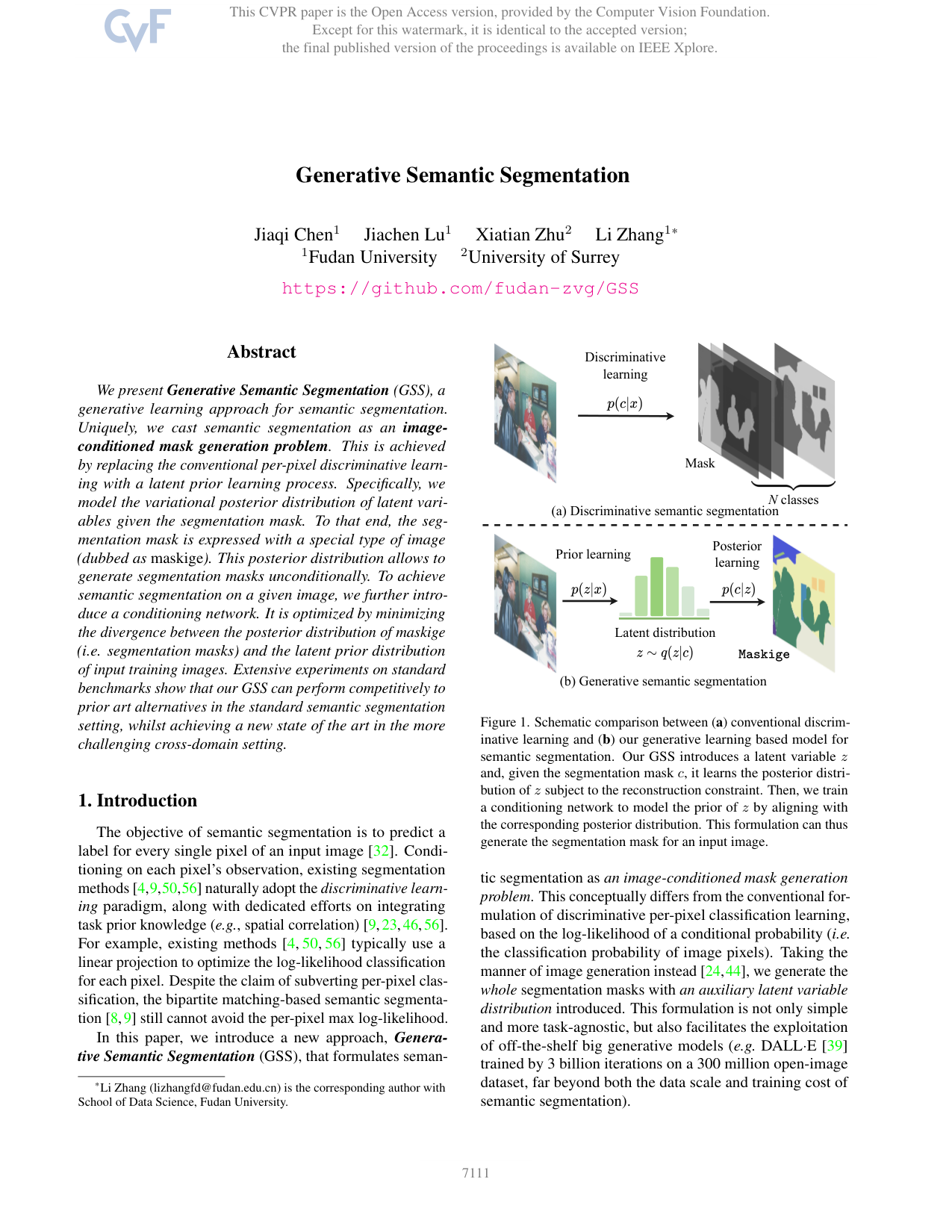
Generative Semantic Segmentation
Jiaqi Chen, Jiachen Lu, Xiatian Zhu, Li Zhang
Why you should read this
Proposes Generative Semantic Segmentation to cast semantic segmentation as an image-conditioned mask generation problem using discrete latent priors and mask-as-image representations, delivering state-of-the-art generalization on challenging cross-domain benchmarks.
We present Generative Semantic Segmentation (GSS), a generative learning approach for semantic segmentation. Uniquely, we cast semantic segmentation as an image-conditioned mask generation problem. This is achieved by replacing the conventional per-pixel discriminative learning with a latent prior learning process. Specifically, we model the variational posterior distribution of latent variables given the segmentation mask. To that end, the segmentation mask is expressed with a special type of image (dubbed as maskige). This posterior distribution allows to generate segmentation masks unconditionally. To achieve semantic segmentation on a given image, we further introduce a conditioning network. It is optimized by minimizing the divergence between the posterior distribution of maskige (i.e. segmentation masks) and the latent prior distribution of input training images. Extensive experiments on standard benchmarks show that our GSS can perform competitively to prior art alternatives in the standard semantic segmentation setting, whilst achieving a new state of the art in the more challenging cross-domain setting.
Added
2026-09-26
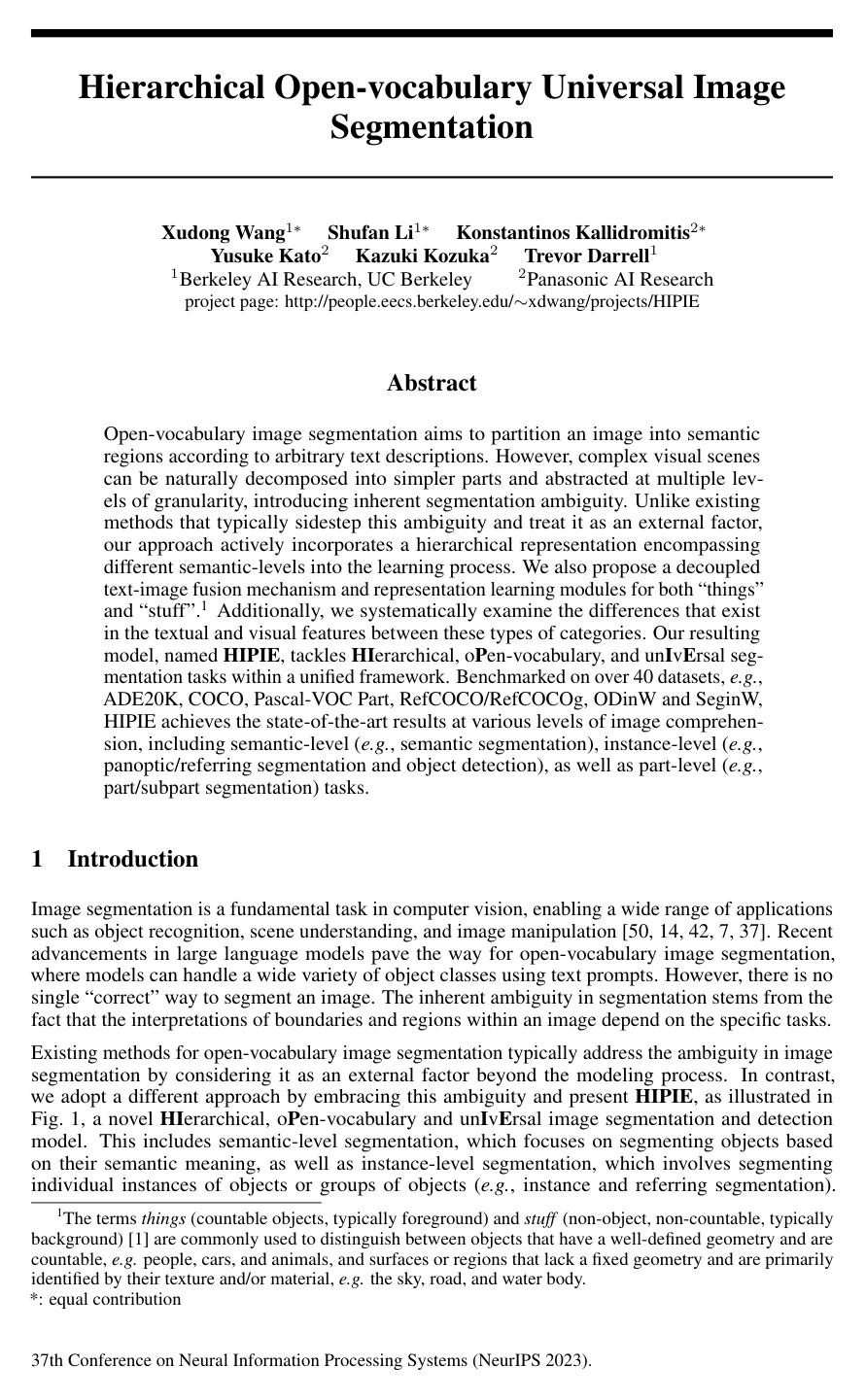
Hierarchical Open-vocabulary Universal Image Segmentation
Xudong Wang, Shufan Li, Konstantinos Kallidromitis, Yusuke Kato, Kazuki Kozuka, Trevor Darrell
Why you should read this
Presents HIPIE, a unified open-vocabulary framework that resolves segmentation ambiguity across multiple granularities by incorporating hierarchical visual representations alongside decoupled text-image fusion mechanisms for stuff and thing categories.
Open-vocabulary image segmentation aims to partition an image into semantic regions according to arbitrary text descriptions. However, complex visual scenes can be naturally decomposed into simpler parts and abstracted at multiple levels of granularity, introducing inherent segmentation ambiguity. Unlike existing methods that typically sidestep this ambiguity and treat it as an external factor, our approach actively incorporates a hierarchical representation encompassing different semantic-levels into the learning process. We also propose a decoupled text-image fusion mechanism and representation learning modules for both “things” and “stuff”.1 Additionally, we systematically examine the differences that exist in the textual and visual features between these types of categories. Our resulting model, named HIPIE, tackles HIerarchical, oPen-vocabulary, and unIvErsal segmentation tasks within a unified framework. Benchmarked on over 40 datasets, e.g., ADE20K, COCO, Pascal-VOC Part, RefCOCO/RefCOCOg, ODinW and SeginW, HIPIE achieves the state-of-the-art results at various levels of image comprehension, including semantic-level (e.g., semantic segmentation), instance-level (e.g., panoptic/referring segmentation and object detection), as well as part-level (e.g., part/subpart segmentation) tasks.
Added
2026-09-26
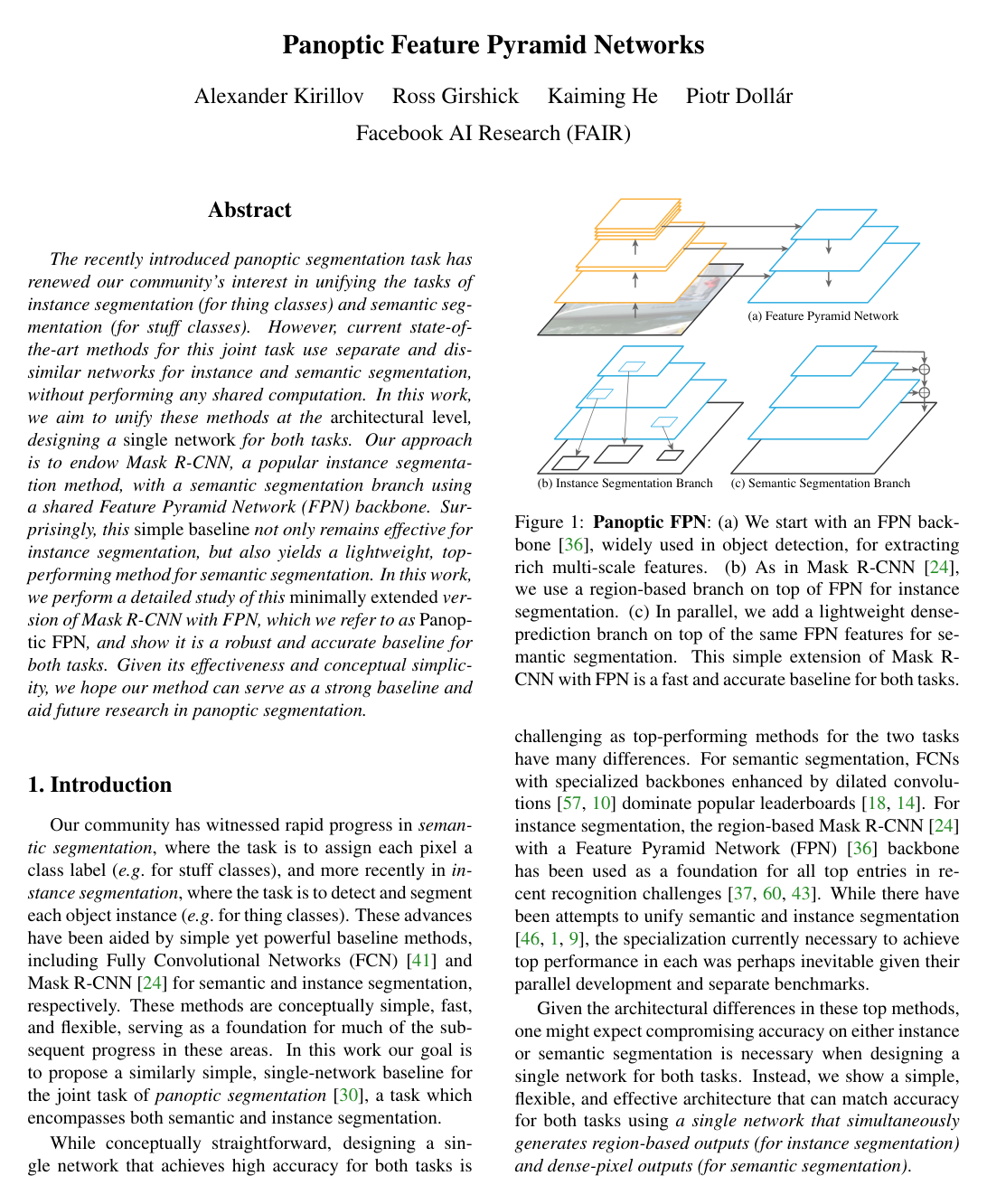
Panoptic Feature Pyramid Networks
Alexander Kirillov, Ross B. Girshick, Kaiming He, Piotr Dollár
Why you should read this
Presents Panoptic FPN, a simple yet highly effective framework that unifies instance and semantic segmentation into a single architecture by adding a lightweight semantic segmentation branch to Mask R-CNN over a shared Feature Pyramid Network backbone.
The recently introduced panoptic segmentation task has renewed our community's interest in unifying the tasks of instance segmentation (for thing classes) and semantic segmentation (for stuff classes). However, current state-of-the-art methods for this joint task use separate and dissimilar networks for instance and semantic segmentation, without performing any shared computation. In this work, we aim to unify these methods at the architectural level, designing a single network for both tasks. Our approach is to endow Mask R-CNN, a popular instance segmentation method, with a semantic segmentation branch using a shared Feature Pyramid Network (FPN) backbone. Surprisingly, this simple baseline not only remains effective for instance segmentation, but also yields a lightweight, top-performing method for semantic segmentation. In this work, we perform a detailed study of this minimally extended version of Mask R-CNN with FPN, which we refer to as Panoptic FPN, and show it is a robust and accurate baseline for both tasks. Given its effectiveness and conceptual simplicity, we hope our method can serve as a strong baseline and aid future research in panoptic segmentation.
Added
2026-09-24
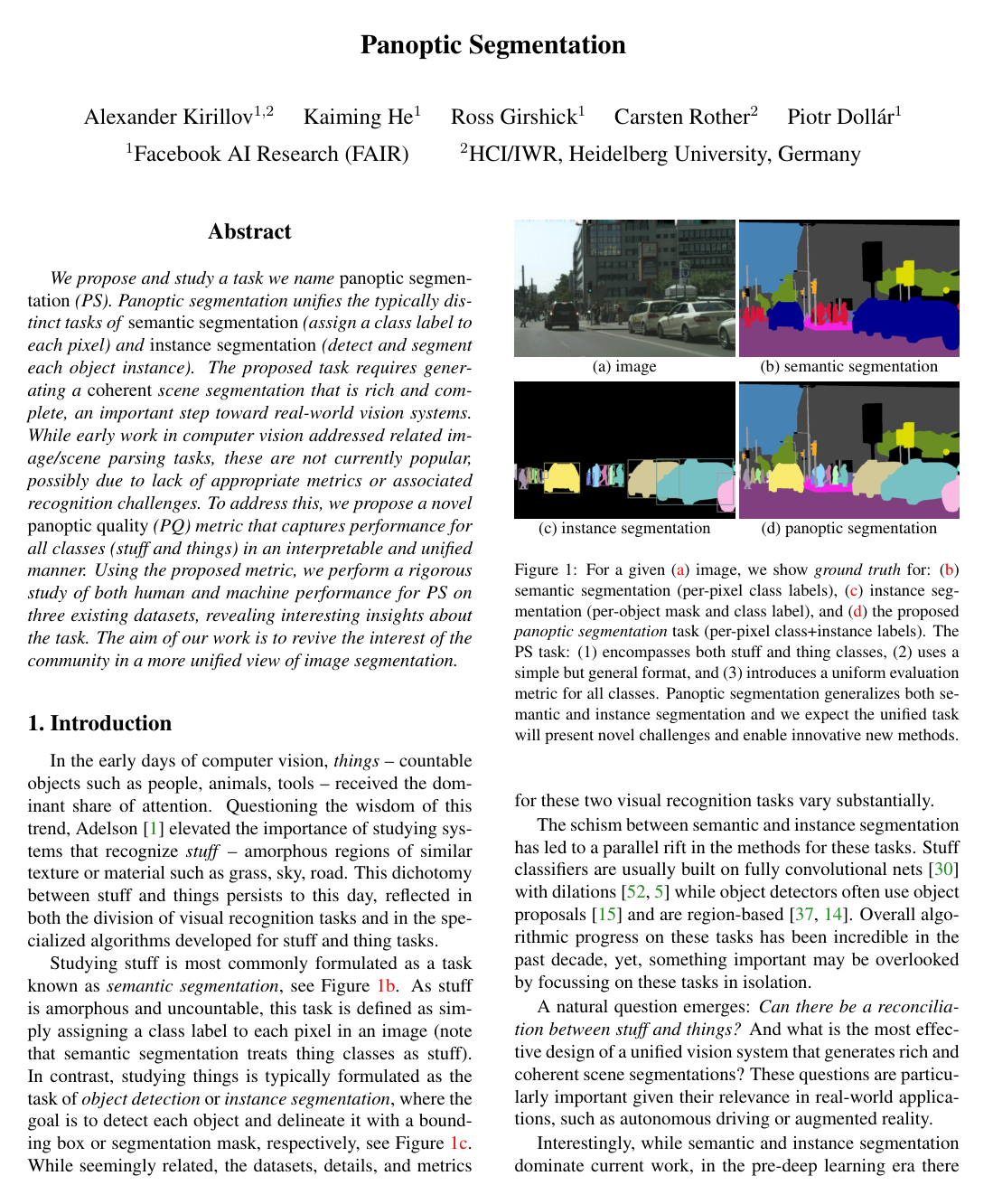
Panoptic Segmentation
Alexander Kirillov, Kaiming He, Ross Girshick, Carsten Rother, Piotr Dollár
Why you should read this
Introduces panoptic segmentation to unify semantic and instance segmentation into a single visual recognition task, establishing the Panoptic Quality metric to evaluate both countable objects and background regions within a standardized framework.
We propose and study a task we name panoptic segmentation (PS). Panoptic segmentation unifies the typically distinct tasks of semantic segmentation (assign a class label to each pixel) and instance segmentation (detect and segment each object instance). The proposed task requires generating a coherent scene segmentation that is rich and complete, an important step toward real-world vision systems. While early work in computer vision addressed related image/scene parsing tasks, these are not currently popular, possibly due to lack of appropriate metrics or associated recognition challenges. To address this, we propose a novel panoptic quality (PQ) metric that captures performance for all classes (stuff and things) in an interpretable and unified manner. Using the proposed metric, we perform a rigorous study of both human and machine performance for PS on three existing datasets, revealing interesting insights about the task. The aim of our work is to revive the interest of the community in a more unified view of image segmentation.
Added
2026-09-24
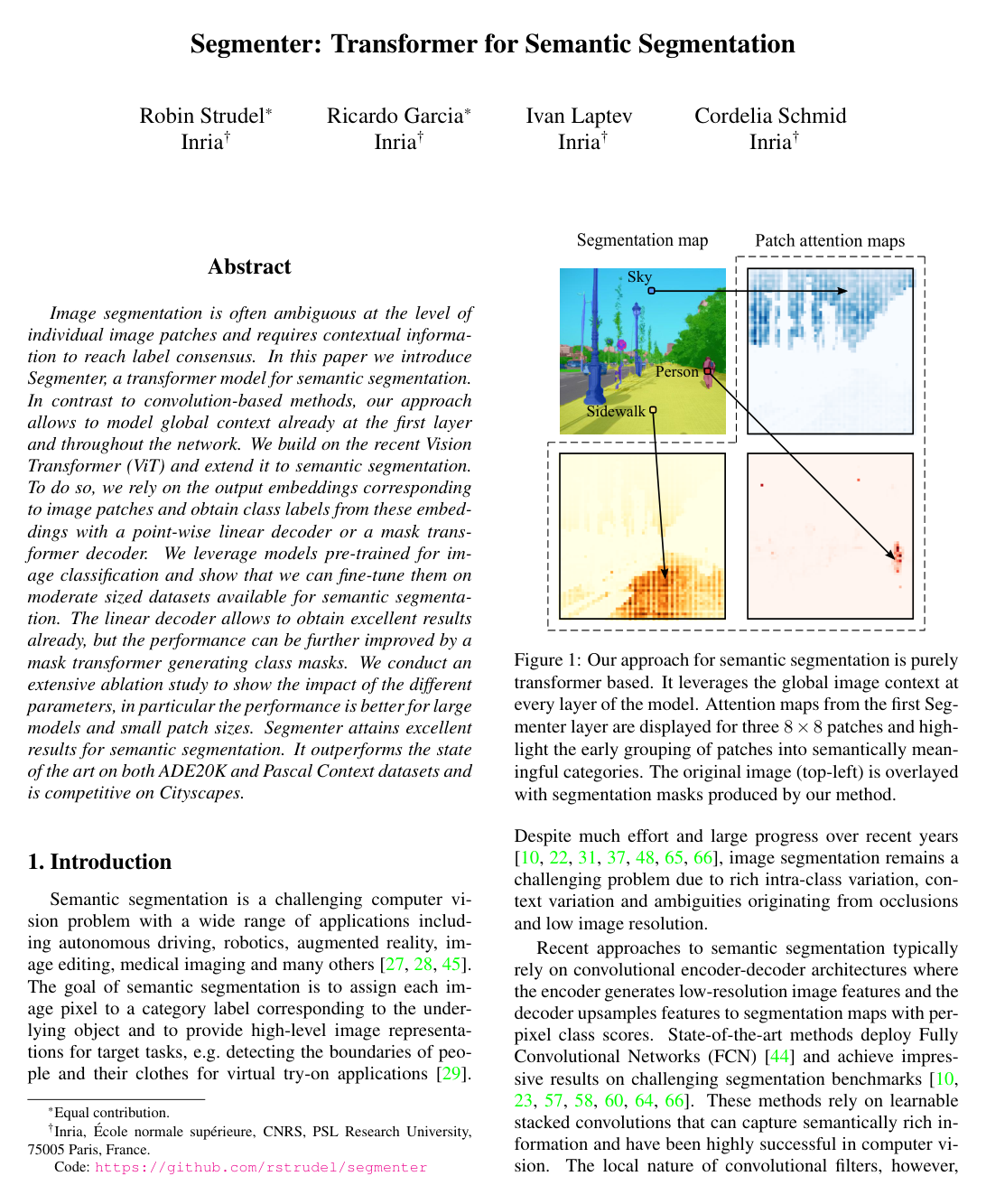
Segmenter: Transformer for Semantic Segmentation
Robin Strudel, Ricardo Garcia, Ivan Laptev, Cordelia Schmid
Why you should read this
Introduces Segmenter, an end-to-end Vision Transformer architecture for semantic segmentation that captures global context throughout the network using a mask transformer decoder, surpassing convolutional baselines on the ADE20K and Pascal Context benchmarks.
Image segmentation is often ambiguous at the level of individual image patches and requires contextual information to reach label consensus. In this paper we introduce Segmenter, a transformer model for semantic segmentation. In contrast to convolution-based methods, our approach allows to model global context already at the first layer and throughout the network. We build on the recent Vision Transformer (ViT) and extend it to semantic segmentation. To do so, we rely on the output embeddings corresponding to image patches and obtain class labels from these embeddings with a point-wise linear decoder or a mask transformer decoder. We leverage models pre-trained for image classification and show that we can fine-tune them on moderate sized datasets available for semantic segmentation. The linear decoder allows to obtain excellent results already, but the performance can be further improved by a mask transformer generating class masks. We conduct an extensive ablation study to show the impact of the different parameters, in particular the performance is better for large models and small patch sizes. Segmenter attains excellent results for semantic segmentation. It outperforms the state of the art on both ADE20K and Pascal Context datasets and is competitive on Cityscapes.
Added
2026-09-17
Per-Pixel Classification is Not All You Need for Semantic Segmentation
Bowen Cheng, Alexander G. Schwing, Alexander Kirillov
Why you should read this
Proposes MaskFormer, a unified mask classification framework that replaces standard per-pixel approaches to achieve state-of-the-art accuracy across both semantic and panoptic segmentation benchmarks.
Modern approaches typically formulate semantic segmentation as a per-pixel classification task, while instance-level segmentation is handled with an alternative mask classification. Our key insight: mask classification is sufficiently general to solve both semantic- and instance-level segmentation tasks in a unified manner using the exact same model, loss, and training procedure. Following this observation, we propose MaskFormer, a simple mask classification model which predicts a set of binary masks, each associated with a single global class label prediction. Overall, the proposed mask classification-based method simplifies the landscape of effective approaches to semantic and panoptic segmentation tasks and shows excellent empirical results. In particular, we observe that MaskFormer outperforms per-pixel classification baselines when the number of classes is large. Our mask classification-based method outperforms both current state-of-the-art semantic (55.6 mIoU on ADE20K) and panoptic segmentation (52.7 PQ on COCO) models.
Added
2026-09-16
A Survey of Convolutional Neural Networks: Analysis, Applications, and Prospects
Zewen Li, Fan Liu, Wenjie Yang, Shou-Heng Peng, Jun Zhou
Why you should read this
Synthesizes structural advancements across one-dimensional, two-dimensional, and multi-dimensional convolutional neural networks, offering experimentally grounded rules of thumb for model design and highlighting critical directions for future research.
Convolutional Neural Network (CNN) is one of the most significant networks in the deep learning field. Since CNN made impressive achievements in many areas, including but not limited to computer vision and natural language processing, it attracted much attention both of industry and academia in the past few years. The existing reviews mainly focus on the applications of CNN in different scenarios without considering CNN from a general perspective, and some novel ideas proposed recently are not covered. In this review, we aim to provide novel ideas and prospects in this fast-growing field as much as possible. Besides, not only two-dimensional convolution but also one-dimensional and multi-dimensional ones are involved. First, this review starts with a brief introduction to the history of CNN. Second, we provide an overview of CNN. Third, classic and advanced CNN models are introduced, especially those key points making them reach state-of-the-art results. Fourth, through experimental analysis, we draw some conclusions and provide several rules of thumb for function selection. Fifth, the applications of one-dimensional, two-dimensional, and multi-dimensional convolution are covered. Finally, some open issues and promising directions for CNN are discussed to serve as guidelines for future work.
Added
2026-09-13
Rethinking Semantic Segmentation from a Sequence-to-Sequence Perspective with Transformers
Sixiao Zheng, Jiachen Lu, Hengshuang Zhao, Xiatian Zhu, Zekun Luo, Yabiao Wang, Yanwei Fu, Jianfeng Feng, Tao Xiang, Philip H. S. Torr, Li Zhang
Why you should read this
Introduces the SEgmentation TRansformer (SETR), replacing traditional convolutional encoder-decoder models with a pure sequence-to-sequence transformer that extracts global visual context across every layer to achieve state-of-the-art accuracy on major benchmarks like ADE20K.
Most recent semantic segmentation methods adopt a fully-convolutional network (FCN) with an encoder-decoder architecture. The encoder progressively reduces the spatial resolution and learns more abstract/semantic visual concepts with larger receptive fields. Since context modeling is critical for segmentation, the latest efforts have been focused on increasing the receptive field, through either dilated/atrous convolutions or inserting attention modules. However, the encoder-decoder based FCN architecture remains unchanged. In this paper, we aim to provide an alternative perspective by treating semantic segmentation as a sequence-to-sequence prediction task. Specifically, we deploy a pure transformer (ie, without convolution and resolution reduction) to encode an image as a sequence of patches. With the global context modeled in every layer of the transformer, this encoder can be combined with a simple decoder to provide a powerful segmentation model, termed SEgmentation TRansformer (SETR). Extensive experiments show that SETR achieves new state of the art on ADE20K (50.28% mIoU), Pascal Context (55.83% mIoU) and competitive results on Cityscapes. Particularly, we achieve the first position in the highly competitive ADE20K test server leaderboard on the day of submission.
Added
2026-09-11

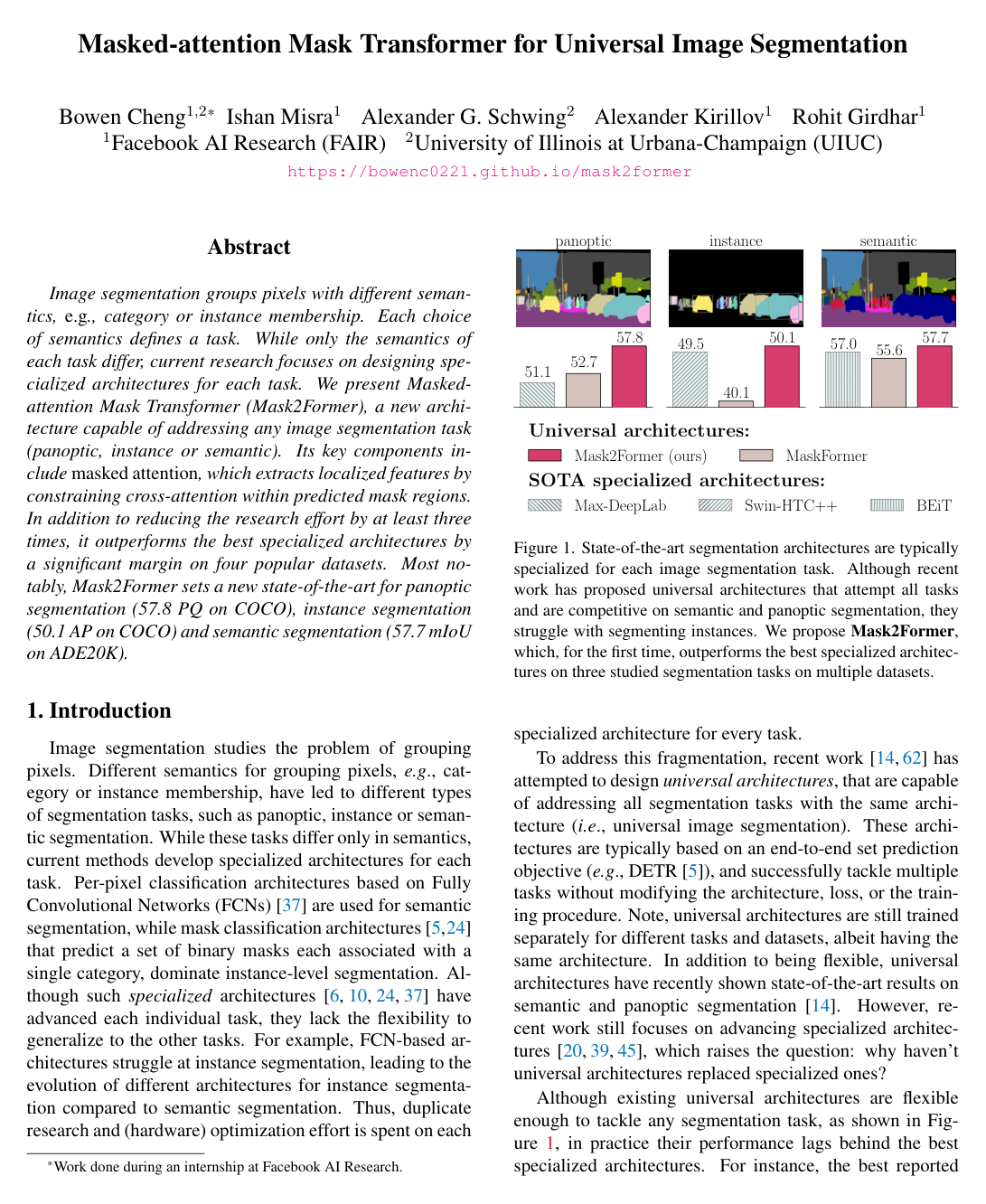
Masked-attention Mask Transformer for Universal Image Segmentation
Bowen Cheng, Ishan Misra, Alexander G. Schwing, Alexander Kirillov, Rohit Girdhar
Why you should read this
Proposes Mask2Former, a unified segmentation architecture that utilizes masked attention to constrain cross-attention within predicted mask regions, achieving state-of-the-art performance across panoptic, instance, and semantic segmentation tasks while significantly improving training efficiency and convergence.
Image segmentation groups pixels with different semantics, e.g., category or instance membership. Each choice of semantics defines a task. While only the semantics of each task differ, current research focuses on designing spe-cialized architectures for each task. We present Masked- attention Mask Transformer (Mask2Former), a new archi-tecture capable of addressing any image segmentation task (panoptic, instance or semantic). Its key components in-clude masked attention, which extracts localized features by constraining cross-attention within predicted mask regions. In addition to reducing the research effort by at least three times, it outperforms the best specialized architectures by a significant margin on four popular datasets. Most no-tably, Mask2Former sets a new state-of-the-art for panoptic segmentation (57.8 PQ on COCO), instance segmentation (50.1 AP on COCO) and semantic segmentation (57.7 mIoU onADE20K).
Added
2026-05-18
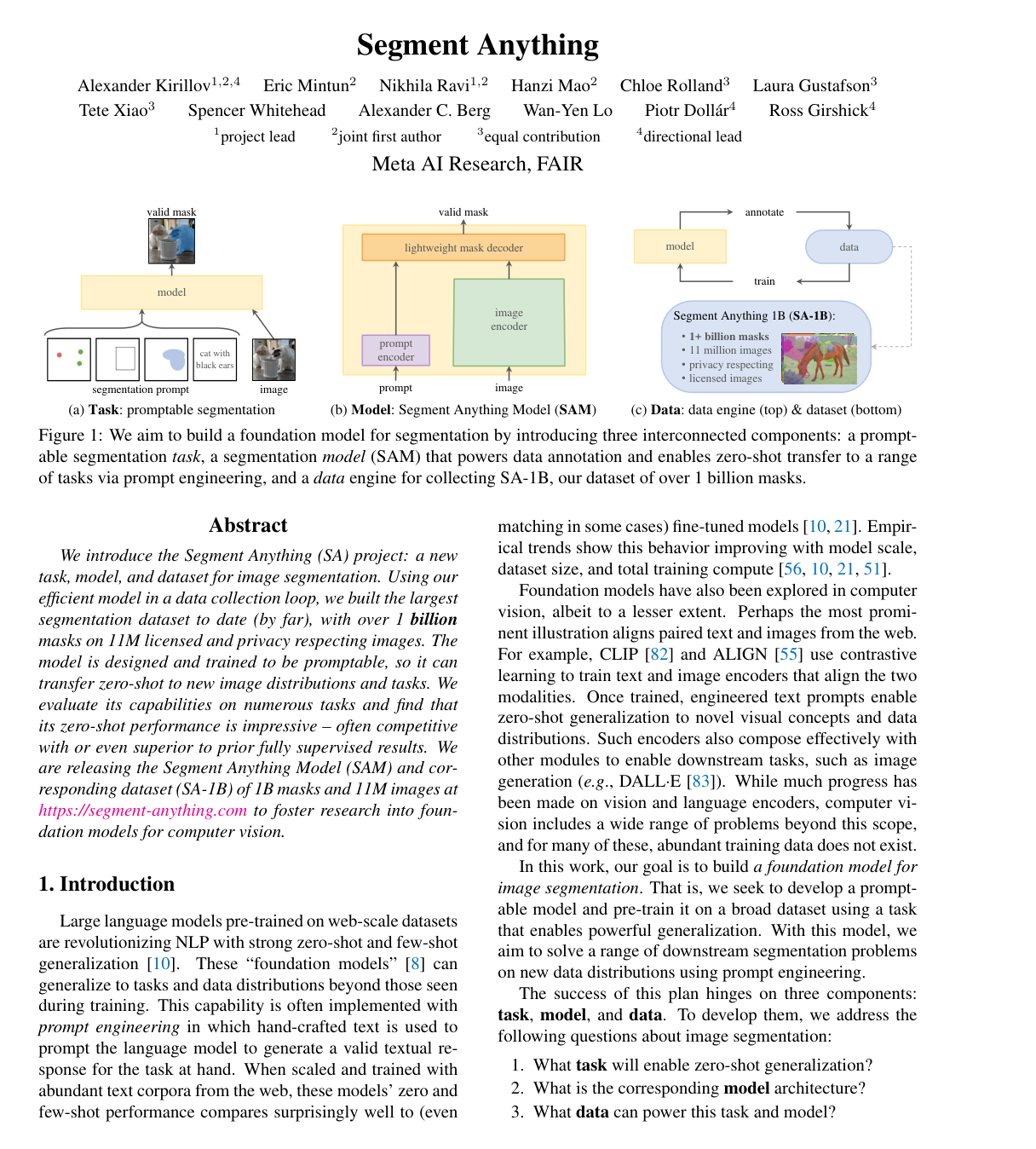
Segment Anything
Alexander M. Kirillov, Eric Mintun, Nikhila Ravi, Hanzi Mao, Chloe Rolland, Laura Gustafson, Tete Xiao, Spencer Whitehead, Alexander C. Berg, Wan‐Yen Lo, Piotr Dollár, Ross Girshick
Why you should read this
Establishes the first tangible "foundation model" for image segmentation that supports zero-shot prompting via points, boxes, or text.
We introduce the Segment Anything (SA) project: a new task, model, and dataset for image segmentation. Using our efficient model in a data collection loop, we built the largest segmentation dataset to date (by far), with over 1 billion masks on 11M licensed and privacy respecting images. The model is designed and trained to be promptable, so it can transfer zero-shot to new image distributions and tasks. We evaluate its capabilities on numerous tasks and find that its zero-shot performance is impressive – often competitive with or even superior to prior fully supervised results. We are releasing the Segment Anything Model (SAM) and corresponding dataset (SA-1B) of 1B masks and 11M images at segment-anything.com to foster research into foundation models for computer vision. We recommend reading the full paper at: arxiv.org/abs/2304.02643.
Added
2026-01-28