
keyword
image-text pairs
An image-text pair is a multimodal data unit composed of a digital image and a corresponding piece of natural language text that describes, annotates, or is semantically associated with the visual content. Commonly sourced from curated annotations, web page alt-text, image captions, or metadata, these pairs serve as foundational training data for vision-language models and multimodal artificial intelligence systems. By linking visual elements to descriptive language, image-text pairs enable computational models to align visual and textual representations within a shared embedding space, facilitating a wide range of tasks including cross-modal retrieval, zero-shot visual recognition, open-vocabulary object detection, and multimodal content generation.
28 items
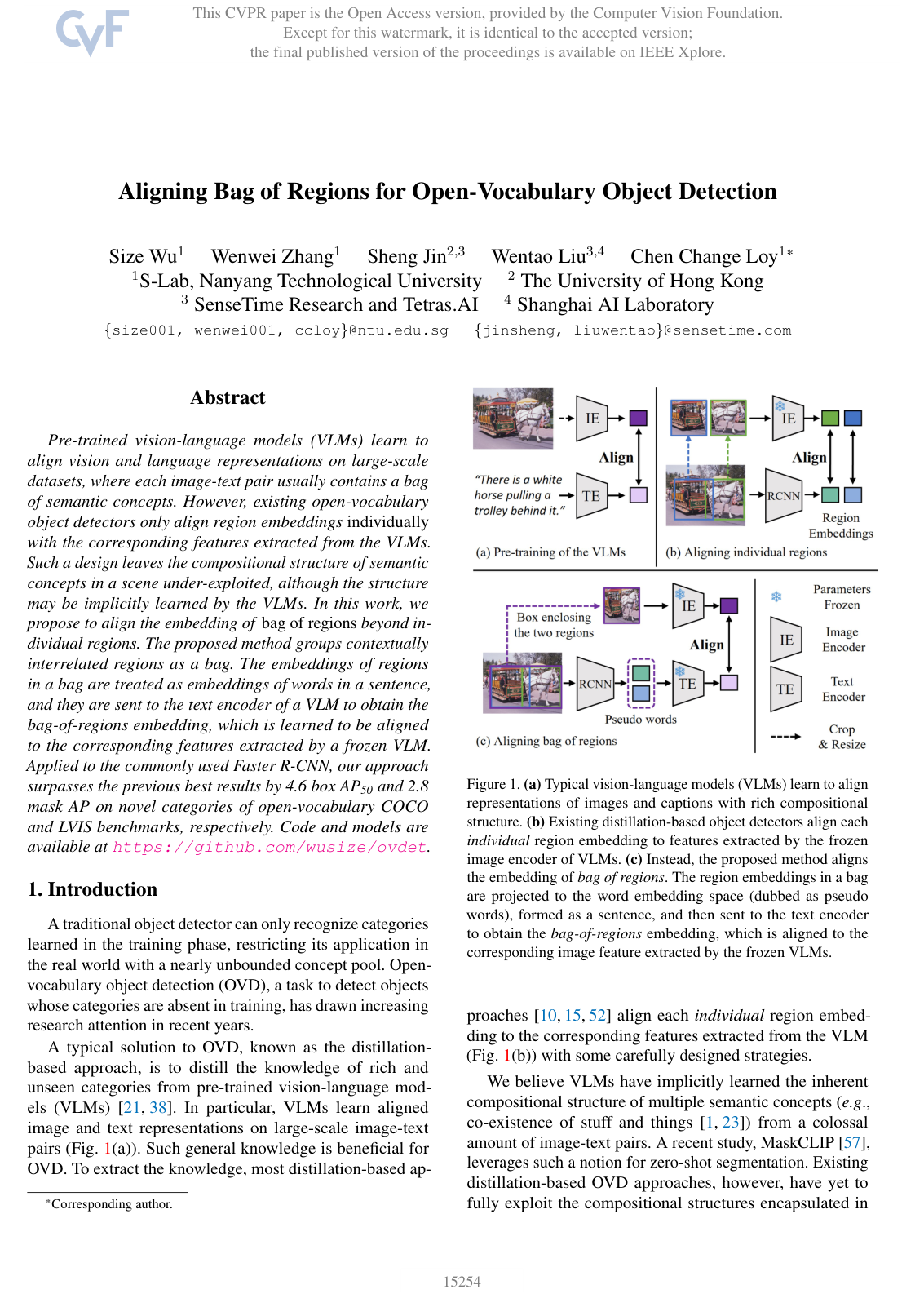
Aligning Bag of Regions for Open-Vocabulary Object Detection
Size Wu, Wenwei Zhang, Sheng Jin, Wentao Liu, Chen Change Loy
Why you should read this
Proposes BARON, an open-vocabulary object detection framework that models contextual relations among multiple regions by encoding them as pseudo-word sentences for alignment with vision-language models, significantly boosting novel-category detection performance on COCO and LVIS benchmarks.
Pre-trained vision-language models (VLMs) learn to align vision and language representations on large-scale datasets, where each image-text pair usually contains a bag of semantic concepts. However, existing open-vocabulary object detectors only align region embeddings individually with the corresponding features extracted from the VLMs. Such a design leaves the compositional structure of semantic concepts in a scene under-exploited, although the structure may be implicitly learned by the VLMs. In this work, we propose to align the embedding of bag of regions beyond individual regions. The proposed method groups contextually interrelated regions as a bag. The embeddings of regions in a bag are treated as embeddings of words in a sentence, and they are sent to the text encoder of a VLM to obtain the bag-of-regions embedding, which is learned to be aligned to the corresponding features extracted by a frozen VLM. Applied to the commonly used Faster R-CNN, our approach surpasses the previous best results by 4.6 box AP50 and 2.8 mask AP on novel categories of open-vocabulary COCO and LVIS benchmarks, respectively. Code and models are available at https://github.com/wusize/ovdet.
Added
2026-10-05
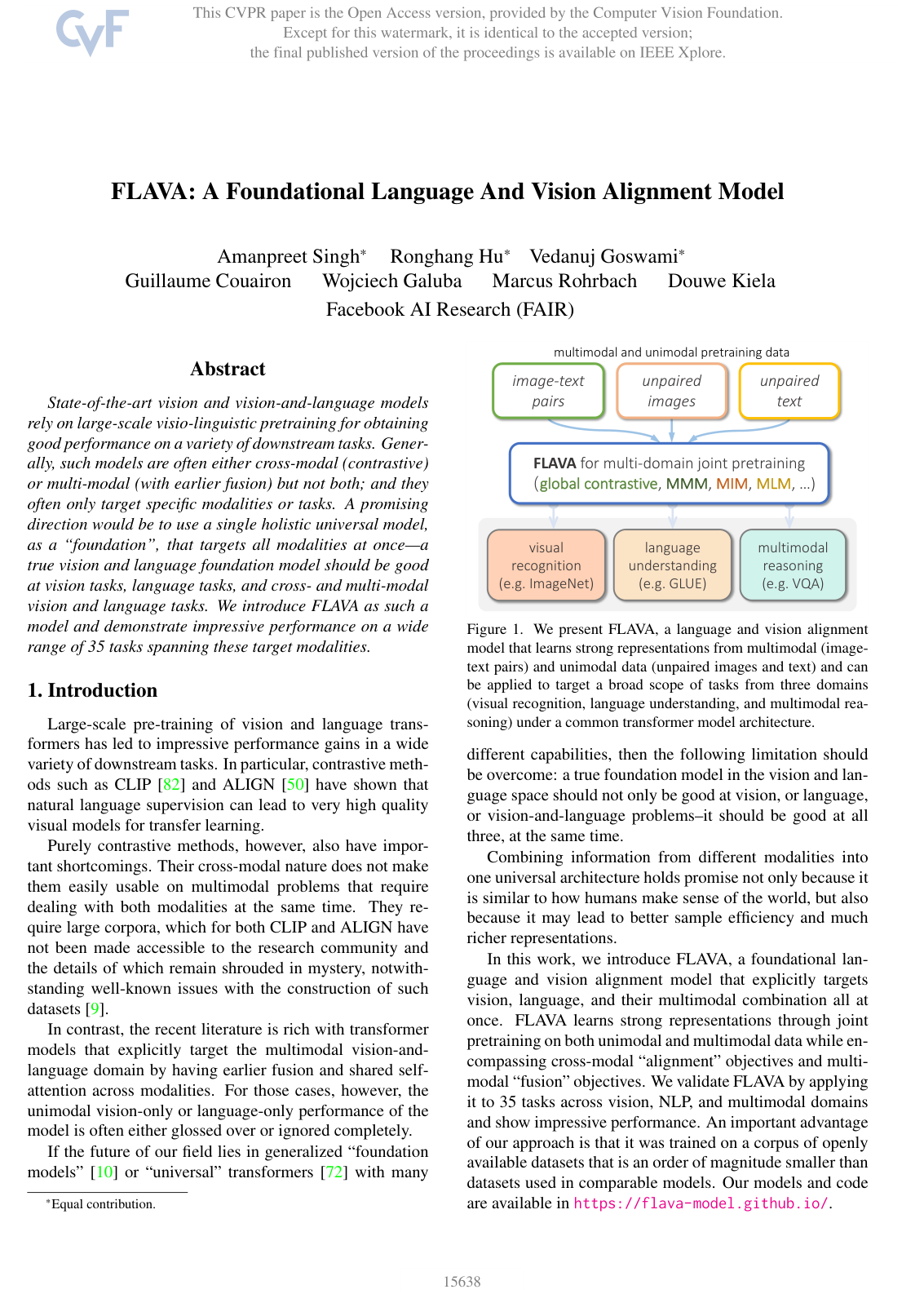
FLAVA: A Foundational Language And Vision Alignment Model
Amanpreet Singh, Ronghang Hu, Vedanuj Goswami, Guillaume Couairon, Wojciech Galuba, Marcus Rohrbach, Douwe Kiela
Why you should read this
Presents a unified foundation architecture that jointly pretrains on unimodal and multimodal data using both contrastive and fusion objectives, achieving strong performance across 35 distinct vision, language, and cross-modal tasks using only public datasets.
State-of-the-art vision and vision-and-language models rely on large-scale visio-linguistic pretraining for obtaining good performance on a variety of downstream tasks. Generally, such models are often either cross-modal (contrastive) or multi-modal (with earlier fusion) but not both; and they often only target specific modalities or tasks. A promising direction would be to use a single holistic universal model, as a “foundation”, that targets all modalities at once—a true vision and language foundation model should be good at vision tasks, language tasks, and cross- and multi-modal vision and language tasks. We introduce FLAVA as such a model and demonstrate impressive performance on a wide range of 35 tasks spanning these target modalities.
Added
2026-10-05
SimVLM: Simple Visual Language Model Pretraining with Weak Supervision
Zirui Wang, Jiahui Yu, Adams Wei Yu, Zihang Dai, Yulia Tsvetkov, Yuan Cao
Why you should read this
Introduces SimVLM, a simplified vision-language model trained end-to-end on weakly supervised data using a single prefix language modeling objective, achieving state-of-the-art benchmark performance and strong zero-shot multimodal capabilities without requiring expensive object-level annotations.
With recent progress in joint modeling of visual and textual representations, Vision-Language Pretraining (VLP) has achieved impressive performance on many multimodal downstream tasks. However, the requirement for expensive annotations including clean image captions and regional labels limits the scalability of existing approaches, and complicates the pretraining procedure with the introduction of multiple dataset-specific objectives. In this work, we relax these constraints and present a minimalist pretraining framework, named Simple Visual Language Model (SimVLM). Unlike prior work, SimVLM reduces the training complexity by exploiting large-scale weak supervision, and is trained end-to-end with a single prefix language modeling objective. Without utilizing extra data or task-specific customization, the resulting model significantly outperforms previous pretraining methods and achieves new state-of-the-art results on a wide range of discriminative and generative vision-language benchmarks, including VQA (+3.74% vqa-score), NLVR2 (+1.17% accuracy), SNLI-VE (+1.37% accuracy) and image captioning tasks (+10.1% average CIDEr score). Furthermore, we demonstrate that SimVLM acquires strong generalization and transfer ability, enabling zero-shot behavior including open-ended visual question answering and cross-modality transfer.
Added
2026-10-05
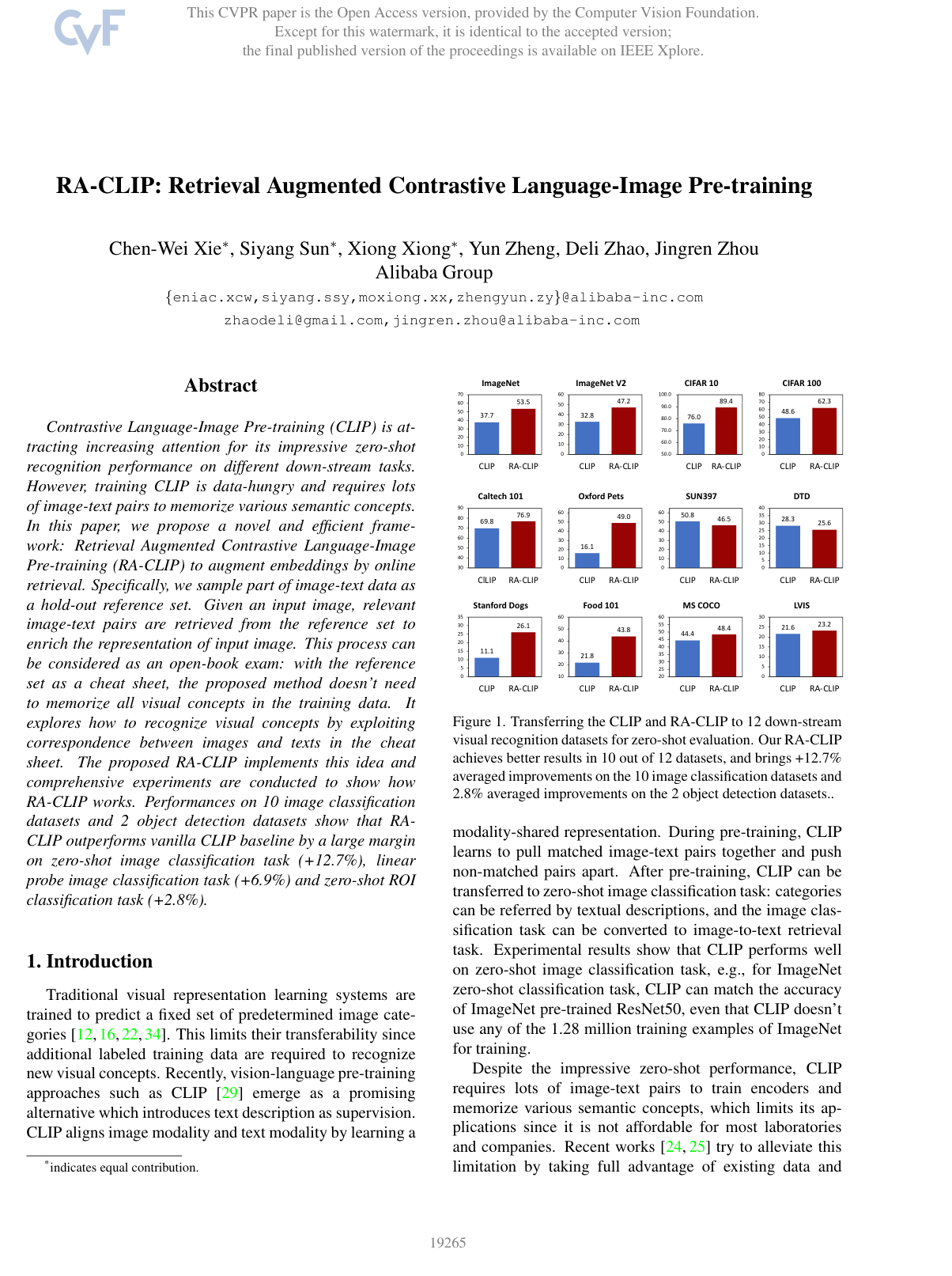
RA-CLIP: Retrieval Augmented Contrastive Language-Image Pre-Training
Chen-Wei Xie, Siyang Sun, Xiong Xiong, Yun Zheng, Deli Zhao, Jingren Zhou
Why you should read this
Proposes an open-book contrastive learning framework that uses online image-text retrieval from a reference set to augment visual embeddings, boosting zero-shot classification performance without requiring models to memorize vast training concepts.
Contrastive Language-Image Pre-training (CLIP) is attracting increasing attention for its impressive zero-shot recognition performance on different down-stream tasks. However, training CLIP is data-hungry and requires lots of image-text pairs to memorize various semantic concepts. In this paper, we propose a novel and efficient framework: Retrieval Augmented Contrastive Language-Image Pre-training (RA-CLIP) to augment embeddings by online retrieval. Specifically, we sample part of image-text data as a hold-out reference set. Given an input image, relevant image-text pairs are retrieved from the reference set to enrich the representation of input image. This process can be considered as an open-book exam: with the reference set as a cheat sheet, the proposed method doesn't need to memorize all visual concepts in the training data. It explores how to recognize visual concepts by exploiting correspondence between images and texts in the cheat sheet. The proposed RA-CLIP implements this idea and comprehensive experiments are conducted to show how RA-CLIP works. Performances on 10 image classification datasets and 2 object detection datasets show that RA-CLIP outperforms vanilla CLIP baseline by a large margin on zero-shot image classification task (+12.7%), linear probe image classification task (+6.9%) and zero-shot ROI classification task (+2.8%).
Added
2026-09-26
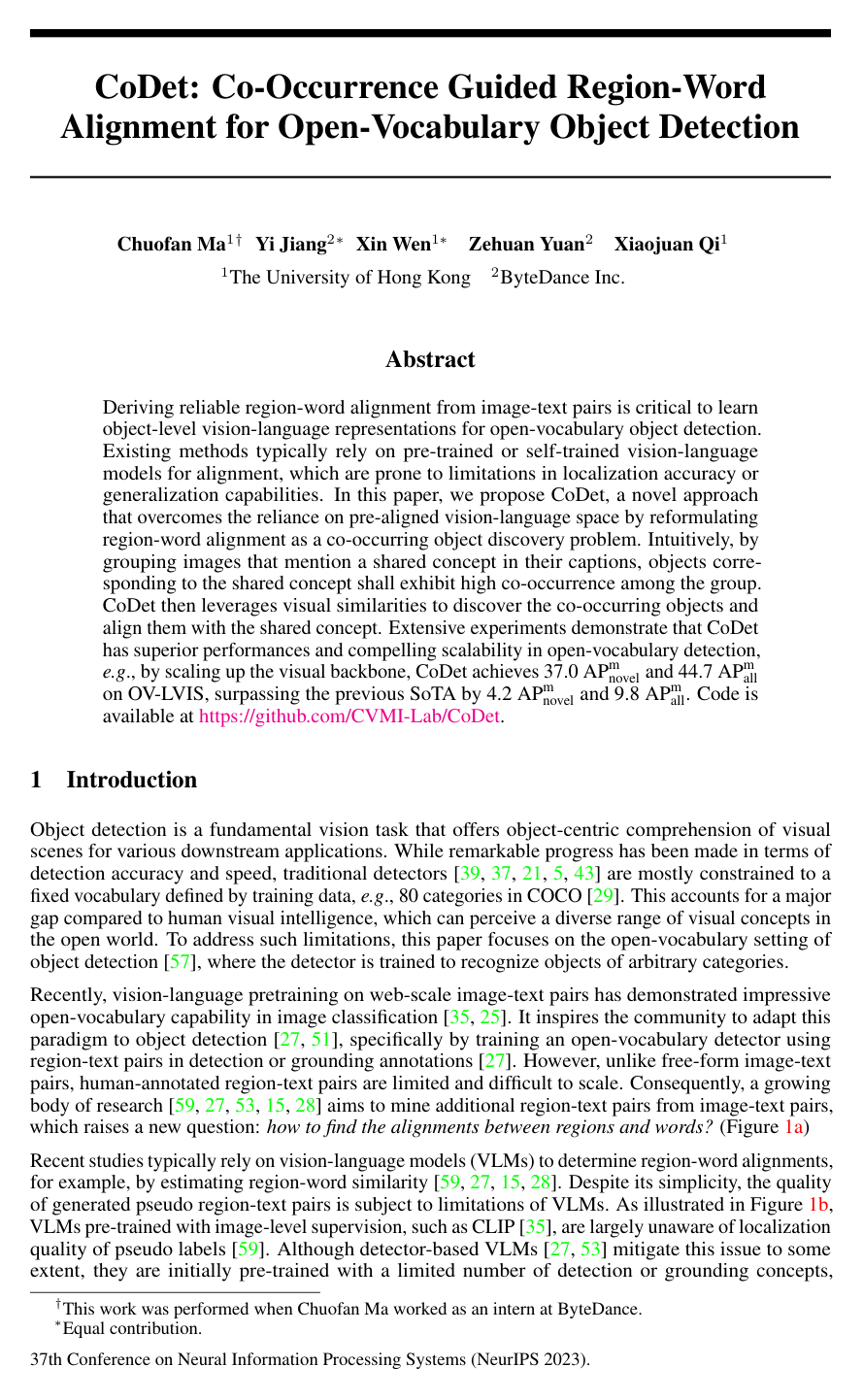
CoDet: Co-occurrence Guided Region-Word Alignment for Open-Vocabulary Object Detection
Chuofan Ma, Yi Jiang, Xin Wen, Zehuan Yuan, Xiaojuan Qi
Why you should read this
Proposes an open-vocabulary object detection framework that bypasses pre-aligned vision-language models by discovering co-occurring visual objects across captioned image groups to achieve state-of-the-art novel category detection on OV-LVIS.
Deriving reliable region-word alignment from image-text pairs is critical to learn object-level vision-language representations for open-vocabulary object detection. Existing methods typically rely on pre-trained or self-trained vision-language models for alignment, which are prone to limitations in localization accuracy or generalization capabilities. In this paper, we propose CoDet, a novel approach that overcomes the reliance on pre-aligned vision-language space by reformulating region-word alignment as a co-occurring object discovery problem. Intuitively, by grouping images that mention a shared concept in their captions, objects corresponding to the shared concept shall exhibit high co-occurrence among the group. CoDet then leverages visual similarities to discover the co-occurring objects and align them with the shared concept. Extensive experiments demonstrate that CoDet has superior performances and compelling scalability in open-vocabulary detection, e.g., by scaling up the visual backbone, CoDet achieves 37.0 AP_novel^m and 44.7 AP_all^m on OV-LVIS, surpassing the previous SoTA by 4.2 AP_novel^m and 9.8 AP_all^m. Code is available at https://github.com/CVMI-Lab/CoDet.
Added
2026-09-26
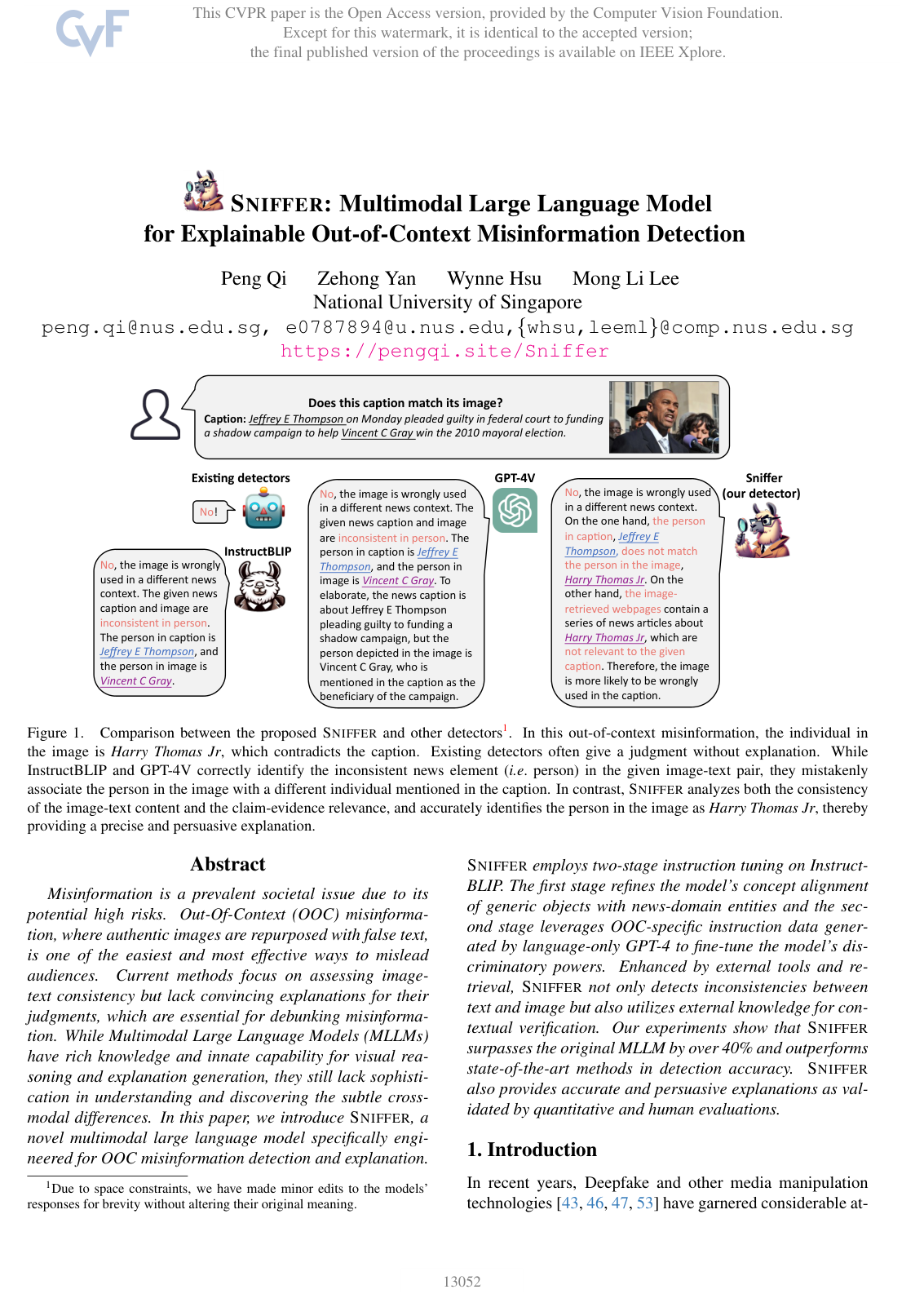
Sniffer: Multimodal Large Language Model for Explainable Out-of-Context Misinformation Detection
Peng Qi, Zehong Yan, Wynne Hsu, Mong-Li Lee
Why you should read this
Proposes SNIFFER, a multimodal large language model fine-tuned via two-stage instruction tuning and augmented with external retrieval to detect out-of-context misinformation while generating accurate, persuasive explanations.
Misinformation is a prevalent societal issue due to its potential high risks. Out-Of-Context (OOC) misinformation, where authentic images are repurposed with false text, is one of the easiest and most effective ways to mislead audiences. Current methods focus on assessing image-text consistency but lack convincing explanations for their judgments, which are essential for debunking misinformation. While Multimodal Large Language Models (MLLMs) have rich knowledge and innate capability for visual reasoning and explanation generation, they still lack sophistication in understanding and discovering the subtle cross-modal differences. In this paper, we introduce SNIFFER, a novel multimodal large language model specifically engineered for OOC misinformation detection and explanation. SNIFFER employs two-stage instruction tuning on Instruct-BLIP. The first stage refines the model’s concept alignment of generic objects with news-domain entities and the second stage leverages OOC-specific instruction data generated by language-only GPT-4 to fine-tune the model’s discriminatory powers. Enhanced by external tools and retrieval, SNIFFER not only detects inconsistencies between text and image but also utilizes external knowledge for contextual verification. Our experiments show that SNIFFER surpasses the original MLLM by over 40% and outperforms state-of-the-art methods in detection accuracy. SNIFFER also provides accurate and persuasive explanations as validated by quantitative and human evaluations.
Added
2026-09-26
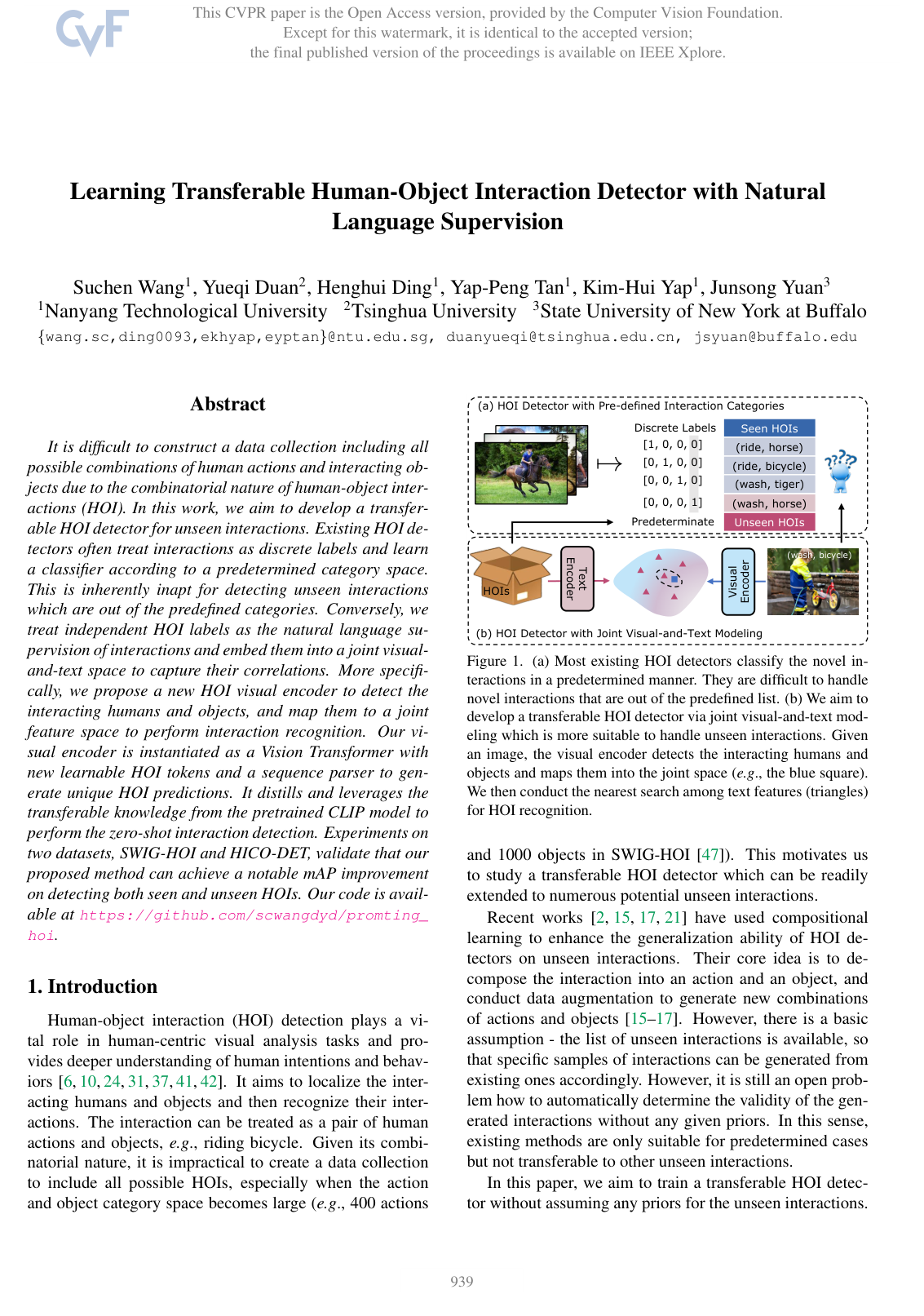
Learning Transferable Human-Object Interaction Detector with Natural Language Supervision
Suchen Wang, Yueqi Duan, Henghui Ding, Yap-Peng Tan, Kim-Hui Yap, Junsong Yuan
Why you should read this
Proposes a vision-language framework for zero-shot human-object interaction detection that aligns Vision Transformer-extracted interaction tokens with learned text prompts to recognize unseen action-object combinations without predefining interaction classes.
It is difficult to construct a data collection including all possible combinations of human actions and interacting objects due to the combinatorial nature of human-object interactions (HOI). In this work, we aim to develop a transferable HOI detector for unseen interactions. Existing HOI detectors often treat interactions as discrete labels and learn a classifier according to a predetermined category space. This is inherently inapt for detecting unseen interactions which are out of the predefined categories. Conversely, we treat independent HOI labels as the natural language supervision of interactions and embed them into a joint visual-and-text space to capture their correlations. More specifically, we propose a new HOI visual encoder to detect the interacting humans and objects, and map them to a joint feature space to perform interaction recognition. Our visual encoder is instantiated as a Vision Transformer with new learnable HOI tokens and a sequence parser to generate unique HOI predictions. It distills and leverages the transferable knowledge from the pretrained CLIP model to perform the zero-shot interaction detection. Experiments on two datasets, SWIG-HOI and HICO-DET, validate that our proposed method can achieve a notable mAP improvement on detecting both seen and unseen HOIs. Our code is available at https://github.com/scwangdyd/promting_hoi.
Added
2026-09-26
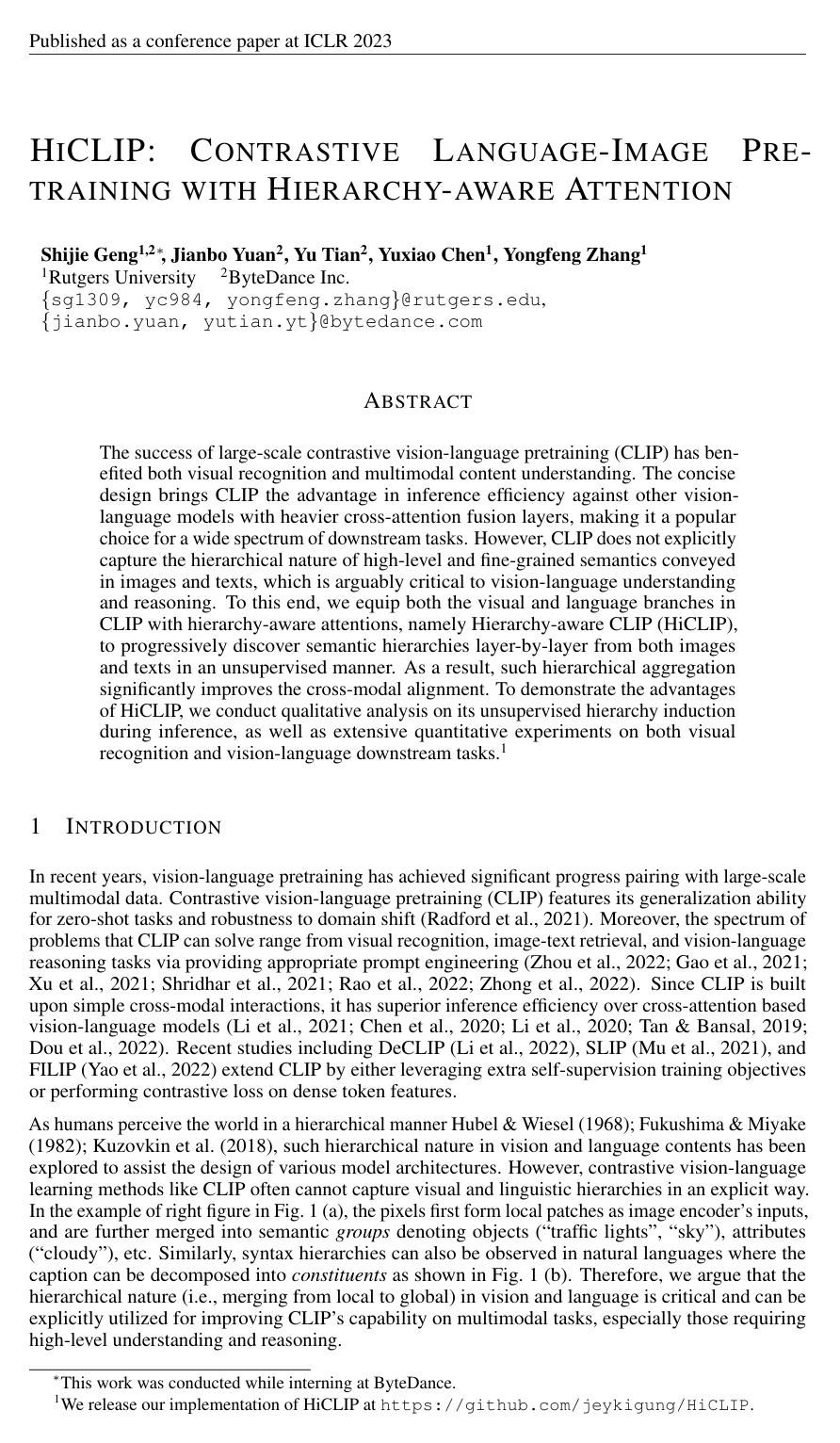
HiCLIP: Contrastive Language-Image Pretraining with Hierarchy-aware Attention
Shijie Geng, Jianbo Yuan, Yu Tian, Yuxiao Chen, Yongfeng Zhang
Why you should read this
Introduces HiCLIP to integrate hierarchy-aware attention into contrastive vision-language pretraining, enabling the unsupervised discovery of multi-level semantics across images and text to improve cross-modal alignment on downstream tasks.
The success of large-scale contrastive vision-language pretraining (CLIP) has benefited both visual recognition and multimodal content understanding. The concise design brings CLIP the advantage in inference efficiency against other vision-language models with heavier cross-attention fusion layers, making it a popular choice for a wide spectrum of downstream tasks. However, CLIP does not explicitly capture the hierarchical nature of high-level and fine-grained semantics conveyed in images and texts, which is arguably critical to vision-language understanding and reasoning. To this end, we equip both the visual and language branches in CLIP with hierarchy-aware attentions, namely Hierarchy-aware CLIP (HiCLIP), to progressively discover semantic hierarchies layer-by-layer from both images and texts in an unsupervised manner. As a result, such hierarchical aggregation significantly improves the cross-modal alignment. To demonstrate the advantages of HiCLIP, we conduct qualitative analysis on its unsupervised hierarchy induction during inference, as well as extensive quantitative experiments on both visual recognition and vision-language downstream tasks.
Added
2026-09-26
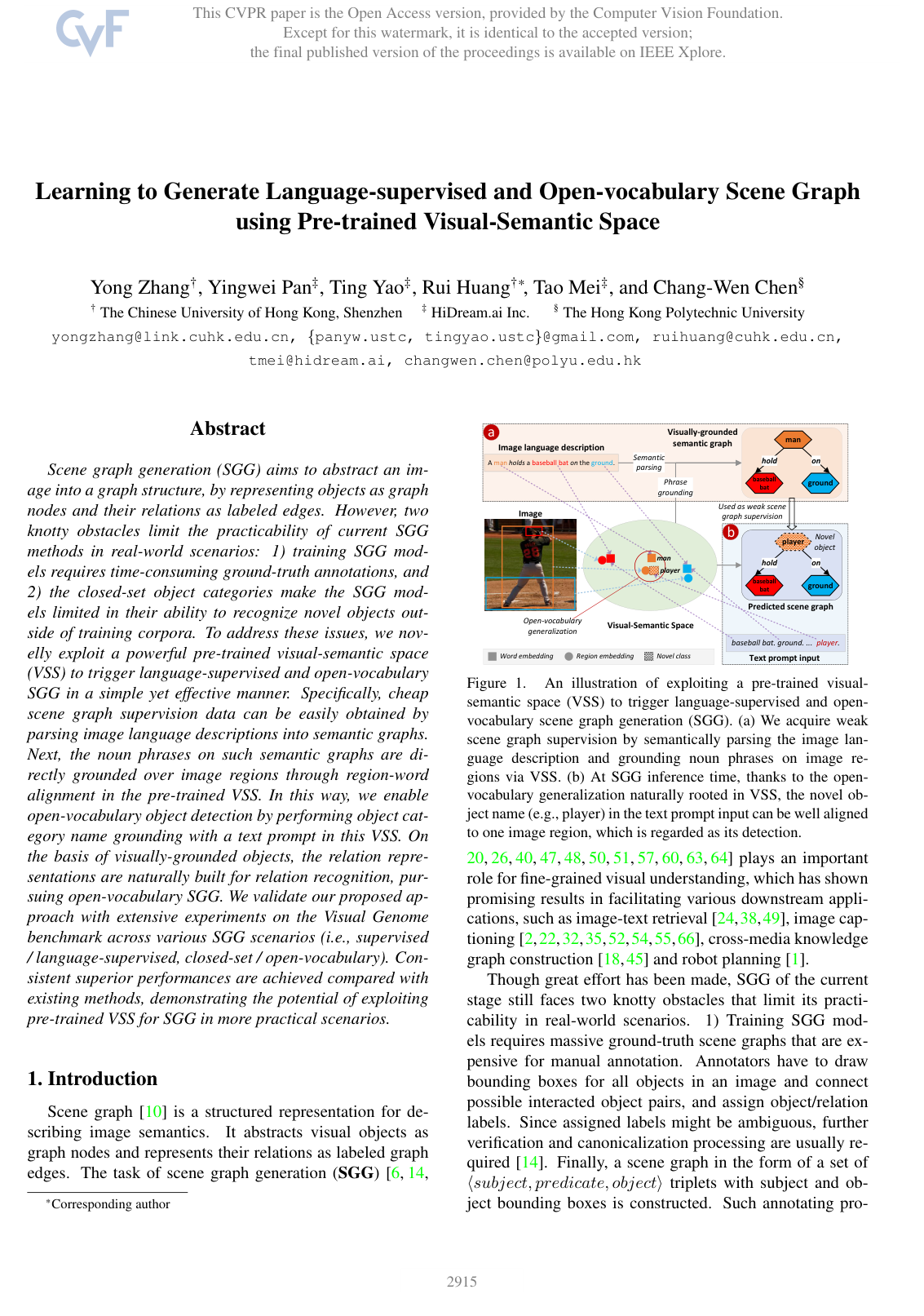
Learning to Generate Language-Supervised and Open-Vocabulary Scene Graph Using Pre-Trained Visual-Semantic Space
Yong Zhang, Yingwei Pan, Ting Yao, Rui Huang, Tao Mei, Chang Wen Chen
Why you should read this
Proposes a scene graph generation framework that uses pre-trained visual-semantic spaces to detect novel objects and relations from image captions without requiring expensive manual annotations.
Scene graph generation (SGG) aims to abstract an image into a graph structure, by representing objects as graph nodes and their relations as labeled edges. However, two knotty obstacles limit the practicability of current SGG methods in real-world scenarios: 1) training SGG models requires time-consuming ground-truth annotations, and 2) the closed-set object categories make the SGG models limited in their ability to recognize novel objects outside of training corpora. To address these issues, we novelly exploit a powerful pre-trained visual-semantic space (VSS) to trigger language-supervised and open-vocabulary SGG in a simple yet effective manner. Specifically, cheap scene graph supervision data can be easily obtained by parsing image language descriptions into semantic graphs. Next, the noun phrases on such semantic graphs are directly grounded over image regions through region-word alignment in the pre-trained VSS. In this way, we enable open-vocabulary object detection by performing object category name grounding with a text prompt in this VSS. On the basis of visually-grounded objects, the relation representations are naturally built for relation recognition, pursuing open-vocabulary SGG. We validate our proposed approach with extensive experiments on the Visual Genome benchmark across various SGG scenarios (i.e., supervised / language-supervised, closed-set / open-vocabulary). Consistent superior performances are achieved compared with existing methods, demonstrating the potential of exploiting pre-trained VSS for SGG in more practical scenarios.
Added
2026-09-26
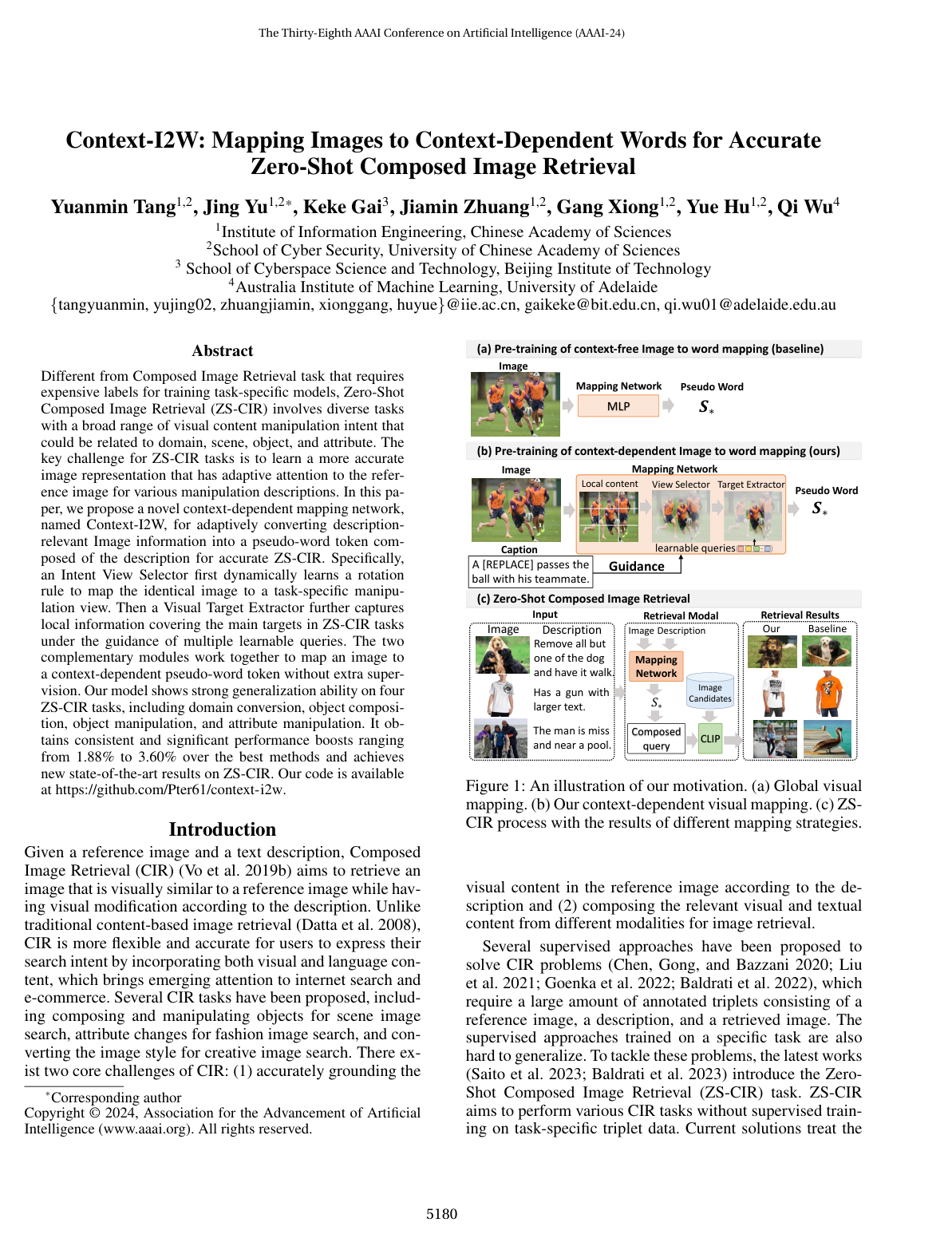
Context-I2W: Mapping Images to Context-Dependent Words for Accurate Zero-Shot Composed Image Retrieval
Yuanmin Tang, Jing Yu, Keke Gai, Jiamin Zhuang, Gang Xiong, Yue Hu, Qi Wu
Why you should read this
Proposes a context-dependent mapping network that converts description-relevant visual information into pseudo-word tokens using hierarchical view selection and target extraction, significantly advancing zero-shot composed image retrieval without requiring expensive supervised triplet annotations.
Different from Composed Image Retrieval task that requires expensive labels for training task-specific models, Zero-Shot Composed Image Retrieval (ZS-CIR) involves diverse tasks with a broad range of visual content manipulation intent that could be related to domain, scene, object, and attribute. The key challenge for ZS-CIR tasks is to learn a more accurate image representation that has adaptive attention to the reference image for various manipulation descriptions. In this paper, we propose a novel context-dependent mapping network, named Context-I2W, for adaptively converting description-relevant Image information into a pseudo-word token composed of the description for accurate ZS-CIR. Specifically, an Intent View Selector first dynamically learns a rotation rule to map the identical image to a task-specific manipulation view. Then a Visual Target Extractor further captures local information covering the main targets in ZS-CIR tasks under the guidance of multiple learnable queries. The two complementary modules work together to map an image to a context-dependent pseudo-word token without extra supervision. Our model shows strong generalization ability on four ZS-CIR tasks, including domain conversion, object composition, object manipulation, and attribute manipulation. It obtains consistent and significant performance boosts ranging from 1.88% to 3.60% over the best methods and achieves new state-of-the-art results on ZS-CIR. Our code is available at https://github.com/Pter61/context-i2w.
Added
2026-09-26
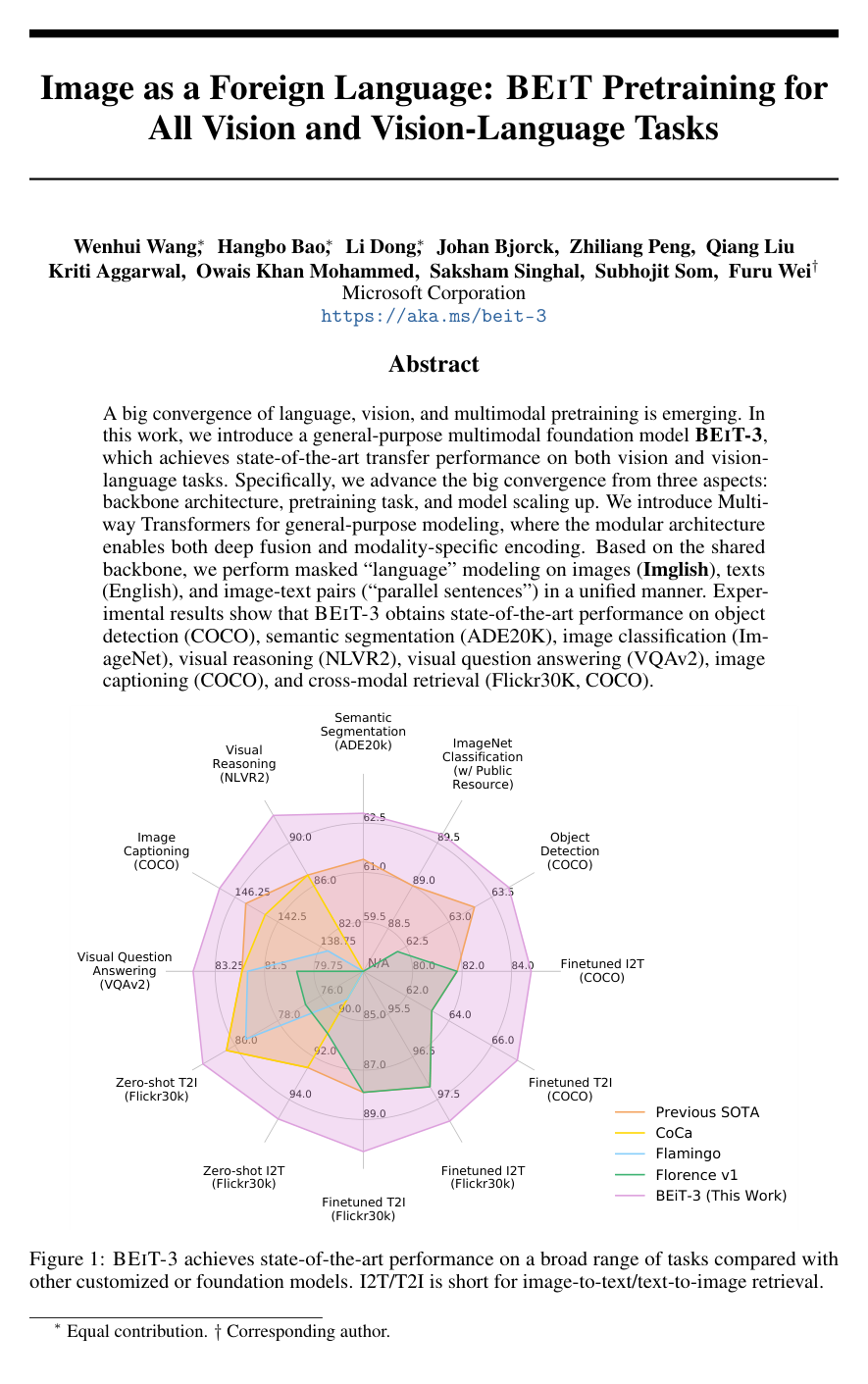
Image as a Foreign Language: BEIT Pretraining for Vision and Vision-Language Tasks
Wenhui Wang, Hangbo Bao, Li Dong, Johan Bjorck, Zhiliang Peng, Qiang Liu, Kriti Aggarwal, Owais Khan Mohammed, Saksham Singhal, Subhojit Som, Furu Wei
Why you should read this
Introduces BEiT-3, a unified multimodal foundation model that treats images as a foreign language and pretrains a Multiway Transformer via masked data modeling to achieve state-of-the-art transfer performance across major vision and vision-language benchmarks.
A big convergence of language, vision, and multimodal pretraining is emerging. In this work, we introduce a general-purpose multimodal foundation model BEiT-3, which achieves state-of-the-art transfer performance on both vision and vision-language tasks. Specifically, we advance the big convergence from three aspects: backbone architecture, pretraining task, and model scaling up. We introduce Multiway Transformers for general-purpose modeling, where the modular architecture enables both deep fusion and modality-specific encoding. Based on the shared backbone, we perform masked "language" modeling on images (Imglish), texts (English), and image-text pairs ("parallel sentences") in a unified manner. Experimental results show that BEiT-3 obtains state-of-the-art performance on object detection (COCO), semantic segmentation (ADE20K), image classification (ImageNet), visual reasoning (NLVR2), visual question answering (VQAv2), image captioning (COCO), and cross-modal retrieval (Flickr30K, COCO).
Added
2026-09-26
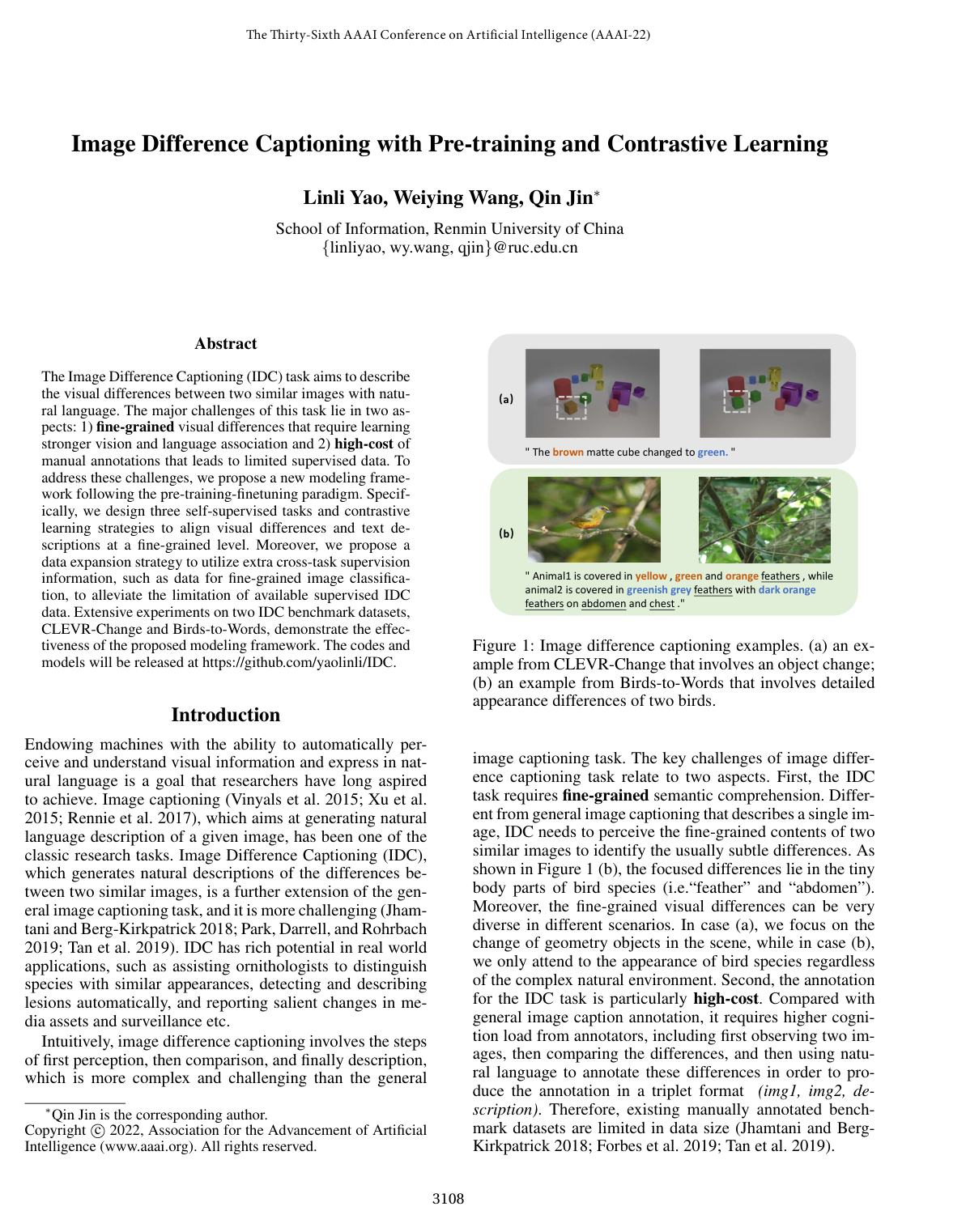
Image Difference Captioning with Pre-training and Contrastive Learning
Linli Yao, Weiying Wang, Qin Jin
Why you should read this
Proposes a self-supervised pre-training and contrastive learning framework paired with a cross-task data expansion strategy to achieve state-of-the-art fine-grained image difference captioning despite limited annotated pairs.
The Image Difference Captioning (IDC) task aims to describe the visual differences between two similar images with natural language. The major challenges of this task lie in two aspects: 1) fine-grained visual differences that require learning stronger vision and language association and 2) high-cost of manual annotations that leads to limited supervised data. To address these challenges, we propose a new modeling framework following the pre-training-finetuning paradigm. Specifically, we design three self-supervised tasks and contrastive learning strategies to align visual differences and text descriptions at a fine-grained level. Moreover, we propose a data expansion strategy to utilize extra cross-task supervision information, such as data for fine-grained image classification, to alleviate the limitation of available supervised IDC data. Extensive experiments on two IDC benchmark datasets, CLEVR-Change and Birds-to-Words, demonstrate the effectiveness of the proposed modeling framework. The codes and models will be released at https://github.com/yaolinli/IDC.
Added
2026-09-26
CLIP is Also an Efficient Segmenter: A Text-Driven Approach for Weakly Supervised Semantic Segmentation
Yuqi Lin, Minghao Chen, Wenxiao Wang, Boxi Wu, Ke Li, Binbin Lin, Haifeng Liu, Xiaofei He
Why you should read this
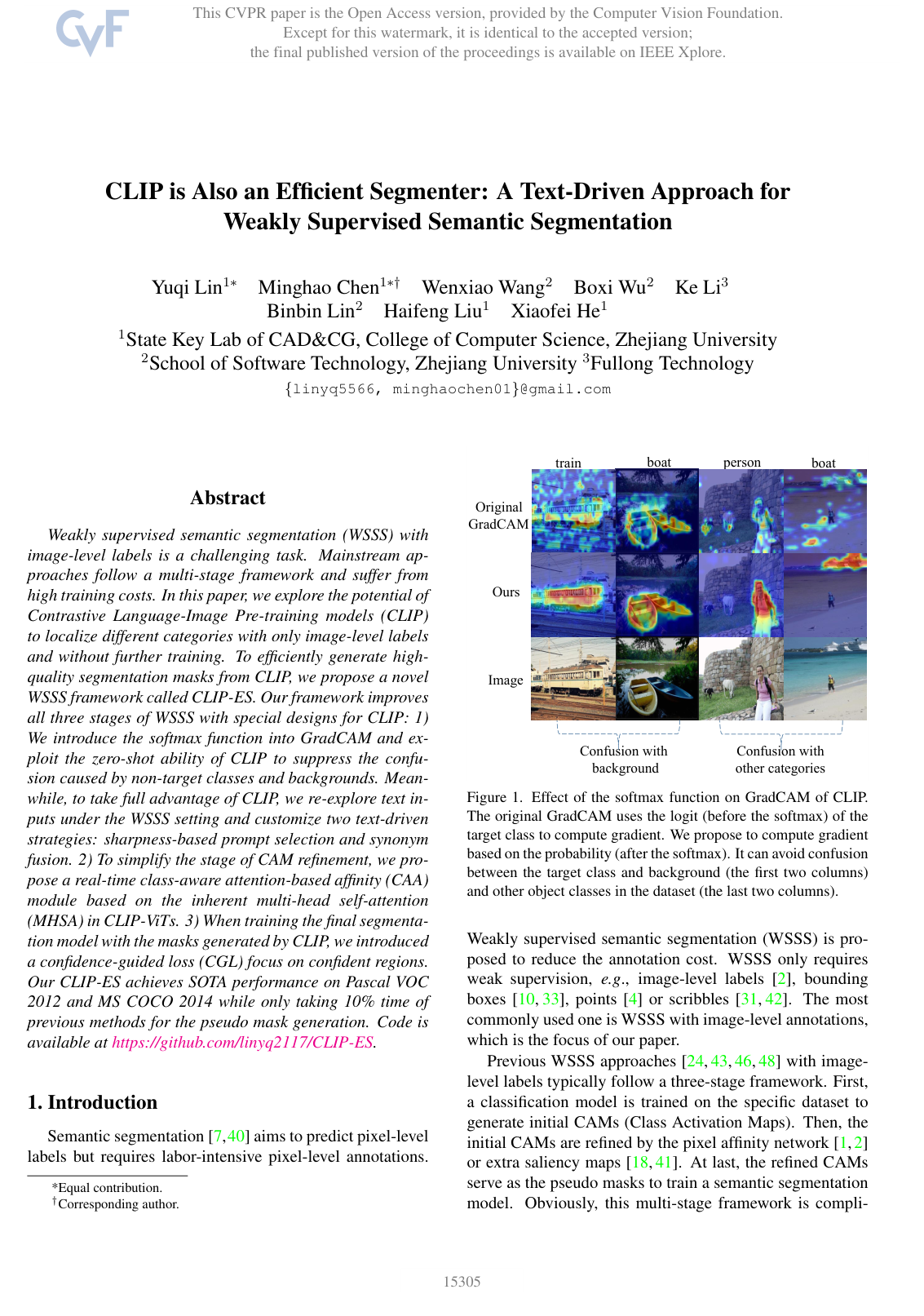
Presents CLIP-ES, a training-free framework that adapts frozen CLIP models with softmax-modified GradCAM, text-driven prompt strategies, and real-time attention refinement to generate high-quality pseudo segmentation masks tenfold faster than traditional multi-stage weakly supervised methods.
Weakly supervised semantic segmentation (WSSS) with image-level labels is a challenging task. Mainstream approaches follow a multi-stage framework and suffer from high training costs. In this paper, we explore the potential of Contrastive Language-Image Pre-training models (CLIP) to localize different categories with only image-level labels and without further training. To efficiently generate high-quality segmentation masks from CLIP, we propose a novel WSSS framework called CLIP-ES. Our framework improves all three stages of WSSS with special designs for CLIP: 1) We introduce the softmax function into GradCAM and exploit the zero-shot ability of CLIP to suppress the confusion caused by non-target classes and backgrounds. Meanwhile, to take full advantage of CLIP, we re-explore text inputs under the WSSS setting and customize two text-driven strategies: sharpness-based prompt selection and synonym fusion. 2) To simplify the stage of CAM refinement, we propose a real-time class-aware attention-based affinity (CAA) module based on the inherent multi-head self-attention (MHSA) in CLIP-ViTs. 3) When training the final segmentation model with the masks generated by CLIP, we introduced a confidence-guided loss (CGL) focus on confident regions. Our CLIP-ES achieves SOTA performance on Pascal VOC 2012 and MS COCO 2014 while only taking 10% time of previous methods for the pseudo mask generation. Code is available at https://github.com/linyq2117/CLIP-ES.
Added
2026-09-26
Learning Open-Vocabulary Semantic Segmentation Models From Natural Language Supervision
Jilan Xu, Junlin Hou, Yuejie Zhang, Rui Feng, Yi Wang, Yu Qiao, Weidi Xie
Why you should read this
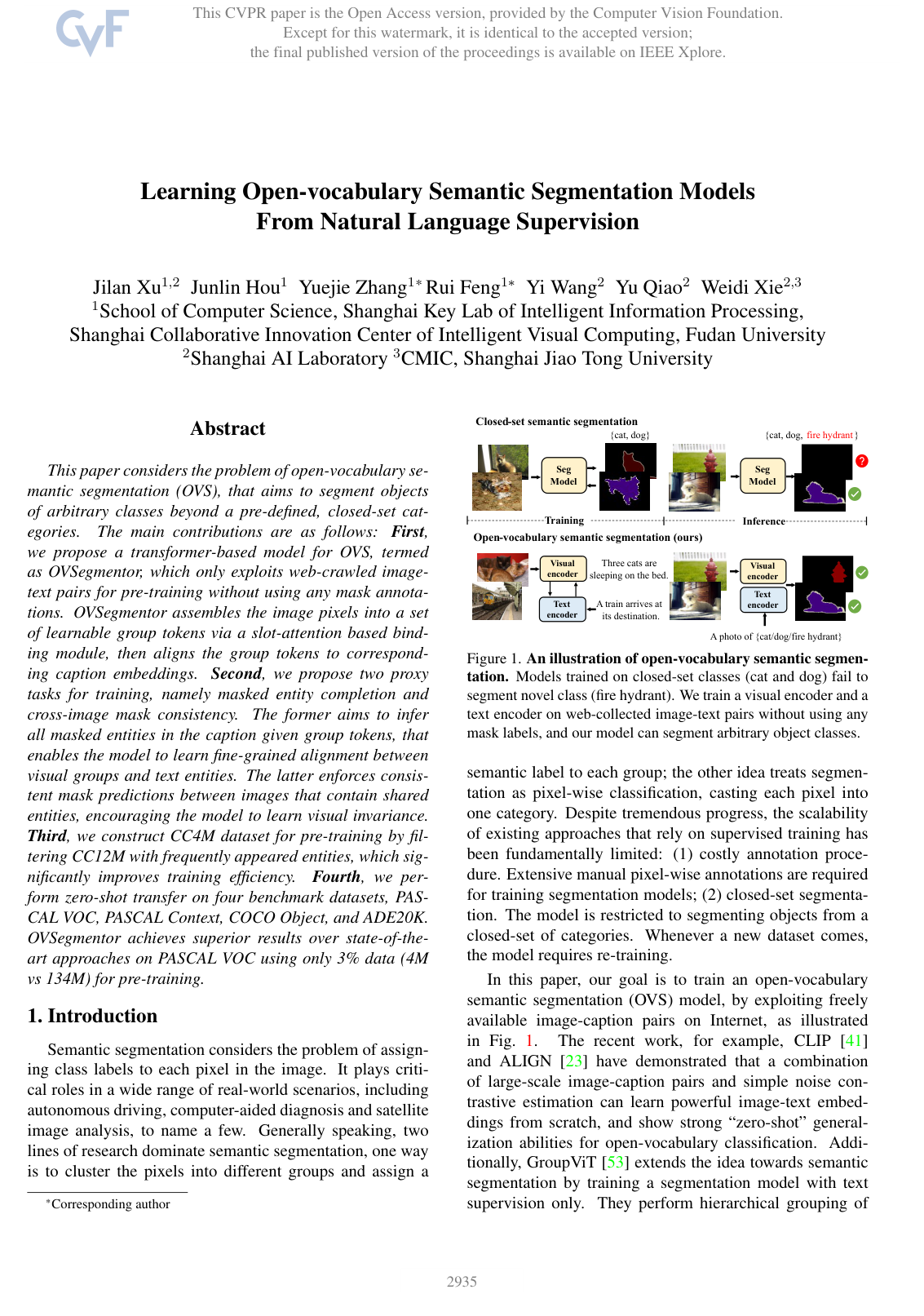
Presents OVSegmentor, a vision-language framework that learns open-vocabulary semantic segmentation directly from web-scale image-caption pairs without manual mask annotations by using slot-attention group tokens and proxy tasks for masked entity completion and cross-image consistency.
This paper considers the problem of open-vocabulary semantic segmentation (OVS), that aims to segment objects of arbitrary classes beyond a pre-defined, closed-set categories. The main contributions are as follows: First, we propose a transformer-based model for OVS, termed as OVSegmentor, which only exploits web-crawled image-text pairs for pre-training without using any mask annotations. OVSegmentor assembles the image pixels into a set of learnable group tokens via a slot-attention based binding module, then aligns the group tokens to corresponding caption embeddings. Second, we propose two proxy tasks for training, namely masked entity completion and cross-image mask consistency. The former aims to infer all masked entities in the caption given group tokens, that enables the model to learn fine-grained alignment between visual groups and text entities. The latter enforces consistent mask predictions between images that contain shared entities, encouraging the model to learn visual invariance. Third, we construct CC4M dataset for pre-training by filtering CC12M with frequently appeared entities, which significantly improves training efficiency. Fourth, we perform zero-shot transfer on four benchmark datasets, PASCAL VOC, PASCAL Context, COCO Object, and ADE20K. OVSegmentor achieves superior results over state-of-the-art approaches on PASCAL VOC using only 3% data (4M vs 134M) for pre-training.
Added
2026-09-26
SoftCLIP: Softer Cross-Modal Alignment Makes CLIP Stronger
Yuting Gao, Jinfeng Liu, Zihan Xu, Tong Wu, Enwei Zhang, Ke Li, Jie Yang, Wei Liu, Xing Sun
Why you should read this
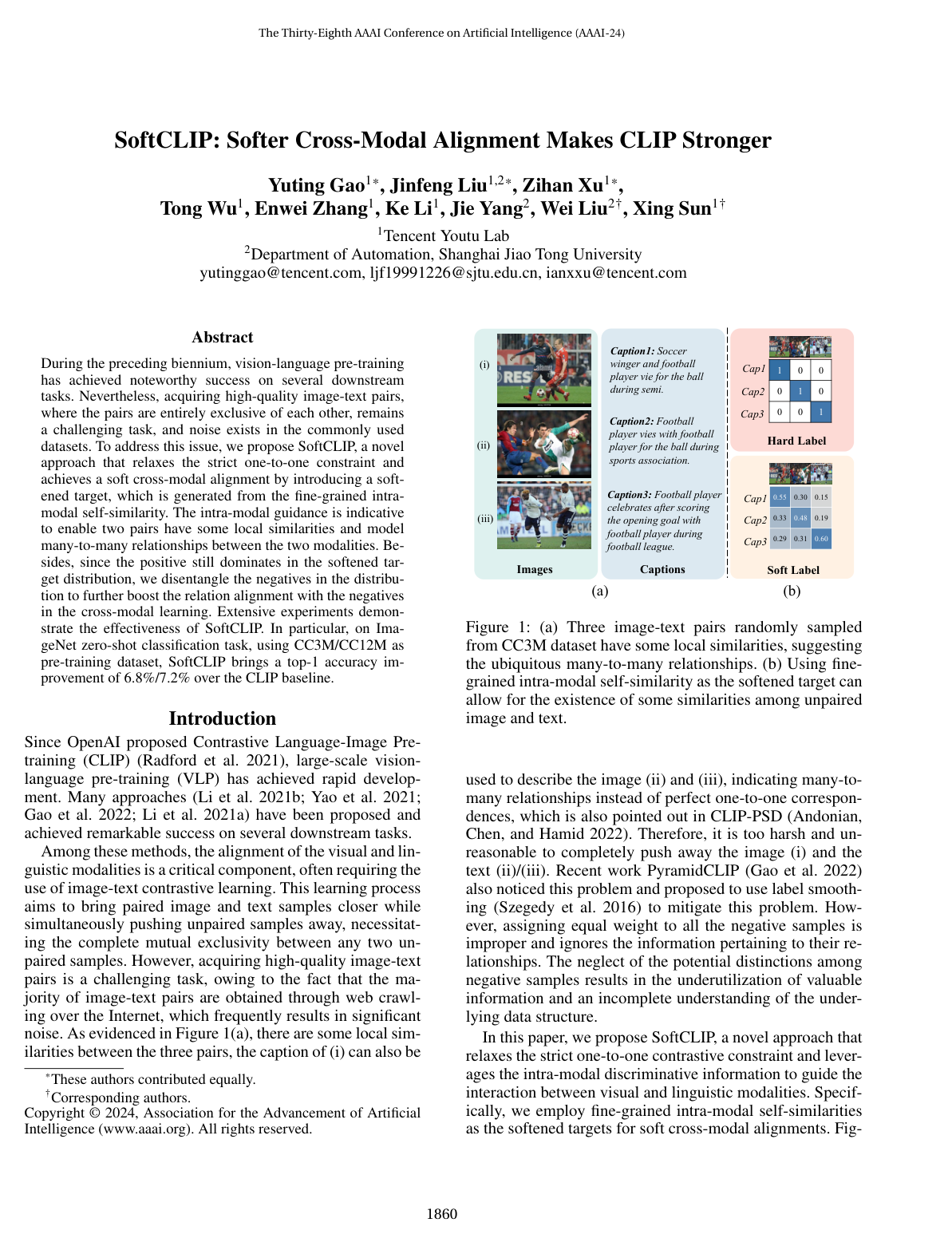
Proposes a relaxed contrastive learning framework that uses fine-grained intra-modal self-similarity and negative-pair disentanglement as soft alignment targets, significantly improving CLIP's zero-shot classification performance on noisy web-scale image-text datasets.
During the preceding biennium, vision-language pre-training has achieved noteworthy success on several downstream tasks. Nevertheless, acquiring high-quality image-text pairs, where the pairs are entirely exclusive of each other, remains a challenging task, and noise exists in the commonly used datasets. To address this issue, we propose SoftCLIP, a novel approach that relaxes the strict one-to-one constraint and achieves a soft cross-modal alignment by introducing a softened target, which is generated from the fine-grained intra-modal self-similarity. The intra-modal guidance is indicative to enable two pairs have some local similarities and model many-to-many relationships between the two modalities. Besides, since the positive still dominates in the softened target distribution, we disentangle the negatives in the distribution to further boost the relation alignment with the negatives in the cross-modal learning. Extensive experiments demonstrate the effectiveness of SoftCLIP. In particular, on ImageNet zero-shot classification task, using CC3M/CC12M as pre-training dataset, SoftCLIP brings a top-1 accuracy improvement of 6.8%/7.2% over the CLIP baseline.
Added
2026-09-26
Open-Vocabulary Multi-Label Classification via Multi-Modal Knowledge Transfer
Sunan He, Taian Guo, Tao Dai, Ruizhi Qiao, Xiujun Shu, Bo Ren, Shu-Tao Xia
Why you should read this
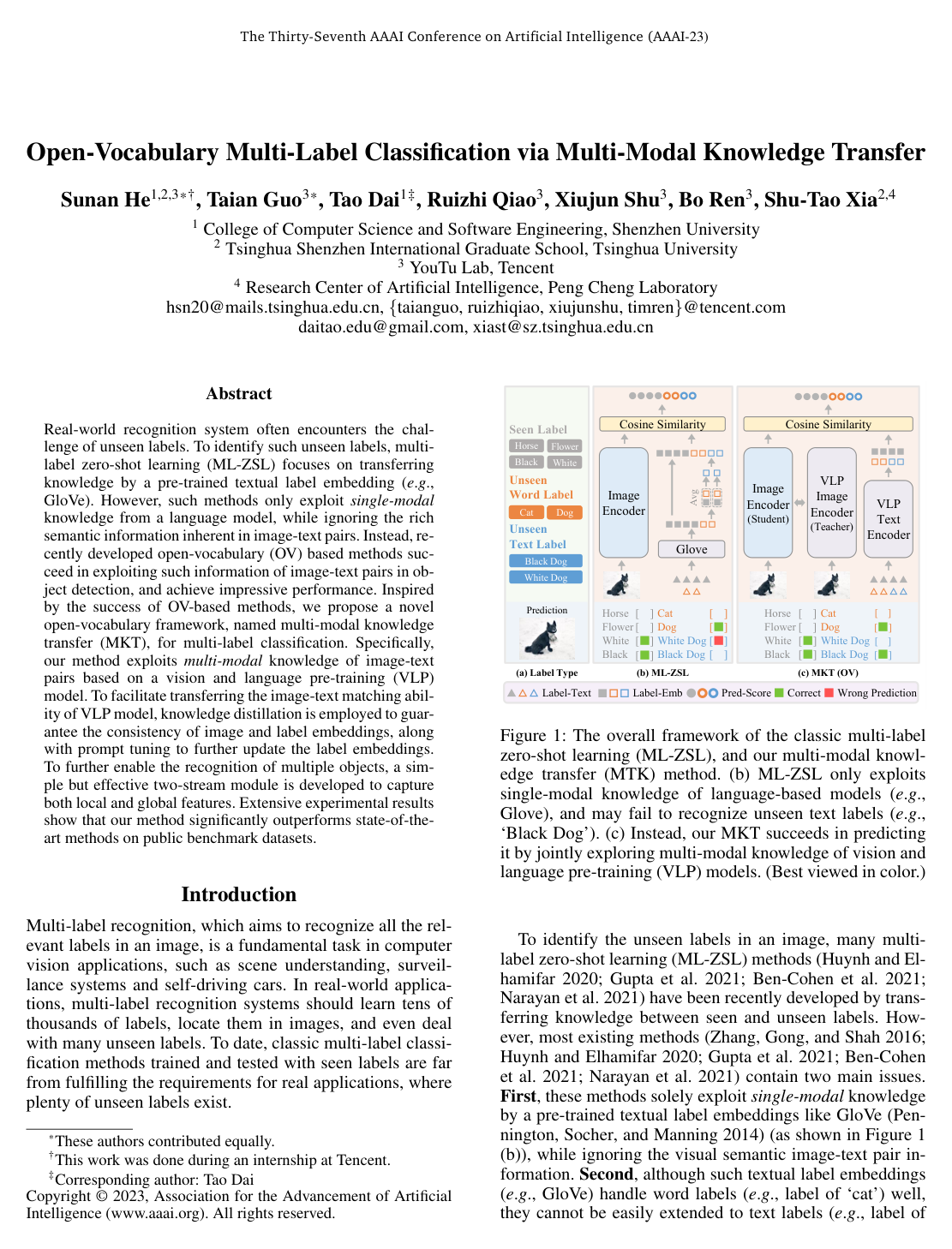
Proposes a multi-modal knowledge transfer framework that adapts vision-language pre-trained models via knowledge distillation, prompt tuning, and a two-stream feature extractor to recognize unseen object labels in multi-label classification.
Real-world recognition system often encounters the challenge of unseen labels. To identify such unseen labels, multi-label zero-shot learning (ML-ZSL) focuses on transferring knowledge by a pre-trained textual label embedding (e.g., GloVe). However, such methods only exploit single-modal knowledge from a language model, while ignoring the rich semantic information inherent in image-text pairs. Instead, recently developed open-vocabulary (OV) based methods succeed in exploiting such information of image-text pairs in object detection, and achieve impressive performance. Inspired by the success of OV-based methods, we propose a novel open-vocabulary framework, named multi-modal knowledge transfer (MKT), for multi-label classification. Specifically, our method exploits multi-modal knowledge of image-text pairs based on a vision and language pre-training (VLP) model. To facilitate transferring the image-text matching ability of VLP model, knowledge distillation is employed to guarantee the consistency of image and label embeddings, along with prompt tuning to further update the label embeddings. To further enable the recognition of multiple objects, a simple but effective two-stream module is developed to capture both local and global features. Extensive experimental results show that our method significantly outperforms state-of-the-art methods on public benchmark datasets.
Added
2026-09-26
MatCha: Enhancing Visual Language Pretraining with Math Reasoning and Chart Derendering
Fangyu Liu, Francesco Piccinno, Syrine Krichene, Chenxi Pang, Kenton Lee, Mandar Joshi, Yasemin Altun, Nigel Collier, Julian Martin Eisenschlos
Why you should read this
Proposes a pretraining framework combining chart derendering and math reasoning tasks that improves visual language models, boosting performance on ChartQA and PlotQA by up to 20% while generalizing effectively to diverse visual document tasks.
Visual language data such as plots, charts, and infographics are ubiquitous in the human world. However, state-of-the-art vision-language models do not perform well on these data. We propose MATCHA (Math reasoning and Chart derendering pretraining) to enhance visual language models' capabilities in jointly modeling charts/plots and language data. Specifically we propose several pretraining tasks that cover plot deconstruction and numerical reasoning which are the key capabilities in visual language modeling. We perform the MATCHA pretraining starting from Pix2Struct, a recently proposed image-to-text visual language model. On standard benchmarks such as PlotQA and ChartQA, the MATCHA model outperforms state-of-the-art methods by as much as nearly 20%. We also examine how well the MATCHA pretraining transfers to domains such as screenshots, textbook diagrams, and document figures and observe overall improvement, verifying the usefulness of MATCHA pretraining on broader visual language tasks.12
Added
2026-09-26
BadCLIP: Dual-Embedding Guided Backdoor Attack on Multimodal Contrastive Learning
Siyuan Liang, Mingli Zhu, Aishan Liu, Baoyuan Wu, Xiaochun Cao, Ee-Chien Chang
Why you should read this
Proposes BadCLIP, a dual-embedding guided backdoor attack on multimodal contrastive learning models that aligns visual trigger patterns with target text and image representations to evade state-of-the-art detection and persist through clean fine-tuning.
While existing backdoor attacks have successfully infected multimodal contrastive learning models such as CLIP, they can be easily countered by specialized backdoor defenses for MCL models. This paper reveals the threats in this practical scenario and introduces the BadCLIP attack, which is resistant to backdoor detection and model fine-tuning defenses. To achieve this, we draw motivations from the perspective of the Bayesian rule and propose a dual-embedding guided framework for backdoor attacks. Specifically, we ensure that visual trigger patterns approximate the textual target semantics in the embedding space, making it challenging to detect the subtle parameter variations induced by backdoor learning on such natural trigger patterns. Additionally, we optimize the visual trigger patterns to align the poisoned samples with target vision features in order to hinder backdoor unlearning through clean fine-tuning. Our experiments show a significant improvement in attack success rate (+45.3% ASR) over current leading methods, even against state-of-the-art backdoor defenses, highlighting our attack’s effectiveness in various scenarios, including downstream tasks. Our codes can be found at https://github.com/LiangSiyuan21/BadCLIP.
Added
2026-09-26
Kosmos-2: Grounding Multimodal Large Language Models to the World
Zhiliang Peng, Wenhui Wang, Li Dong, Yaru Hao, Shaohan Huang, Shuming Ma, Furu Wei
Why you should read this
Introduces Kosmos-2, a multimodal large language model that links text spans directly to visual bounding boxes via location tokens, enabling integrated visual grounding, referring, and vision-language generation.
We introduce Kosmos-2, a Multimodal Large Language Model (MLLM), enabling new capabilities of perceiving object descriptions (e.g., bounding boxes) and grounding text to the visual world. Specifically, we represent refer expressions as links in Markdown, i.e., ``[text span](bounding boxes)'', where object descriptions are sequences of location tokens. Together with multimodal corpora, we construct large-scale data of grounded image-text pairs (called GrIT) to train the model. In addition to the existing capabilities of MLLMs (e.g., perceiving general modalities, following instructions, and performing in-context learning), Kosmos-2 integrates the grounding capability into downstream applications. We evaluate Kosmos-2 on a wide range of tasks, including (i) multimodal grounding, such as referring expression comprehension, and phrase grounding, (ii) multimodal referring, such as referring expression generation, (iii) perception-language tasks, and (iv) language understanding and generation. This work lays out the foundation for the development of Embodiment AI and sheds light on the big convergence of language, multimodal perception, action, and world modeling, which is a key step toward artificial general intelligence. Code and pretrained models are available at this https URL.
Added
2026-09-25
A survey on multimodal large language models
Shukang Yin, Chaoyou Fu, Sirui Zhao, Ke Li, Xing Sun, Tong Xu, Enhong Chen
Why you should read this
Synthesizes the rapid progress in Multimodal Large Language Models by structuring their core architectures, training strategies, and evaluation protocols while detailing critical advanced topics such as multimodal hallucination, chain-of-thought reasoning, and cross-modal extensions.
Recently, Multimodal Large Language Model (MLLM) represented by GPT-4V has been a new rising research hotspot, which uses powerful Large Language Models (LLMs) as a brain to perform multimodal tasks. The surprising emergent capabilities of MLLM, such as writing stories based on images and OCR-free math reasoning, are rare in traditional multimodal methods, suggesting a potential path to artificial general intelligence. To this end, both academia and industry have endeavored to develop MLLMs that can compete with or even better than GPT-4V, pushing the limit of research at a surprising speed. In this paper, we aim to trace and summarize the recent progress of MLLMs. First of all, we present the basic formulation of MLLM and delineate its related concepts, including architecture, training strategy and data, as well as evaluation. Then, we introduce research topics about how MLLMs can be extended to support more granularity, modalities, languages, and scenarios. We continue with multimodal hallucination and extended techniques, including Multimodal ICL (M-ICL), Multimodal CoT (M-CoT), and LLM-Aided Visual Reasoning (LAVR). To conclude the paper, we discuss existing challenges and point out promising research directions. In light of the fact that the era of MLLM has only just begun, we will keep updating this survey and hope it can inspire more research. An associated GitHub link collecting the latest papers is available at this https URL.
Added
2026-09-24