RA-CLIP: Retrieval Augmented Contrastive Language-Image Pre-Training
Chen-Wei XieSiyang SunXiong XiongYun ZhengDeli ZhaoJingren Zhou
Proposes an open-book contrastive learning framework that uses online image-text retrieval from a reference set to augment visual embeddings, boosting zero-shot classification performance without requiring models to memorize vast training concepts.
Modern vision-language systems such as Contrastive Language-Image Pre-training (CLIP) have transformed visual recognition by enabling models to recognize new visual concepts without task-specific training data. However, standard models require massive datasets of tens to hundreds of millions of image-text pairs to memorize concepts directly within their model parameters. This excessive data requirement makes training prohibitively expensive for most organizations and research teams.
The article demonstrates and evaluates Retrieval Augmented Contrastive Language-Image Pre-training (RA-CLIP), a framework designed to make vision-language training substantially more data-efficient. The core objective is to show that providing an external reference dataset during evaluation allows a visual model to look up relevant descriptions rather than memorizing every concept internally.
The researchers implemented this approach by splitting image-text data into a primary training set and a hold-out reference set consisting of 1.6 million image-text pairs, roughly one-tenth of the total training volume. When processing an input image, the system uses an efficient image retriever to search the reference set for the top matching image-text pairs. A multi-head cross-attention module then integrates textual and visual information from these retrieved pairs directly into the input image representation. The system was pre-trained using 15 million image-text pairs from a standard public dataset and evaluated across ten image classification benchmarks and two object detection benchmarks.
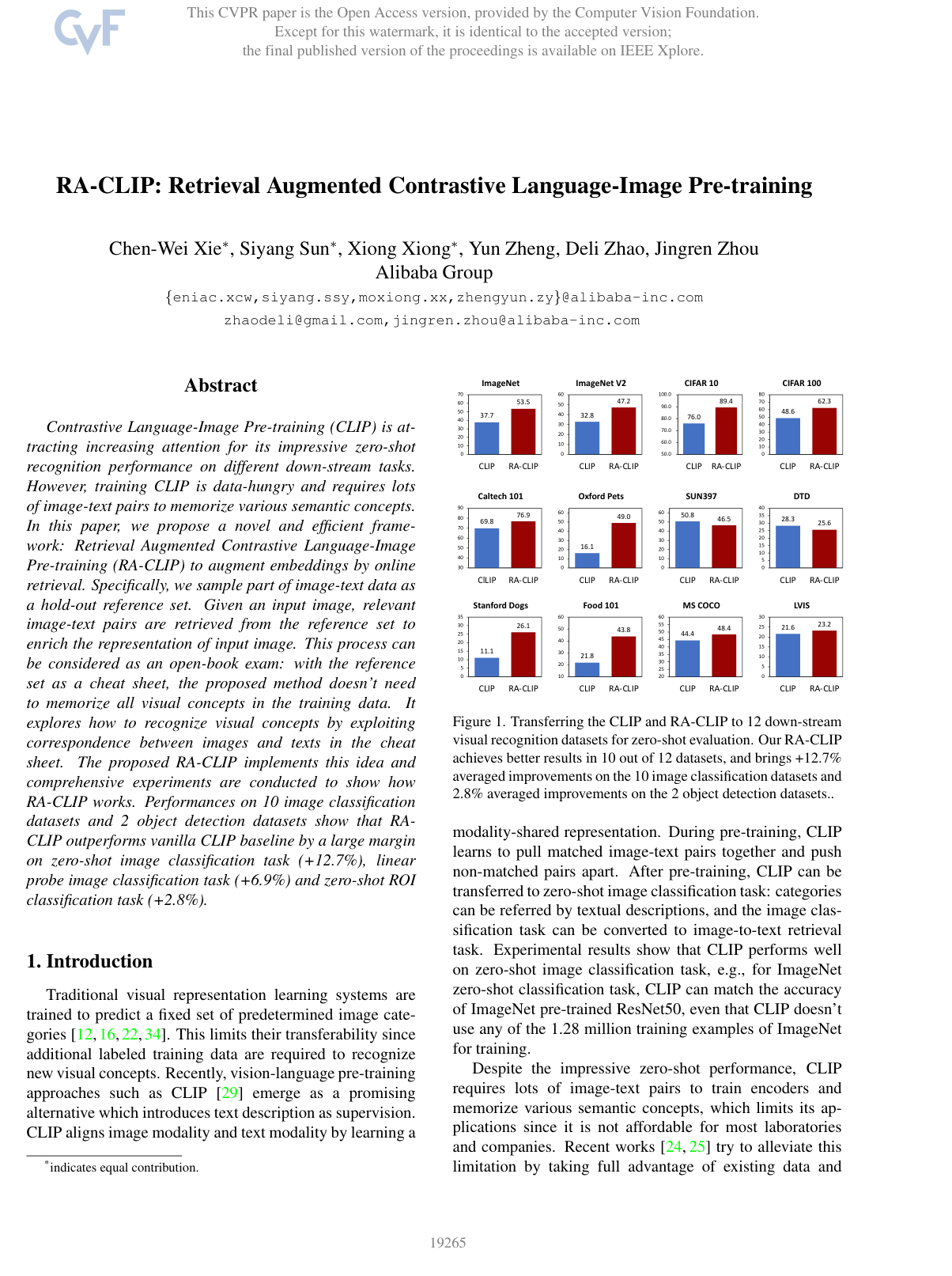
The findings show that the proposed framework consistently outperforms standard methods across diverse recognition tasks. First, the retrieval-augmented framework achieved an average zero-shot image classification accuracy of 52.0% across ten benchmarks, outperforming standard baseline models by an absolute margin of 12.7% and beating previous state-of-the-art methods such as DeCLIP and SLIP. Second, on the standard ImageNet benchmark, zero-shot accuracy rose from 37.7% to 53.5% under the same training budget, and scaling the reference pool from 1,000 to 10 million pairs produced steady accuracy gains. Third, the framework improved linear probe classification accuracy by an average of 6.9% over standard baselines (reaching 75.5%) and improved zero-shot region-of-interest detection performance on standard object detection benchmarks, particularly for small and medium objects.
These results demonstrate that treating concept recognition as an open-book lookup rather than internal memorization significantly improves data and computational efficiency. Organizations can deploy higher-performing vision-language models at reduced pre-training data scale, lowering infrastructure costs and development timelines. Furthermore, the findings show that external reference sets from different standard image-text collections perform robustly without requiring dataset-specific tuning.
Organizations developing or deploying visual AI systems should adopt retrieval-augmented architectures to improve performance when training data budgets are constrained. Teams should use standard pre-trained uni-modal encoders to extract reference embeddings offline, minimizing runtime latency and computational overhead. When implementing the retrieval module, practitioners should focus retrieval augmentation primarily on the image representations rather than text representations, as the article found that text-to-text augmentation introduces noise.
Decision-makers should note certain operational boundaries: the retrieval mechanism adds minor system complexity and search latency during inference, and performance gains begin to show diminishing returns as the reference dataset expands past several million pairs. Confidence in the empirical results is high given rigorous benchmarking across twelve diverse datasets, but organizations should conduct pilot testing to optimize retrieval indexing and latency for real-time edge applications.
- Paper: Learning Transferable Visual Models From Natural Language Supervision, Alec Radford et al.. This foundational work introduces Contrastive Language-Image Pre-training (CLIP), the core paradigm and baseline architecture that RA-CLIP directly adapts with retrieval augmentation.
- Paper: Retrieval Augmented Classification for Long-Tail Visual Recognition, Alexander Long et al. (2022). This paper establishes external non-parametric memory retrieval for image classification, directly motivating RA-CLIP's premise of replacing internal parameter memorization with visual lookups.
- Paper: Conceptual 12M: Pushing Web-Scale Image-Text Pre-Training To Recognize Long-Tail Visual Concepts, Soravit Changpinyo et al. (2021). This work provides Conceptual 12M and analyzes long-tail web-scale multimodal pre-training, which forms the key data landscape and conceptual challenge addressed by RA-CLIP.
- Paper: Scaling Up Visual and Vision-Language Representation Learning With Noisy Text Supervision, Chao Jia et al. (2021). This work demonstrates scaling dual-encoder contrastive vision-language representation learning with noisy web pairs (ALIGN), exemplifying the standard memorization pre-training regime improved upon by RA-CLIP.
- Paper: Training Data is More Valuable than You Think: A Simple and Effective Method by Retrieving from Training Data, Shuohang Wang et al. (2022). This paper introduces the principle of retrieving informative examples directly from the training corpus during execution to boost parameter efficiency, which RA-CLIP adapts to vision-language learning.
- Paper: CLIP-Adapter: Better Vision-Language Models with Feature Adapters, Peng Gao et al. (2021). This study introduces feature adapters on top of frozen vision-language encoders, providing key architectural context for lightweight feature modification in contrastive models.
- Paper: RegionCLIP: Region-based Language-Image Pretraining, Yiwu Zhong et al. (2022). This paper develops region-level visual-language grounding (RegionCLIP), contextualizing RA-CLIP's evaluation and performance improvements on fine-grained object detection tasks.
- Paper: PreFLMR: Scaling Up Fine-Grained Late-Interaction Multi-modal Retrievers, Weizhe Lin et al. (2024). This work scales fine-grained, late-interaction multimodal retrievers for external knowledge retrieval, extending the retrieval-augmented paradigm beyond pre-training to complex multimodal knowledge search.
- Paper: Dual Memory Networks: A Versatile Adaptation Approach for Vision-Language Models, Yabin Zhang et al. (2024). This paper extends memory-augmented vision-language adaptation by implementing dual static and dynamic online memory caches during inference.
- Paper: SoftCLIP: Softer Cross-Modal Alignment Makes CLIP Stronger, Yuting Gao et al. (2024). This research builds on vision-language representation efficiency by replacing rigid one-to-one pairings with soft cross-modal targets derived from intra-modal similarity.
- Paper: Improving CLIP Training with Language Rewrites, Lijie Fan et al. (2023). This work explores a complementary strategy for improving CLIP data efficiency by using LLM-generated language rewrites to expand the diversity of supervision.
- Paper: Vision-Language Models for Vision Tasks: A Survey, Jingyi Zhang et al. (2023). This comprehensive survey categorizes and contextualizes recent advancements in vision-language models, pre-training objectives, and downstream adaptation methods.