
keyword
image retrieval
Image retrieval is the process within computer vision and information retrieval of searching, identifying, and retrieving digital images from a collection that match a user query. Depending on the system, the query can be presented in various formats, such as an existing image, a sketch, a designated image region, or a natural language text description. The retrieval process operates by extracting visual or multimodal feature representations and computing similarity metrics between the query and stored items within an embedding space. While early methods relied on handcrafted descriptors capturing low-level properties such as color histograms, textures, and keypoint patterns, modern approaches typically leverage deep neural networks and multimodal vision-language models to achieve semantic and fine-grained matching across large-scale datasets.
31 items
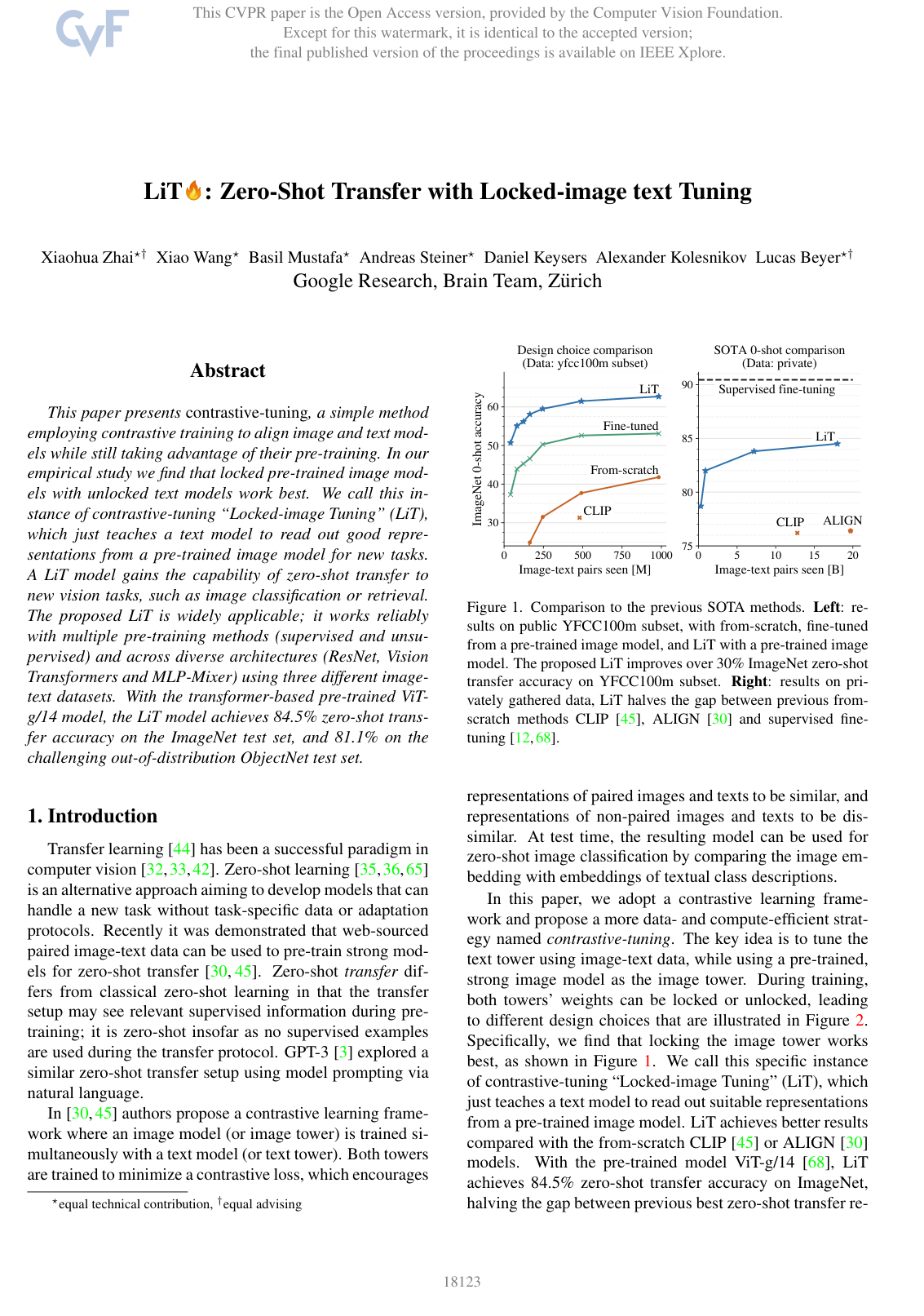
LiT: Zero-Shot Transfer with Locked-image text Tuning
Xiaohua Zhai, Xiao Wang, Basil Mustafa, Andreas Steiner, Daniel Keysers, Alexander Kolesnikov, Lucas Beyer
Why you should read this
Demonstrates that training a text model to align with a frozen, pre-trained image encoder significantly improves data and compute efficiency in zero-shot vision-language tasks, outperforming from-scratch contrastive learning baselines while achieving 84.5% top-1 accuracy on ImageNet.
This paper presents contrastive-tuning, a simple method employing contrastive training to align image and text models while still taking advantage of their pre-training. In our empirical study we find that locked pre-trained image models with unlocked text models work best. We call this instance of contrastive-tuning “Locked-image Tuning” (LiT), which just teaches a text model to read out good representations from a pre-trained image model for new tasks. A LiT model gains the capability of zero-shot transfer to new vision tasks, such as image classification or retrieval. The proposed LiT is widely applicable; it works reliably with multiple pre-training methods (supervised and unsupervised) and across diverse architectures (ResNet, Vision Transformers and MLP-Mixer) using three different image-text datasets. With the transformer-based pre-trained ViT-g/14 model, the LiT model achieves 84.5% zero-shot transfer accuracy on the ImageNet test set, and 81.1% on the challenging out-of-distribution ObjectNet test set.
Added
2026-10-05
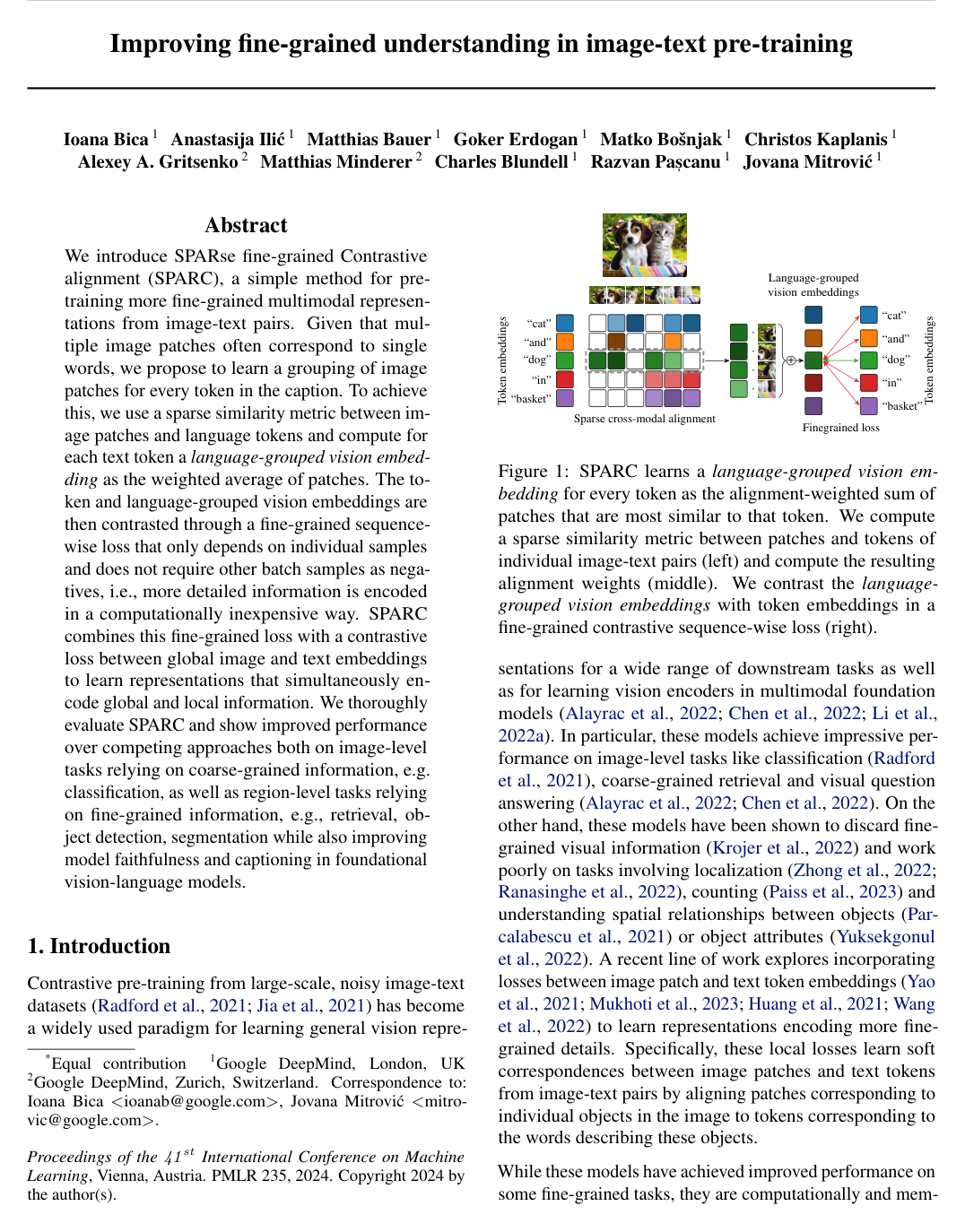
Improving fine-grained understanding in image-text pre-training
Ioana Bica, Anastasija Ilic, Matthias Bauer, Goker Erdogan, Matko Bosnjak, Christos Kaplanis, Alexey A. Gritsenko, Matthias Minderer, Charles Blundell, Razvan Pascanu, Jovana Mitrovic
Why you should read this
Proposes a computationally efficient vision-language pre-training method that groups image patches per text token via sparse alignment, boosting performance across both fine-grained region-level tasks and global image classification.
We introduce SPARCe fine-grained Contrastive alignment (SPARC), a simple method for pre-training more fine-grained multimodal representations from image-text pairs. Given that multiple image patches often correspond to single words, we propose to learn a grouping of image patches for every token in the caption. To achieve this, we use a sparse similarity metric between image patches and language tokens and compute for each text token a language-grouped vision embedding as the weighted average of patches. The token and language-grouped vision embeddings are then contrasted through a fine-grained sequence-wise loss that only depends on individual samples and does not require other batch samples as negatives, i.e., more detailed information is encoded in a computationally inexpensive way. SPARC combines this fine-grained loss with a contrastive loss between global image and text embeddings to learn representations that simultaneously encode global and local information. We thoroughly evaluate SPARC and show improved performance over competing approaches both on image-level tasks relying on coarse-grained information, e.g. classification, as well as region-level tasks relying on fine-grained information, e.g., retrieval, object detection, segmentation while also improving model faithfulness and captioning in foundational vision-language models.
Added
2026-10-03
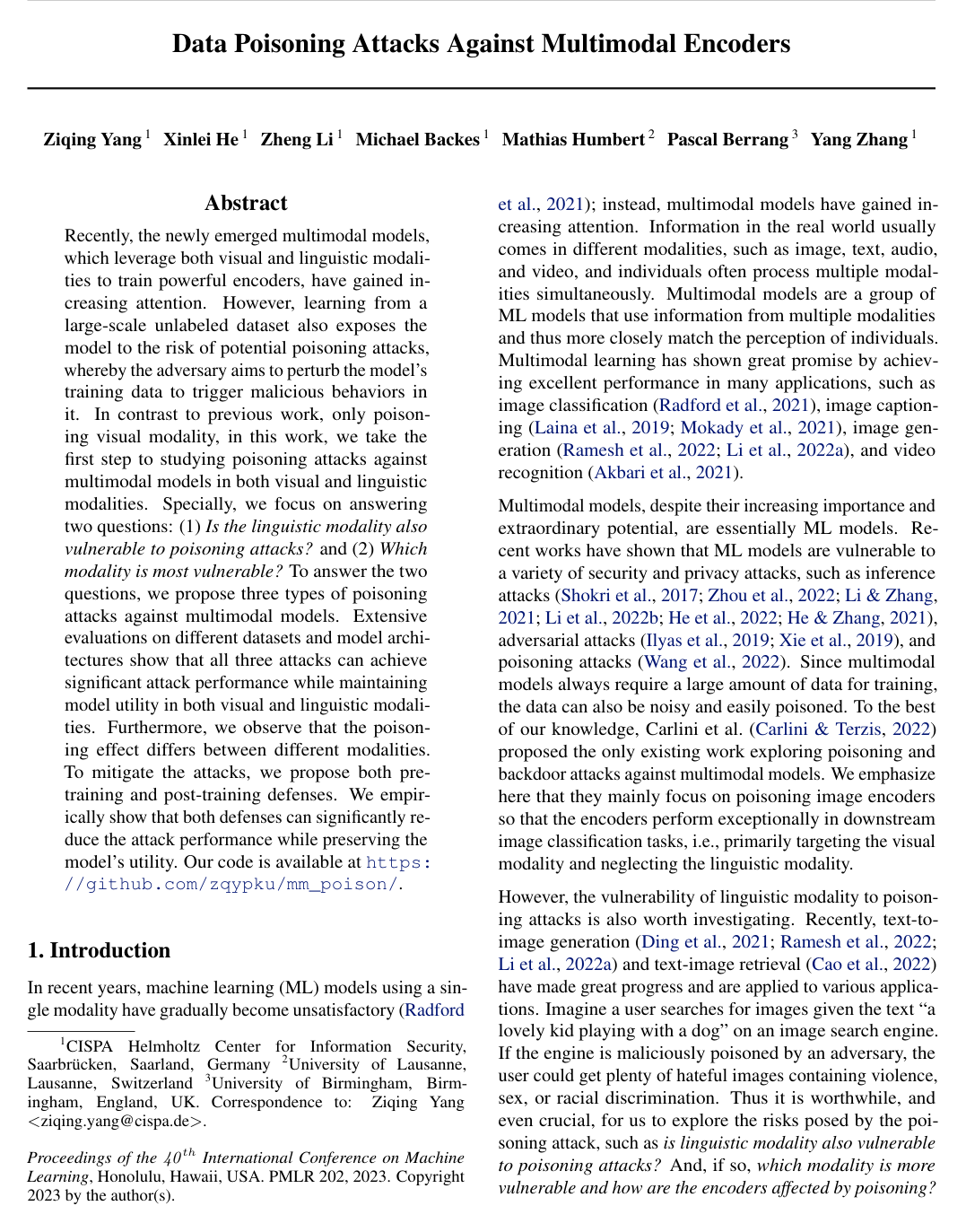
Data Poisoning Attacks Against Multimodal Encoders
Ziqing Yang, Xinlei He, Zheng Li, Michael Backes, Mathias Humbert, Pascal Berrang, Yang Zhang
Why you should read this
Reveals that contrastive learning-based multimodal encoders are susceptible to data poisoning through linguistic as well as visual modalities, introducing three cross-modal poisoning attacks alongside targeted pre- and post-training defenses.
Recently, the newly emerged multimodal models, which leverage both visual and linguistic modalities to train powerful encoders, have gained increasing attention. However, learning from a large-scale unlabeled dataset also exposes the model to the risk of potential poisoning attacks, whereby the adversary aims to perturb the model’s training data to trigger malicious behaviors in it. In contrast to previous work, only poisoning visual modality, in this work, we take the first step to studying poisoning attacks against multimodal models in both visual and linguistic modalities. Specially, we focus on answering two questions: (1) Is the linguistic modality also vulnerable to poisoning attacks? and (2) Which modality is most vulnerable? To answer the two questions, we propose three types of poisoning attacks against multimodal models. Extensive evaluations on different datasets and model architectures show that all three attacks can achieve significant attack performance while maintaining model utility in both visual and linguistic modalities. Furthermore, we observe that the poisoning effect differs between different modalities. To mitigate the attacks, we propose both pre-training and post-training defenses. We empirically show that both defenses can significantly reduce the attack performance while preserving the model’s utility. Our code is available at https://github.com/zqypku/mm_poison/.
Added
2026-10-02
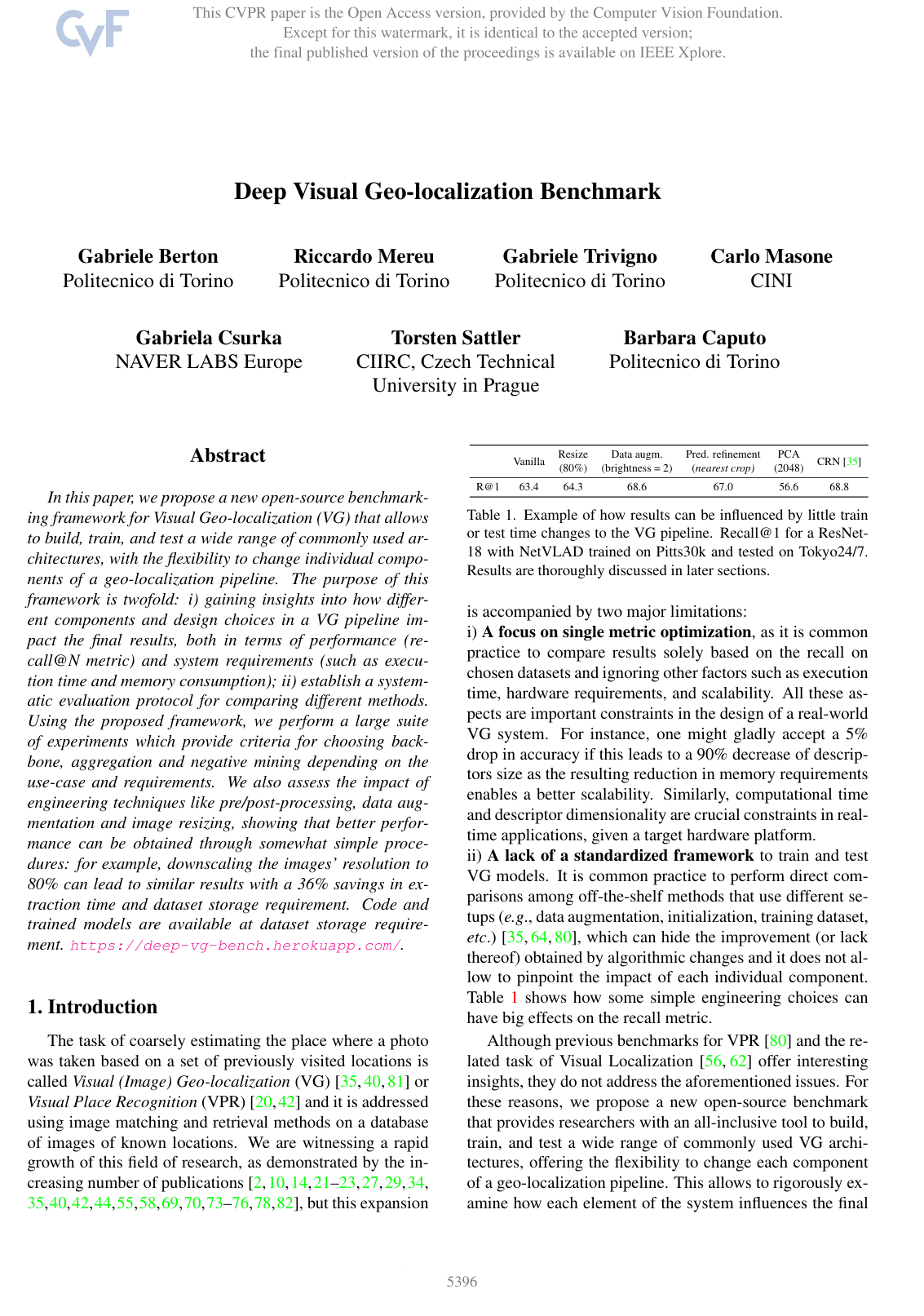
Deep Visual Geo-localization Benchmark
Gabriele Moreno Berton, Riccardo Mereu, Gabriele Trivigno, Carlo Masone, Gabriela Csurka, Torsten Sattler, Barbara Caputo
Why you should read this
Establishes a modular visual geo-localization benchmarking framework and conducts extensive evaluations across pipeline components, offering practical guidelines that balance retrieval accuracy with real-world computational and memory costs.
In this paper, we propose a new open-source benchmark-ing framework for Visual Geo-localization (VG) that allows to build, train, and test a wide range of commonly used ar-chitectures, with the flexibility to change individual compo-nents of a geo-localization pipeline. The purpose of this framework is twofold: i) gaining insights into how differ-ent components and design choices in a VG pipeline im-pact the final results, both in terms of performance (re-call@N metric) and system requirements (such as execu-tion time and memory consumption); ii) establish a system-atic evaluation protocol for comparing different methods. Using the proposed framework, we perform a large suite of experiments which provide criteria for choosing back-bone, aggregation and negative mining depending on the use-case and requirements. We also assess the impact of engineering techniques like pre/post-processing, data aug-mentation and image resizing, showing that better perfor-mance can be obtained through somewhat simple proce-dures: for example, downscaling the images' resolution to 80% can lead to similar results with a 36% savings in ex-traction time and dataset storage requirement. Code and trained models are available at dataset storage require-ment. https://deep-vg-bench.herokuapp.com/.
Added
2026-09-26
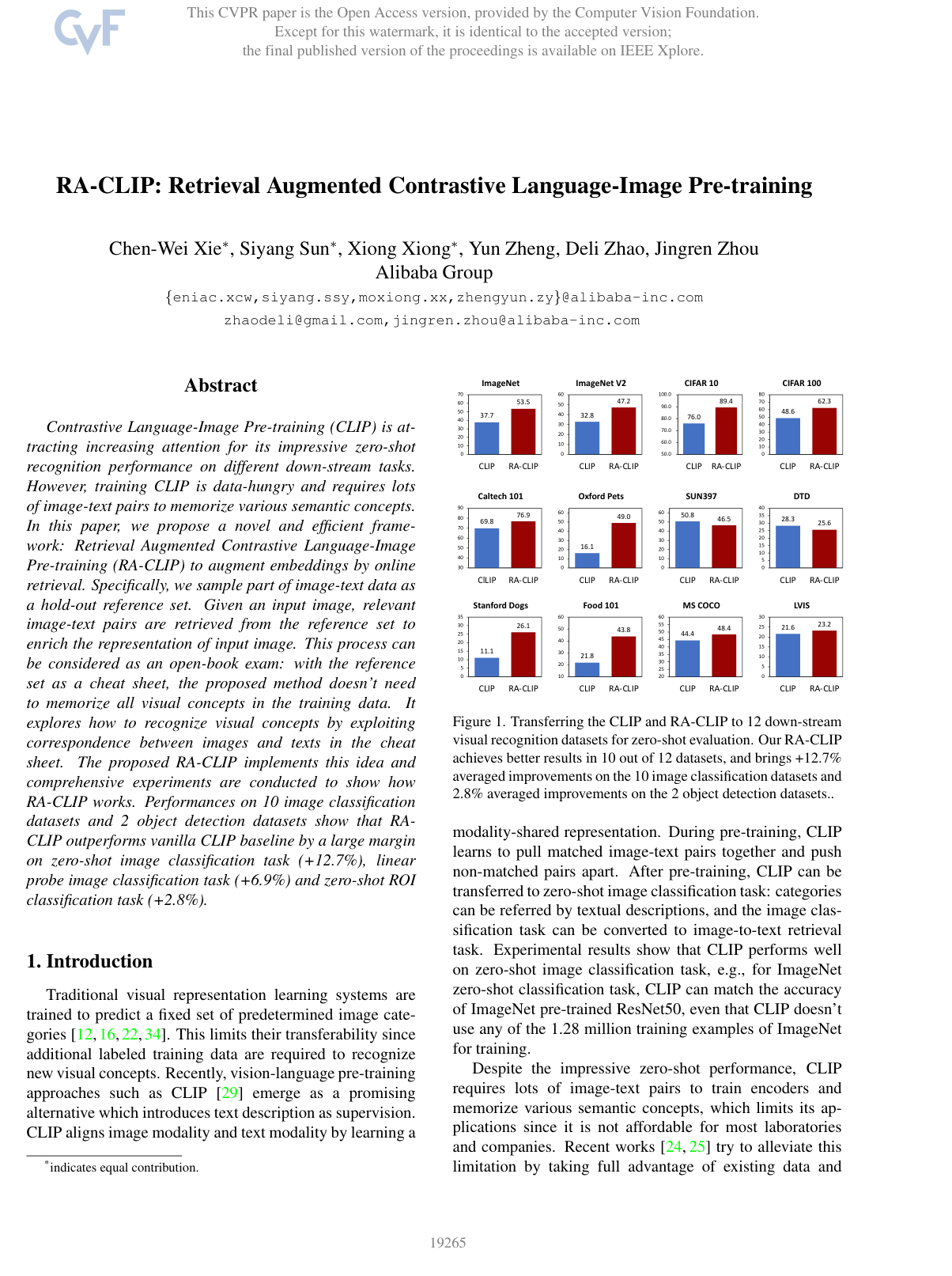
RA-CLIP: Retrieval Augmented Contrastive Language-Image Pre-Training
Chen-Wei Xie, Siyang Sun, Xiong Xiong, Yun Zheng, Deli Zhao, Jingren Zhou
Why you should read this
Proposes an open-book contrastive learning framework that uses online image-text retrieval from a reference set to augment visual embeddings, boosting zero-shot classification performance without requiring models to memorize vast training concepts.
Contrastive Language-Image Pre-training (CLIP) is attracting increasing attention for its impressive zero-shot recognition performance on different down-stream tasks. However, training CLIP is data-hungry and requires lots of image-text pairs to memorize various semantic concepts. In this paper, we propose a novel and efficient framework: Retrieval Augmented Contrastive Language-Image Pre-training (RA-CLIP) to augment embeddings by online retrieval. Specifically, we sample part of image-text data as a hold-out reference set. Given an input image, relevant image-text pairs are retrieved from the reference set to enrich the representation of input image. This process can be considered as an open-book exam: with the reference set as a cheat sheet, the proposed method doesn't need to memorize all visual concepts in the training data. It explores how to recognize visual concepts by exploiting correspondence between images and texts in the cheat sheet. The proposed RA-CLIP implements this idea and comprehensive experiments are conducted to show how RA-CLIP works. Performances on 10 image classification datasets and 2 object detection datasets show that RA-CLIP outperforms vanilla CLIP baseline by a large margin on zero-shot image classification task (+12.7%), linear probe image classification task (+6.9%) and zero-shot ROI classification task (+2.8%).
Added
2026-09-26
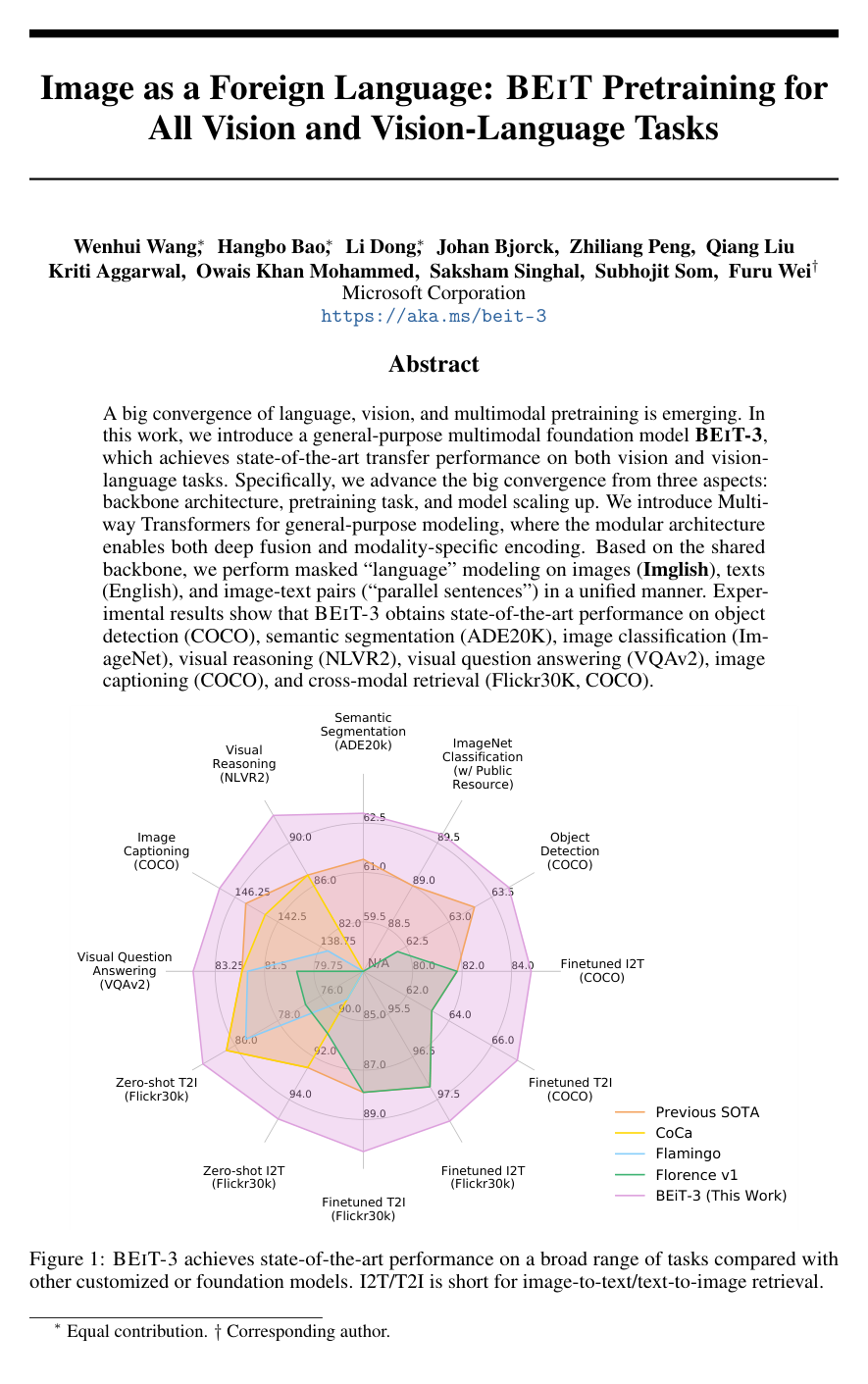
Image as a Foreign Language: BEIT Pretraining for Vision and Vision-Language Tasks
Wenhui Wang, Hangbo Bao, Li Dong, Johan Bjorck, Zhiliang Peng, Qiang Liu, Kriti Aggarwal, Owais Khan Mohammed, Saksham Singhal, Subhojit Som, Furu Wei
Why you should read this
Introduces BEiT-3, a unified multimodal foundation model that treats images as a foreign language and pretrains a Multiway Transformer via masked data modeling to achieve state-of-the-art transfer performance across major vision and vision-language benchmarks.
A big convergence of language, vision, and multimodal pretraining is emerging. In this work, we introduce a general-purpose multimodal foundation model BEiT-3, which achieves state-of-the-art transfer performance on both vision and vision-language tasks. Specifically, we advance the big convergence from three aspects: backbone architecture, pretraining task, and model scaling up. We introduce Multiway Transformers for general-purpose modeling, where the modular architecture enables both deep fusion and modality-specific encoding. Based on the shared backbone, we perform masked "language" modeling on images (Imglish), texts (English), and image-text pairs ("parallel sentences") in a unified manner. Experimental results show that BEiT-3 obtains state-of-the-art performance on object detection (COCO), semantic segmentation (ADE20K), image classification (ImageNet), visual reasoning (NLVR2), visual question answering (VQAv2), image captioning (COCO), and cross-modal retrieval (Flickr30K, COCO).
Added
2026-09-26
ReCo: Retrieve and Co-segment for Zero-shot Transfer
Gyungin Shin, Weidi Xie, Samuel Albanie
Why you should read this
Proposes a zero-shot semantic segmentation framework that combines vision-language image retrieval with cross-image co-segmentation to build open-vocabulary segmenters from unlabeled data without requiring any manual pixel annotations.
Semantic segmentation has a broad range of applications, but its real-world impact has been significantly limited by the prohibitive annotation costs necessary to enable deployment. Segmentation methods that forgo supervision can side-step these costs, but exhibit the inconvenient requirement to provide labelled examples from the target distribution to assign concept names to predictions. An alternative line of work in language-image pre-training has recently demonstrated the potential to produce models that can both assign names across large vocabularies of concepts and enable zero-shot transfer for classification, but do not demonstrate commensurate segmentation abilities. We leverage the retrieval abilities of one such language-image pre-trained model, CLIP, to dynamically curate training sets from unlabelled images for arbitrary collections of concept names, and leverage the robust correspondences offered by modern image representations to co-segment entities among the resulting collections. The synthetic segment collections are then employed to construct a segmentation model (without requiring pixel labels) whose knowledge of concepts is inherited from the scalable pre-training process of CLIP. We demonstrate that our approach, termed Retrieve and Co-segment (ReCo) performs favourably to conventional unsupervised segmentation approaches while inheriting the convenience of nameable predictions and zero-shot transfer. We also demonstrate ReCo’s ability to generate specialist segmenters for extremely rare objects.
Added
2026-09-26
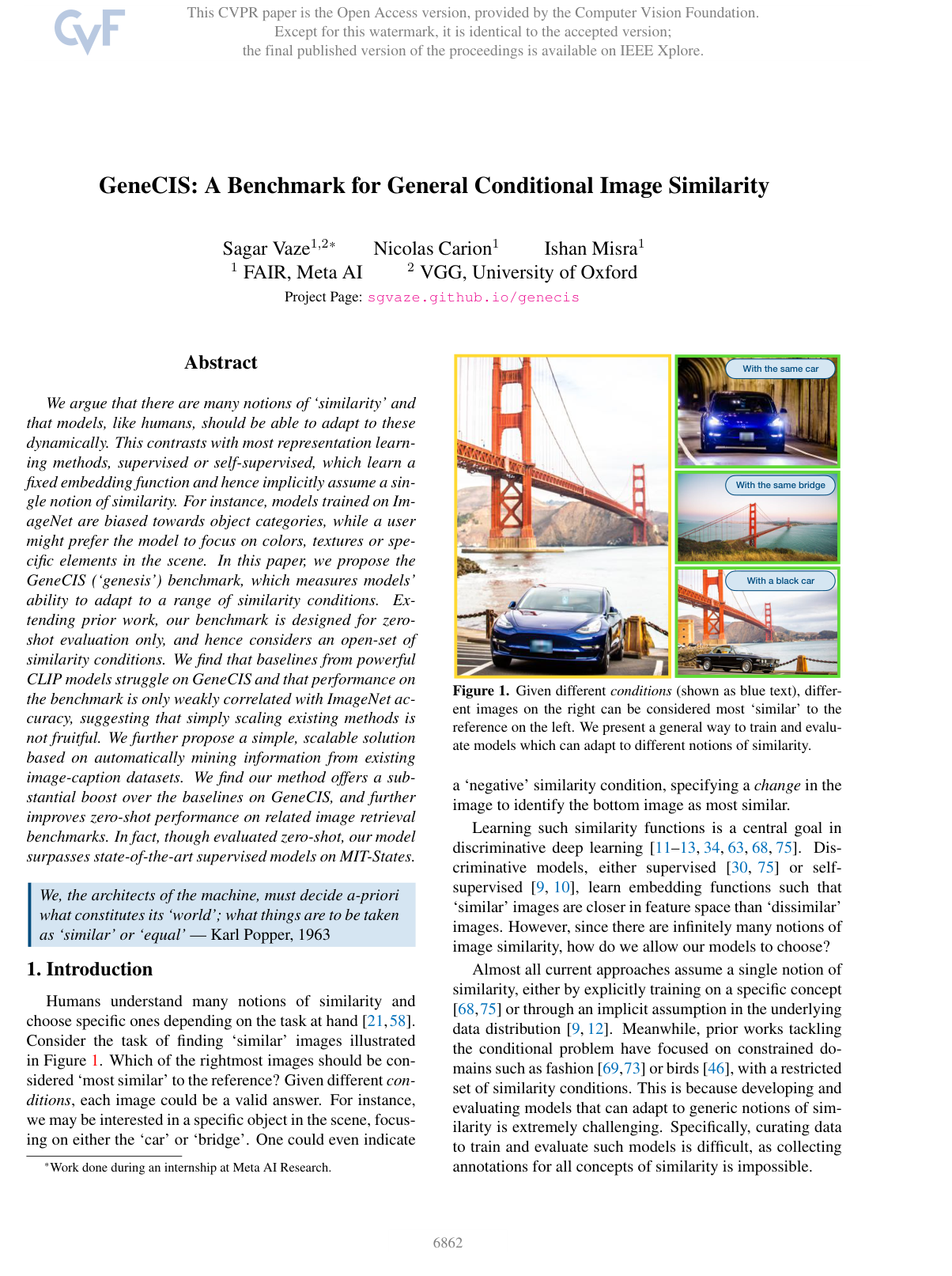
GeneCIS: A Benchmark for General Conditional Image Similarity
Sagar Vaze, Nicolas Carion, Ishan Misra
Why you should read this
Introduces the GeneCIS benchmark to evaluate zero-shot conditional image similarity and presents a scalable training strategy that mines image-caption datasets to significantly improve retrieval models when adapting to open-ended similarity criteria.
We argue that there are many notions of ‘similarity’ and that models, like humans, should be able to adapt to these dynamically. This contrasts with most representation learning methods, supervised or self-supervised, which learn a fixed embedding function and hence implicitly assume a single notion of similarity. For instance, models trained on ImageNet are biased towards object categories, while a user might prefer the model to focus on colors, textures or specific elements in the scene. In this paper, we propose the GeneCIS (‘genesis’) benchmark, which measures models’ ability to adapt to a range of similarity conditions. Extending prior work, our benchmark is designed for zero-shot evaluation only, and hence considers an open-set of similarity conditions. We find that baselines from powerful CLIP models struggle on GeneCIS and that performance on the benchmark is only weakly correlated with ImageNet accuracy, suggesting that simply scaling existing methods is not fruitful. We further propose a simple, scalable solution based on automatically mining information from existing image-caption datasets. We find our method offers a substantial boost over the baselines on GeneCIS, and further improves zero-shot performance on related image retrieval benchmarks. In fact, though evaluated zero-shot, our model surpasses state-of-the-art supervised models on MIT-States.
Added
2026-09-26
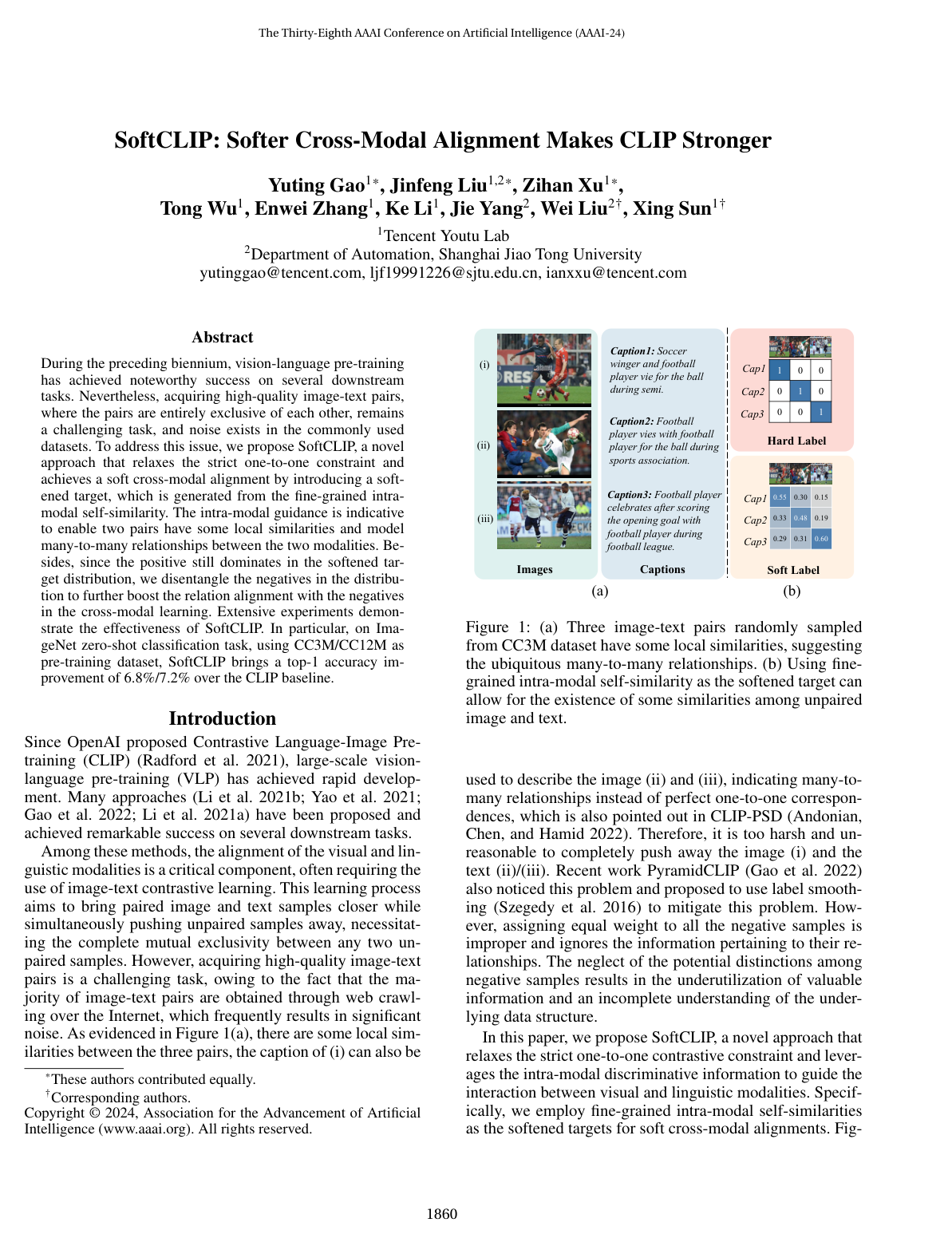
SoftCLIP: Softer Cross-Modal Alignment Makes CLIP Stronger
Yuting Gao, Jinfeng Liu, Zihan Xu, Tong Wu, Enwei Zhang, Ke Li, Jie Yang, Wei Liu, Xing Sun
Why you should read this
Proposes a relaxed contrastive learning framework that uses fine-grained intra-modal self-similarity and negative-pair disentanglement as soft alignment targets, significantly improving CLIP's zero-shot classification performance on noisy web-scale image-text datasets.
During the preceding biennium, vision-language pre-training has achieved noteworthy success on several downstream tasks. Nevertheless, acquiring high-quality image-text pairs, where the pairs are entirely exclusive of each other, remains a challenging task, and noise exists in the commonly used datasets. To address this issue, we propose SoftCLIP, a novel approach that relaxes the strict one-to-one constraint and achieves a soft cross-modal alignment by introducing a softened target, which is generated from the fine-grained intra-modal self-similarity. The intra-modal guidance is indicative to enable two pairs have some local similarities and model many-to-many relationships between the two modalities. Besides, since the positive still dominates in the softened target distribution, we disentangle the negatives in the distribution to further boost the relation alignment with the negatives in the cross-modal learning. Extensive experiments demonstrate the effectiveness of SoftCLIP. In particular, on ImageNet zero-shot classification task, using CC3M/CC12M as pre-training dataset, SoftCLIP brings a top-1 accuracy improvement of 6.8%/7.2% over the CLIP baseline.
Added
2026-09-26
Automatic image annotation and retrieval using cross-media relevance models
J. Jeon, V. Lavrenko, R. Manmatha
Why you should read this
Presents a cross-media relevance model that learns joint distributions of visual region clusters and keywords to automatically annotate and retrieve images, doubling the mean precision of previous machine translation approaches.
Libraries have traditionally used manual image annotation for indexing and then later retrieving their image collections. However, manual image annotation is an expensive and labor intensive procedure and hence there has been great interest in coming up with automatic ways to retrieve images based on content. Here, we propose an automatic approach to annotating and retrieving images based on a training set of images. We assume that regions in an image can be described using a small vocabulary of blobs. Blobs are generated from image features using clustering. Given a training set of images with annotations, we show that probabilistic models allow us to predict the probability of generating a word given the blobs in an image. This may be used to automatically annotate and retrieve images given a word as a query. We show that relevance models allow us to derive these probabilities in a natural way. Experiments show that the annotation performance of this cross-media relevance model is almost six times as good (in terms of mean precision) than a model based on word-blob co-occurrence model and twice as good as a state of the art model derived from machine translation. Our approach shows the usefulness of using formal information retrieval models for the task of image annotation and retrieval.
Added
2026-09-25
Learning Fine-Grained Image Similarity with Deep Ranking
Jiang Wang, Yang Song, Thomas Leung, Chuck Rosenberg, Jingbin Wang, James Philbin, Bo Chen, Ying Wu
Why you should read this
Develops a multiscale deep ranking network paired with an efficient triplet sampling algorithm to learn fine-grained visual similarity directly from images, outperforming standard classification models and hand-crafted visual representations.
Learning fine-grained image similarity is a challenging task. It needs to capture between-class and within-class image differences. This paper proposes a deep ranking model that employs deep learning techniques to learn similarity metric directly from this http URL has higher learning capability than models based on hand-crafted features. A novel multiscale network structure has been developed to describe the images effectively. An efficient triplet sampling algorithm is proposed to learn the model with distributed asynchronized stochastic gradient. Extensive experiments show that the proposed algorithm outperforms models based on hand-crafted visual features and deep classification models.
Added
2026-09-25
Framing Image Description as a Ranking Task: Data, Models and Evaluation Metrics
Micah Hodosh, Peter Young, Julia Hockenmaier
Why you should read this
Establishes a unified ranking framework and a benchmark of 8,000 images with multiple descriptive captions to evaluate sentence-based image description and retrieval independently of text generation challenges.
The ability to associate images with natural language sentences that describe what is depicted in them is a hallmark of image understanding, and a prerequisite for applications such as sentence-based image search. In analogy to image search, we propose to frame sentence-based image annotation as the task of ranking a given pool of captions. We introduce a new benchmark collection for sentence-based image description and search, consisting of 8,000 images that are each paired with five different captions which provide clear descriptions of the salient entities and events. We introduce a number of systems that perform quite well on this task, even though they are only based on features that can be obtained with minimal supervision. Our results clearly indicate the importance of training on multiple captions per image, and of capturing syntactic (word order-based) and semantic features of these captions. We also perform an in-depth comparison of human and automatic evaluation metrics for this task, and propose strategies for collecting human judgments cheaply and on a very large scale, allowing us to augment our collection with additional relevance judgments of which captions describe which image. Our analysis shows that metrics that consider the ranked list of results for each query image or sentence are significantly more robust than metrics that are based on a single response per query. Moreover, our study suggests that the evaluation of ranking-based image description systems may be fully automated.
Added
2026-09-25
Learning to compare image patches via convolutional neural networks
Sergey Zagoruyko, Nikos Komodakis
Why you should read this
Demonstrates how specialized convolutional neural network architectures can learn image patch similarity directly from raw pixels to outperform traditional handcrafted feature matching across standard computer vision benchmarks.
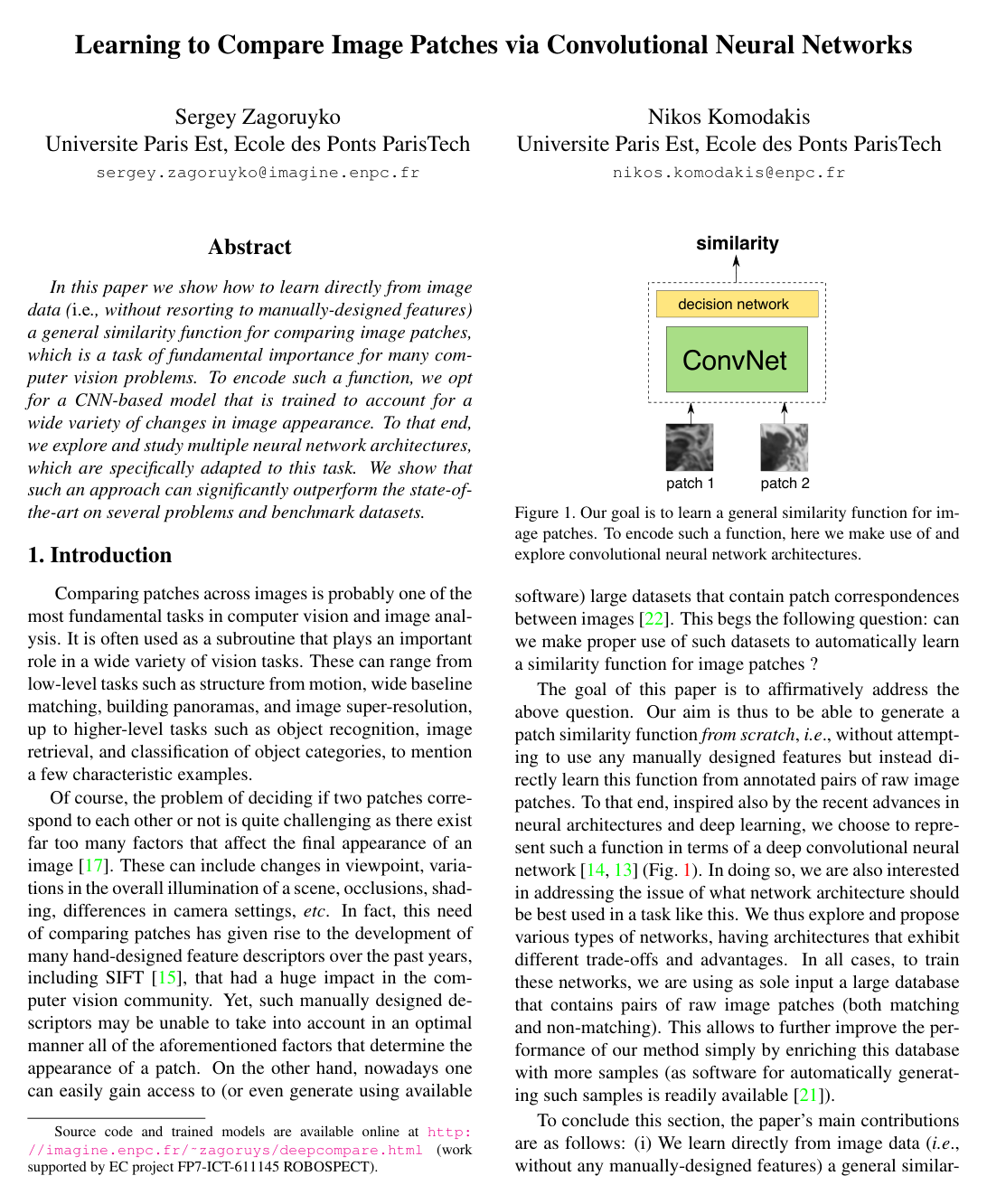
In this paper we show how to learn directly from image data (i.e., without resorting to manually-designed features) a general similarity function for comparing image patches, which is a task of fundamental importance for many computer vision problems. To encode such a function, we opt for a CNN-based model that is trained to account for a wide variety of changes in image appearance. To that end, we explore and study multiple neural network architectures, which are specifically adapted to this task. We show that such an approach can significantly outperform the state-of-the-art on several problems and benchmark datasets.
Added
2026-09-25
Scalable Nearest Neighbor Algorithms for High Dimensional Data
Marius Muja, D. Lowe
Why you should read this
Presents scalable approximate nearest neighbor search methods, including randomized k-d trees and priority search k-means trees, paired with an automated configuration mechanism implemented in the widely used FLANN library to drastically accelerate high-dimensional matching.
For many computer vision and machine learning problems, large training sets are key for good performance. However, the most computationally expensive part of many computer vision and machine learning algorithms consists of finding nearest neighbor matches to high dimensional vectors that represent the training data. We propose new algorithms for approximate nearest neighbor matching and evaluate and compare them with previous algorithms. For matching high dimensional features, we find two algorithms to be the most efficient: the randomized k-d forest and a new algorithm proposed in this paper, the priority search k-means tree. We also propose a new algorithm for matching binary features by searching multiple hierarchical clustering trees and show it outperforms methods typically used in the literature. We show that the optimal nearest neighbor algorithm and its parameters depend on the data set characteristics and describe an automated configuration procedure for finding the best algorithm to search a particular data set. In order to scale to very large data sets that would otherwise not fit in the memory of a single machine, we propose a distributed nearest neighbor matching framework that can be used with any of the algorithms described in the paper. All this research has been released as an open source library called fast library for approximate nearest neighbors (FLANN), which has been incorporated into OpenCV and is now one of the most popular libraries for nearest neighbor matching.
Added
2026-09-24
Im2Text: Describing Images Using 1 Million Captioned Photographs
Vicente Ordonez, Girish Kulkarni, Tamara L. Berg
Why you should read this
Introduces a web-scale dataset of one million filtered captioned photographs alongside non-parametric retrieval methods that effectively generate natural image descriptions by transferring human captions.
We develop and demonstrate automatic image description methods using a large captioned photo collection. One contribution is our technique for the automatic collection of this new dataset – performing a huge number of Flickr queries and then filtering the noisy results down to 1 million images with associated visually relevant captions. Such a collection allows us to approach the extremely challenging problem of description generation using relatively simple non-parametric methods and produces surprisingly effective results. We also develop methods incorporating many state of the art, but fairly noisy, estimates of image content to produce even more pleasing results. Finally we introduce a new objective performance measure for image captioning.
Added
2026-09-24
Fine-Tuning CNN Image Retrieval with No Human Annotation
Filip Radenovic, Giorgos Tolias, Ondřej Chum
Why you should read this
Introduces an automated framework that leverages 3D structure-from-motion models to mine hard training examples without human annotation, while introducing trainable Generalized-Mean pooling to achieve state-of-the-art CNN image retrieval performance.
Image descriptors based on activations of Convolutional Neural Networks (CNNs) have become dominant in image retrieval due to their discriminative power, compactness of representation, and search efficiency. Training of CNNs, either from scratch or fine-tuning, requires a large amount of annotated data, where a high quality of annotation is often crucial. In this work, we propose to fine-tune CNNs for image retrieval on a large collection of unordered images in a fully automated manner. Reconstructed 3D models obtained by the state-of-the-art retrieval and structure-from-motion methods guide the selection of the training data. We show that both hard-positive and hard-negative examples, selected by exploiting the geometry and the camera positions available from the 3D models, enhance the performance of particular-object retrieval. CNN descriptor whitening discriminatively learned from the same training data outperforms commonly used PCA whitening. We propose a novel trainable Generalized-Mean (GeM) pooling layer that generalizes max and average pooling and show that it boosts retrieval performance. Applying the proposed method to the VGG network achieves state-of-the-art performance on the standard benchmarks: Oxford Buildings, Paris, and Holidays datasets.
Added
2026-09-24
Blobworld: Image Segmentation Using Expectation-Maximization and Its Application to Image Querying
C. Carson, Serge J. Belongie, H. Greenspan, Jitendra Malik
Why you should read this
Introduces a region-based image retrieval framework that uses Expectation-Maximization clustering across joint color, texture, and spatial features to enable object-level queries that significantly outperform traditional global histogram methods.
Retrieving images from large and varied collections using image content as a key is a challenging and important problem. We present a new image representation which provides a transformation from the raw pixel data to a small set of image regions which are coherent in color and texture. This “Blobworld” representation is created by clustering pixels in a joint color-texture-position feature space. The segmentation algorithm is fully automatic and has been run on a collection of 10,000 natural images. We describe a system that uses the Blobworld representation to retrieve images from this collection. An important aspect of the system is that the user is allowed to view the internal representation of the submitted image and the query results. Similar systems do not offer the user this view into the workings of the system; consequently, query results from these systems can be inexplicable, despite the availability of knobs for adjusting the similarity metrics. By finding image regions which roughly correspond to objects, we allow querying at the level of objects rather than global image properties. We present results indicating that querying for distinctive objects using Blobworld produces significantly higher precision than does querying using color and texture histograms of the entire image.
Added
2026-09-24
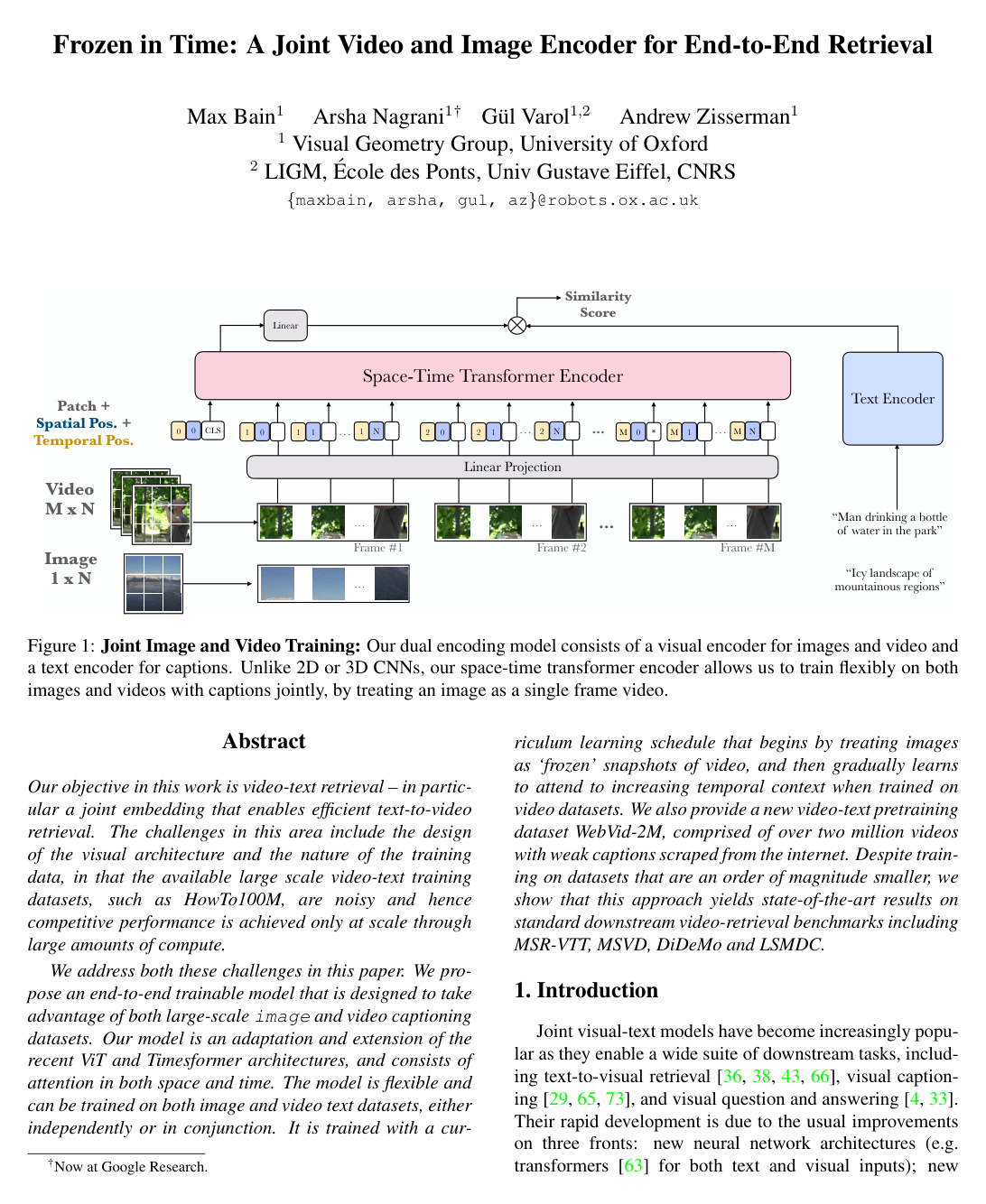
Frozen in Time: A Joint Video and Image Encoder for End-to-End Retrieval
Max Bain, Arsha Nagrani, Gül Varol, Andrew Zisserman
Why you should read this
Proposes an end-to-end spatiotemporal visual architecture trained jointly on static images and video captions alongside the WebVid-2M dataset, achieving state-of-the-art text-to-video retrieval performance with an order of magnitude less training data.
Our objective in this work is video-text retrieval - in particular a joint embedding that enables efficient text-to-video retrieval. The challenges in this area include the design of the visual architecture and the nature of the training data, in that the available large scale video-text training datasets, such as HowTo100M, are noisy and hence competitive performance is achieved only at scale through large amounts of compute. We address both these challenges in this paper. We propose an end-to-end trainable model that is designed to take advantage of both large-scale image and video captioning datasets. Our model is an adaptation and extension of the recent ViT and Timesformer architectures, and consists of attention in both space and time. The model is flexible and can be trained on both image and video text datasets, either independently or in conjunction. It is trained with a curriculum learning schedule that begins by treating images as 'frozen' snapshots of video, and then gradually learns to attend to increasing temporal context when trained on video datasets. We also provide a new video-text pretraining dataset WebVid-2M, comprised of over two million videos with weak captions scraped from the internet. Despite training on datasets that are an order of magnitude smaller, we show that this approach yields state-of-the-art results on standard downstream video-retrieval benchmarks including MSR-VTT, MSVD, DiDeMo and LSMDC.
Added
2026-09-24
Support Vector Machines for Multiple-Instance Learning
S. Andrews, Ioannis Tsochantaridis, Thomas Hofmann
Why you should read this
Extends Support Vector Machines to multiple-instance learning by formulating pattern-level and bag-level maximum margin optimizations as mixed integer quadratic programs, enabling kernel-based classification on weakly annotated data across drug design, image indexing, and text categorization tasks.
This paper presents two new formulations of multiple-instance learning as a maximum margin problem. The proposed extensions of the Support Vector Machine (SVM) learning approach lead to mixed integer quadratic programs that can be solved heuristically. Our generalization of SVMs makes a state-of-the-art classification technique, including non-linear classification via kernels, available to an area that up to now has been largely dominated by special purpose methods. We present experimental results on a pharmaceutical data set and on applications in automated image indexing and document categorization.
Added
2026-09-24
Local Grayvalue Invariants for Image Retrieval
Cordelia Schmid, R. Mohr
Why you should read this
Proposes a pioneering framework for image retrieval from large databases by combining multiscale differential grayvalue invariants at interest points with multidimensional indexing and geometric voting constraints to achieve reliable recognition despite partial occlusion, scale shifts, and perspective changes.
This paper addresses the problem of retrieving images from large image databases. The method is based on local grayvalue invariants which are computed at automatically detected interest points. A voting algorithm and semilocal constraints make retrieval possible. Indexing allows for efficient retrieval from a database of more than 1,000 images. Experimental results show correct retrieval in the case of partial visibility, similarity transformations, extraneous features, and small perspective deformations.
Added
2026-09-18