Open-Vocabulary Multi-Label Classification via Multi-Modal Knowledge Transfer
Sunan HeTaian GuoTao DaiRuizhi QiaoXiujun ShuBo RenShu-Tao Xia
Proposes a multi-modal knowledge transfer framework that adapts vision-language pre-trained models via knowledge distillation, prompt tuning, and a two-stream feature extractor to recognize unseen object labels in multi-label classification.
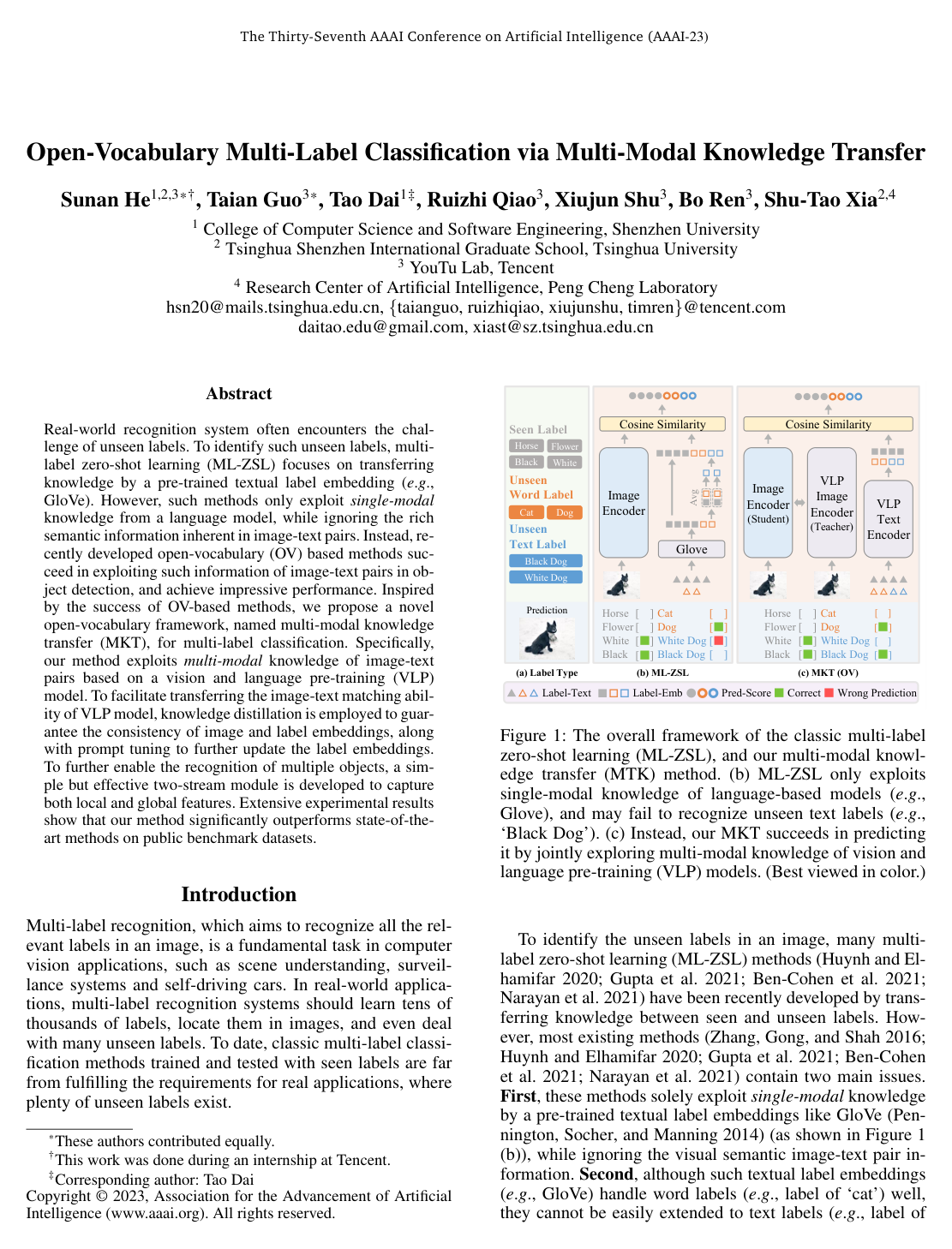
Real-world computer vision systems for applications such as autonomous driving, surveillance, and automated scene understanding must recognize thousands of diverse concepts, including categories never encountered during training. Traditional multi-label zero-shot recognition approaches attempt to generalize to unseen categories by relying on text-only language models. However, because these systems lack visual context, they struggle to capture visual consistency across concepts and perform poorly when evaluating complex or descriptive multi-word phrases.
The article evaluates an open-vocabulary framework designed to recognize both seen and unseen multi-word visual labels by transferring rich multi-modal knowledge from pre-trained vision-and-language models. The primary objective is to demonstrate that aligning visual image representations with multi-modal pre-trained text embeddings significantly improves multi-label classification accuracy across open vocabularies.
The authors develop the Multi-Modal Knowledge Transfer framework, which integrates a Vision Transformer backbone with the pre-trained CLIP vision-and-language model. The architecture employs a two-stream feature extraction module to process both broad global image context and granular local image patches. To ensure effective transfer, the system uses knowledge distillation to align global image representations with pre-trained visual embeddings, paired with continuous prompt tuning to optimize text label embeddings. The framework was evaluated on two benchmark datasets: NUS-WIDE, containing over 269,000 images and 1,006 label categories, and Open Images, spanning over 9 million training images and thousands of complex categories.
The experimental findings show significant performance improvements over prior state-of-the-art models. On the NUS-WIDE zero-shot benchmark, the proposed framework achieved a mean average precision of 37.6%, outperforming the previous leading method by an absolute margin of 11.7% and a direct fine-tuned baseline by 7.1%. In generalized zero-shot testing, which requires classifying seen and unseen labels simultaneously, the method improved precision from 12.1% to 18.3%. On the large-scale Open Images dataset, the framework achieved a zero-shot mean average precision of 68.1% and a weighted precision of 89.2%, outperforming existing zero-shot baselines by 2.5% and 16.3%, respectively. Ablation analyses confirmed that combining global distillation with local patch analysis and prompt tuning produced superior noise resistance and higher predictive accuracy than any component used in isolation.
These results indicate that leveraging joint vision-and-language pre-training substantially reduces the performance penalty typically associated with unseen categories. By effectively handling arbitrary, multi-word descriptive queries without requiring task-specific manual retraining, this approach offers an efficient path to deploying adaptable vision systems. This flexibility lowers ongoing data annotation costs, speeds up deployment timelines for new visual categories, and reduces the risk of classification failures in dynamic real-world environments.
Organizations developing large-scale image tagging, content moderation, or visual surveillance pipelines should consider adopting vision-language distillation frameworks rather than purely text-based zero-shot architectures. Implementation teams should balance local and global feature extraction parameters, as localized analysis improves the detection of small objects but requires calibration to avoid noise sensitivity. Further research and validation should focus on extending this multi-modal transfer methodology to complex video streams and dense real-time robotic perception tasks.
Confidence in these findings is supported by consistent improvements across multiple large-scale public benchmarks. However, stakeholders should note that performance remains sensitive to hyperparameter tuning, specifically the balance between knowledge distillation weights and local pooling configurations. Additionally, overall accuracy remains dependent on the underlying semantic coverage of the pre-trained vision-language foundation model.
- Paper: DualCoOp: Fast Adaptation to Multi-Label Recognition with Limited Annotations, Ximeng Sun et al. (2022). It introduces prompt tuning and spatial feature aggregation for adapting vision-language models to multi-label zero-shot classification, establishing foundational concepts used by the source paper.
- Paper: Open-vocabulary Object Detection via Vision and Language Knowledge Distillation, Xiuye Gu et al. (2021). It establishes open-vocabulary recognition through vision-and-language knowledge distillation (ViLD), inspiring the multi-modal distillation mechanisms adapted by the source.
- Paper: DeViSE: A Deep Visual-Semantic Embedding Model, Andrea Frome et al. (2013). It provides the foundational framework for mapping visual features into pre-trained text semantic spaces to enable zero-shot classification.
- Paper: Zero-Shot Learning—A Comprehensive Evaluation of the Good, the Bad and the Ugly, Yongqin Xian et al. (2017). It formalizes rigorous benchmark protocols and evaluation principles for zero-shot visual recognition upon which subsequent multi-label zero-shot setups are built.
- Paper: Vision-Language Models for Vision Tasks: A Survey, Jingyi Zhang et al. (2023). It provides a comprehensive survey of vision-language foundation models and downstream adaptation strategies, contextualizing distillation and prompt tuning methods like those in the source.
- Paper: Learning Open-Vocabulary Semantic Segmentation Models From Natural Language Supervision, Jilan Xu et al. (2023). It extends open-vocabulary vision-language alignment techniques to dense pixel-level semantic segmentation using natural language supervision.
- Paper: Detecting Any Human-Object Interaction Relationship: Universal HOI Detector with Spatial Prompt Learning on Foundation Models, Yichao Cao et al. (2023). It builds on open-vocabulary multimodal transfer principles to tackle complex relational recognition in open-world human-object interaction detection.
- Paper: CLIP as RNN: Segment Countless Visual Concepts without Training Endeavor, Shuyang Sun et al. (2024). It advances open-vocabulary visual concept recognition by demonstrating iterative zero-shot segmentation without task-specific fine-tuning.