
keyword
multi-label image recognition
Multi-label image recognition is a computer vision task that involves identifying and assigning multiple non-exclusive semantic labels or categories to a single image. Unlike traditional single-label classification, which assigns an image to exactly one mutually exclusive category, multi-label recognition accounts for complex real-world scenes where multiple objects, attributes, or scene elements coexist simultaneously. Systems performing this task predict the presence of each category from a set of possible labels, often utilizing deep learning architectures and vision-language representations to capture both visual features and semantic correlations among different labels.
3 items
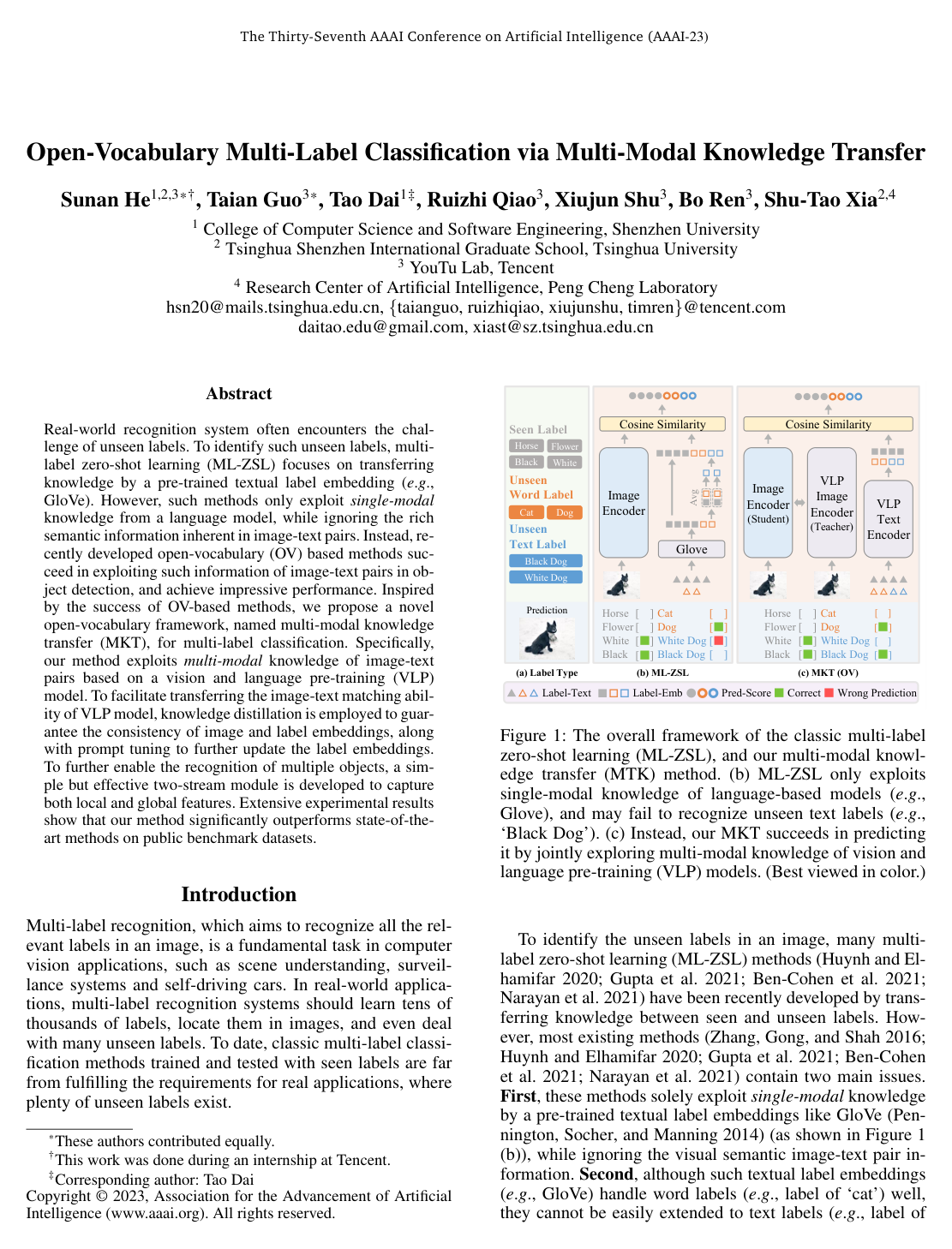
Open-Vocabulary Multi-Label Classification via Multi-Modal Knowledge Transfer
Sunan He, Taian Guo, Tao Dai, Ruizhi Qiao, Xiujun Shu, Bo Ren, Shu-Tao Xia
Why you should read this
Proposes a multi-modal knowledge transfer framework that adapts vision-language pre-trained models via knowledge distillation, prompt tuning, and a two-stream feature extractor to recognize unseen object labels in multi-label classification.
Real-world recognition system often encounters the challenge of unseen labels. To identify such unseen labels, multi-label zero-shot learning (ML-ZSL) focuses on transferring knowledge by a pre-trained textual label embedding (e.g., GloVe). However, such methods only exploit single-modal knowledge from a language model, while ignoring the rich semantic information inherent in image-text pairs. Instead, recently developed open-vocabulary (OV) based methods succeed in exploiting such information of image-text pairs in object detection, and achieve impressive performance. Inspired by the success of OV-based methods, we propose a novel open-vocabulary framework, named multi-modal knowledge transfer (MKT), for multi-label classification. Specifically, our method exploits multi-modal knowledge of image-text pairs based on a vision and language pre-training (VLP) model. To facilitate transferring the image-text matching ability of VLP model, knowledge distillation is employed to guarantee the consistency of image and label embeddings, along with prompt tuning to further update the label embeddings. To further enable the recognition of multiple objects, a simple but effective two-stream module is developed to capture both local and global features. Extensive experimental results show that our method significantly outperforms state-of-the-art methods on public benchmark datasets.
Added
2026-09-26
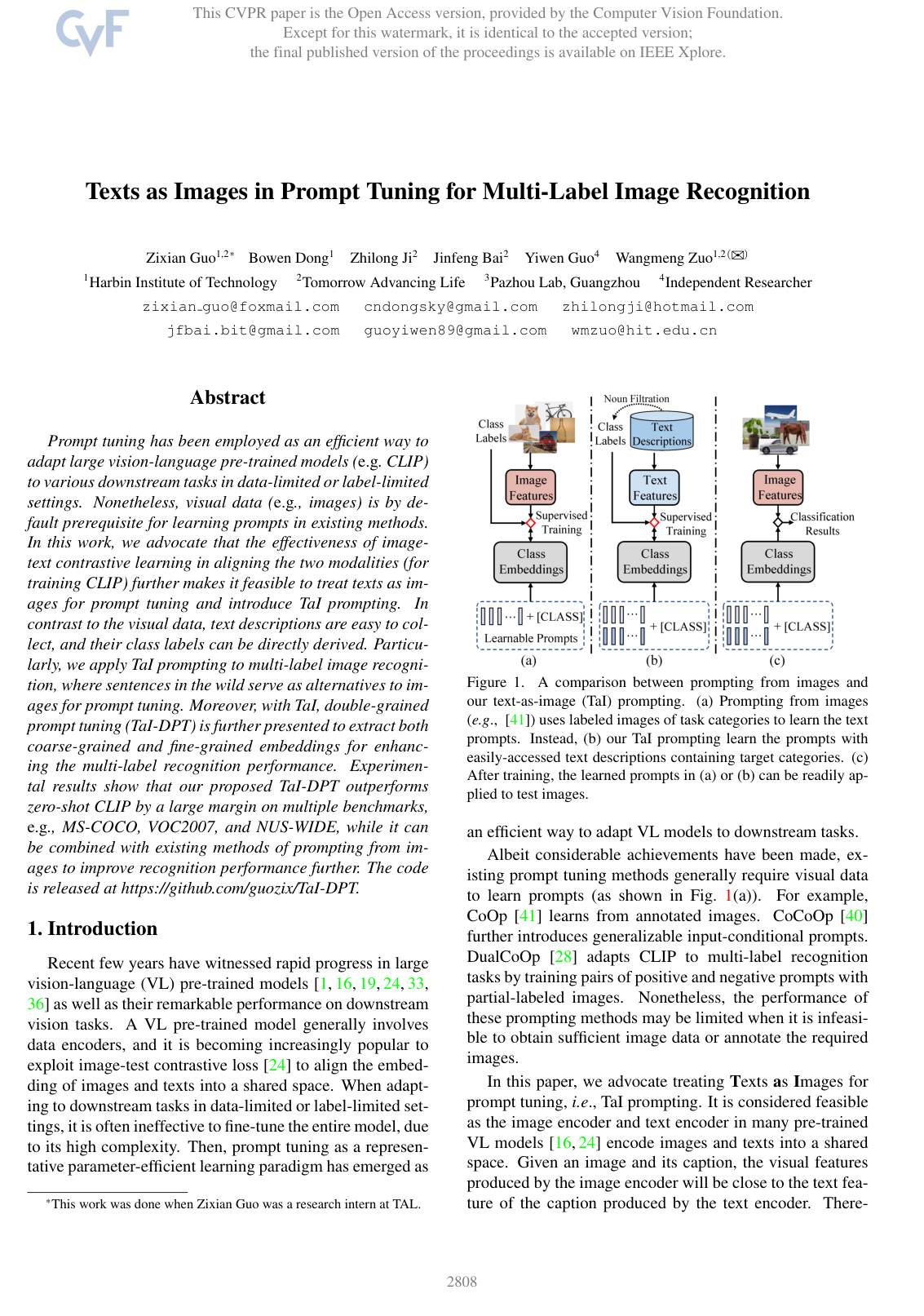
Texts as Images in Prompt Tuning for Multi-Label Image Recognition
Zixian Guo, Bowen Dong, Zhilong Ji, Jinfeng Bai, Yiwen Guo, Wangmeng Zuo
Why you should read this
Proposes a prompt tuning framework that trains vision-language models for multi-label image recognition using easily accessible text descriptions instead of labeled images, achieving strong classification performance without visual training data.
Prompt tuning has been employed as an efficient way to adapt large vision-language pre-trained models (e.g. CLIP) to various downstream tasks in data-limited or label-limited settings. Nonetheless, visual data (e.g., images) is by default prerequisite for learning prompts in existing methods. In this work, we advocate that the effectiveness of image-text contrastive learning in aligning the two modalities (for training CLIP) further makes it feasible to treat texts as images for prompt tuning and introduce TaI prompting. In contrast to the visual data, text descriptions are easy to collect, and their class labels can be directly derived. Particularly, we apply TaI prompting to multi-label image recognition, where sentences in the wild serve as alternatives to images for prompt tuning. Moreover, with TaI, dual-grained prompt tuning (TaI-DPT) is further presented to extract both coarse-grained and fine-grained embeddings for enhancing the multi-label recognition performance. Experimental results show that our proposed TaI-DPT outperforms zero-shot CLIP by a large margin on multiple benchmarks, e.g., MS-COCO, VOC2007, and NUS-WIDE, while it can be combined with existing methods of prompting from images to improve recognition performance further. The code is released at https://github.com/guozix/TaI-DPT.
Added
2026-09-26
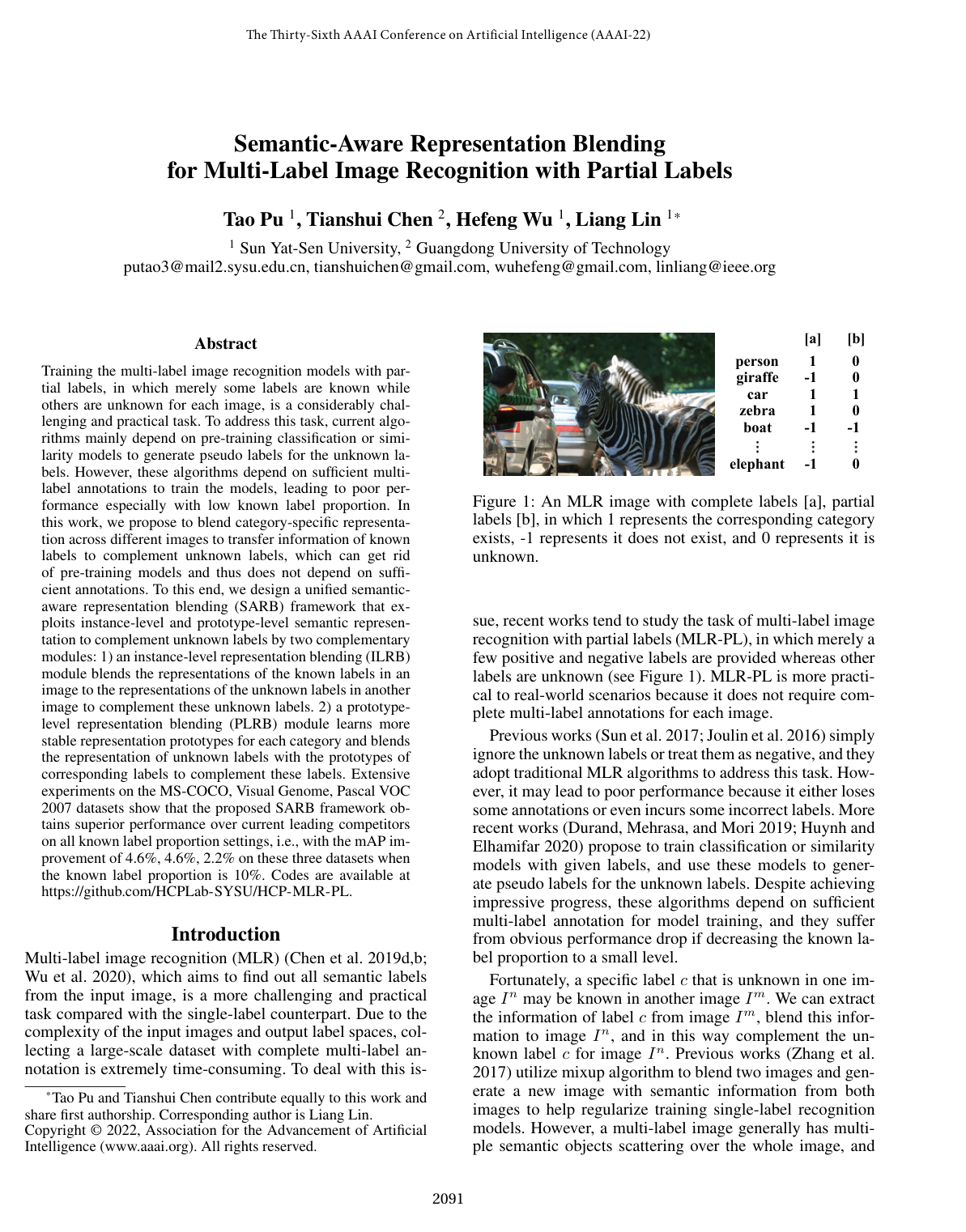
Semantic-Aware Representation Blending for Multi-Label Image Recognition with Partial Labels
Tao Pu, Tianshui Chen, Hefeng Wu, Liang Lin
Why you should read this
Proposes a semantic-aware representation blending framework that transfers category-specific features across images at both instance and prototype levels to effectively complement missing annotations in multi-label image recognition without requiring pre-trained pseudo-labeling models.
Training the multi-label image recognition models with partial labels, in which merely some labels are known while others are unknown for each image, is a considerably challenging and practical task. To address this task, current algorithms mainly depend on pre-training classification or similarity models to generate pseudo labels for the unknown labels. However, these algorithms depend on sufficient multi-label annotations to train the models, leading to poor performance especially with low known label proportion. In this work, we propose to blend category-specific representation across different images to transfer information of known labels to complement unknown labels, which can get rid of pre-training models and thus does not depend on sufficient annotations. To this end, we design a unified semantic-aware representation blending (SARB) framework that exploits instance-level and prototype-level semantic representation to complement unknown labels by two complementary modules: 1) an instance-level representation blending (ILRB) module blends the representations of the known labels in an image to the representations of the unknown labels in another image to complement these unknown labels. 2) a prototype-level representation blending (PLRB) module learns more stable representation prototypes for each category and blends the representation of unknown labels with the prototypes of corresponding labels to complement these labels. Extensive experiments on the MS-COCO, Visual Genome, Pascal VOC 2007 datasets show that the proposed SARB framework obtains superior performance over current leading competitors on all known label proportion settings, i.e., with the mAP improvement of 4.6%, 4.6%, 2.2% on these three datasets when the known label proportion is 10%. Codes are available at https://github.com/HCPLab-SYSU/HCP-MLR-PL.
Added
2026-09-26