An Edit Friendly DDPM Noise Space: Inversion and Manipulations
Inbar Huberman-SpiegelglasVladimir KulikovTomer Michaeli
Proposes an exact, optimization-free DDPM inversion method that maps real images into a structured noise space, enabling diverse and structure-preserving text-guided editing without requiring model fine-tuning or attention manipulation.
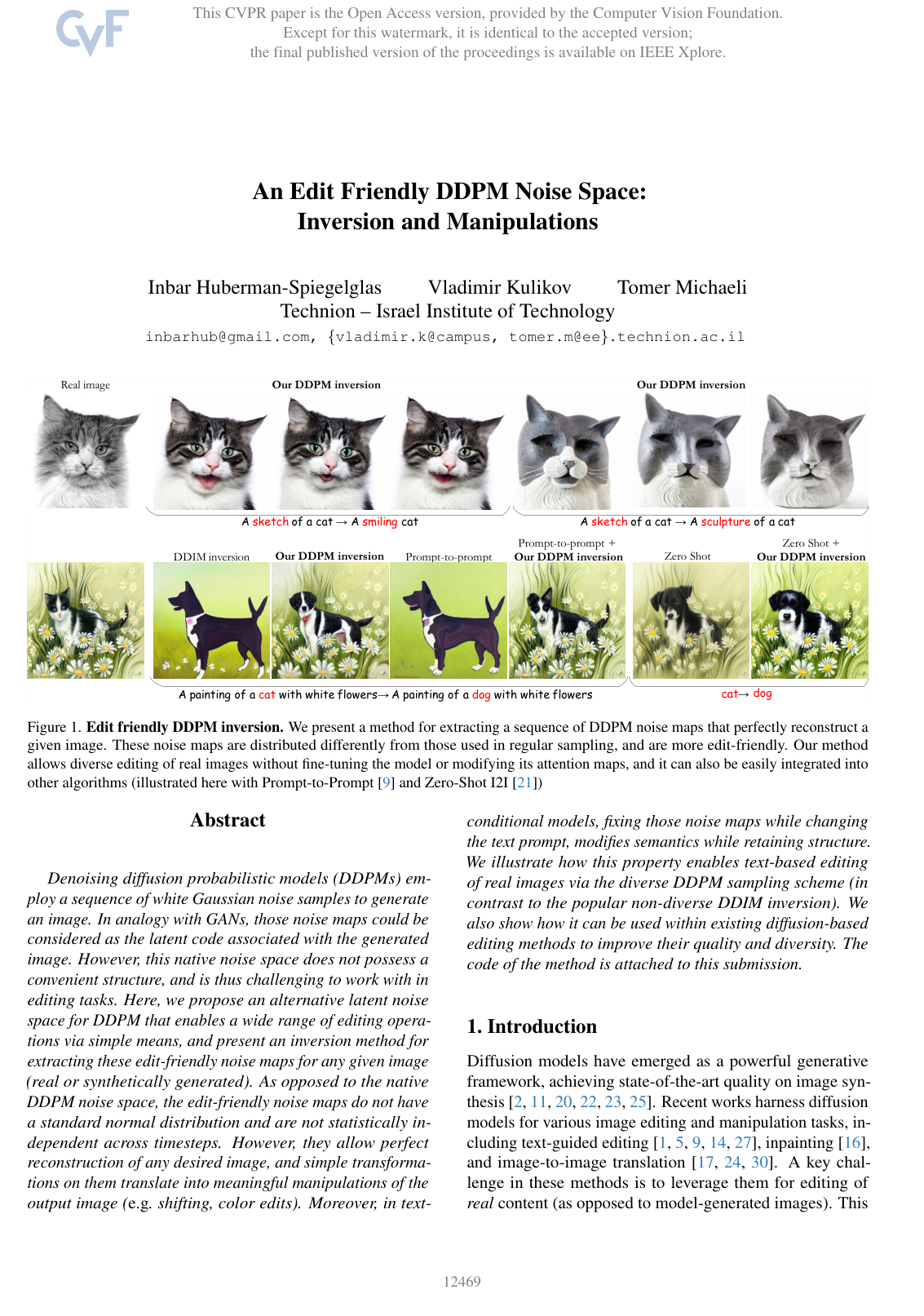
Diffusion models represent the state of the art in image generation, but editing real, existing images with these systems remains difficult. Most current workflows rely on deterministic inversion methods that require either many computational steps, intensive model retraining, or internal attention manipulation to keep the edited output faithful to the original image. Standard probabilistic generation schemes possess a mathematically rich noise space, but their standard internal representations do not naturally retain image structure during editing.
The article demonstrates an alternative mathematical inversion strategy for probabilistic diffusion models that extracts structured, edit-friendly noise maps from any given image without requiring model fine-tuning or internal network modifications.
The researchers evaluated their approach by deriving an exact reconstruction technique that constructs intermediate noisy states independently from the source image, rather than chaining them through regular sequential sampling. They tested this method on two benchmark datasets across hundreds of image-text editing pairs, comparing speed, structural preservation, and text alignment against leading commercial and open-source diffusion editing baselines.
The analysis produced several key findings. First, the proposed inversion extracts noise maps with higher variances and negative temporal correlations, imprinting the underlying image structure far more strongly than standard noise. Second, the method achieves an optimal balance between structural fidelity and prompt compliance: on zero-shot image-to-image translation benchmarks, integrating the technique reduced perceptual error from 0.35 to 0.27 (an approximate 23% improvement) while preserving identical text alignment accuracy. Third, the process operates in 36 seconds per image, delivering a fourfold to fourteenfold speedup compared to optimization-heavy alternatives that require 160 to 520 seconds. Finally, because the inversion is stochastic, it generates diverse variations from a single text prompt while preserving core structures—a capability unavailable in deterministic methods.
These findings indicate that image editing pipelines can achieve superior visual quality and throughput without costly per-image model training. For operational systems, eliminating optimization loops drastically lowers compute costs, reduces user latency, and removes the risk of catastrophic degradation in fine textures and object structures during complex edits.
Organizations developing or deploying diffusion-based editing tools should integrate this inversion method into existing production frameworks to improve image fidelity and reduce processing overhead. Implementation teams should tune the forward skipping and guidance parameters to fit their specific domain requirements and explore batch generation to leverage the inherent output diversity.
Confidence in these findings is high for standard image editing and image-to-image tasks, as validated across multiple benchmark datasets and baseline comparisons. However, performance remains dependent on the underlying base model's comprehension of complex prompts, and users should carefully validate parameter selections when deploying across non-standard visual domains.
- Paper: Denoising Diffusion Probabilistic Models, Jonathan Ho et al. (2020). This seminal work establishes Denoising Diffusion Probabilistic Models (DDPM) and their stochastic sampling dynamics, which the target paper directly inverts and restructures for image editing.
- Paper: Denoising Diffusion Implicit Models, Jiaming Song et al. (2021). This paper introduces Denoising Diffusion Implicit Models (DDIM) and deterministic sampling, which define the standard inversion baselines that the target paper aims to improve upon.
- Paper: Null-text Inversion for Editing Real Images using Guided Diffusion Models, Ron Mokady et al. (2022). This paper develops Null-text Inversion for diffusion editing via optimization, providing the primary baseline and motivating the target paper's search for an optimization-free, stochastic alternative.
- Paper: Prompt-to-Prompt Image Editing with Cross Attention Control, Amir Hertz et al. (2022). This foundational paper presents cross-attention control for text-guided editing, establishing the internal representation mechanisms and editing paradigms that the target paper builds upon.
- Paper: SDEdit: Guided Image Synthesis and Editing with Stochastic Differential Equations, Chenlin Meng et al. (2022). This paper introduces stochastic differential equation-based image editing by adding noise and denoising, providing key conceptual foundations for manipulating noisy latent trajectories.
- Paper: High-Resolution Image Synthesis with Latent Diffusion Models, Robin Rombach et al. (2022). This work introduces Latent Diffusion Models, establishing the latent-space architecture on which modern inversion and text-driven image editing techniques operate.
- Paper: Imagic: Text-Based Real Image Editing with Diffusion Models, Bahjat Kawar et al. (2022). This study demonstrates text-based real image editing using diffusion models, highlighting the computational trade-offs of per-image fine-tuning that the target paper circumvents.
- Paper: InstructPix2Pix: Learning to Follow Image Editing Instructions, Tim Brooks et al. (2023). This work provides essential context for instruction-based diffusion editing pipelines and zero-shot image-to-image translation benchmarks.
- Paper: FireFlow: Fast Inversion of Rectified Flow for Image Semantic Editing, Yingying Deng et al. (2025). This paper advances training-free inversion techniques by developing higher-order ODE solvers for fast, high-fidelity semantic editing in rectified flow models.
- Paper: Initno: Boosting Text-to-Image Diffusion Models via Initial Noise Optimization, Xiefan Guo et al. (2024). This study builds on manipulating the initial noise distribution by optimizing noise parameters directly to improve text alignment in diffusion models.
- Paper: DiffEditor: Boosting Accuracy and Flexibility on Diffusion-Based Image Editing, Chong Mou et al. (2024). This work extends diffusion-based image manipulation by incorporating localized randomness and rollback techniques to achieve precise interactive edits.
- Paper: Fast ODE-based Sampling for Diffusion Models in Around 5 Steps, Zhenyu Zhou et al. (2024). This paper investigates geometric trajectories in diffusion noise spaces to enable high-quality ODE-based sampling in as few as five steps.
- Paper: Variational Flow Maps: Make Some Noise for One-Step Conditional Generation, Abbas Mammadov et al. (2026). This work extends noise-space reformulation strategies to one-step conditional generation and inverse problems via variational flow maps.