FireFlow: Fast Inversion of Rectified Flow for Image Semantic Editing

Yingying DengXiangyu HeChangwang MeiPeisong WangFan Tang

article2025ICML55 citations

Introduces a training-free numerical solver for rectified flow models that achieves second-order inversion precision with first-order computational efficiency, enabling high-fidelity image semantic editing in only eight steps with a three-fold speedup.

Listen

Generative artificial intelligence models have become central tools for automated image synthesis and editing. In practical applications, modifying an existing image requires an inversion process that transforms the observed image back into a structured latent representation before applying target edits. While modern generative frameworks based on ordinary differential equations—known as Rectified Flow models—offer straighter paths and faster sampling than earlier stochastic diffusion techniques, existing inversion methods remain computationally expensive, require dozens of iterative steps, or introduce severe reconstruction errors that distort non-edited image areas.

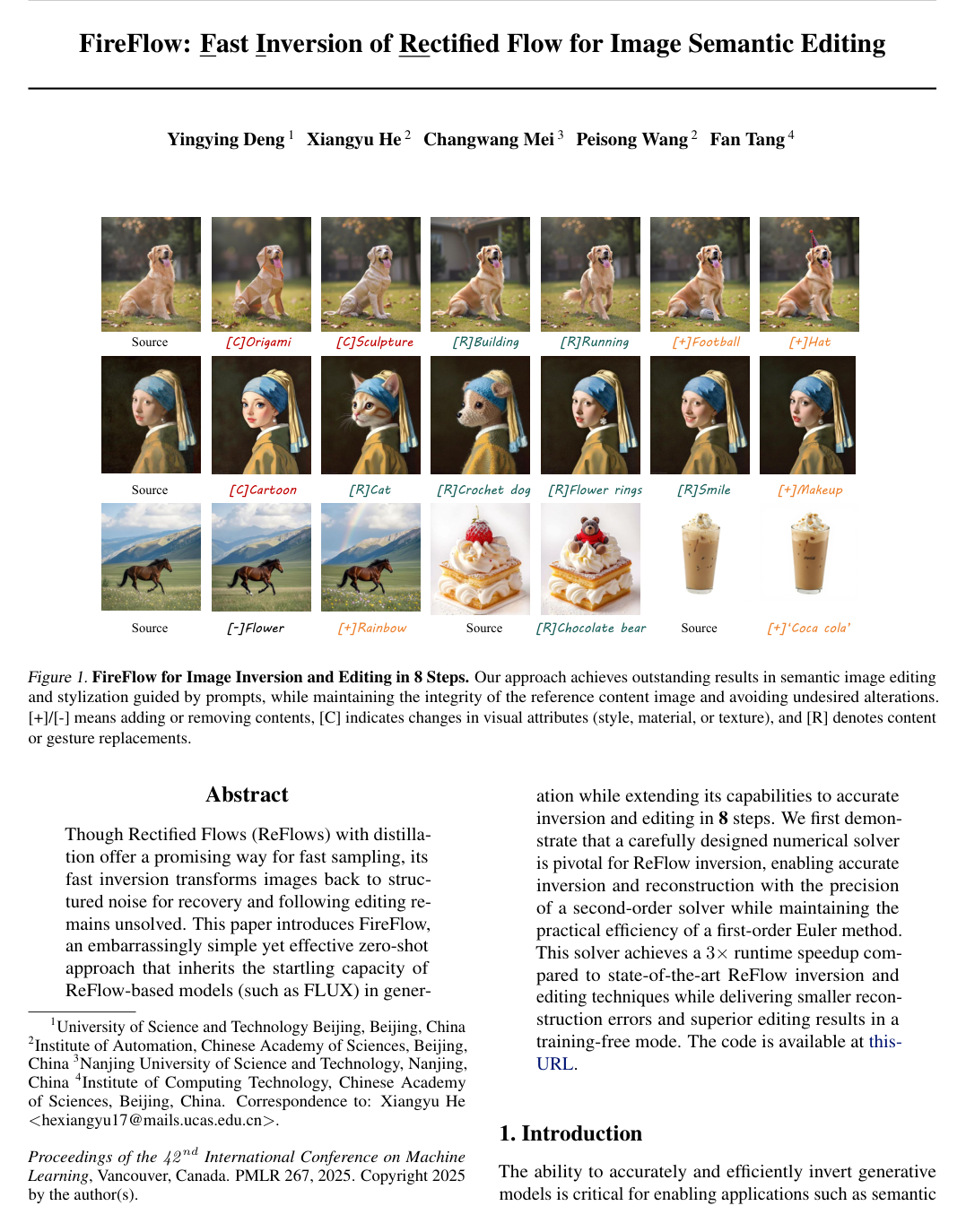
The article introduces FireFlow, a zero-shot, training-free numerical framework designed to evaluate and demonstrate whether image inversion and prompt-guided editing can achieve high reconstruction precision with significantly reduced computational overhead in as few as eight steps.

To overcome the computational trade-offs of existing techniques, the authors designed a modified numerical solver that reinterprets the generation dynamics through higher-order ordinary differential equation principles. Higher-order methods typically demand multiple network evaluations per step, doubling computational cost. FireFlow resolves this by caching and reusing intermediate velocity approximations from preceding steps, effectively retaining second-order mathematical accuracy while requiring only a single network evaluation per iteration. The authors verified their solver through theoretical convergence proofs, synthetic 2D distribution benchmarks, standard generation datasets such as CIFAR-10 and MS-COCO, and specialized editing and reconstruction benchmarks, including the Densely Captioned Images and PIE-Bench datasets.

The experimental findings show substantial improvements in both operational speed and visual fidelity. First, FireFlow achieves an approximate 3× runtime speedup over state-of-the-art Rectified Flow inversion techniques, completing 1024×1024 image edits in about 24.5 seconds compared to over 71 to 78 seconds for baseline approaches. Second, the solver reduces reconstruction errors by over 70% relative to standard baselines, demonstrating faster and more stable convergence. Third, during text-guided semantic editing across hundreds of complex benchmark prompts, FireFlow achieves superior background preservation and text alignment in eight steps (requiring 18 total network evaluations), outperforming both diffusion-based models and competing flow solvers that require 28 to 50 steps.

These findings indicate that high-fidelity generative image manipulation does not require costly fine-tuning, complex multi-network architectures, or slow inference pipelines. For enterprise systems, deploying efficient solver dynamics directly reduces graphics hardware resource requirements and latency, making real-time, interactive image editing commercially viable within production pipelines.

Organizations developing or deploying image editing workflows should consider adopting velocity-reusing solvers like FireFlow to lower operational compute costs and accelerate turnaround times. When implementing attention feature replacement for editing, teams should utilize FireFlow's standard value-feature configuration for general edits, while evaluating key-feature blending strategies if handling substantial color changes or unusual compositional modifications.

The article notes certain limitations: the basic value-replacement strategy occasionally struggles with severe color shifts or atypical visual descriptions, and alternative feature-blending adjustments introduce modest trade-offs in background preservation. Nevertheless, supported by rigorous numerical proofs and empirical validations across diverse benchmarks, confidence in the primary efficiency and reconstruction improvements is high.

arXiv: 2412.07517
Cover for FireFlow: Fast Inversion of Rectified Flow for Image Semantic Editing

Abstract

Though Rectified Flows (ReFlows) with distillation offer a promising way for fast sampling, its fast inversion transforms images back to structured noise for recovery and following editing remains unsolved. This paper introduces FireFlow, an embarrassingly simple yet effective zero-shot approach that inherits the startling capacity of ReFlow-based models (such as FLUX) in generation while extending its capabilities to accurate inversion and editing in 8 steps. We first demonstrate that a carefully designed numerical solver is pivotal for ReFlow inversion, enabling accurate inversion and reconstruction with the precision of a second-order solver while maintaining the practical efficiency of a first-order Euler method. This solver achieves a 3× runtime speedup compared to state-of-the-art ReFlow inversion and editing techniques while delivering smaller reconstruction errors and superior editing results in a training-free mode. The code is available at this-URL.

Table of Contents

  • 1. Introduction
  • 2. Preliminaries and Related Works
  • 2.1. Rectified Flow
  • 2.2. Inversion
  • 2.3. Editing
  • 3. Motivation
  • 4. Method
  • 5. Experiment
  • 5.1. Implementation Details
  • 5.2. Text-to-image Generation
  • 5.3. Inversion and Reconstruction
  • 5.4. Inversion-based Semantic Image Editing
  • 6. Conclusion
  • Acknowledgement
  • Impact Statement
  • References
  • A. The Pseudo-code for Inversion and Editing
  • B. Technical Proofs
  • B.1. Proof of Proposition 3.1
  • B.2. Proof of Proposition 4.1
  • B.3. Proof of Theorem 4.2
  • C. Empirical Convergence Rate
  • D. Python-style Pseudo-Code
  • E. Ablation Study
  • F. Limitations

Knowls

  1. Knowl 1 — Modified midpoint solver with one new function evaluation per step

    model/method

    FireFlow solves the ReFlow probability-flow ODE dX(t)dt=vθ(X(t),t)\frac{dX(t)}{dt}=v_\theta(X(t),t) using a modified midpoint scheme. Here, X(t)∈RdX(t)\in\mathbb{R}^d is the latent state, tt is continuous time, and vθv_\theta is the pretrained ReFlow drift model. For a discretization point tit_i and step size hi=ti+1−tih_i=t_{i+1}-t_i, FireFlow reuses the midpoint velocity computed at the preceding step:

    v^i=vθ(X~i−12,ti−12),\hat v_i=v_\theta\left(\widetilde X_{i-\frac12},t_{i-\frac12}\right),

    where X~i−12\widetilde X_{i-\frac12} is stored in memory from the preceding iteration. It then computes

    X~i+12=Xi+hi2v^i,\widetilde X_{i+\frac12}=X_i+\frac{h_i}{2}\hat v_i, vi+12=vθ(X~i+12,ti+hi2),v_{i+\frac12}=v_\theta\left(\widetilde X_{i+\frac12},t_i+\frac{h_i}{2}\right), Xi+1=Xi+hivi+12.X_{i+1}=X_i+h_i v_{i+\frac12}.

    At the first step, FireFlow evaluates vθ(X0,t0)v_\theta(X_0,t_0) to form the initial midpoint state and evaluates the model once more at that midpoint; every subsequent step loads the previous midpoint velocity and requires only one new evaluation of vθv_\theta. The same update works for inversion with hi>0h_i>0 and denoising with decreasing time and typically hi<0h_i<0. Thus, the method has the per-step cost of Euler integration while using midpoint information to obtain second-order behavior.

  2. Knowl 2 — Training-free inversion and semantic editing pipeline

    algorithm

    FireFlow performs zero-shot image inversion and editing with a pretrained ReFlow model, a prompt-embedding network, and no auxiliary editing model. The inversion process maps a reference image to structured noise while storing self-attention value features; the denoising process uses an edited prompt and reuses those stored features to preserve source content.

    Input: Reference image X0X_0, source and edit prompts, inversion time grid t0<⋯<tNt_0<\cdots<t_N, pretrained drift model vθv_\theta, prompt encoder, and self-attention feature storage
    Output: Edited image X0editX_0^{edit}
    Inversion:
      Evaluate vθ(X0,t0)v_\theta(X_0,t_0) and take a half-step to obtain the first midpoint state.
      Evaluate the drift at that midpoint, save its self-attention value features as V0invV^{inv}_0, and take a full midpoint update.
      For each remaining inversion interval:
        Load the previously saved midpoint velocity.
        Use it to form the current half-step state.
        Evaluate vθv_\theta once at the current midpoint.
        Save the new midpoint velocity and its self-attention value features.
        Take the full midpoint update.
      Return the structured noise XNX_N and all stored inversion features VinvV^{inv}.
    Editing and denoising:
      Initialize the state at XNX_N and traverse the time grid backward from tNt_N to t0t_0 using the edit prompt.
      At every drift evaluation, replace the denoising self-attention value features with the stored inversion features at the corresponding time.
      Reuse the preceding midpoint velocity, evaluate the model once at each new midpoint, and apply the full midpoint update.
      Return the final state as the edited image X0editX_0^{edit}.

    For a trajectory with NN intervals, initialization uses two drift evaluations and each later interval uses one, so the inversion and denoising trajectories together require approximately 2(N+1)2(N+1) function evaluations. With eight editing intervals, FireFlow uses 18 evaluations in total and does not require a separately trained auxiliary model.

  3. Knowl 3 — Second-order accuracy of the modified midpoint method

    theoretical result

    Consider the ReFlow ODE dXdt=vθ(X,t)\frac{dX}{dt}=v_\theta(X,t) on a finite interval, where vθv_\theta is smooth and bounded. Let v^θ(Xt,t)\widehat v_\theta(X_t,t) be the velocity reused by FireFlow instead of the exact velocity vθ(Xt,t)v_\theta(X_t,t). If the reuse error satisfies

    ∥v^θ(Xt,t)−vθ(Xt,t)∥≤O(h),\left\|\widehat v_\theta(X_t,t)-v_\theta(X_t,t)\right\|\leq O(h),

    where hh is the integration step size, then FireFlow has the same local truncation error as the standard midpoint method, O(h3)O(h^3), and the same global truncation error, O(h2)O(h^2). The result holds because the O(h)O(h) velocity-reuse error is multiplied by the half-step factor before it affects the midpoint evaluation. Consequently, FireFlow retains second-order numerical accuracy while requiring only one new drift-model evaluation per step after initialization.

  4. Knowl 4 — Bound on the velocity-reuse error

    theoretical result

    For FireFlow's reused velocity v^θ(Xt,t)=vθ(Xt−1+h2,t−1+h2)\widehat v_\theta(X_t,t)=v_\theta(X_{t-1}+\frac{h}{2},t-1+\frac{h}{2}), assume that the ReFlow drift vθ(X,t)v_\theta(X,t) is smooth in time and has bounded spatial derivative ∂vθ∂X\frac{\partial v_\theta}{\partial X}. The difference between the reused velocity and the exact velocity at the current state obeys

    ∥v^θ(Xt,t)−vθ(Xt,t)∥≤O(h).\left\|\widehat v_\theta(X_t,t)-v_\theta(X_t,t)\right\|\leq O(h).

    The bound contains a temporal contribution proportional to the half-step time displacement and a spatial contribution controlled by the bounded Jacobian of vθv_\theta; recursive reuse does not amplify the error beyond first order in hh. This bound supplies the condition required for FireFlow to achieve the standard midpoint method's second-order global accuracy.

  5. Knowl 5 — Propagation of inversion error through reverse denoising

    theoretical result

    Let a numerical inversion produce an endpoint perturbation ΔT\Delta_T at time TT relative to the exact inverted state. Suppose the reverse dynamics are governed by dXdt=−vθ(X,1−t)\frac{dX}{dt}=-v_\theta(X,1-t) and are Lipschitz continuous in XX with constant L≥0L\geq0 over the reverse interval [0,T][0,T]. The perturbation at the reconstructed image satisfies

    ∥Δ0∥≤e−LT∥ΔT∥.\|\Delta_0\|\leq e^{-LT}\|\Delta_T\|.

    Therefore, reverse denoising does not increase the endpoint inversion error under the stated Lipschitz condition. If a pp-th-order ODE solver creates inversion error of order O(hp)O(h^p), the reconstructed image also has asymptotic error O(hp)O(h^p), up to the Lipschitz-dependent factor.

  6. Knowl 6 — Efficiency and formal order compared with existing ReFlow editing solvers

    data/table

    The paper compares training-free FLUX/ReFlow inversion-editing methods along four dimensions: number of integration steps, total number of drift-model evaluations for inversion plus editing, local truncation-error order, and whether a pretrained auxiliary editing model is needed. FireFlow reaches the second-order local error of RF-Solver while using substantially fewer evaluations and no auxiliary model.

    Could not parse LaTeX table

    Here, NFE denotes the total number of forward evaluations of the drift model during inversion and editing. The comparison demonstrates the intended trade-off: FireFlow combines an eight-step editing trajectory, 18 total evaluations, and third-order local truncation error without requiring an additional pretrained model.

  7. Knowl 7 — Few-step image generation with preserved or improved quality

    data/table

    FireFlow was evaluated as an ODE solver for both unconditional CIFAR-10 generation using open-source 1-Rectified-Flow-distill weights and text-to-image generation with FLUX-dev on 10,000 MSCOCO validation images. FID measures distributional image quality, with lower values preferred; IS measures unconditional generation quality, with higher values preferred; CLIP Score measures text-image alignment, with higher values preferred.

    Could not parse LaTeX table
    Could not parse LaTeX table

    On CIFAR-10, FireFlow obtains the lowest FID, 5.35, while using six evaluations, compared with 10 evaluations for the five-step standard midpoint solver. On FLUX-dev, FireFlow obtains the lowest FID, 25.16, with 11 evaluations and maintains a CLIP Score of 31.42, comparable to the 20- and 40-evaluation baselines.

  8. Knowl 8 — Lower-error inversion and reconstruction at both high and low budgets

    data/table

    Inversion and reconstruction were evaluated on the first 1,000 images of the Densely Captioned Images dataset with FLUX-dev. NFE includes both inversion and reconstruction evaluations, and reconstruction does not use latent features saved during inversion. Lower LPIPS is preferred, while higher SSIM and PSNR are preferred.

    Could not parse LaTeX table

    At 30 steps, FireFlow has the best reconstruction metrics in every listed quality column: LPIPS 0.1579, SSIM 0.8160, and PSNR 23.87, while using 62 evaluations versus 120 for RF-Solver. At approximately the same low computational budget, FireFlow also outperforms the competing ReFlow inversion methods, achieving LPIPS 0.4111, SSIM 0.5945, and PSNR 16.01 with 18 evaluations. Reconstruction-error convergence experiments further report up to a 2.7-times speedup and more than 70% error reduction relative to the compared ReFlow solvers.

  9. Knowl 9 — Semantic editing quality and inference speed on PIE-Bench

    data/table

    FireFlow was tested on PIE-Bench, which contains 700 images and 10 edit categories. The evaluation measures structural distance and background preservation using PSNR and SSIM, together with CLIP similarity for the whole image and the edited region. Lower structural distance is preferred; higher PSNR, SSIM, and CLIP similarity are preferred.

    Could not parse LaTeX table

    With eight editing steps and 18 evaluations, FireFlow reaches structural distance 0.0271, PSNR 23.03, SSIM 0.8249, whole-image CLIP similarity 26.02, and edited-region CLIP similarity 22.81. With eight steps it also preserves background structure better than the compared ReFlow methods at their listed settings while maintaining competitive text alignment.

    Per-image inference time was measured on an RTX 3090. FireFlow is substantially faster than the ReFlow baselines at both tested resolutions:

    Could not parse LaTeX table
  10. Knowl 10 — Empirical validation of velocity reuse and eight-step editing

    empirical result

    Experiments support the assumptions behind FireFlow's solver. On a two-dimensional synthetic 2-Rectified-Flow problem whose source and target distributions are Gaussian mixtures, FireFlow with NFE =20=20 produces samples whose density and structure more closely match the target distribution than Euler integration at the same NFE, while its transport trajectories are straighter and closer to ideal linear motion than the compared numerical trajectories.

    On FLUX-dev, the average velocity-reuse error during both inversion and reconstruction grows approximately linearly with the step size, following CΔtC\Delta t for an empirical constant CC. Although occasional spikes occur, the error remains controlled across most integration steps; the plotted variability is represented by approximately one standard deviation.

    An editing-step ablation varied the number of steps from 2 to 12. Two steps do not incorporate the editing prompt effectively, whereas quality improves as the step count increases. Eight steps produce results comparable to 10 or 12 steps, motivating the use of eight editing steps in the main experiments.

  11. Knowl 11 — Editing limitations and the preservation–editability trade-off

    limitation

    FireFlow's default editing rule replaces the self-attention value features of the edited trajectory with values recorded during inversion:

    SelfAttn⁡edit=Softmax⁡(QeditKeditd)Vinv,\operatorname{SelfAttn}_{edit}=\operatorname{Softmax}\left(\frac{Q_{edit}K_{edit}}{\sqrt d}\right)V_{inv},

    where QeditQ_{edit} and KeditK_{edit} are the edited trajectory's query and key features, VinvV_{inv} is the inversion trajectory's value feature, and dd is the attention-key dimension. This rule preserves source structure and background well, but the paper empirically finds that it can fail when an edit changes an object's color or describes an uncommon natural-image scenario, such as an image with an occluded head or an unusual character description.

    A proposed remedy adds the inversion key feature to the edited key feature while using the edited value feature:

    SelfAttn⁡edit=Softmax⁡(Qedit(Kedit+Kinv)d)Vedit,\operatorname{SelfAttn}_{edit}=\operatorname{Softmax}\left(\frac{Q_{edit}(K_{edit}+K_{inv})}{\sqrt d}\right)V_{edit},

    where KinvK_{inv} and VeditV_{edit} are the inversion key and edited value features, respectively. This variant can resolve some failed color and uncommon-scene edits, but it reduces preservation of the original structure and background. Thus, FireFlow's simple value-replacement strategy offers strong preservation and efficiency at the cost of limited robustness for difficult semantic changes.

Coverage note — The appendix derivations and full qualitative image grids were omitted because the stated error guarantees and quantitative outcomes capture their standalone contribution; the attention-feature ablation is summarized in the limitation knowl rather than reproduced in full.

References

  1. 1.Brack, M., Friedrich, F., Kornmeier, K., Tsaban, L., Schramowski, P., Kersting, K., and Passos, A. LED-ITS++: limitless image editing using text-to-image models. In IEEE/CVF Conference on Computer Vision and Pattern Recognition, CVPR 2024, Seattle, WA, USA, June 16-22, 2024, pp. 8861–8870. IEEE, 2024.
  2. 2.Brooks, T., Holynski, A., and Efros, A. A. Instruct-pix2pix: Learning to follow image editing instructions. In IEEE/CVF Conference on Computer Vision and Pattern Recognition, CVPR 2023, Vancouver, BC, Canada, June 17-24, 2023, pp. 18392–18402. IEEE, 2023.
  3. 3.Cao, M., Wang, X., Qi, Z., Shan, Y., Qie, X., and Zheng, Y. Masactrl: Tuning-free mutual self-attention control for consistent image synthesis and editing. In Proceedings of the IEEE/CVF International Conference on Computer Vision (ICCV), pp. 22560–22570, October 2023.
  4. 4.Chen, T., Gu, J., Dinh, L., Theodorou, E., Susskind, J. M., and Zhai, S. Generative modeling with phase stochastic bridge. In The Twelfth International Conference on Learning Representations, 2024. URL https://openreview.net/forum?id=tUtGjQEDd4.
  5. 5.Chen, X., Fang, H., Lin, T., Vedantam, R., Gupta, S., Dollár, P., and Zitnick, C. L. Microsoft COCO captions: Data collection and evaluation server. CoRR, abs/1504.00325, 2015. URL http://arxiv.org/abs/1504.00325.
  6. 6.Cho, H., Lee, J., Kim, S. B., Oh, T., and Jeong, Y. Noise map guidance: Inversion with spatial context for real image editing. In The Twelfth International Conference on Learning Representations, ICLR 2024, Vienna, Austria, May 7-11, 2024. OpenReview.net, 2024.
  7. 7.Couairon, G., Verbeek, J., Schwenk, H., and Cord, M. Diffedit: Diffusion-based semantic image editing with mask guidance. In The Eleventh International Conference on Learning Representations, ICLR 2023, Kigali, Rwanda, May 1-5, 2023. OpenReview.net, 2023.
  8. 8.Deng, Y., He, X., Tang, F., and Dong, W. Z*: Zero-shot style transfer via attention reweighting. In Proceedings of the IEEE/CVF Conference on Computer Vision and Pattern Recognition (CVPR), pp. 6934–6944, June 2024a.
  9. 9.Deng, Y., He, X., Tang, F., and Dong, W. Z-star+: A zero-shot style transfer method via adjusting style distribution, 2024b. URL https://arxiv.org/abs/2411.19231.
  10. 10.Deng, Y., He, X., Tang, F., and Dong, W. Z-magic: Zero-shot multiple attributes guided image creator, 2025. URL https://arxiv.org/abs/2503.12124.
  11. 11.Deutch, G., Gal, R., Garibi, D., Patashnik, O., and Cohen-Or, D. Turboedit: Text-based image editing using few-step diffusion models. In Igarashi, T., Shamir, A., and Zhang, H. R. (eds.), SIGGRAPH Asia 2024 Conference Papers, SA 2024, Tokyo, Japan, December 3-6, 2024, pp. 41:1–41:12. ACM, 2024.
  12. 12.Dong, W., Xue, S., Duan, X., and Han, S. Prompt tuning inversion for text-driven image editing using diffusion models. In IEEE/CVF International Conference on Computer Vision, ICCV 2023, Paris, France, October 1-6, 2023, pp. 7396–7406. IEEE, 2023.
  13. 13.Hertz, A., Mokady, R., Tenenbaum, J., Aberman, K., Pritch, Y., and Cohen-Or, D. Prompt-to-prompt image editing with cross attention control. arXiv preprint arXiv:2208.01626, 2022.
  14. 14.Heusel, M., Ramsauer, H., Unterthiner, T., Nessler, B., and Hochreiter, S. Gans trained by a two time-scale update rule converge to a local nash equilibrium. In Guyon, I., von Luxburg, U., Bengio, S., Wallach, H. M., Fergus, R., Vishwanathan, S. V. N., and Garnett, R. (eds.), Advances in Neural Information Processing Systems 30: Annual Conference on Neural Information Processing Systems 2017, December 4-9, 2017, Long Beach, CA, USA, pp. 6626–6637, 2017.
  15. 15.Huberman-Spiegelglas, I., Kulikov, V., and Michaeli, T. An edit friendly DDPM noise space: Inversion and manipulations. In IEEE/CVF Conference on Computer Vision and Pattern Recognition, CVPR 2024, Seattle, WA, USA, June 16-22, 2024, pp. 12469–12478. IEEE, 2024.
  16. 16.Ju, X., Zeng, A., Bian, Y., Liu, S., and Xu, Q. Pnp inversion: Boosting diffusion-based editing with 3 lines of code. International Conference on Learning Representations (ICLR), 2024.
  17. 17.Lin, H., Wang, M., Wang, J., An, W., Chen, Y., Liu, Y., Tian, F., Dai, G., Wang, J., and Wang, Q. Schedule your edit: A simple yet effective diffusion noise schedule for image editing. CoRR, abs/2410.18756, 2024.
  18. 18.Liu, X., Gong, C., and Liu, Q. Flow straight and fast: Learning to generate and transfer data with rectified flow. In The Eleventh International Conference on Learning Representations, ICLR 2023, Kigali, Rwanda, May 1-5, 2023. OpenReview.net, 2023. URL https://openreview.net/forum?id=XVjTT1nw5z.
  19. 19.Meng, C., He, Y., Song, Y., Song, J., Wu, J., Zhu, J.-Y., and Ermon, S. SDEdit: Guided image synthesis and editing with stochastic differential equations. In International Conference on Learning Representations, 2022.
  20. 20.Miyake, D., Iohara, A., Saito, Y., and Tanaka, T. Negative-prompt inversion: Fast image inversion for editing with text-guided diffusion models. CoRR, abs/2305.16807, 2023.
  21. 21.Mokady, R., Hertz, A., Aberman, K., Pritch, Y., and Cohen-Or, D. Null-text inversion for editing real images using guided diffusion models. In IEEE/CVF Conference on Computer Vision and Pattern Recognition, CVPR 2023, Vancouver, BC, Canada, June 17-24, 2023, pp. 6038–6047. IEEE, 2023.
  22. 22.Park, D., Lee, S., Kim, S., Lee, T., Hong, Y., and Kim, H. J. Constant acceleration flow. In The Thirty-eighth Annual Conference on Neural Information Processing Systems, 2024. URL https://openreview.net/forum?id=hsgNvC5YM9.
  23. 23.Parmar, G., Singh, K. K., Zhang, R., Li, Y., Lu, J., and Zhu, J. Zero-shot image-to-image translation. In Brunvand, E., Sheffer, A., and Wimmer, M. (eds.), ACM SIGGRAPH 2023 Conference Proceedings, SIGGRAPH 2023, Los Angeles, CA, USA, August 6-10, 2023, pp. 11:1–11:11. ACM, 2023. doi: 10.1145/3588432.3591513. URL https://doi.org/10.1145/3588432.3591513.
  24. 24.Podell, D., English, Z., Lacey, K., Blattmann, A., Dockhorn, T., Muller, J., Penna, J., and Rombach, R. SDXL: Improving latent diffusion models for high-resolution image synthesis. In The Twelfth International Conference on Learning Representations, 2024. URL https://openreview.net/forum?id=di52zR8xgf.
  25. 25.Radford, A., Kim, J. W., Hallacy, C., Ramesh, A., Goh, G., Agarwal, S., Sastry, G., Askell, A., Mishkin, P., Clark, J., Krueger, G., and Sutskever, I. Learning transferable visual models from natural language supervision. In Meila, M. and Zhang, T. (eds.), Proceedings of the 38th International Conference on Machine Learning, ICML 2021, 18-24 July 2021, Virtual Event, volume 139 of Proceedings of Machine Learning Research, pp. 8748–8763. PMLR, 2021.
  26. 26.Ramesh, A., Dhariwal, P., Nichol, A., Chu, C., and Chen, M. Hierarchical text-conditional image generation with CLIP latents. CoRR, abs/2204.06125, 2022. doi: 10.48550/ARXIV.2204.06125. URL https://doi.org/10.48550/arXiv.2204.06125.
  27. 27.Rombach, R., Blattmann, R., Lorenz, D., Esser, P., and Ommer, B. High-resolution image synthesis with latent diffusion models. In Proceedings of the IEEE/CVF Conference on Computer Vision and Pattern Recognition (CVPR), pp. 10684–10695, June 2022.
  28. 28.Rout, L., Chen, Y., Ruiz, N., Caramanis, C., Shakkottai, S., and Chu, W.-S. Semantic image inversion and editing using rectified stochastic differential equations. In The Thirteenth International Conference on Learning Representations, 2025. URL https://openreview.net/forum?id=Hu0FSOSEyS.
  29. 29.Song, J., Meng, C., and Ermon, S. Denoising diffusion implicit models. In 9th International Conference on Learning Representations, ICLR 2021, Virtual Event, Austria, May 3-7, 2021. OpenReview.net, 2021.
  30. 30.Tewel, Y., Gal, R., Samuel, D., Atzmon, Y., Wolf, L., and Chechik, G. Add-it: Training-free object insertion in images with pretrained diffusion models. In The Thirteenth International Conference on Learning Representations, 2025. URL https://openreview.net/forum?id=ZeaTvXw080.
  31. 31.Tumanyan, N., Geyer, M., Bagon, S., and Dekel, T. Plug-and-play diffusion features for text-driven image-to-image translation. In IEEE/CVF Conference on Computer Vision and Pattern Recognition, CVPR 2023, Vancouver, BC, Canada, June 17-24, 2023, pp. 1921–1930. IEEE, 2023.
  32. 32.Urbanek, J., Bordes, F., Astolfi, P., Williamson, M., Sharma, V., and Romero-Soriano, A. A picture is worth more than 77 text tokens: Evaluating clip-style models on dense captions. In Proceedings of the IEEE/CVF Conference on Computer Vision and Pattern Recognition (CVPR), pp. 26700–26709, June 2024.
  33. 33.Wang, J., Pu, J., Qi, Z., Guo, J., Ma, Y., Huang, N., Chen, Y., Li, X., and Shan, Y. Taming rectified flow for inversion and editing. arXiv preprint arXiv:2411.04746, 2024.
  34. 34.Wang, Z., Bovik, A. C., Sheikh, H. R., and Simoncelli, E. P. Image quality assessment: from error visibility to structural similarity. IEEE Trans. Image Process., 13(4): 600–612, 2004.
  35. 35.Xu, S., Huang, Y., Pan, J., Ma, Z., and Chai, J. Inversion-free image editing with language-guided diffusion models. In IEEE/CVF Conference on Computer Vision and Pattern Recognition, CVPR 2024, Seattle, WA, USA, June 16-22, 2024, pp. 9454–9461. IEEE, 2024. doi: 10.1109/CVPR52733.2024.00903. URL https://doi.org/10.1109/CVPR52733.2024.00903.
  36. 36.Zhang, L., Rao, A., and Agrawala, M. Adding conditional control to text-to-image diffusion models. In 2023 IEEE/CVF International Conference on Computer Vision (ICCV), pp. 3813–3824, 2023. doi: 10.1109/ICCV51070.2023.00355.
  37. 37.Zhang, R., Isola, P., Efros, A. A., Shechtman, E., and Wang, O. The unreasonable effectiveness of deep features as a perceptual metric. In 2018 IEEE Conference on Computer Vision and Pattern Recognition, CVPR 2018, Salt Lake City, UT, USA, June 18-22, 2018, pp. 586–595. Computer Vision Foundation / IEEE Computer Society, 2018.
  38. 38.Zhang, Y., Huang, N., Tang, F., Huang, H., Ma, C., Dong, W., and Xu, C. Inversion-based creativity transfer with diffusion models. CoRR, abs/2211.13203, 2022.

Citation

MLA
Deng, Y., et al. “FireFlow: Fast Inversion of Rectified Flow for Image Semantic Editing”. arXiv, 2024, http://arxiv.org/abs/2412.07517v1.
APA
Deng, Y., He, X., Mei, C., Wang, P., & Tang, F. (2024). FireFlow: Fast Inversion of Rectified Flow for Image Semantic Editing. arXiv. http://arxiv.org/abs/2412.07517v1
Chicago
Deng, Y., X. He, C. Mei, P. Wang, and F. Tang. 2024. “FireFlow: Fast Inversion of Rectified Flow for Image Semantic Editing”. arXiv. http://arxiv.org/abs/2412.07517v1.
Harvard
Deng, Y. et al. (2024) “FireFlow: Fast Inversion of Rectified Flow for Image Semantic Editing”, arXiv [Preprint]. Available at: http://arxiv.org/abs/2412.07517v1.
Vancouver
1. Deng Y, He X, Mei C, Wang P, Tang F (2024) FireFlow: Fast Inversion of Rectified Flow for Image Semantic Editing. arXiv

BibTeX

@article{deng2024fireflow,
  title = {FireFlow: Fast Inversion of Rectified Flow for Image Semantic Editing},
  author = {Deng, Yingying and He, Xiangyu and Mei, Changwang and Wang, Peisong and Tang, Fan},
  year = {2024},
  journal = {arXiv},
  url = {http://arxiv.org/abs/2412.07517v1},
  eprint = {2412.07517}
}
Metadata:arXiv

Access the Paper

This paper is available from its original source. Click below to access the PDF.

Open PDF
License: https://creativecommons.org/licenses/by/4.0/