Null-text Inversion for Editing Real Images using Guided Diffusion Models
Ron MokadyAmir HertzKfir AbermanYael PritchDaniel Cohen-Or
Introduces an inversion technique for classifier-free guided diffusion models that optimizes unconditional text embeddings, enabling precise, high-fidelity real image editing without fine-tuning model weights.
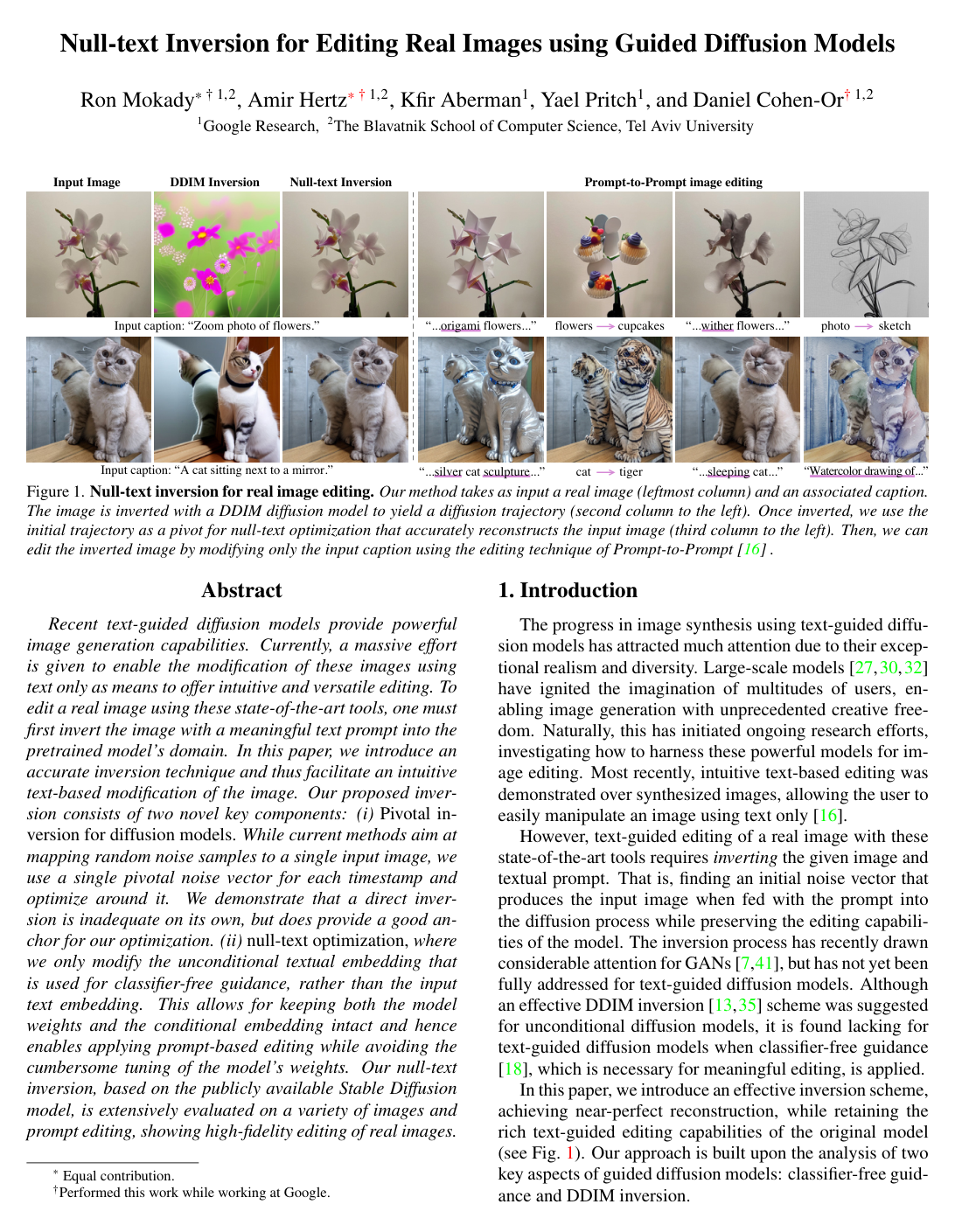
Recent advances in text-guided diffusion models have enabled realistic image generation from text prompts. However, applying intuitive text-based modifications to real photographs remains a major challenge. Existing editing tools require inverting a real image into the diffusion model's latent representation. Previous inversion techniques either produce inaccurate reconstructions, require users to draw manual masks, or rely on fine-tuning entire model weights for each edit, which causes high computational overhead and damages the model's learned priors.
The article demonstrates an accurate and efficient inversion framework, termed Null-text Inversion, designed to facilitate intuitive text-based editing of real images without modifying model weights or requiring user masks. The method is built and evaluated upon the publicly available Stable Diffusion architecture.
The approach introduces two primary components to overcome reconstruction errors: Diffusion Pivotal Inversion and null-text optimization. First, standard deterministic inversion produces an initial noisy trajectory that acts as an anchor or pivot. Second, the method optimizes only the unconditional "null-text" embedding used in classifier-free guidance at each diffusion timestamp, keeping the conditional prompt embedding and the model weights completely intact. The authors evaluated the approach across 100 benchmark image-caption pairs and conducted human perceptual user studies comparing it against leading text-guided editing baselines.
The evaluation yielded several critical findings. First, pivotal null-text optimization reaches near-optimal reconstruction fidelity within 250 to 500 optimization steps, taking approximately one minute on a single graphics processing unit. Second, in a 50-participant comparative user study, the proposed method was preferred by 65.1% of participants for balancing text instruction fidelity with original image preservation, significantly outperforming alternative methods like Text2LIVE (16.6%), SDEdit (14.5%), and VQGAN+CLIP (3.8%). Third, unlike methods that tune model weights and require separate training for every modification, a single one-minute inversion with this technique allows infinite subsequent text edits on the same image, with each edit executing in roughly 10 seconds. Finally, the framework is robust to varying input captions and successfully improves fidelity when paired with other existing editing techniques.
These findings indicate that high-fidelity image manipulation can be achieved at a fraction of the computational and memory cost associated with model fine-tuning. By avoiding model duplication, deployment costs and infrastructure overhead are drastically reduced. Furthermore, preserving the core model weights mitigates the risk of semantic drift and preserves generative prior knowledge across repeated edits.
Organizations developing creative editing tools should adopt this lightweight inversion strategy rather than full-model fine-tuning pipelines. To automate workflows, organizations can pair the system with off-the-shelf captioning models to automatically supply source prompts. Future technical development should focus on reducing the initial inversion time to enable real-time interactive performance and extending the underlying diffusion architectures to handle complex structural posture transformations.
The primary limitation of the method is the initial one-minute inversion runtime, which prevents real-time, instantaneous editing. Additionally, the approach relies on the underlying auto-encoder and cross-attention precision of the base model, which can occasionally introduce minor facial artifacts or misaligned attention maps. Despite these constraints, the results demonstrate high confidence in providing robust, high-fidelity, and scalable image manipulation for non-real-time production pipelines.
- Paper: Prompt-to-Prompt Image Editing with Cross Attention Control, Amir Hertz et al. (2022). Introduces prompt-to-prompt cross-attention manipulation for diffusion models, which provides the underlying editing framework that Null-text Inversion adapts for real images.
- Paper: Classifier-Free Diffusion Guidance, Jonathan Ho et al. (2022). Introduces classifier-free guidance and its unconditional null-text embedding, the exact mechanism optimized by Null-text Inversion to achieve accurate real-image reconstruction.
- Paper: High-Resolution Image Synthesis with Latent Diffusion Models, Robin Rombach et al. (2022). Establishes latent diffusion models (Stable Diffusion), the base generative backbone on which the pivotal inversion and null-text optimization are implemented and evaluated.
- Paper: Denoising Diffusion Implicit Models, Jiaming Song et al. (2021). Presents deterministic DDIM sampling and inversion trajectories, which form the pivotal noise anchors that Null-text Inversion optimizes around.
- Paper: An Image is Worth One Word: Personalizing Text-to-Image Generation using Textual Inversion, Rinon Gal et al. (2022). Introduces the concept of optimizing pseudo-word textual embeddings in frozen diffusion models, paving the conceptual way for unconditional embedding optimization.
- Paper: InstructPix2Pix: Learning to Follow Image Editing Instructions, Tim Brooks et al. (2023). Builds directly on Prompt-to-Prompt and real-image editing paradigms to train an end-to-end instruction-guided editing model that bypasses per-image inversion optimization.
- Paper: Instruct-NeRF2NeRF: Editing 3D Scenes with Instructions, Ayaan Haque et al. (2023). Extends 2D text-guided image editing methods into 3D scene editing through iterative dataset update loops over neural radiance fields.