Built independently by an author, for readers. Read the story and support ChapterPal

keyword

DDPM sampling

DDPM sampling is the iterative generation process in denoising diffusion probabilistic models where an artificial neural network progressively removes noise from a random Gaussian distribution to synthesize structured data, such as an image. Operating as a stochastic reverse Markov chain across a sequence of discrete timesteps, the model repeatedly predicts the noise component of the current state, computes the mean of the preceding less noisy state, and injects a calibrated amount of fresh Gaussian noise. This step-by-step stochastic transition allows the model to approximate the true data distribution and explore diverse generative trajectories, distinguishing DDPM sampling from deterministic sampling methods and producing high-fidelity, varied outputs.

1 item

An Edit Friendly DDPM Noise Space: Inversion and Manipulations

An Edit Friendly DDPM Noise Space: Inversion and Manipulations

Inbar Huberman-Spiegelglas, Vladimir Kulikov, Tomer Michaeli

OrganizationsTechnion – Israel Institute of Technology

Why you should read this

Proposes an exact, optimization-free DDPM inversion method that maps real images into a structured noise space, enabling diverse and structure-preserving text-guided editing without requiring model fine-tuning or attention manipulation.

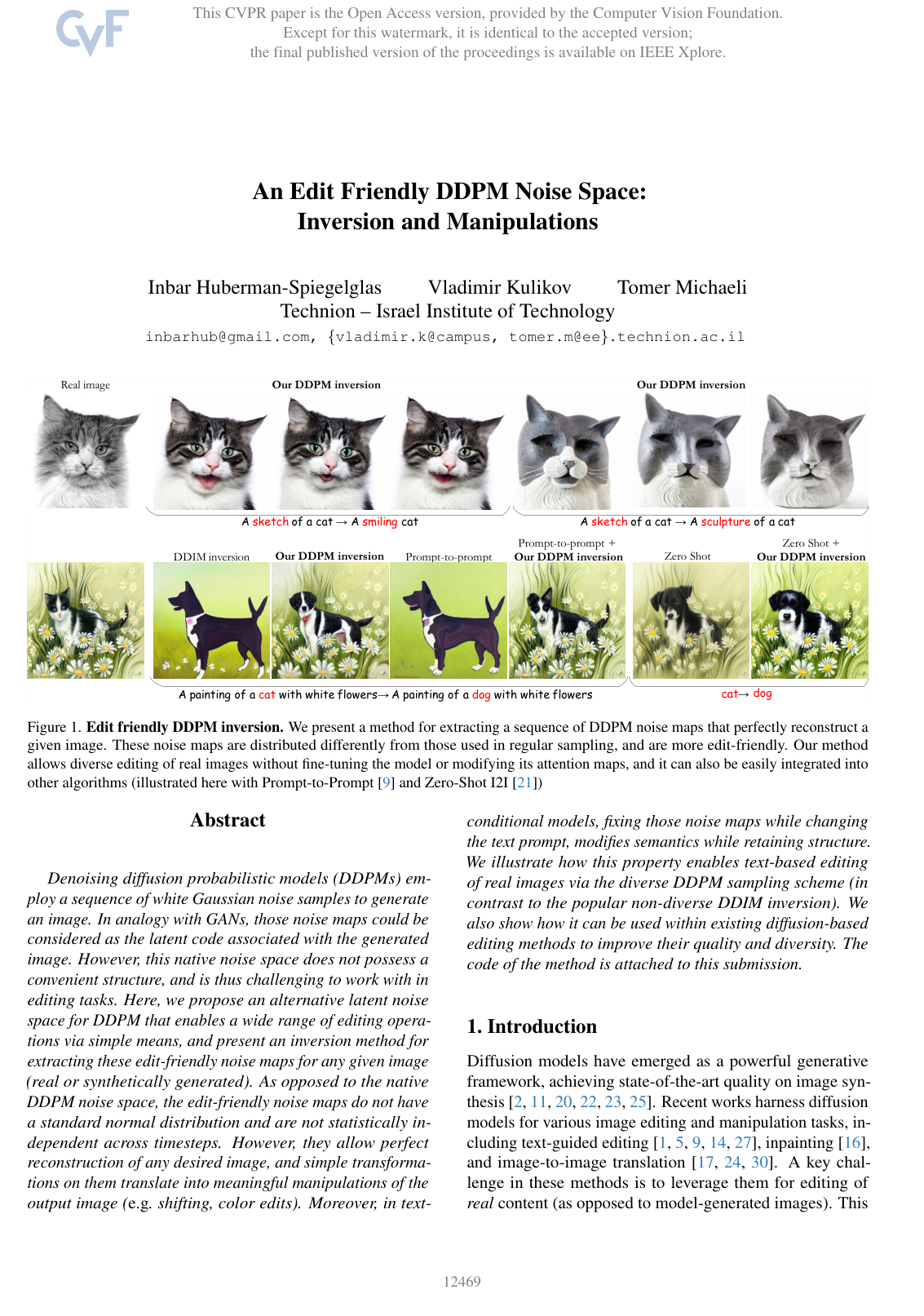
Denoising diffusion probabilistic models (DDPMs) employ a sequence of white Gaussian noise samples to generate an image. In analogy with GANs, those noise maps could be considered as the latent code associated with the generated image. However, this native noise space does not possess a convenient structure, and is thus challenging to work with in editing tasks. Here, we propose an alternative latent noise space for DDPM that enables a wide range of editing operations via simple means, and present an inversion method for extracting these edit-friendly noise maps for any given image (real or synthetically generated). As opposed to the native DDPM noise space, the edit-friendly noise maps do not have a standard normal distribution and are not statistically independent across timesteps. However, they allow perfect reconstruction of any desired image, and simple transformations on them translate into meaningful manipulations of the output image (e.g. shifting, color edits). Moreover, in text-conditional models, fixing those noise maps while changing the text prompt, modifies semantics while retaining structure. We illustrate how this property enables text-based editing of real images via the diverse DDPM sampling scheme (in contrast to the popular non-diverse DDIM inversion). We also show how it can be used within existing diffusion-based editing methods to improve their quality and diversity. The code of the method is attached to this submission.

Added

2026-09-26