Imagic: Text-Based Real Image Editing with Diffusion Models
Bahjat KawarShiran ZadaOran LangOmer TovHuiwen ChangTali DekelInbar MosseriMichal Irani
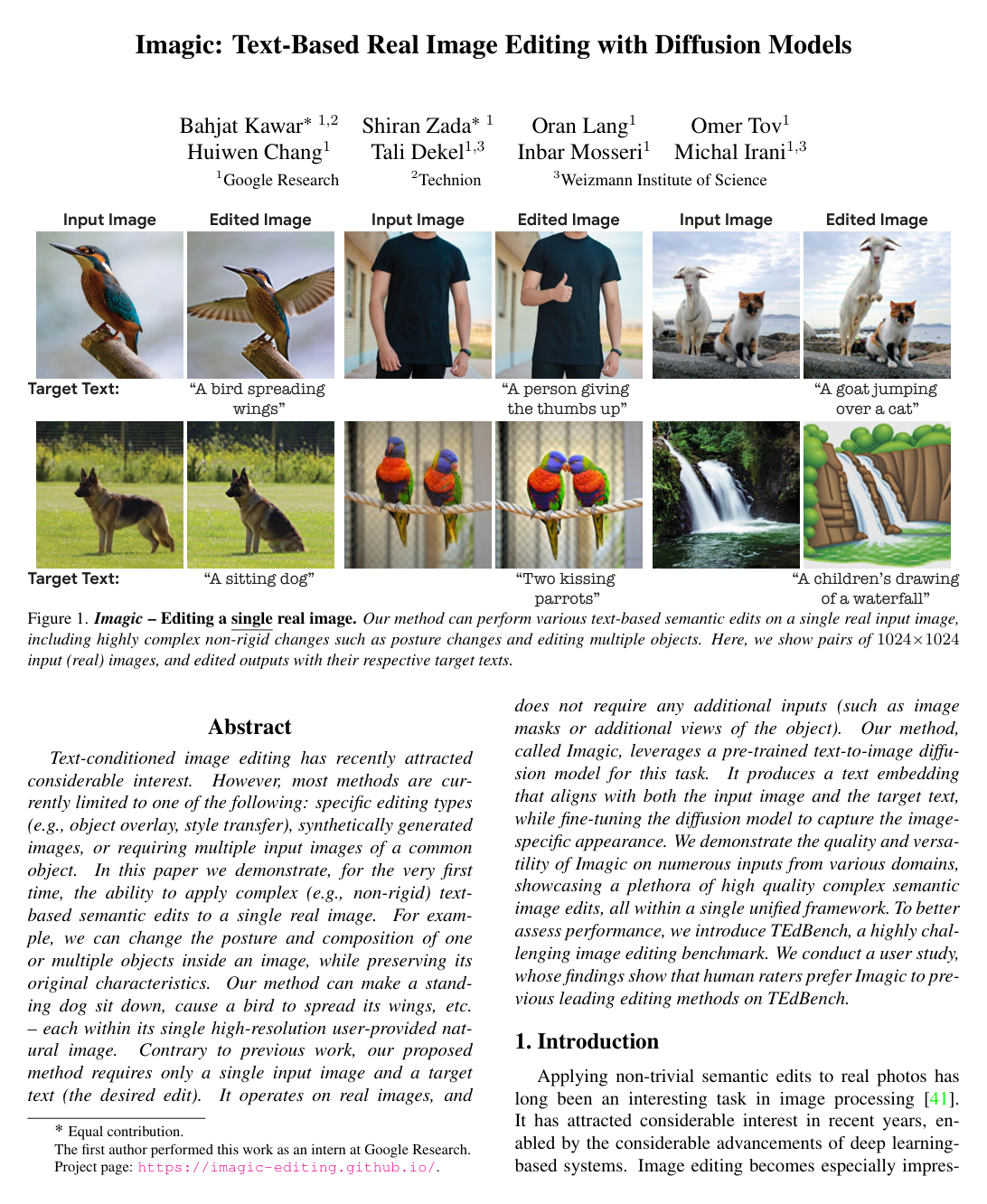
Introduces Imagic, a method that uses pre-trained diffusion models to perform complex, non-rigid semantic edits on a single real image using only a text prompt without requiring masks or multi-view data.
Applying natural language text prompts to edit real photographs has become a central objective in computer vision, but existing approaches face significant practical barriers. Most current methods require auxiliary inputs such as user-drawn spatial masks, detailed descriptions of the original image, or multiple reference photographs of the target subject. Furthermore, existing techniques struggle with complex, non-rigid edits—such as changing an animal's posture or adjusting object interactions—often corrupting original image details or failing to alter the geometry convincingly.
The article demonstrates and evaluates a framework called Imagic, which performs sophisticated semantic edits on a single real image using only a target text prompt. The primary objective is to verify whether text-to-image diffusion models can execute complex, non-rigid modifications while preserving the unedited composition, background, and identity present in the original photograph.
The researchers designed a three-step optimization process: first, optimizing a text representation to capture the input image; second, fine-tuning the generative model parameters to reconstruct the photograph accurately; and third, linearly interpolating between the optimized representation and the target text prompt to generate the edited output. To establish credibility, the framework was validated across two diffusion architectures (Imagen and Stable Diffusion) using high-resolution natural photographs. The authors also established TEdBench, a dedicated benchmark of 100 complex non-rigid editing pairs, and conducted an Amazon Mechanical Turk user study collecting 9,213 human evaluations against three leading baselines (SDEdit, DDIB, and Text2LIVE).
The evaluation yielded several key findings. In the perceptual user study, human raters preferred Imagic over each alternative baseline with a preference rate exceeding 70%. Ablation analyses proved that fine-tuning the diffusion model is critical; without it, the model cannot maintain high fidelity to the original image when moving toward the target edit. Additionally, the optimal balance between image fidelity and text alignment consistently emerged within an interpolation intensity range of 0.6 to 0.8 across tested inputs, demonstrating a robust editing corridor.
These findings indicate that generative diffusion models possess latent compositional capabilities that enable precise, non-rigid editing without manual masking. For organizations evaluating generative image tools, this capability reduces workflow complexity by eliminating the need for multi-image datasets or specialized manual annotations. However, the runtime cost remains significant, requiring approximately seven to eight minutes of fine-tuning per image on high-end hardware, which limits immediate deployment in real-time, user-facing environments.
Decision-makers should treat this framework as a foundation for next-generation automated editing workflows, while prioritizing research into faster test-time optimization and automated selection of the interpolation parameter before enterprise-wide operational deployment. Stakeholders must remain cautious regarding standard model failure cases, including camera angle distortions, subtle under-editing, and inherited model biases such as poor human face generation, as well as the risk of misuse for synthetic misinformation.
- Paper: An Image is Worth One Word: Personalizing Text-to-Image Generation using Textual Inversion, Rinon Gal et al. (2022). Introduces textual inversion for personalizing diffusion models via learned text embeddings, providing the foundational conceptual mechanism that Imagic adapts for single-image text-driven editing.
- Paper: Prompt-to-Prompt Image Editing with Cross Attention Control, Amir Hertz et al. (2022). Establishes text-driven image editing inside pretrained diffusion models without spatial masks by manipulating cross-attention maps, representing a core baseline and conceptual precursor to Imagic.
- Paper: Photorealistic Text-to-Image Diffusion Models with Deep Language Understanding, Chitwan Saharia et al. (2022). Presents the Imagen diffusion architecture and text-conditioning framework that Imagic directly builds upon as its underlying base generative model.
- Paper: High-Resolution Image Synthesis with Latent Diffusion Models, Robin Rombach et al. (2022). Formulates text-conditional latent diffusion models with cross-attention mechanisms, establishing the core generative paradigm used across modern diffusion-based image editing.
- Paper: GLIDE: Towards Photorealistic Image Generation and Editing with Text-Guided Diffusion Models, Alexander Quinn Nichol et al. (2022). Demonstrates early text-guided image editing and inpainting with diffusion models using classifier-free guidance, providing essential background on diffusion-based manipulation.
- Paper: SDEdit: Guided Image Synthesis and Editing with Stochastic Differential Equations, Chenlin Meng et al. (2022). Introduces the principle of diffusing and iteratively denoising an input image for guided synthesis and editing, which underlies inversion and fine-tuning pipelines in diffusion models.
- Paper: InstructPix2Pix: Learning to Follow Image Editing Instructions, Tim Brooks et al. (2023). Builds on single-image editing techniques like Imagic by training a dedicated instruction-following diffusion model that performs edits directly from natural language instructions without per-image optimization.
- Paper: DreamBooth: Fine Tuning Text-to-Image Diffusion Models for Subject-Driven Generation, Nataniel Ruiz et al. (2023). Expands on test-time model fine-tuning and subject preservation techniques by introducing class-specific prior preservation loss to synthesize personalized subjects across diverse contexts.
- Paper: Adding Conditional Control to Text-to-Image Diffusion Models, Lvmin Zhang et al. (2023). Extends text-guided diffusion control beyond text embeddings and fine-tuning by incorporating explicit spatial conditions such as poses and edge maps via dedicated trainable network copies.
- Paper: Instruct-NeRF2NeRF: Editing 3D Scenes with Instructions, Ayaan Haque et al. (2023). Lifts 2D diffusion-based image editing concepts to 3D scene editing by iteratively updating neural radiance fields with diffusion-guided render modifications.
- Paper: T2I-Adapter: Learning Adapters to Dig out More Controllable Ability for Text-to-Image Diffusion Models, Chong Mou et al. (2023). Provides a lightweight adapter framework for aligning pretrained text-to-image diffusion models with structural guidance signals without requiring per-image model fine-tuning.
- Paper: AnimateDiff: Animate Your Personalized Text-to-Image Diffusion Models without Specific Tuning, Yuwei Guo et al. (2024). Extends personalized and edited image diffusion models into dynamic video generation by injecting reusable motion modeling modules without modifying base model knowledge.