I2SB: Image-to-Image Schrödinger Bridge
Guan-Horng LiuArash VahdatDe-An HuangEvangelos A. TheodorouWeili NieAnima Anandkumar
Develops Image-to-Image Schrödinger Bridge (ISB), a simulation-free conditional diffusion framework that directly maps degraded to clean image distributions, outperforming standard diffusion models across restoration tasks without requiring prior knowledge of corruption operators.
Digital image restoration—such as repairing corrupted, blurry, or low-resolution images—is critical across domains like medical imaging, autonomous systems, data compression, and defense. Standard diffusion-based generative models synthesize clean images by starting from pure random noise and gradually shaping it using the degraded image as a guide. However, starting from unstructured noise ignores the rich structural content already present in the degraded input, resulting in higher computational costs and requiring many sequential processing steps.
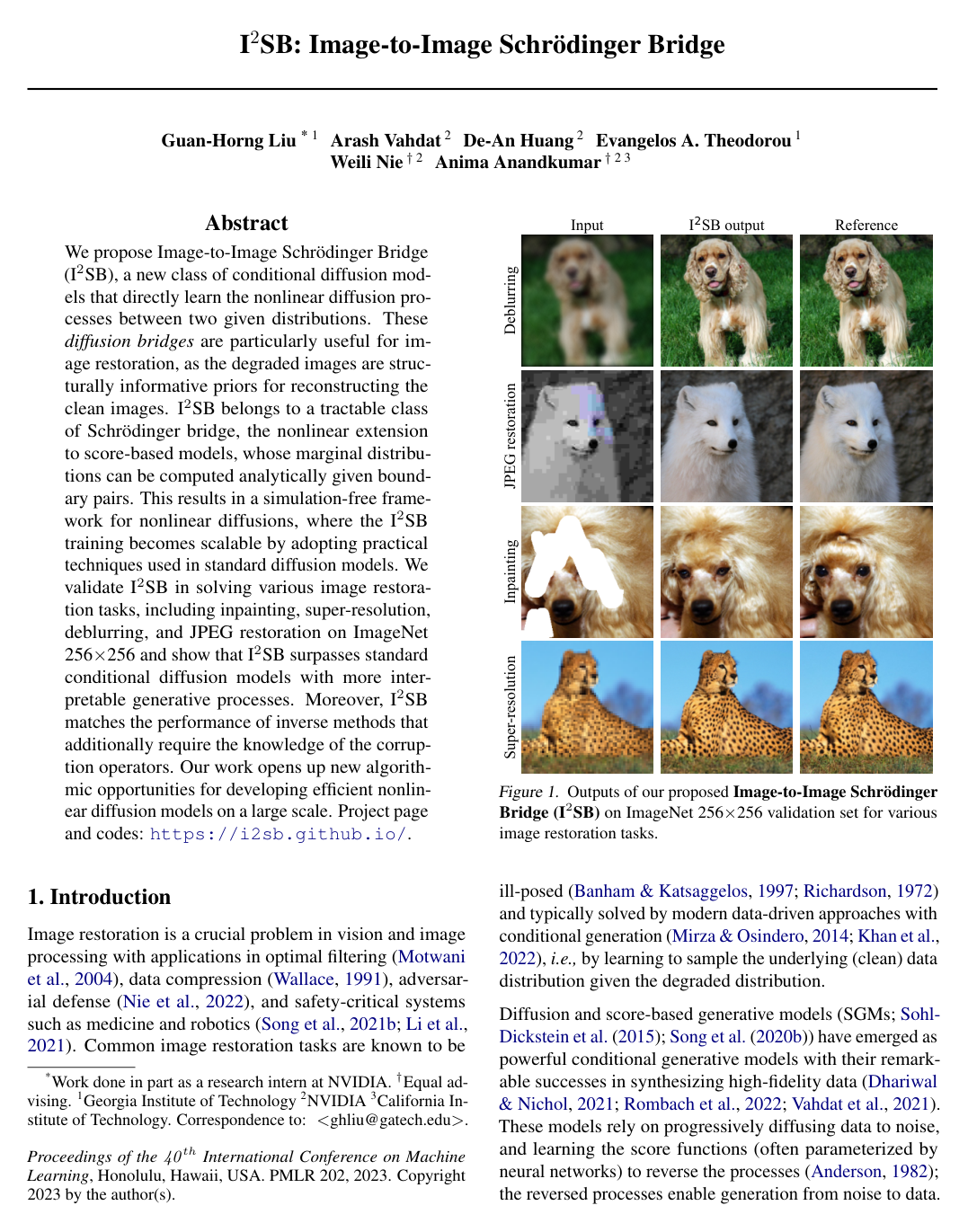
The article demonstrates and evaluates the Image-to-Image Schrödinger Bridge (I2SB), a new class of generative diffusion models designed specifically for image-to-image translation. The main objective is to establish an efficient, simulation-free framework that learns direct, nonlinear transitions from degraded images to clean targets without generating content from random noise.
The authors formulated I2SB by reformulating Schrödinger Bridge theory into a tractable structure compatible with standard diffusion architectures. This mathematical approach allows intermediate training states to be computed analytically from clean-degraded image pairs, avoiding the heavy memory and computational overhead of previous Schrödinger Bridge methods. The framework was evaluated on the ImageNet benchmark at 256×256 resolution across multiple restoration tasks, including image inpainting, JPEG artifact removal, deblurring, and 4× super-resolution, and compared against standard conditional diffusion models, traditional Schrödinger Bridge baselines, and specialized inverse solvers.
The evaluation yielded several key findings. First, I2SB outperformed standard conditional diffusion models across most tasks, reducing visual distortion scores (measured by Fréchet Inception Distance) from 8.3 to 4.6 in aggressive JPEG restoration and from 14.8 to 2.8 in bicubic super-resolution. Second, I2SB matched or exceeded the restoration quality of specialized inverse methods without requiring explicit mathematical descriptions of how the images were degraded. Third, the framework drastically improved computational efficiency during generation; for example, on freeform inpainting, I2SB achieved target restoration quality with only 2 to 10 sampling steps, whereas baseline conditional diffusion models required at least 100 steps. Finally, I2SB scaled seamlessly to high-resolution tasks where previous Schrödinger Bridge models were computationally intractable, running significantly faster while cutting memory usage.
These findings indicate that directly modeling transitions between related data distributions provides substantial gains in computational speed and visual fidelity. For organizations deploying computer vision systems, I2SB reduces operational latency and compute costs during inference, enabling near real-time, high-quality image enhancement on standard hardware. Furthermore, eliminating the need to model specific degradation mechanics lowers development complexity across diverse operational settings.
Stakeholders seeking to deploy image restoration pipelines should consider adopting the I2SB framework over conventional noise-to-image diffusion models, particularly where inference budgets or low-latency requirements are strict. Future development should explore combining I2SB with task-specific physical constraints and extending the framework to unsupervised settings where paired training data is unavailable.
A primary limitation of I2SB is its reliance on paired training data (matching degraded and clean images). While paired samples are straightforward to synthesize for most restoration tasks, the approach cannot currently be applied directly to unpaired translation problems without further architectural adaptation. Confidence in the reported performance is high across standard supervised image restoration benchmarks.
- Paper: Denoising Diffusion Probabilistic Models, Jonathan Ho et al. (2020). It introduces standard denoising diffusion probabilistic models, providing the core foundational diffusion mechanics and score-based parameterizations that I2SB extends to non-linear Schrödinger bridges.
- Paper: Palette: Image-to-Image Diffusion Models, Chitwan Saharia et al. (2021). It establishes conditional image-to-image diffusion models for restoration tasks, serving as the direct baseline paradigm that I2SB replaces with direct boundary-to-boundary diffusion bridges.
- Paper: Diffusion-based Molecule Generation with Informative Prior Bridges, Lemeng Wu et al. (2022). It develops diffusion bridges with informative priors between distributions, laying key groundwork for constructing stochastic bridge processes between non-Gaussian endpoints.
- Paper: Diffusion Posterior Sampling for General Noisy Inverse Problems, Hyungjin Chung et al. (2022). It provides the formulation for solving inverse restoration problems via posterior sampling in diffusion models, against which I2SB evaluates its corruption-operator-agnostic bridge formulation.
- Paper: Denoising Diffusion Restoration Models, Bahjat Kawar et al. (2022). It establishes a benchmark methodology for unsupervised linear inverse image restoration using pre-trained diffusion models, contextualizing I2SB's comparison with inverse problem solvers.
- Paper: Zero-Shot Image Restoration Using Denoising Diffusion Null-Space Model, Yinhuai Wang et al. (2023). It introduces range-null space decomposition for diffusion-based image restoration, offering essential context for operator-dependent restoration baselines compared in I2SB.
- Paper: SDEdit: Guided Image Synthesis and Editing with Stochastic Differential Equations, Chenlin Meng et al. (2022). It introduces SDE-based image synthesis and editing by perturbing guide images with intermediate noise, representing an earlier formulation of image-to-image diffusion trajectories.
- Paper: Elucidating the Design Space of Diffusion-Based Generative Models, Tero Karras et al. (2022). It systematizes the design space, preconditioning, and sampling schedules of continuous diffusion models, informing practical training and scaling strategies used in I2SB.
- Paper: There and Back Again: Bidirectional Diffusion Bridges for Multimodality Translation, Gabe Guo et al. (2026). It extends the mathematical principles of continuous data-to-data diffusion bridges beyond image restoration into bidirectional multimodal translation across heterogeneous domains.
- Paper: BBDM: Image-to-Image Translation with Brownian Bridge Diffusion Models, Bo Li et al. (2023). It explores a closely related Brownian bridge diffusion formulation for image-to-image translation, operating within latent space to tackle broader cross-domain tasks.
- Paper: A Variational Perspective on Solving Inverse Problems with Diffusion Models, Morteza Mardani et al. (2024). It advances diffusion-based inverse problem solving through a variational maximum-likelihood perspective that circumvents posterior score approximations.
- Paper: Wavelet-based Fourier Information Interaction with Frequency Diffusion Adjustment for Underwater Image Restoration, Chen Zhao et al. (2024). It applies two-stage frequency-adjusted diffusion refinement to specialized underwater image restoration settings.
- Paper: Score-Based Diffusion Models in Function Space, Jae Hyun Lim 0001 et al. (2025). It generalizes continuous score-based diffusion modeling from finite-dimensional image spaces to infinite-dimensional function spaces and operator learning.