
keyword
image-to-image translation
Image-to-image translation is a computer vision and deep learning task that involves transforming an image from a source domain to a target domain while preserving its underlying structure and content. The primary objective is to learn a mapping between distinct visual representations, enabling applications such as converting sketches or semantic label maps into photorealistic images, transferring artistic styles, colorizing monochrome photos, and executing image restorations like deblurring and super-resolution. These systems can be trained using paired datasets, where direct one-to-one correspondences exist between domains, or unpaired datasets, where the model learns domain distributions without matched examples. Modern implementations predominantly leverage deep generative architectures, including conditional generative adversarial networks and diffusion models, to synthesize realistic target images deterministically or generate diverse multimodal outputs across various visual styles.
12 items
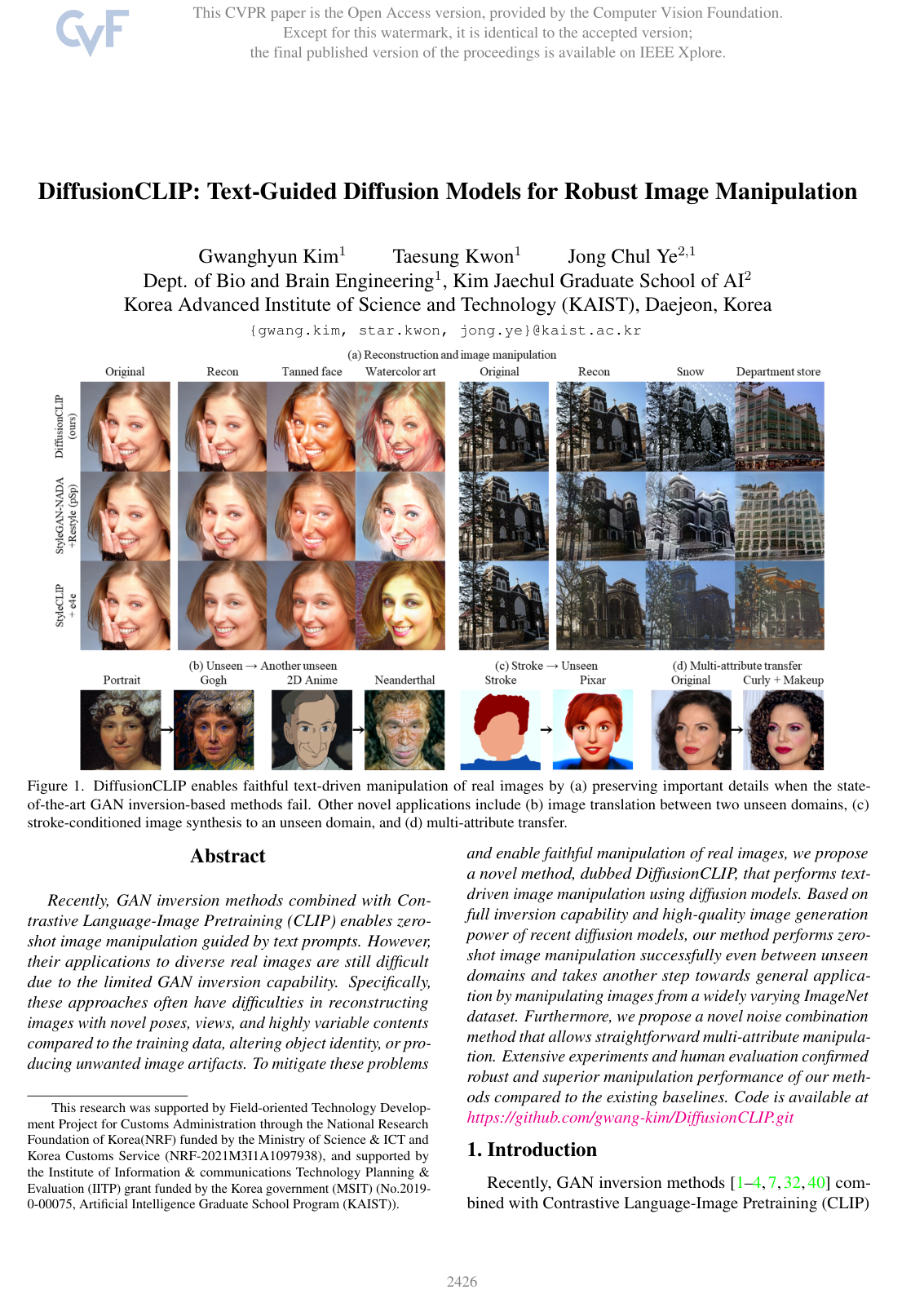
DiffusionCLIP: Text-Guided Diffusion Models for Robust Image Manipulation
Gwanghyun Kim, Taesung Kwon, Jong Chul Ye
Why you should read this
Proposes a text-guided image manipulation framework that couples diffusion model inversion with CLIP loss fine-tuning, overcoming GAN inversion limitations to edit complex real-world images and combine multiple visual attributes across diverse domains.
Recently, GAN inversion methods combined with Contrastive Language-Image Pretraining (CLIP) enables zero-shot image manipulation guided by text prompts. However, their applications to diverse real images are still difficult due to the limited GAN inversion capability. Specifically, these approaches often have difficulties in reconstructing images with novel poses, views, and highly variable contents compared to the training data, altering object identity, or producing unwanted image artifacts. To mitigate these problems and enable faithful manipulation of real images, we propose a novel method, dubbed DiffusionCLIP, that performs text-driven image manipulation using diffusion models. Based on full inversion capability and high-quality image generation power of recent diffusion models, our method performs zero-shot image manipulation successfully even between unseen domains and takes another step towards general application by manipulating images from a widely varying ImageNet dataset. Furthermore, we propose a novel noise combination method that allows straightforward multi-attribute manipulation. Extensive experiments and human evaluation confirmed robust and superior manipulation performance of our methods compared to the existing baselines. Code is available at https://github.com/gwang-kim/DiffusionCLIP.git
Added
2026-10-05
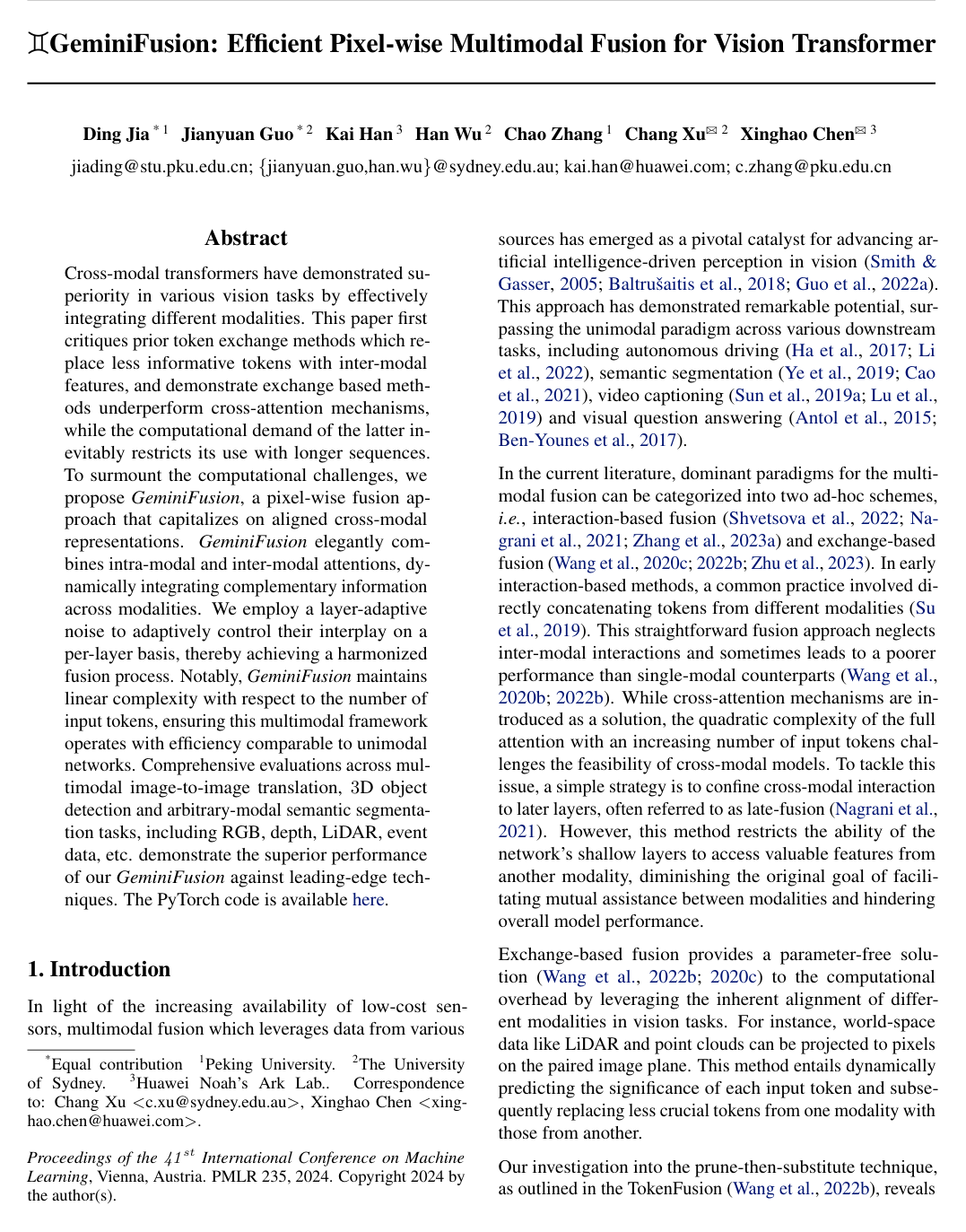
GeminiFusion: Efficient Pixel-wise Multimodal Fusion for Vision Transformer
Ding Jia, Jianyuan Guo, Kai Han, Han Wu, Chao Zhang, Chang Xu, Xinghao Chen
Why you should read this
Proposes GeminiFusion, a multimodal vision transformer framework that achieves linear computational complexity by combining intra-modal and inter-modal attention at aligned spatial positions, matching the efficiency of unimodal models while outperforming token exchange and full cross-attention across diverse segmentation, detection, and translation benchmarks.
Cross-modal transformers have demonstrated superiority in various vision tasks by effectively integrating different modalities. This paper first critiques prior token exchange methods which replace less informative tokens with inter-modal features, and demonstrate exchange based methods underperform cross-attention mechanisms, while the computational demand of the latter inevitably restricts its use with longer sequences. To surmount the computational challenges, we propose GeminiFusion, a pixel-wise fusion approach that capitalizes on aligned cross-modal representations. GeminiFusion elegantly combines intra-modal and inter-modal attentions, dynamically integrating complementary information across modalities. We employ a layer-adaptive noise to adaptively control their interplay on a per-layer basis, thereby achieving a harmonized fusion process. Notably, GeminiFusion maintains linear complexity with respect to the number of input tokens, ensuring this multimodal framework operates with efficiency comparable to unimodal networks. Comprehensive evaluations across multimodal image-to-image translation, 3D object detection and arbitrary-modal semantic segmentation tasks, including RGB, depth, LiDAR, event data, etc. demonstrate the superior performance of our GeminiFusion against leading-edge techniques. The PyTorch code is available here.
Added
2026-10-03
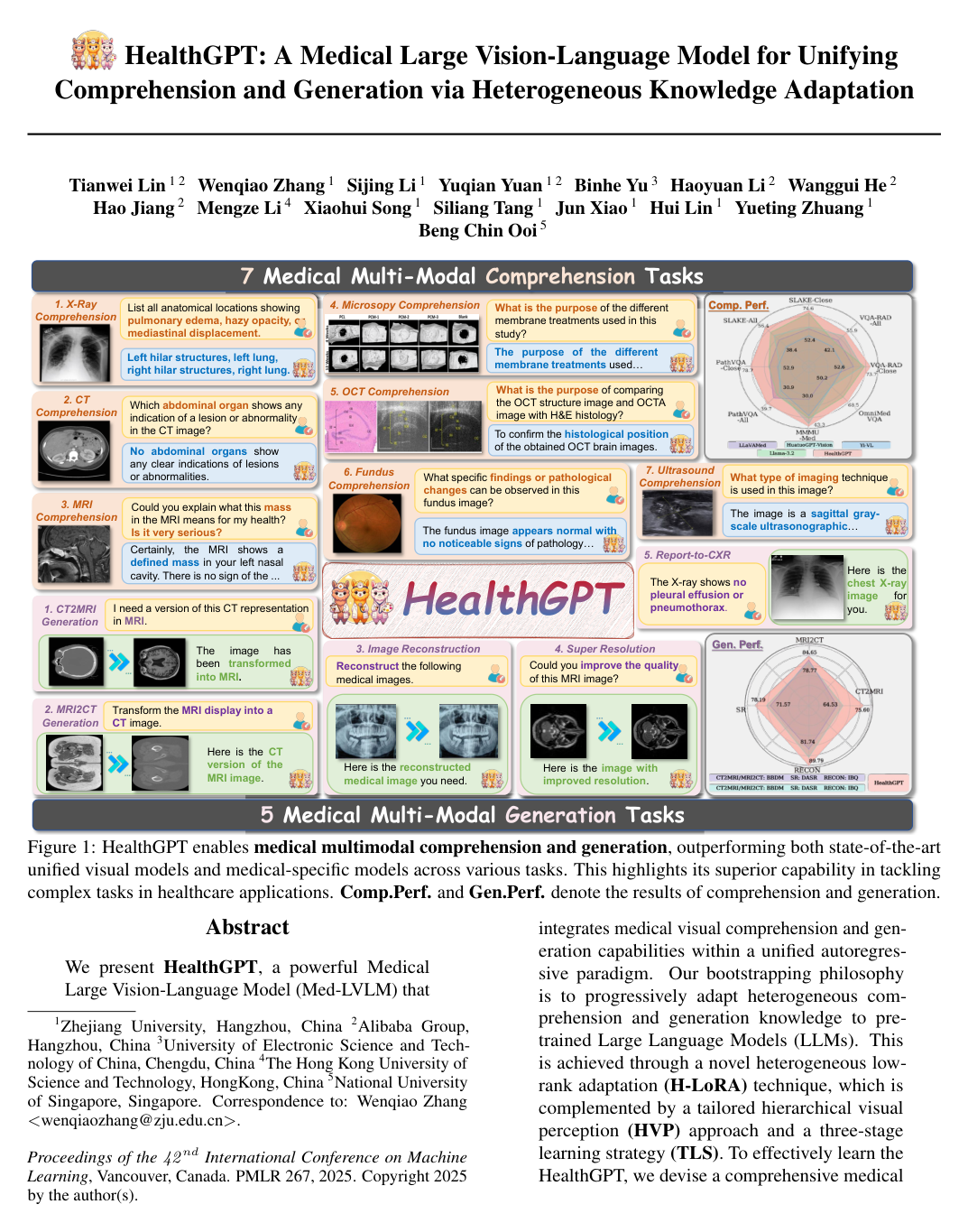
HealthGPT: A Medical Large Vision-Language Model for Unifying Comprehension and Generation via Heterogeneous Knowledge Adaptation
Tianwei Lin, Wenqiao Zhang, Sijing Li, Yuqian Yuan, Binhe Yu, Haoyuan Li, Wanggui He, Hao Jiang, Mengze Li, Xiaohui Song, Siliang Tang, Jun Xiao, Hui Lin, Yueting Zhuang, Beng Chin Ooi
Why you should read this
Presents HealthGPT, a medical large vision-language model that unifies multimodal comprehension and image generation tasks within a single autoregressive framework using a heterogeneous low-rank adaptation technique to prevent task interference.
Added
2026-10-02
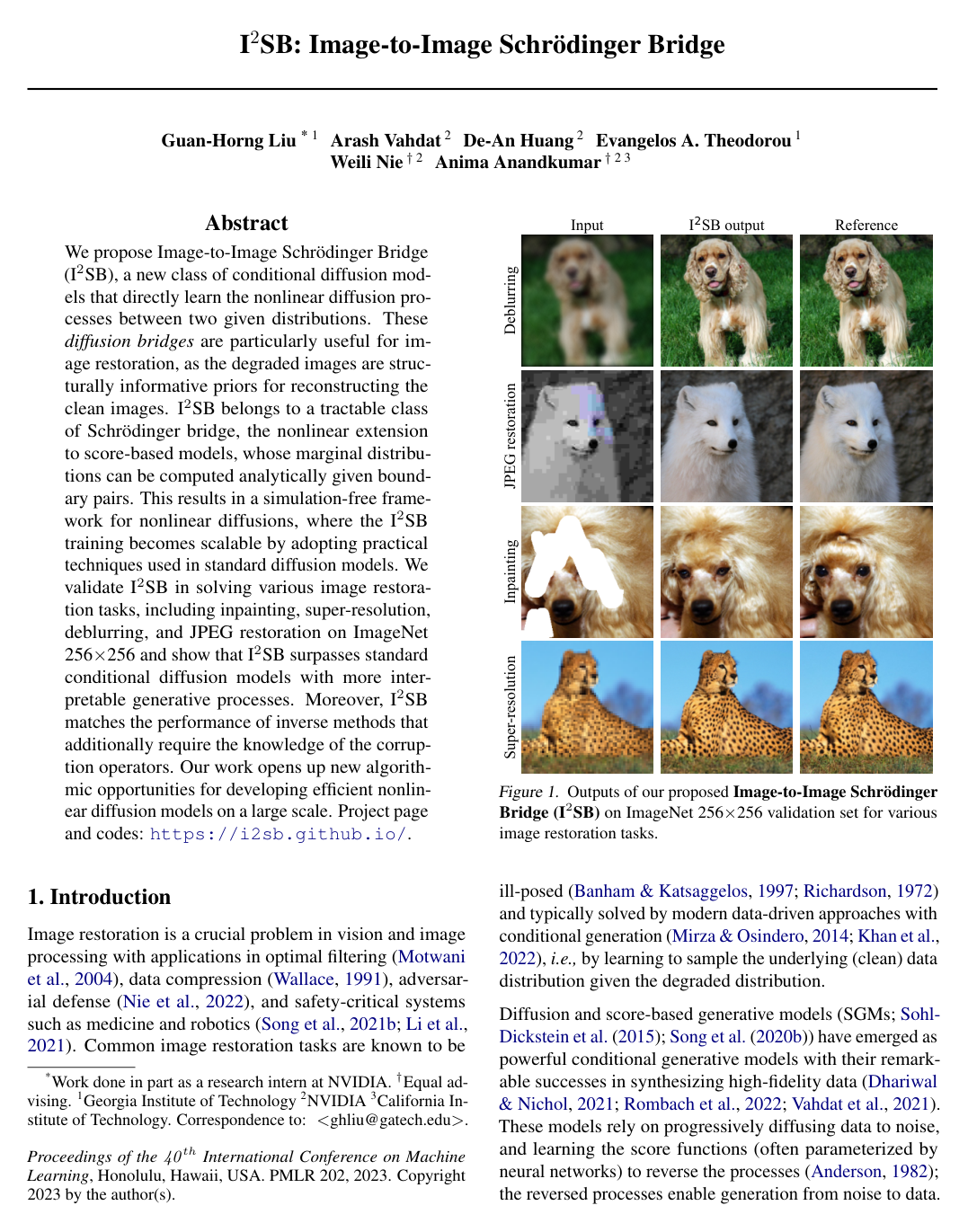
I2SB: Image-to-Image Schrödinger Bridge
Guan-Horng Liu, Arash Vahdat, De-An Huang, Evangelos A. Theodorou, Weili Nie, Anima Anandkumar
Why you should read this
Develops Image-to-Image Schrödinger Bridge (ISB), a simulation-free conditional diffusion framework that directly maps degraded to clean image distributions, outperforming standard diffusion models across restoration tasks without requiring prior knowledge of corruption operators.
We propose Image-to-Image Schrödinger Bridge (ISB), a new class of conditional diffusion models that directly learn the nonlinear diffusion processes between two given distributions. These diffusion bridges are particularly useful for image restoration, as the degraded images are structurally informative priors for reconstructing the clean images. ISB belongs to a tractable class of Schrödinger bridge, the nonlinear extension to score-based models, whose marginal distributions can be computed analytically given boundary pairs. This results in a simulation-free framework for nonlinear diffusions, where the ISB training becomes scalable by adopting practical techniques used in standard diffusion models. We validate ISB in solving various image restoration tasks, including inpainting, super-resolution, deblurring, and JPEG restoration on ImageNet 256x256 and show that ISB surpasses standard conditional diffusion models with more interpretable generative processes. Moreover, ISB matches the performance of inverse methods that additionally require the knowledge of the corruption operators. Our work opens up new algorithmic opportunities for developing efficient nonlinear diffusion models on a large scale. scale. Project page and codes: this https URL
Added
2026-09-28
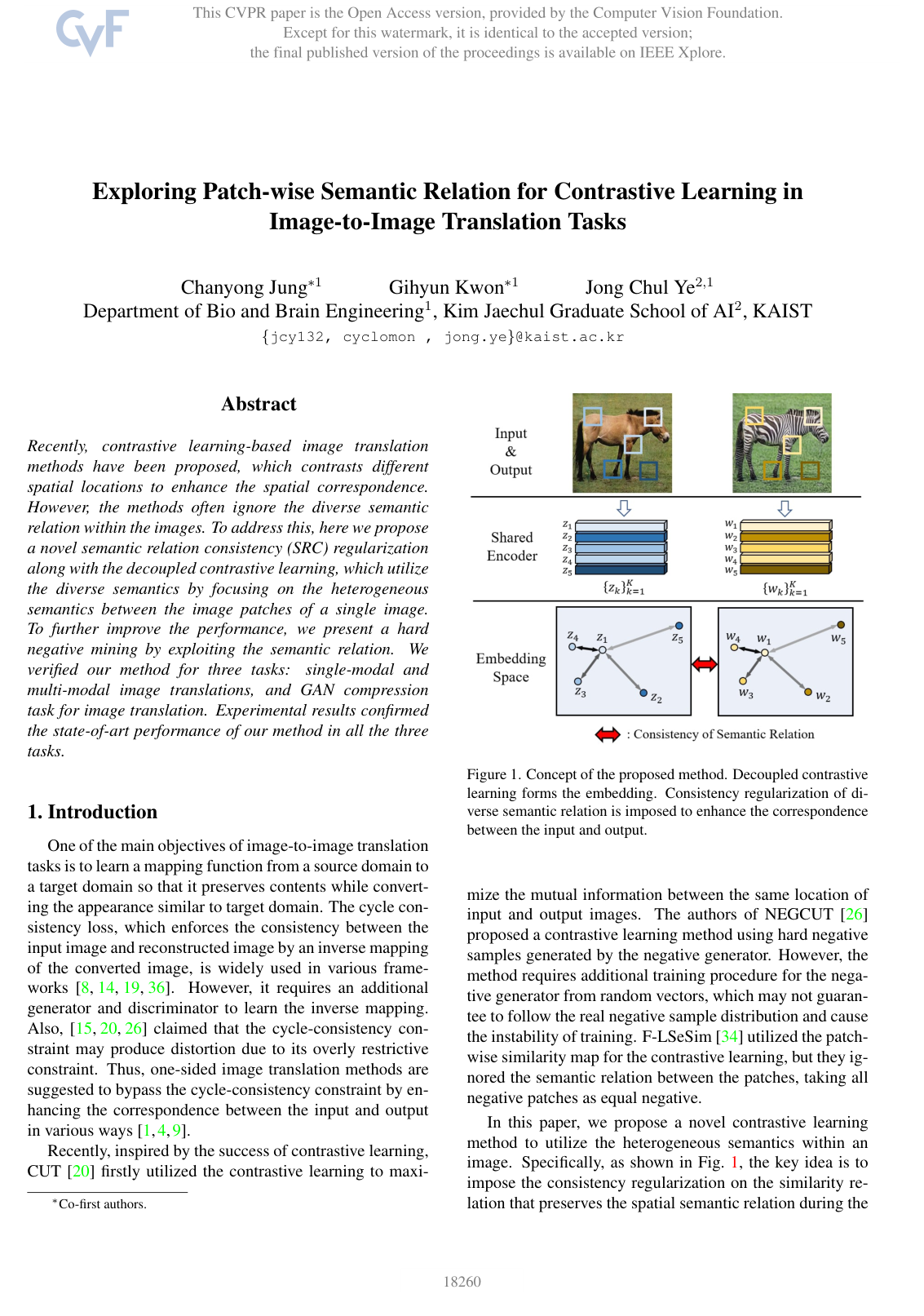
Exploring Patch-wise Semantic Relation for Contrastive Learning in Image-to-Image Translation Tasks
Chanyong Jung, Gihyun Kwon, Jong Chul Ye
Why you should read this
Proposes a semantic relation consistency regularization and relation-based hard negative mining framework that captures heterogeneous patch semantics to achieve state-of-the-art performance across single-modal, multi-modal, and GAN-compressed image translation tasks.
Recently, contrastive learning-based image translation methods have been proposed, which contrasts different spatial locations to enhance the spatial correspondence. However, the methods often ignore the diverse semantic relation within the images. To address this, here we propose a novel semantic relation consistency (SRC) regularization along with the decoupled contrastive learning, which utilize the diverse semantics by focusing on the heterogeneous semantics between the image patches of a single image. To further improve the performance, we present a hard negative mining by exploiting the semantic relation. We verified our method for three tasks: single-modal and multi-modal image translations, and GAN compression task for image translation. Experimental results confirmed the state-of-art performance of our method in all the three tasks.
Added
2026-09-26
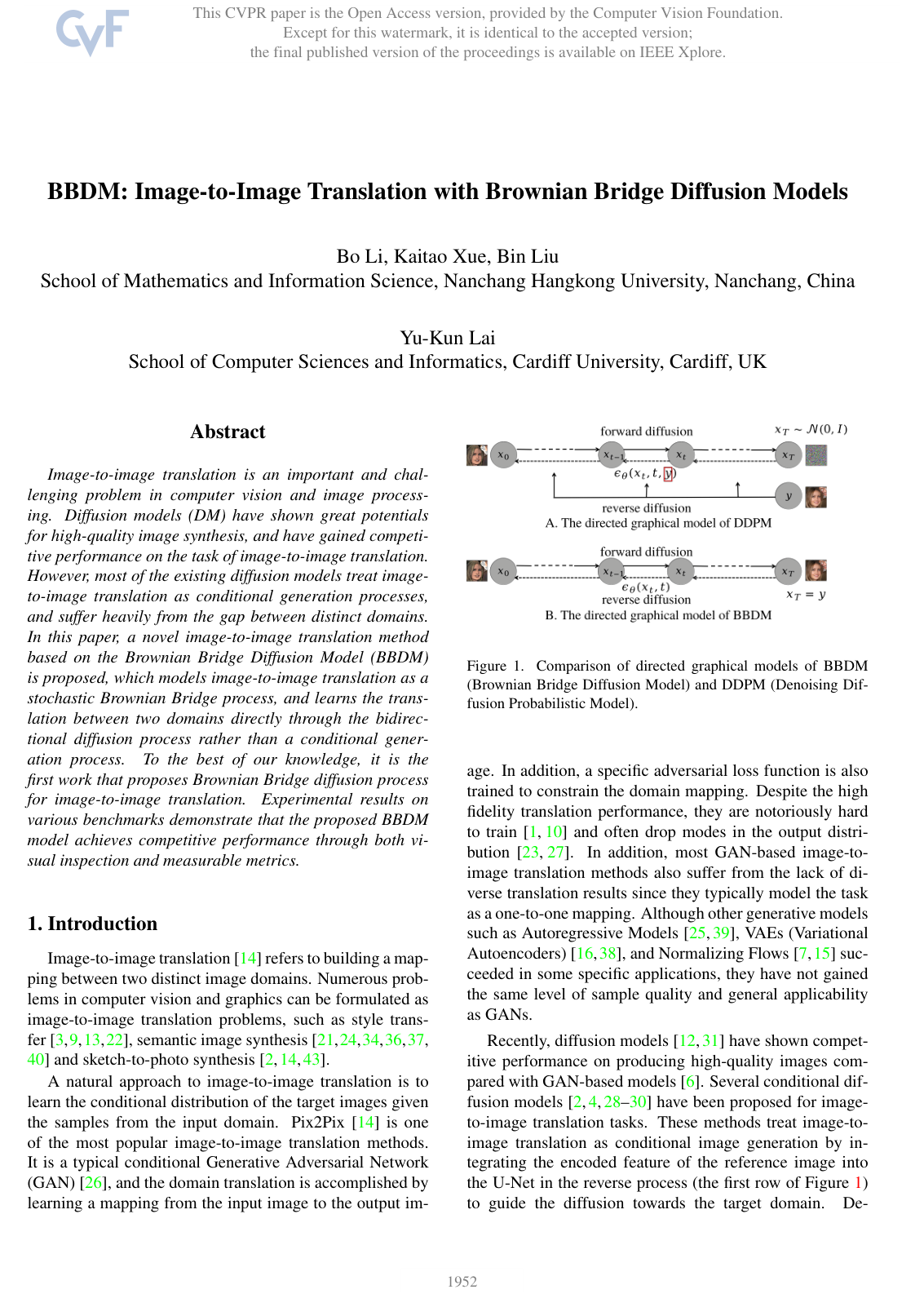
BBDM: Image-to-Image Translation with Brownian Bridge Diffusion Models
Bo Li, Kaitao Xue, Bin Liu, Yu-Kun Lai
Why you should read this
Proposes a novel Brownian Bridge diffusion model that formulates image-to-image translation as a direct bidirectional stochastic process between domains rather than conditional generation, yielding superior cross-domain mapping and synthesis quality.
Image-to-image translation is an important and challenging problem in computer vision and image processing. Diffusion models (DM) have shown great potentials for high-quality image synthesis, and have gained competitive performance on the task of image-to-image translation. However, most of the existing diffusion models treat image-to-image translation as conditional generation processes, and suffer heavily from the gap between distinct domains. In this paper, a novel image-to-image translation method based on the Brownian Bridge Diffusion Model (BBDM) is proposed, which models image-to-image translation as a stochastic Brownian Bridge process, and learns the translation between two domains directly through the bidirectional diffusion process rather than a conditional generation process. To the best of our knowledge, it is the first work that proposes Brownian Bridge diffusion process for image-to-image translation. Experimental results on various benchmarks demonstrate that the proposed BBDM model achieves competitive performance through both visual inspection and measurable metrics.
Added
2026-09-26
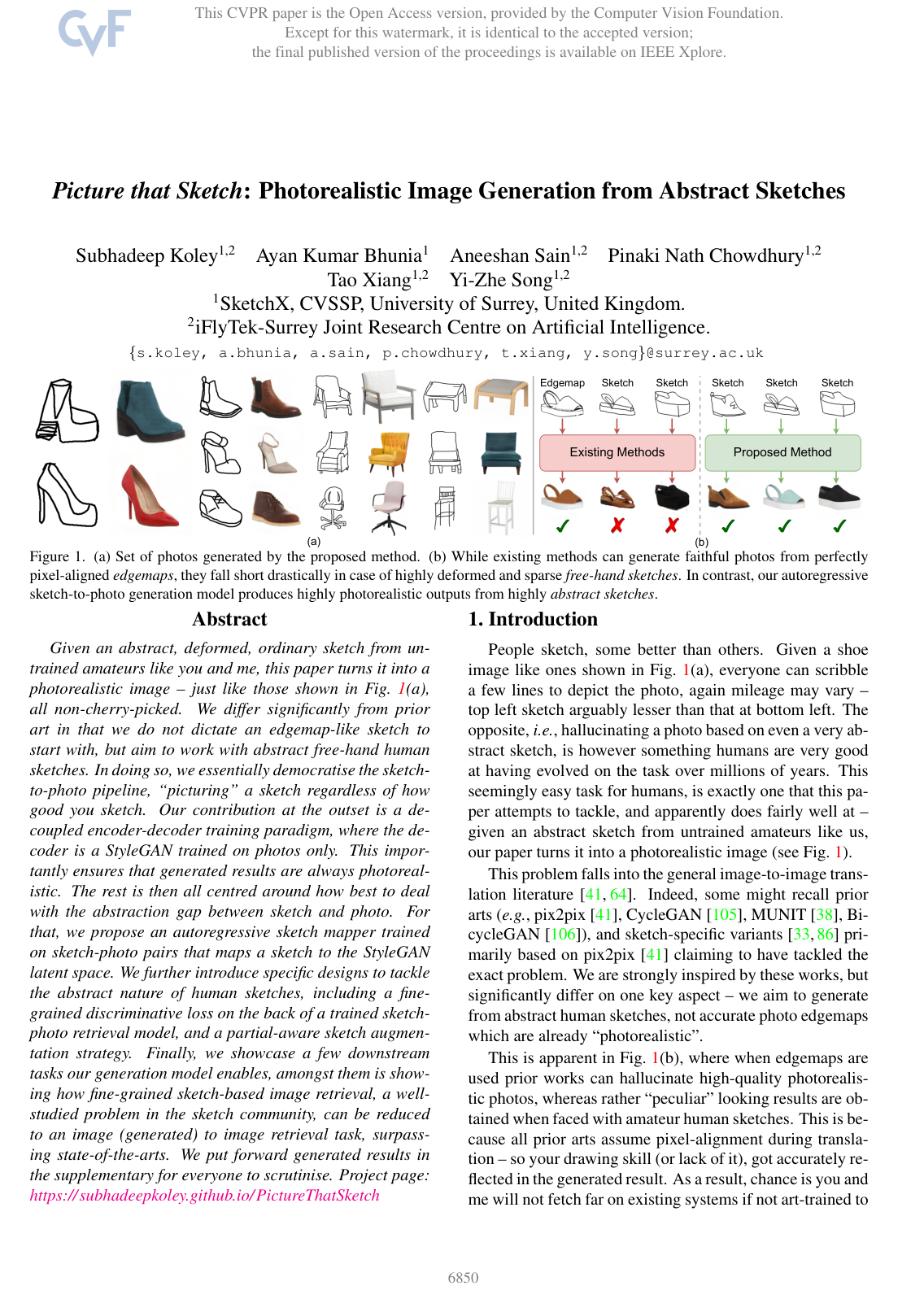
Picture that Sketch: Photorealistic Image Generation from Abstract Sketches
Subhadeep Koley, Ayan Kumar Bhunia, Aneeshan Sain, Pinaki Nath Chowdhury, Tao Xiang, Yi-Zhe Song
Why you should read this
Proposes a decoupled sketch-to-photo generation framework that maps abstract, amateur free-hand sketches into a pre-trained StyleGAN latent space using an autoregressive mapper, producing photorealistic outputs without requiring precise edge alignments and improving fine-grained sketch-based image retrieval.
Given an abstract, deformed, ordinary sketch from untrained amateurs like you and me, this paper turns it into a photorealistic image – just like those shown in Fig. 1(a), all non-cherry-picked. We differ significantly from prior art in that we do not dictate an edgemap-like sketch to start with, but aim to work with abstract free-hand human sketches. In doing so, we essentially democratise the sketch-to-photo pipeline, “picturing” a sketch regardless of how good you sketch. Our contribution at the outset is a decoupled encoder-decoder training paradigm, where the decoder is a StyleGAN trained on photos only. This importantly ensures that generated results are always photorealistic. The rest is then all centred around how best to deal with the abstraction gap between sketch and photo. For that, we propose an autoregressive sketch mapper trained on sketch-photo pairs that maps a sketch to the StyleGAN latent space. We further introduce specific designs to tackle the abstract nature of human sketches, including a fine-grained discriminative loss on the back of a trained sketch-photo retrieval model, and a partial-aware sketch augmentation strategy. Finally, we showcase a few downstream tasks our generation model enables, amongst them is showing how fine-grained sketch-based image retrieval, a well-studied problem in the sketch community, can be reduced to an image (generated) to image retrieval task, surpassing state-of-the-arts. We put forward generated results in the supplementary for everyone to scrutinise. Project page: https://subhadeepkoley.github.io/PictureThatSketch
Added
2026-09-26
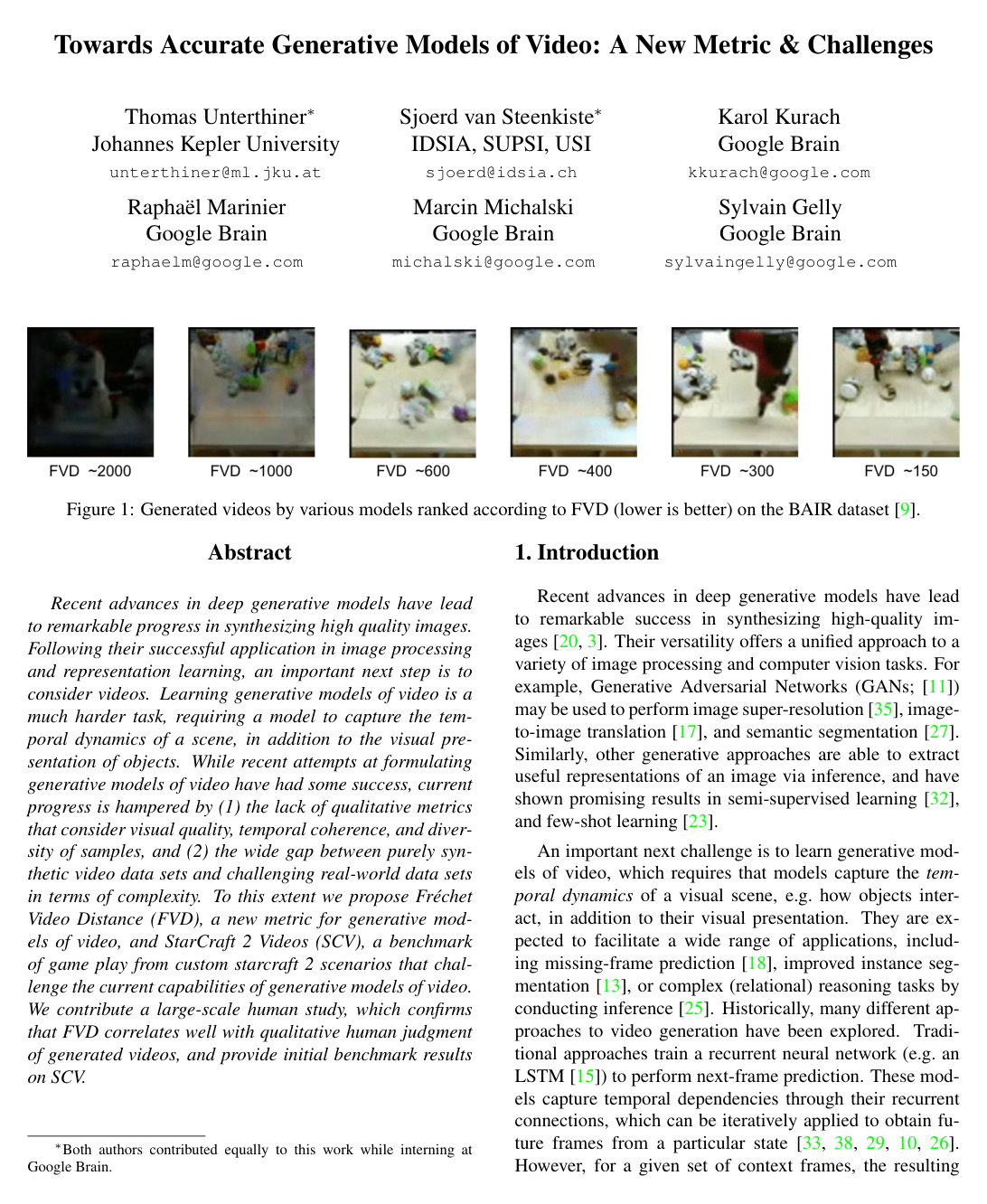
Towards Accurate Generative Models of Video: A New Metric & Challenges
Thomas Unterthiner, Sjoerd van Steenkiste, Karol Kurach, Raphael Marinier, Marcin Michalski, Sylvain Gelly
Why you should read this
Introduces Fréchet Video Distance (FVD), a metric validated against human judgment to evaluate visual quality, temporal coherence, and sample diversity in video generation, alongside the StarCraft 2 Videos benchmark.
Recent advances in deep generative models have lead to remarkable progress in synthesizing high quality images. Following their successful application in image processing and representation learning, an important next step is to consider videos. Learning generative models of video is a much harder task, requiring a model to capture the temporal dynamics of a scene, in addition to the visual presentation of objects. While recent attempts at formulating generative models of video have had some success, current progress is hampered by (1) the lack of qualitative metrics that consider visual quality, temporal coherence, and diversity of samples, and (2) the wide gap between purely synthetic video data sets and challenging real-world data sets in terms of complexity. To this extent we propose Fréchet Video Distance (FVD), a new metric for generative models of video, and StarCraft 2 Videos (SCV), a benchmark of game play from custom starcraft 2 scenarios that challenge the current capabilities of generative models of video. We contribute a large-scale human study, which confirms that FVD correlates well with qualitative human judgment of generated videos, and provide initial benchmark results on SCV.
Added
2026-09-25
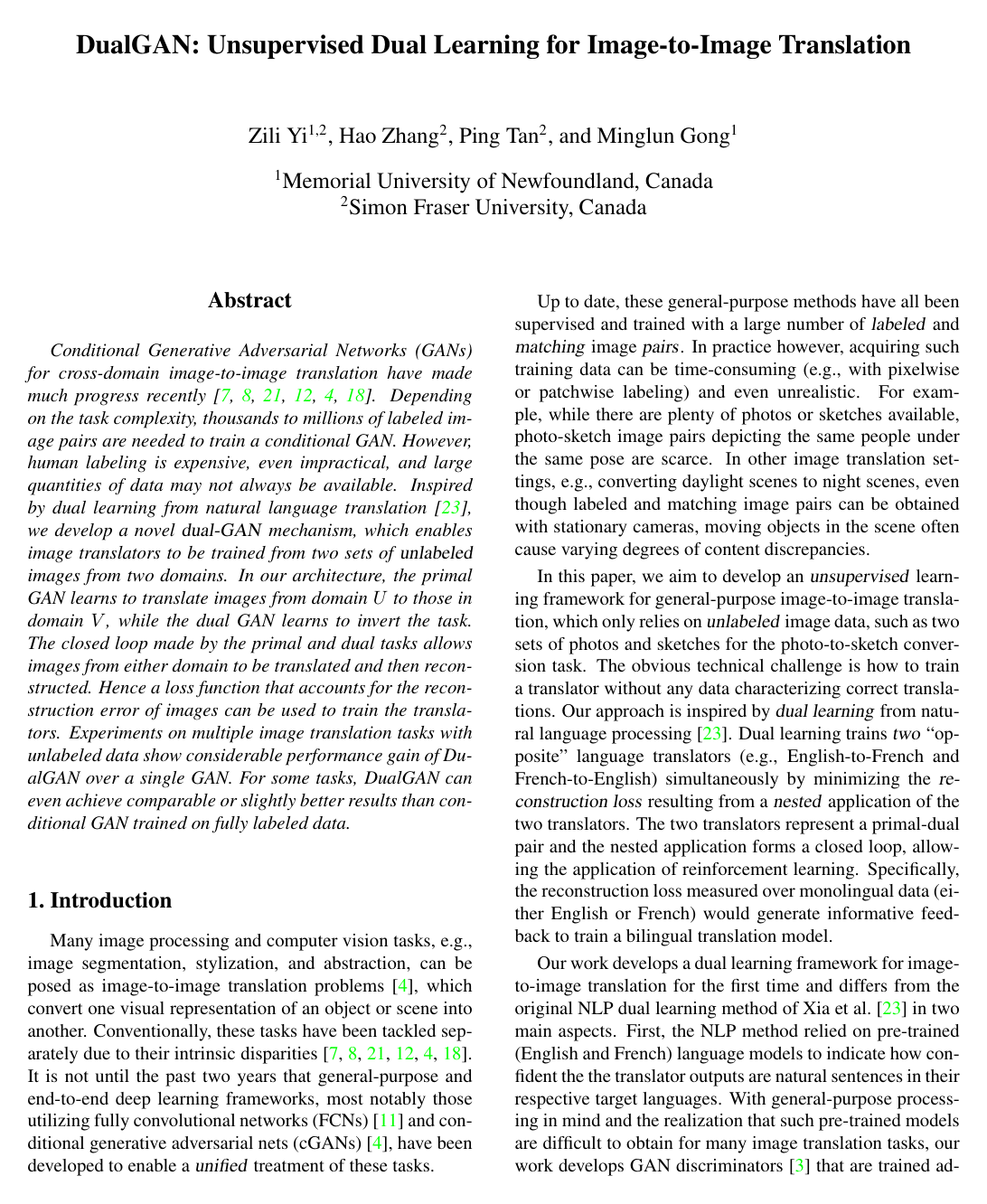
DualGAN: Unsupervised Dual Learning for Image-to-Image Translation
Zili Yi, Hao Zhang, Ping Tan, Minglun Gong
Why you should read this
Proposes DualGAN, an unsupervised framework that leverages closed-loop dual learning to translate images between domains without paired training data, achieving results competitive with fully supervised models.
Conditional Generative Adversarial Networks (GANs) for cross-domain image-to-image translation have made much progress recently. Depending on the task complexity, thousands to millions of labeled image pairs are needed to train a conditional GAN. However, human labeling is expensive, even impractical, and large quantities of data may not always be available. Inspired by dual learning from natural language translation, we develop a novel dual-GAN mechanism, which enables image translators to be trained from two sets of unlabeled images from two domains. In our architecture, the primal GAN learns to translate images from domain U to those in domain V, while the dual GAN learns to invert the task. The closed loop made by the primal and dual tasks allows images from either domain to be translated and then reconstructed. Hence a loss function that accounts for the reconstruction error of images can be used to train the translators. Experiments on multiple image translation tasks with unlabeled data show considerable performance gain of DualGAN over a single GAN. For some tasks, DualGAN can even achieve comparable or slightly better results than conditional GAN trained on fully labeled data.
Added
2026-09-18
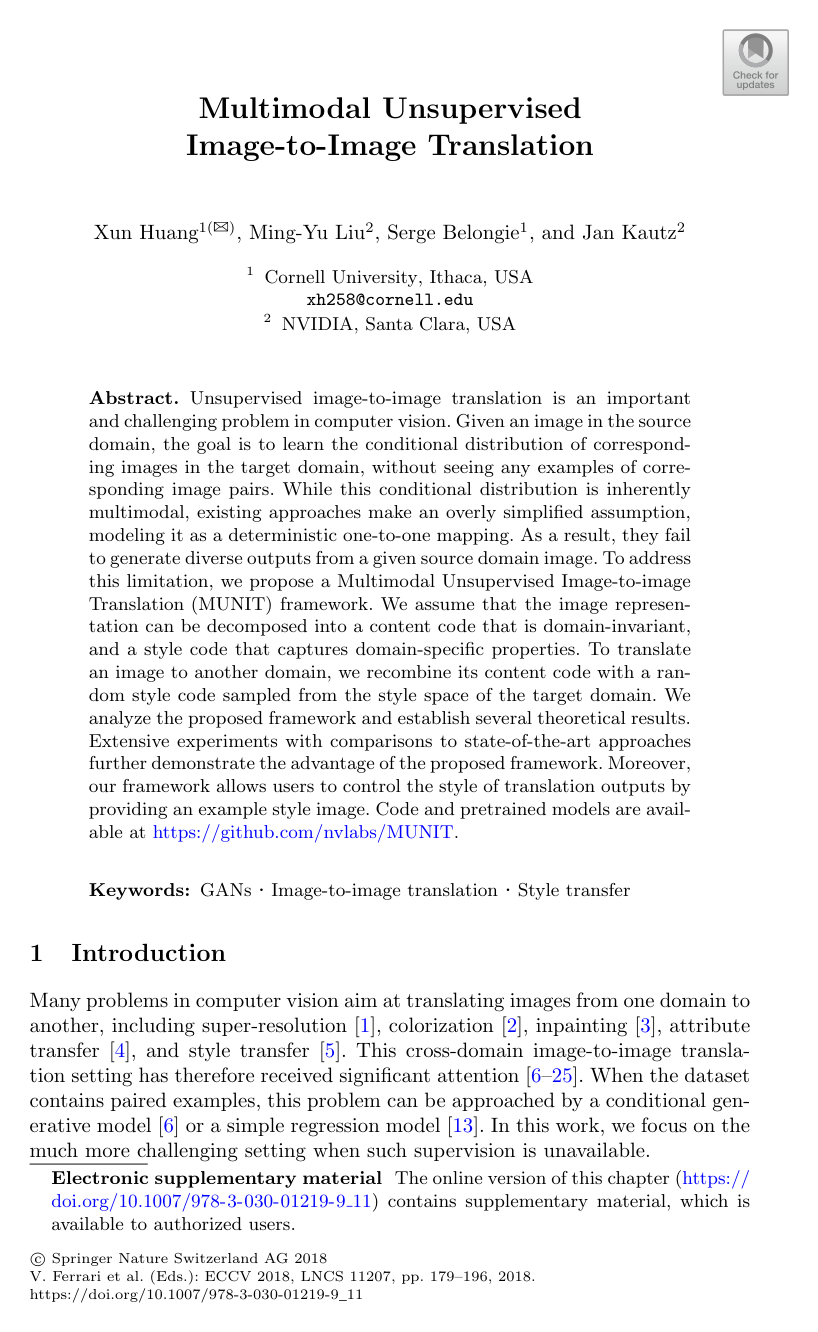
Multimodal Unsupervised Image-to-Image Translation
Xun Huang, Ming-Yu Liu, Serge J. Belongie, Jan Kautz
Why you should read this
Presents the MUNIT framework, which overcomes the one-to-one mapping limitation of unsupervised image translation by disentangling domain-invariant content from domain-specific style to generate diverse, user-controllable outputs.
Unsupervised image-to-image translation is an important and challenging problem in computer vision. Given an image in the source domain, the goal is to learn the conditional distribution of corresponding images in the target domain, without seeing any pairs of corresponding images. While this conditional distribution is inherently multimodal, existing approaches make an overly simplified assumption, modeling it as a deterministic one-to-one mapping. As a result, they fail to generate diverse outputs from a given source domain image. To address this limitation, we propose a Multimodal Unsupervised Image-to-image Translation (MUNIT) framework. We assume that the image representation can be decomposed into a content code that is domain-invariant, and a style code that captures domain-specific properties. To translate an image to another domain, we recombine its content code with a random style code sampled from the style space of the target domain. We analyze the proposed framework and establish several theoretical results. Extensive experiments with comparisons to the state-of-the-art approaches further demonstrates the advantage of the proposed framework. Moreover, our framework allows users to control the style of translation outputs by providing an example style image. Code and pretrained models are available at this https URL
Added
2026-09-14
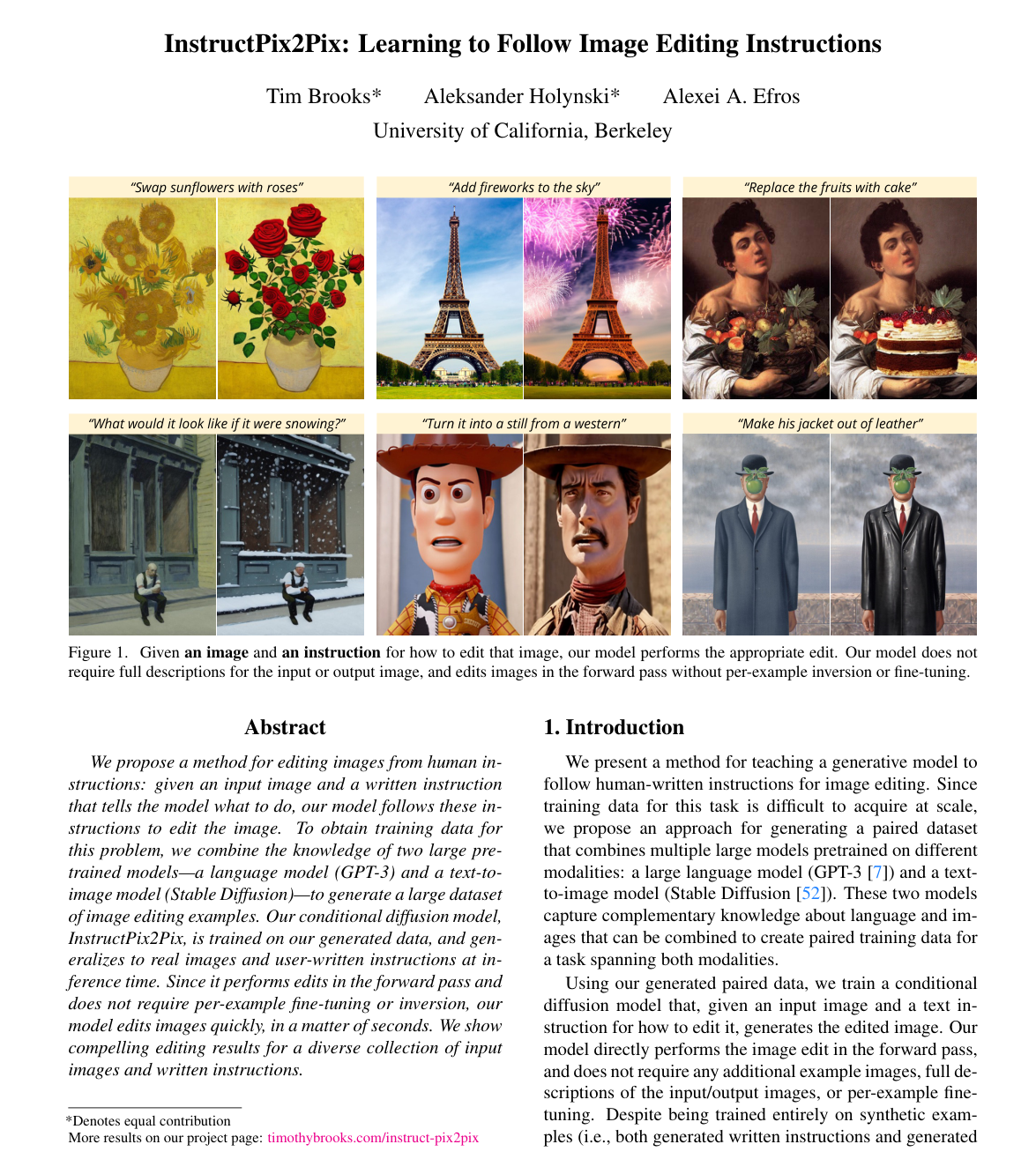
InstructPix2Pix: Learning to Follow Image Editing Instructions
Tim Brooks, Aleksander Holynski, Alexei A. Efros
Why you should read this
Introduces a conditional diffusion model that follows natural language image editing instructions in a single forward pass, enabled by an automated data generation pipeline combining GPT-3 and Stable Diffusion without requiring per-image inversion.
We propose a method for editing images from human instructions: given an input image and a written instruction that tells the model what to do, our model follows these instructions to edit the image. To obtain training data for this problem, we combine the knowledge of two large pretrained models -- a language model (GPT-3) and a text-to-image model (Stable Diffusion) -- to generate a large dataset of image editing examples. Our conditional diffusion model, InstructPix2Pix, is trained on our generated data, and generalizes to real images and user-written instructions at inference time. Since it performs edits in the forward pass and does not require per example fine-tuning or inversion, our model edits images quickly, in a matter of seconds. We show compelling editing results for a diverse collection of input images and written instructions.
Added
2026-09-11
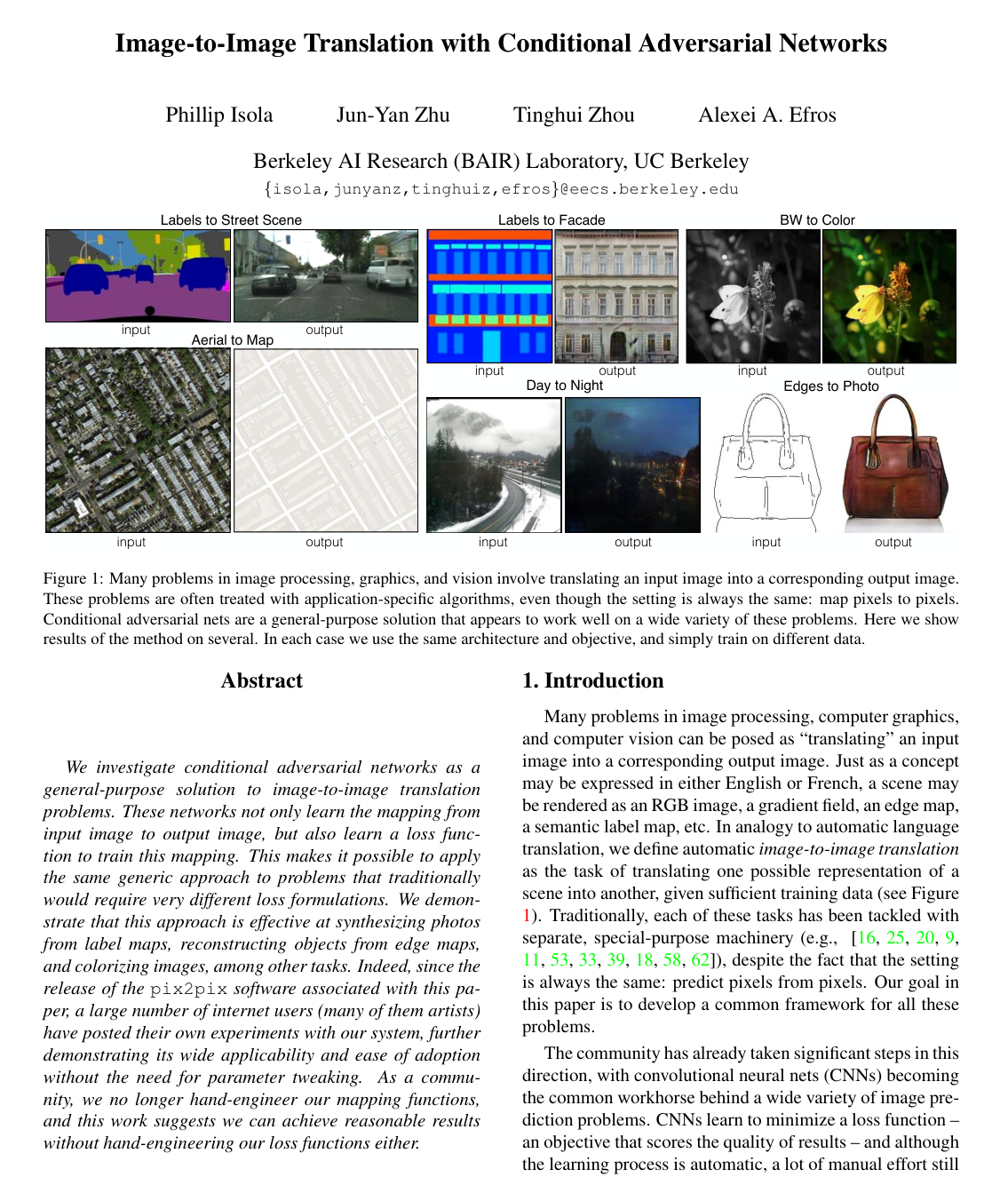
Image-to-Image Translation with Conditional Adversarial Networks
Phillip Isola, Jun-Yan Zhu, Tinghui Zhou, Alexei A. Efros
Why you should read this
Develops the "Pix2Pix" framework to perform paired image translation using a U-Net generator and PatchGAN discriminator.
We investigate conditional adversarial networks as a general-purpose solution to image-to-image translation problems. These networks not only learn the mapping from input image to output image, but also learn a loss function to train this mapping. This makes it possible to apply the same generic approach to problems that traditionally would require very different loss formulations. We demonstrate that this approach is effective at synthesizing photos from label maps, reconstructing objects from edge maps, and colorizing images, among other tasks. Indeed, since the release of the pix2pix software associated with this paper, a large number of internet users (many of them artists) have posted their own experiments with our system, further demonstrating its wide applicability and ease of adoption without the need for parameter tweaking. As a community, we no longer hand-engineer our mapping functions, and this work suggests we can achieve reasonable results without hand-engineering our loss functions either.
Added
2026-03-07