Picture that Sketch: Photorealistic Image Generation from Abstract Sketches
Subhadeep KoleyAyan Kumar BhuniaAneeshan SainPinaki Nath ChowdhuryTao XiangYi-Zhe Song
Proposes a decoupled sketch-to-photo generation framework that maps abstract, amateur free-hand sketches into a pre-trained StyleGAN latent space using an autoregressive mapper, producing photorealistic outputs without requiring precise edge alignments and improving fine-grained sketch-based image retrieval.
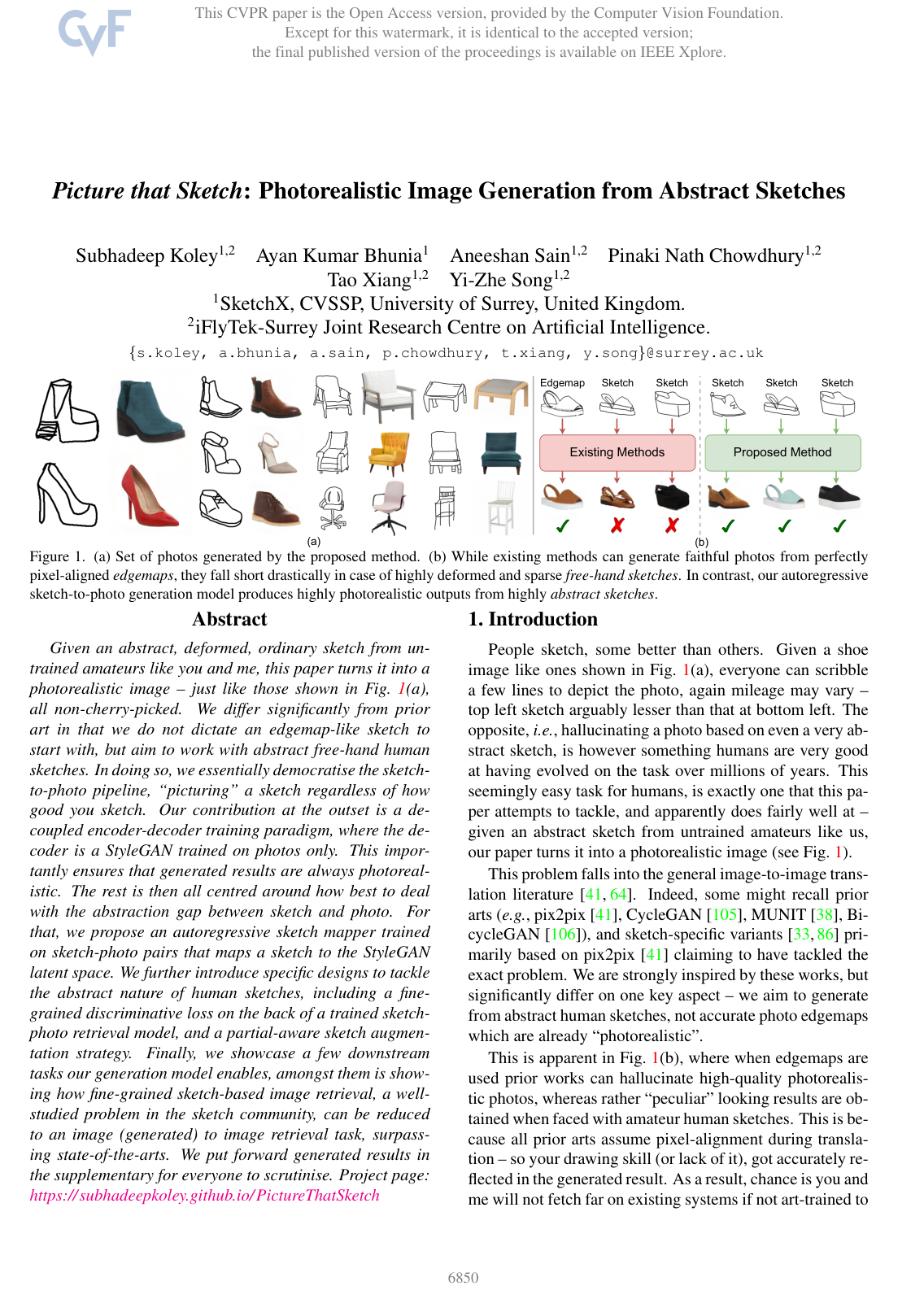
Generating realistic photographic images directly from free-hand human sketches is a long-standing challenge in digital media, e-commerce, and creative design. Most conventional image translation methods assume tight pixel-level alignment, relying on precise edge contours extracted from photos. Because drawings from non-artists are inherently sparse, distorted, and abstract, existing systems routinely output warped, unnatural images by treating crude sketch lines as literal photographic boundaries.
The article demonstrates a novel framework capable of converting highly abstract, amateur free-hand sketches into high-fidelity, photorealistic photos. It aims to eliminate geometric distortions and respect the user's intended subject without requiring formal drawing skills.
The researchers developed a decoupled two-stage architecture that breaks the traditional rigid link between input sketches and output images. First, a state-of-the-art generative image decoder is trained exclusively on unlabelled real photos, guaranteeing that any generated output adheres strictly to natural photographic structures. Second, the authors built an autoregressive sketch mapper that sequentially projects rough sketch strokes into the generator's latent control space. This mapper was trained on paired sketch-photo datasets across multiple categories (shoes, chairs, and handbags) using a combination of standard image reconstruction metrics, a distillation teacher network, and a fine-grained discriminative objective. The framework was evaluated across visual quality benchmarks, perceptual diversity scores, human preference studies involving 30 participants, and downstream visual search tests.
The experimental findings show clear quantitative and qualitative advantages over existing methods. On standard visual quality benchmarks, the model lowered the error metric significantly—achieving a score of 35.85 on shoes compared to 54.48 from the nearest competitor and over 65.00 for traditional translation methods—where lower numbers indicate superior photorealism. In human evaluation studies, the framework achieved an average rating of 4.24 to 4.69 out of 5, nearly double the 2.01 to 2.94 range scored by baseline approaches. In retrieval applications, translating abstract sketches into photos improved fine-grained image search accuracy, achieving a top-1 accuracy of 44.1% on shoe benchmarks compared to 39.1% for the previous best baseline. The system also demonstrated notable robustness, maintaining stable image quality even when tested on incomplete sketches or drawings corrupted by up to 80% synthetic stroke noise.
These results show that decoupling photo synthesis from sketch interpretation effectively overcomes the abstraction gap that has historically limited sketch-based computer vision tools. The system allows users to intuitively control image detail or introduce controlled visual variations simply by adjusting the number of prediction steps. Furthermore, reducing complex cross-domain search into straightforward photo-to-photo matching streamlines workflows in visual search and interactive design.
Organizations developing creative software, e-commerce search tools, or digital design interfaces should consider implementing decoupled generative pipelines to support non-expert sketch input. Next development steps should include piloting the system in interactive search and fine-grained product editing applications. Stakeholders must note that the evaluated model currently operates on specific object categories with fixed-resolution outputs (256x256 pixels) and relies on pre-existing single-category photo datasets. Consequently, further validation is recommended before deploying the method across complex multi-object scenes or unrestrained open-domain categories.
- Paper: A Style-Based Generator Architecture for Generative Adversarial Networks, Tero Karras et al. (2019). Introduces the StyleGAN architecture and its intermediate style latent space, which serves as the foundational photo-only decoder used by the source paper to ensure photorealism.
- Paper: Analyzing and Improving the Image Quality of StyleGAN, Tero Karras et al. (2020). Refines StyleGAN's latent space properties and generator design, directly underpinning the decoupled generative decoder leveraged in the source framework.
- Paper: StyleCLIP: Text-Driven Manipulation of StyleGAN Imagery, Or Patashnik et al. (2021). Demonstrates how to manipulate and map cross-modal inputs into StyleGAN's latent space using specialized mapping networks, conceptually informing the source paper's sketch mapper.
- Paper: Image-to-Image Translation with Conditional Adversarial Networks, Phillip Isola et al. (2017). Establishes the paired conditional image-to-image translation paradigm (Pix2Pix) that the source paper seeks to generalize beyond rigid, edge-aligned sketches to abstract free-hand drawings.
- Paper: Toward Multimodal Image-to-Image Translation, Jun-Yan Zhu et al. (2017). Explores multimodal image-to-image translation and latent mapping from edge drawings to photos, providing essential background on managing the ambiguity inherent in sketch-to-photo synthesis.
- Paper: Generative Visual Manipulation on the Natural Image Manifold, Jun-Yan Zhu et al. (2016). Pioneers the concept of constraining rough user sketches and edits to a learned natural image generative manifold, a core idea scaled up by the source paper.
- Paper: Sketch-based manga retrieval using manga109 dataset, Yusuke Matsui et al. (2015). Provides foundational concepts in sketch-based visual retrieval, which the source paper directly addresses and reframes through generative photo synthesis.
- Paper: Adding Conditional Control to Text-to-Image Diffusion Models, Lvmin Zhang et al. (2023). Presents ControlNet, offering a contemporary diffusion-based alternative for adding spatial conditionings like user sketches directly to pretrained diffusion models.
- Paper: BBDM: Image-to-Image Translation with Brownian Bridge Diffusion Models, Bo Li et al. (2023). Extends domain translation from sketches to photos using Brownian Bridge diffusion models, advancing alternative generative mechanisms beyond GAN latent mapping.
- Paper: MiniGPT-4: Enhancing Vision-Language Understanding with Advanced Large Language Models, Deyao Zhu et al. (2024). Applies multimodal understanding to interpret and generate functional downstream outputs directly from hand-drawn abstract sketches using large language models.
- Paper: PaperBanana: Automating Academic Illustration for AI Scientists, Dawei Zhu et al. (2026). Builds upon multi-agent generative workflows to translate conceptual and abstract visual drafts into fully realized academic diagrams.