StyleCLIP: Text-Driven Manipulation of StyleGAN Imagery
Or PatashnikZongze WuEli ShechtmanDaniel Cohen-OrDani Lischinski
Proposes three complementary techniques that combine CLIP with StyleGAN latent representations, enabling intuitive, text-guided image manipulation without requiring manual latent space exploration or labeled datasets.
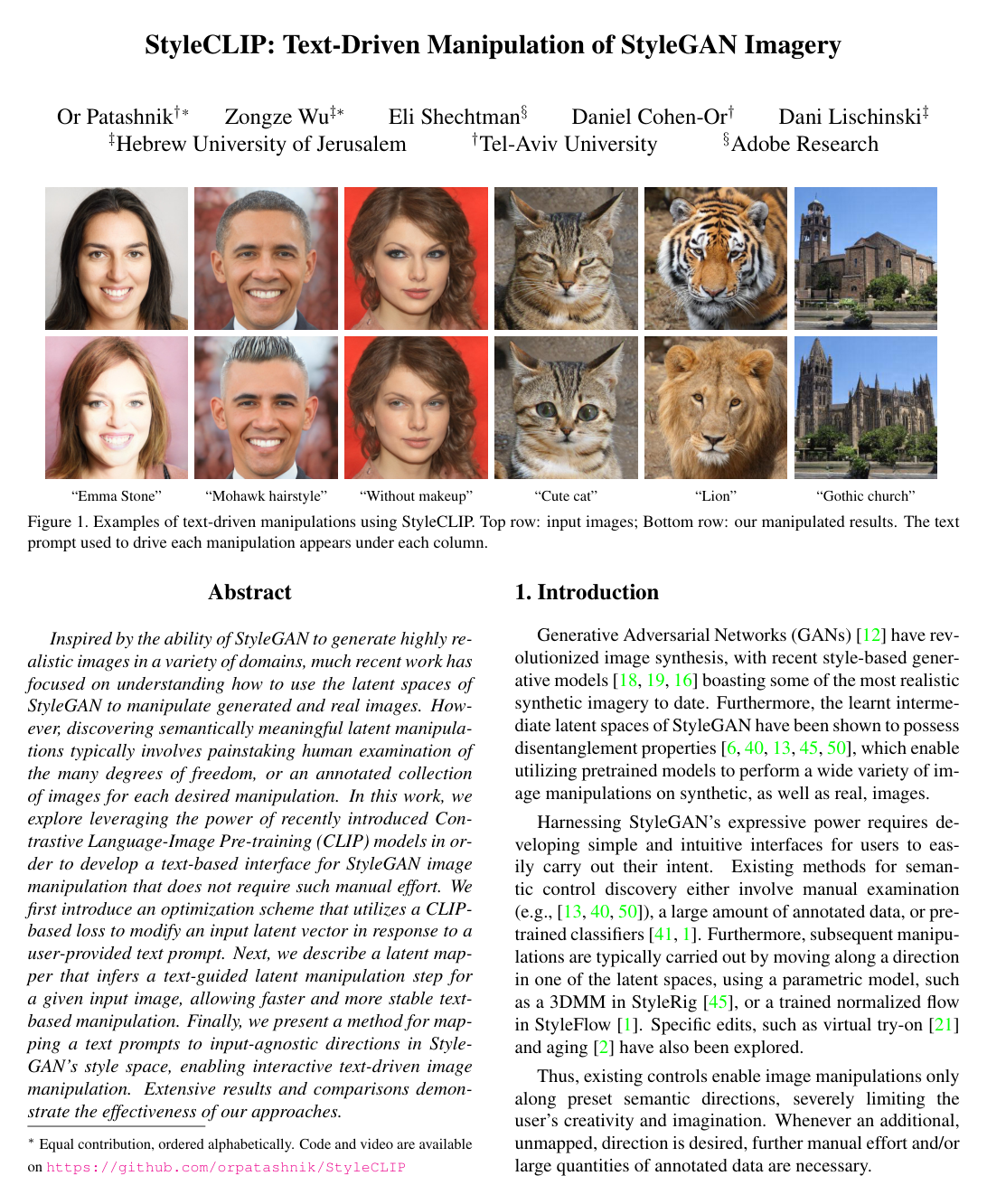
Generative computer vision models produce highly realistic synthetic images, but controlling and modifying specific visual features remains difficult. Traditional editing techniques require labor-intensive manual tuning, specialized training classifiers, or large collections of manually labeled datasets for every individual attribute change. The article evaluates and demonstrates StyleCLIP, a new framework that combines pretrained image generation systems (StyleGAN) with large-scale vision-language models (CLIP) to enable intuitive, semantic image manipulation directly from natural language text prompts without manual annotation.
The researchers developed and compared three non-technical approaches to bridge text and visual generation: direct latent optimization, trained local latent mappers, and global style space directions. Latent optimization directly updates an individual image's representation through iterative gradient descent guided by a text-image alignment score. The local mapper trains a small network for a specific text prompt to predict instantaneous modifications for any given input image. The global directions approach maps a text description into a single, input-agnostic trajectory within the generator's native style space, allowing users to interactively adjust manipulation strength and attribute isolation.
The findings establish that combining text-image models with generative architectures provides flexible, high-fidelity visual control across multiple domains, including human faces, animals, cars, and architecture. First, the global direction technique achieves real-time inference (about 72 milliseconds per edit) and provides granular control over disentanglement, modifying targeted features like gray hair or gender without unintentionally altering unrelated attributes like skin tone or lighting. Second, the local latent mapper excels at complex, identity-dependent transformations (such as altering a portrait toward a specific public figure) in roughly 75 milliseconds per image after a one-time training run of 10 to 12 hours. Third, both mapping approaches outperform concurrent text-driven baseline methods, producing results that match or exceed the visual quality of heavily supervised systems without requiring pre-trained facial classifiers or manual labels.
These results demonstrate that organizations and creative practitioners can eliminate the high costs, timelines, and rigid constraints associated with building custom image classifiers and labeled training sets for digital editing workflows. Text-driven generative editing reduces computational bottlenecks and infrastructure costs, enabling interactive, real-time image manipulation even on a single standard consumer graphics card.
For technical deployment, teams should choose between the global directions method for general, disentangled edits and the local mapper architecture when target transformations require specific identities or complex visual combinations. Future development should focus on testing automated prompt formulation and expanding generative coverage to broader, multi-category domains.
The framework's performance remains constrained by the coverage of the underlying pretrained models; edits that require visual concepts or extreme structural deformations outside the generator's training distribution (such as converting a feline into a canine) remain difficult to execute reliably. Overall confidence in the core findings is strong, supported by consistent quantitative similarity evaluations and visual comparisons across multiple benchmarks.
- Paper: Learning Transferable Visual Models From Natural Language Supervision, Alec Radford et al.. Introduces the Contrastive Language-Image Pre-training (CLIP) foundation model, whose shared multimodal latent space and vision-language guidance loss are the central driving mechanisms of StyleCLIP.
- Paper: A Style-Based Generator Architecture for Generative Adversarial Networks, Tero Karras et al. (2019). Presents the StyleGAN architecture and its intermediate disentangled latent spaces, which form the core generative representations manipulated by StyleCLIP.
- Paper: Analyzing and Improving the Image Quality of StyleGAN, Tero Karras et al. (2020). Refines the StyleGAN generator architecture with weight demodulation and perceptual path regularization, establishing the standard StyleGAN2 backbone used directly in StyleCLIP.
- Paper: Conditional Generative Adversarial Nets, Mehdi Mirza et al. (2014). Establishes the fundamental formulation of conditional generative adversarial networks that underpins controllable synthesis in generative vision models.
- Paper: Prompt-to-Prompt Image Editing with Cross Attention Control, Amir Hertz et al. (2022). Extends text-driven semantic manipulation from GAN latent spaces to diffusion models by controlling internal cross-attention maps for localized and layout-preserving image edits.
- Paper: InstructPix2Pix: Learning to Follow Image Editing Instructions, Tim Brooks et al. (2023). Builds on text-guided image editing paradigms by training conditional diffusion models directly on instruction-following datasets to perform complex edits without per-image optimization.
- Paper: Imagic: Text-Based Real Image Editing with Diffusion Models, Bahjat Kawar et al. (2022). Applies text-driven optimization concepts to real photographs within diffusion architectures, executing non-rigid semantic manipulations using target text prompts.
- Paper: An Image is Worth One Word: Personalizing Text-to-Image Generation using Textual Inversion, Rinon Gal et al. (2022). Inverts the text-to-image pipeline by optimizing personalized pseudo-word embeddings in text space to guide generative models to reproduce specific concepts and styles.
- Paper: Instruct-NeRF2NeRF: Editing 3D Scenes with Instructions, Ayaan Haque et al. (2023). Propagates text-instructed visual editing principles from 2D generative spaces into consistent 3D Neural Radiance Fields.
- Paper: DreamFusion: Text-to-3D using 2D Diffusion, Ben Poole et al. (2023). Generalizes 2D text-guided generative optimization to 3D synthesis by optimizing NeRF representations using score distillation from pretrained vision-language generative models.
- Paper: Adding Conditional Control to Text-to-Image Diffusion Models, Lvmin Zhang et al. (2023). Augments text-conditioned generation with explicit spatial controls like edge maps and poses, solving structural precision limits present in purely text-guided editing.
- Paper: Hierarchical Text-Conditional Image Generation with CLIP Latents, Aditya Ramesh et al. (2022). Leverages CLIP latents within a hierarchical diffusion pipeline (unCLIP) to achieve high-diversity text-conditional image generation and manipulation.