
topic
inverse methods (inverse method)
Inverse methods are computational and mathematical techniques used to infer unknown system parameters, hidden internal structures, or causal inputs from observed effects and measurement data. Operating in the reverse direction of forward models that simulate or predict outputs from known conditions, an inverse method reconstructs the underlying properties of a system when only its responses can be directly measured. Because such estimation tasks frequently involve ill-posed conditions where solutions are non-unique or highly sensitive to measurement noise, inverse methods often employ regularization techniques, numerical optimization algorithms, and Bayesian inference to find stable and physically meaningful solutions. They play a fundamental role across numerous computational domains, including medical tomography, computer vision, geophysical modeling, non-destructive testing, and scientific simulation.
2 items
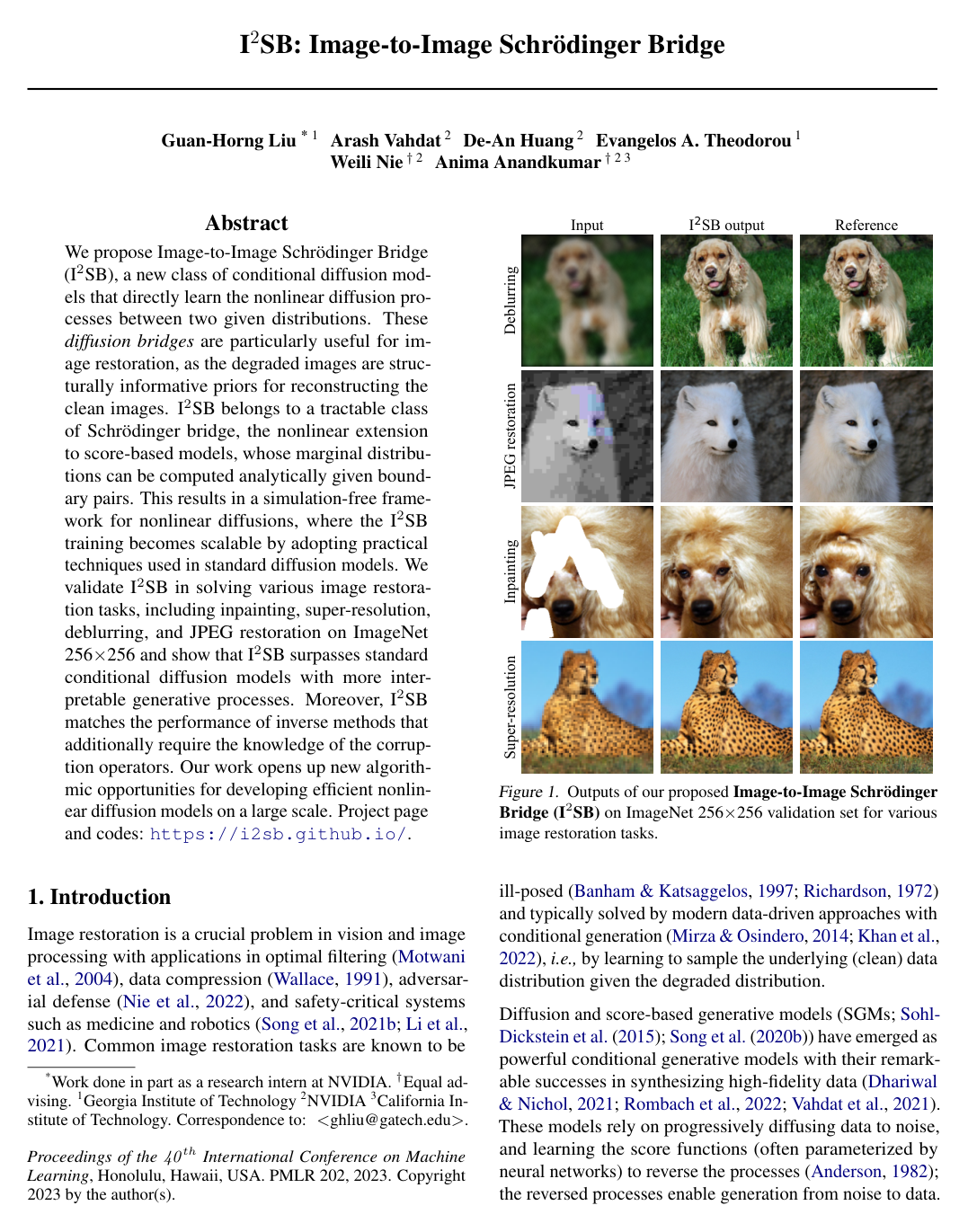
I2SB: Image-to-Image Schrödinger Bridge
Guan-Horng Liu, Arash Vahdat, De-An Huang, Evangelos A. Theodorou, Weili Nie, Anima Anandkumar
Why you should read this
Develops Image-to-Image Schrödinger Bridge (ISB), a simulation-free conditional diffusion framework that directly maps degraded to clean image distributions, outperforming standard diffusion models across restoration tasks without requiring prior knowledge of corruption operators.
We propose Image-to-Image Schrödinger Bridge (ISB), a new class of conditional diffusion models that directly learn the nonlinear diffusion processes between two given distributions. These diffusion bridges are particularly useful for image restoration, as the degraded images are structurally informative priors for reconstructing the clean images. ISB belongs to a tractable class of Schrödinger bridge, the nonlinear extension to score-based models, whose marginal distributions can be computed analytically given boundary pairs. This results in a simulation-free framework for nonlinear diffusions, where the ISB training becomes scalable by adopting practical techniques used in standard diffusion models. We validate ISB in solving various image restoration tasks, including inpainting, super-resolution, deblurring, and JPEG restoration on ImageNet 256x256 and show that ISB surpasses standard conditional diffusion models with more interpretable generative processes. Moreover, ISB matches the performance of inverse methods that additionally require the knowledge of the corruption operators. Our work opens up new algorithmic opportunities for developing efficient nonlinear diffusion models on a large scale. scale. Project page and codes: this https URL
Added
2026-09-28
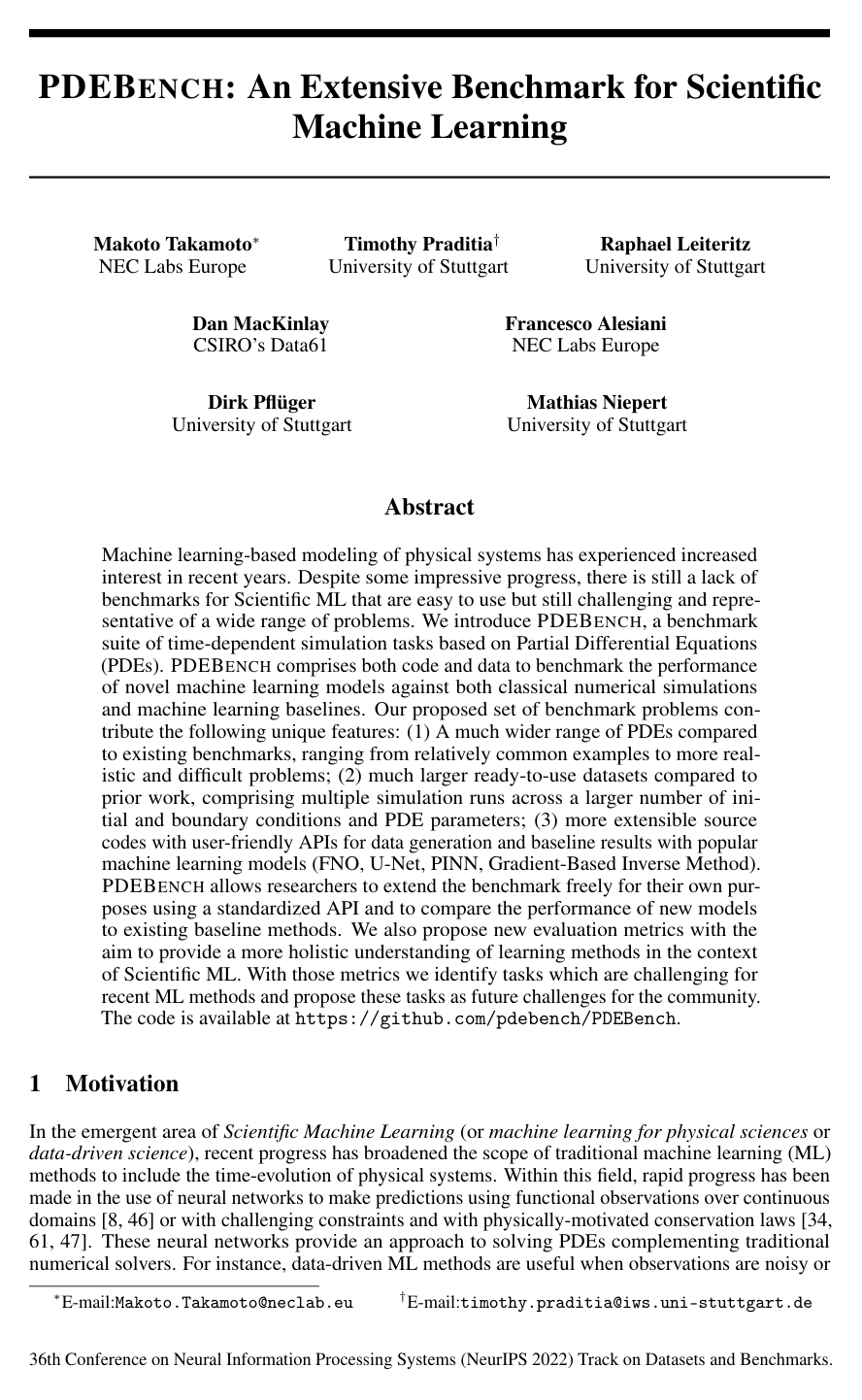
PDEBench: An Extensive Benchmark for Scientific Machine Learning
Makoto Takamoto, Timothy Praditia, Raphael Leiteritz, Daniel MacKinlay, Francesco Alesiani, Dirk Pflüger, Mathias Niepert
Why you should read this
Presents PDEBench, an extensive benchmark suite featuring diverse time-dependent physical simulations, large ready-to-use datasets, and standardized baselines to systematically evaluate and compare scientific machine learning models against classical numerical methods.
Machine learning-based modeling of physical systems has experienced increased interest in recent years. Despite some impressive progress, there is still a lack of benchmarks for Scientific ML that are easy to use but still challenging and representative of a wide range of problems. We introduce PDEBench, a benchmark suite of time-dependent simulation tasks based on Partial Differential Equations (PDEs). PDEBench comprises both code and data to benchmark the performance of novel machine learning models against both classical numerical simulations and machine learning baselines. Our proposed set of benchmark problems contribute the following unique features: (1) A much wider range of PDEs compared to existing benchmarks, ranging from relatively common examples to more realistic and difficult problems; (2) much larger ready-to-use datasets compared to prior work, comprising multiple simulation runs across a larger number of initial and boundary conditions and PDE parameters; (3) more extensible source codes with user-friendly APIs for data generation and baseline results with popular machine learning models (FNO, U-Net, PINN, Gradient-Based Inverse Method). PDEBench allows researchers to extend the benchmark freely for their own purposes using a standardized API and to compare the performance of new models to existing baseline methods. We also propose new evaluation metrics with the aim to provide a more holistic understanding of learning methods in the context of Scientific ML. With those metrics we identify tasks which are challenging for recent ML methods and propose these tasks as future challenges for the community. The code is available at this https URL.
Added
2026-09-26