Zero-Shot Image Restoration Using Denoising Diffusion Null-Space Model
Yinhuai WangJiwen YuJian Zhang
Introduces the Denoising Diffusion Null-Space Model (DDNM), a zero-shot framework that solves arbitrary linear image restoration tasks without retraining by refining only the null-space contents of pre-trained diffusion models during reverse sampling.
Real-world image restoration—such as repairing damaged photos, colorizing grayscale images, and enhancing low-resolution pictures—has traditionally required dedicated deep learning models trained separately for each specific task. These task-specific models demand vast amounts of paired training data, generalize poorly to unfamiliar image degradations, and often struggle to balance visual realness with strict consistency to the original degraded input. The article addresses these core challenges by proposing a flexible, unified restoration framework that operates without task-specific re-training.
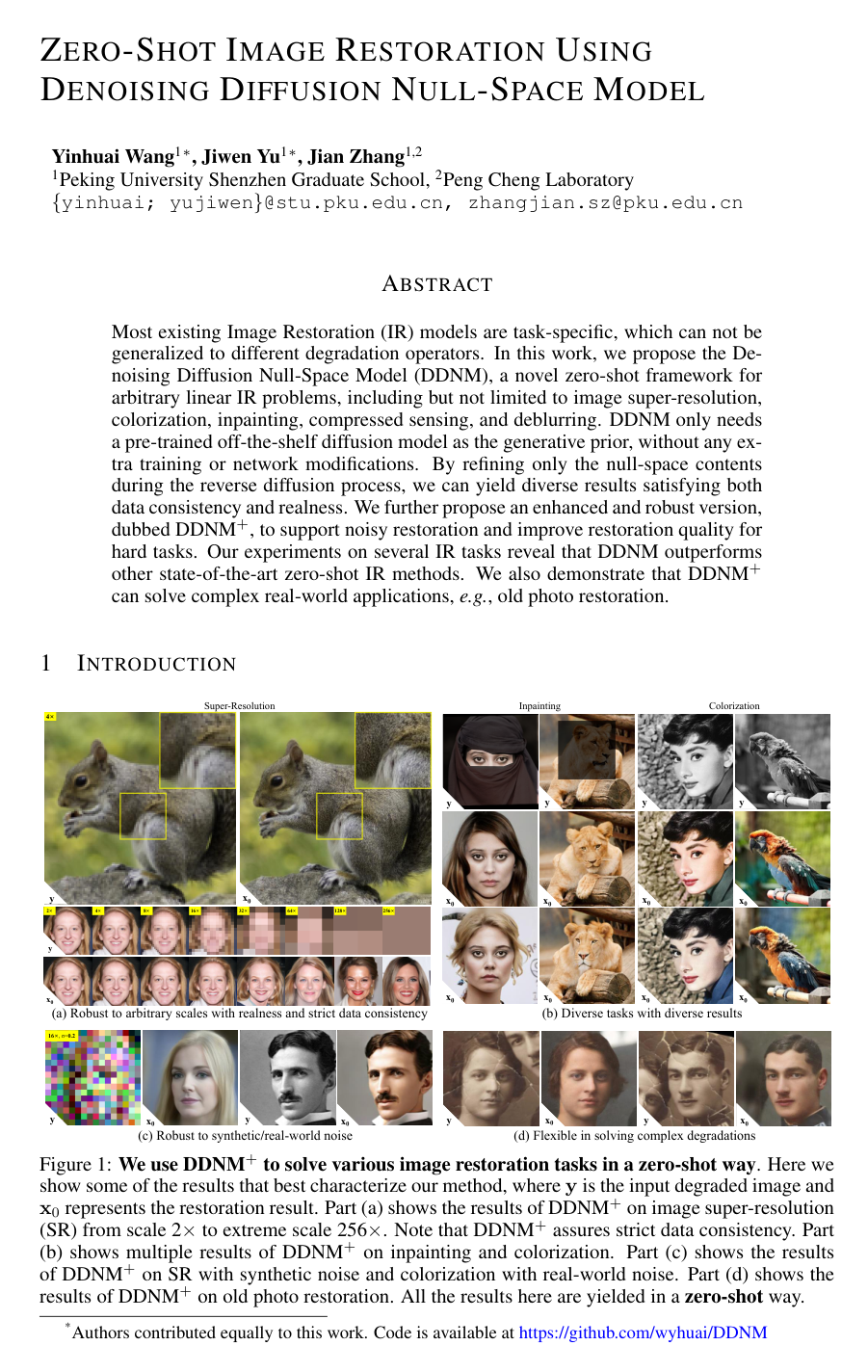
The article demonstrates the Denoising Diffusion Null-Space Model (DDNM) and its enhanced variant, DDNM+, as zero-shot image restoration methods. The main objective is to evaluate whether off-the-shelf, pre-trained generative diffusion models can solve arbitrary linear image restoration problems without any model fine-tuning, architectural modifications, or additional training data.
The evaluated approach uses range-null space decomposition to separate the restoration process mathematically into two independent components: the known data portion (range space) and the missing detail portion (null space). The framework analytically enforces strict fidelity to the input measurement in the range space while utilizing a standard pre-trained diffusion model solely to generate realistic missing details in the null space. The authors evaluated DDNM across diverse tasks—including super-resolution, deblurring, colorization, inpainting, and compressed sensing—using standard benchmark datasets (ImageNet and CelebA at 256x256 resolution) and compared the results against state-of-the-art zero-shot and supervised restoration techniques.
The key findings demonstrate that DDNM outperforms existing zero-shot baseline methods across multiple degradation types. By mathematically fixing the range-space component, DDNM achieved exact data consistency (reaching 0.0 consistency error in inpainting tasks) while generating higher visual quality and lower distortion scores across both CelebA and ImageNet benchmarks. Second, the enhanced DDNM+ framework successfully removed synthetic and real-world noise; in challenging tasks like 16x noisy super-resolution, DDNM+ improved peak signal-to-noise ratio from 13.10 dB to 19.44 dB and dramatically improved visual realness metrics over standard DDNM. Third, incorporating an iterative 'time-travel' sampling trick restored global coherence in extreme settings, such as 32x super-resolution and compressed sensing with only 10% sampling rates. Finally, DDNM maintained identical computational and memory footprints to base diffusion generation (requiring approximately 11.9 seconds per image on standard hardware), avoiding the heavy mathematical matrix operations required by alternative methods.
These findings imply significant practical value for digital image restoration pipelines. Organizations can eliminate the substantial development costs, timelines, and storage overhead associated with training and maintaining separate neural network models for distinct restoration tasks. A single pre-trained generative diffusion model can now be deployed across diverse restoration workflows, seamlessly handling complex compound degradations—such as old photo repair involving simultaneous inpainting, colorization, denoising, and upscaling.
Practitioners should implement DDNM+ when deploying zero-shot restoration pipelines, especially for workflows involving noisy inputs or compound linear degradations. Operators can construct basic linear degradation operators and their mathematical inverses directly by hand for standard tasks like pooling and masking. For wide-aspect or large-format image processing, teams should adopt the proposed mask-shift division technique to prevent visible boundary seams across image patches.
Users should note several limitations and operational constraints. The framework assumes linear or approximately linear degradation operators, meaning non-linear degradations require manual approximations. In addition, the system requires manual tuning of the input noise variance parameter to strike an optimal balance between aggressive noise cleaning and detail preservation. While confidence in the framework's mathematical consistency is high, processing speeds remain constrained by iterative diffusion sampling times, and final generation quality remains strictly bounded by the underlying capacity of the pre-trained diffusion model used.
- Paper: Denoising Diffusion Restoration Models, Bahjat Kawar et al. (2022). Introduces Denoising Diffusion Restoration Models (DDRM) for solving linear inverse restoration problems using pre-trained diffusion priors in spectral space, establishing a direct foundation for DDNM's null-space decomposition approach.
- Paper: Diffusion Posterior Sampling for General Noisy Inverse Problems, Hyungjin Chung et al. (2022). Presents Diffusion Posterior Sampling using Tweedie's formula to solve general noisy inverse problems with pre-trained diffusion models, motivating DDNM's data-consistency and noise handling strategies.
- Paper: RePaint: Inpainting using Denoising Diffusion Probabilistic Models, Andreas Lugmayr et al. (2022). Demonstrates zero-shot image inpainting by conditioning unconditional diffusion models through range-space data replacement during sampling, which DDNM formalizes and generalizes into arbitrary linear operators.
- Paper: Denoising Diffusion Probabilistic Models, Jonathan Ho et al. (2020). Establishes the foundational Denoising Diffusion Probabilistic Model (DDPM) training and reverse sampling framework upon which zero-shot diffusion inverse problem solvers rely.
- Paper: Denoising Diffusion Implicit Models, Jiaming Song et al. (2021). Formulates non-Markovian deterministic sampling (DDIM) that underpins the accelerated reverse diffusion trajectory used for zero-shot image restoration in DDNM.
- Paper: Learning Deep CNN Denoiser Prior for Image Restoration, Kai Zhang et al. (2017). Provides the foundational plug-and-play restoration paradigm where a pre-trained deep denoiser acts as a modular prior for general inverse problems.
- Paper: DPM-Solver: A Fast ODE Solver for Diffusion Probabilistic Model Sampling in Around 10 Steps, Cheng Lu et al. (2022). Develops fast ordinary differential equation solvers for diffusion sampling, providing crucial mathematical insights into exact diffusion trajectories utilized in advanced sampling methods.
- Paper: Elucidating the Design Space of Diffusion-Based Generative Models, Tero Karras et al. (2022). Elucidates the design space and preconditioning of diffusion-based generative models, offering essential theoretical principles for reverse diffusion dynamics.
No sufficiently relevant recommendations were found.