ACPL: Anti-curriculum Pseudo-labelling for Semi-supervised Medical Image Classification

Fengbei LiuYu TianYuanhong ChenYuyuan LiuVasileios BelagiannisGustavo Carneiro

article2022CVPR112 citations

Proposes an anti-curriculum pseudo-labelling framework that prioritizes informative unlabeled samples and ensembles neural network predictions with nearest-neighbor classifiers to outperform state-of-the-art semi-supervised methods on class-imbalanced multi-label and multi-class medical diagnosis tasks.

Listen

Medical image analysis using deep learning often struggles with severe data constraints: while massive collections of unlabelled medical scans exist, obtaining high-quality expert annotations is costly, time-consuming, and scarce. Furthermore, clinical diagnostic tasks frequently involve multi-class or multi-label conditions alongside extreme class imbalances, where normal cases dominate and critical diseases represent only a small fraction of the data. Existing semi-supervised learning techniques that assign artificial labels to unlabelled samples typically select only high-confidence predictions. This practice reinforces majority-class bias, risks compounding classification errors, and struggles to generalise across both single- and multi-disease diagnostic settings.

The article introduces and evaluates anti-curriculum pseudo-labelling (ACPL), a semi-supervised learning method designed to handle imbalanced multi-class and multi-label medical image classification. The core objective is to demonstrate that selecting highly informative, low-density unlabelled samples—contrasting with standard easy-first curriculum learning—mitigates class imbalance and, when paired with an ensemble pseudo-labelling mechanism, improves overall diagnostic accuracy without relying on complex, task-specific data perturbations or computationally expensive self-supervised pre-training.

The approach was evaluated on two widely recognised public benchmarks: the multi-label Chest X-Ray14 dataset containing 112,120 chest radiographs across 14 disease classes, and the multi-class ISIC2018 dataset comprising 10,015 skin lesion images across seven conditions. The authors implemented a standard DenseNet-121 architecture and systematically compared ACPL against established consistency-based, pseudo-labelling, and self-supervised benchmarks across varying proportions of labelled training data ranging from 2% to 20%.

The findings confirm clear performance advantages across both diagnostic tasks. On the Chest X-Ray14 benchmark, ACPL achieved the top area under the ROC curve (AUC) across all evaluated labelled data splits, reaching an AUC of 74.82% with only 2% labelled data and 81.77% with 20% labelled data. This performance outperformed prior pseudo-labelling techniques by 3% to 20% and exceeded top consistency-based and self-supervised models. Class-level analysis on chest radiographs demonstrated superior accuracy in 10 of the 14 disease categories. On the ISIC2018 skin lesion dataset with 20% labelled data, the method set new top benchmarks with an AUC of 94.36%, sensitivity of 72.14%, and an F1 score of 62.23%, improving AUC by up to 3% over consistency methods and markedly outperforming standard self-training. Detailed component testing showed that prioritizing high-information samples raised the representation of rare minority diseases from under 10% to nearly 30% during training, directly resolving class imbalance while maintaining low variance across runs.

These results have significant operational and financial implications for deploying artificial intelligence in clinical environments. By achieving superior classification accuracy from minimal annotated data, healthcare organisations can cut data curation costs and accelerate model deployment timelines. Because ACPL relies on a standard pre-trained foundation rather than complex self-supervised pre-training, it lowers computational overhead while mitigating confirmation bias through an ensemble classifier combining deep network outputs with nearest-neighbour predictions.

Based on these findings, technical teams should consider adopting informative sample selection and ensemble-guided pseudo-labelling when training diagnostic models on imbalanced medical datasets. For organisations with limited labelling budgets, applying this method allows rapid bootstrapping of diagnostic classifiers using standard off-the-shelf architectures. Further validation should include piloting the algorithm on broader clinical imaging modalities and general computer vision tasks.

A primary limitation of this work is its assumption that unlabelled data originates entirely from within the same distribution as the labelled set. The authors note that model behaviour in the presence of out-of-distribution or corrupted clinical inputs remains untested. While confidence in the benchmarked performance is high, practitioners should exercise caution and conduct local validation before applying the method to operational clinical workflows containing out-of-distribution anomalies.

Cover for ACPL: Anti-curriculum Pseudo-labelling for Semi-supervised Medical Image Classification

Abstract

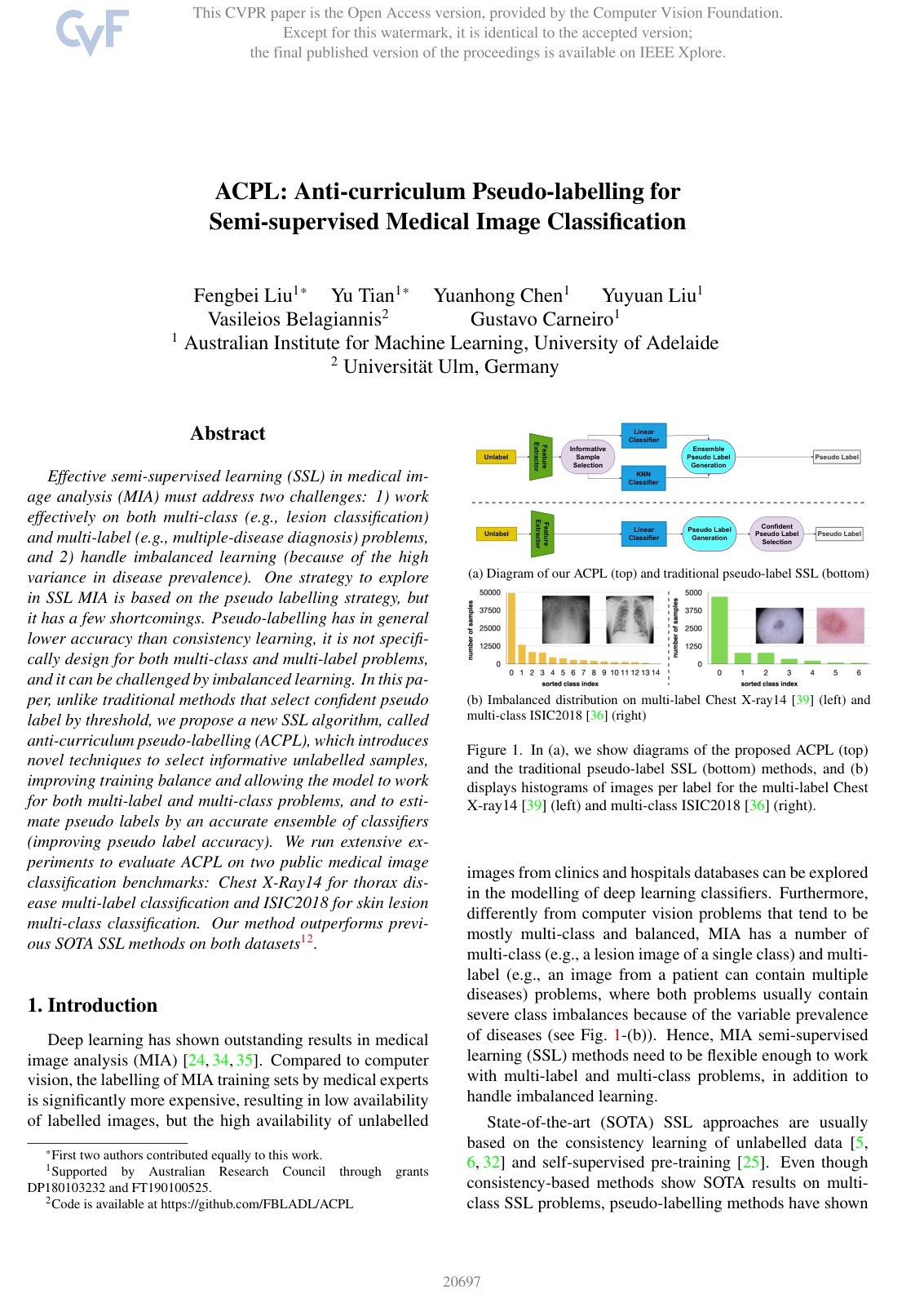
Effective semi-supervised learning (SSL) in medical image analysis (MIA) must address two challenges: 1) work effectively on both multi-class (e.g., lesion classification) and multi-label (e.g., multiple-disease diagnosis) problems, and 2) handle imbalanced learning (because of the high variance in disease prevalence). One strategy to explore in SSL MIA is based on the pseudo labelling strategy, but it has a few shortcomings. Pseudo-labelling has in general lower accuracy than consistency learning, it is not specifically design for both multi-class and multi-label problems, and it can be challenged by imbalanced learning. In this paper, unlike traditional methods that select confident pseudo label by threshold, we propose a new SSL algorithm, called anti-curriculum pseudo-labelling (ACPL), which introduces novel techniques to select informative unlabelled samples, improving training balance and allowing the model to work for both multi-label and multi-class problems, and to estimate pseudo labels by an accurate ensemble of classifiers (improving pseudo label accuracy). We run extensive experiments to evaluate ACPL on two public medical image classification benchmarks: Chest X-Ray14 for thorax disease multi-label classification and ISIC2018 for skin lesion multi-class classification. Our method outperforms previous SOTA SSL methods on both datasets.

Table of Contents

  • 1. Introduction
  • 2. Related Work
  • 3. Methods
  • 3.1. ACPL Optimisation
  • 3.2. Cross Distribution Sample Informativeness (CDSI)
  • 3.3. Informative Mixup (IM)
  • 3.4. Anchor Set Purification (ASP)
  • 4. Experiments
  • 4.1. Implementation Details
  • 4.2. Thorax Disease Classification Result
  • 4.3. Skin Lesion Classification Result
  • 4.4. Ablation Study
  • 5. Discussion and Conclusion
  • References

Knowls

  1. Knowl 1 — Anti-curriculum pseudo-labelling for imbalanced medical image classification

    model/method

    Anti-curriculum pseudo-labelling (ACPL) is a semi-supervised learning method designed for both multi-class and multi-label medical image classification with imbalanced classes. Instead of selecting unlabelled images solely by prediction confidence, ACPL first selects images with high cross-distribution sample informativeness (CDSI), which preferentially exposes informative and often minority-class samples. It then assigns pseudo-labels with informative mixup (IM), combining a deep classifier and a K-nearest-neighbor classifier, and maintains a compact anchor set with anchor set purification (ASP). The resulting anti-curriculum schedule pseudo-labels informative samples before less informative ones, while avoiding a separately estimated class-wise confidence threshold.

  2. Knowl 2 — Semi-supervised problem formulation and in-distribution assumption

    assumption

    ACPL uses a small labelled set DL={(xi,yi)}i=1∣DL∣\mathcal{D}_L=\{(\mathbf{x}_i,\mathbf{y}_i)\}_{i=1}^{|\mathcal{D}_L|} and a much larger unlabelled set DU={xi}i=1∣DU∣\mathcal{D}_U=\{\mathbf{x}_i\}_{i=1}^{|\mathcal{D}_U|}, with ∣DL∣≪∣DU∣|\mathcal{D}_L|\ll|\mathcal{D}_U|. Each image satisfies x∈X⊂RH×W×C\mathbf{x}\in\mathcal{X}\subset\mathbb{R}^{H\times W\times C}, where HH, WW, and CC are image height, width, and number of colour channels. Each label is y∈{0,1}∣Y∣\mathbf{y}\in\{0,1\}^{|\mathcal{Y}|}; it is one-hot for multi-class classification and binary-valued for multi-label classification. The classifier is pθ:X→[0,1]∣Y∣p_\theta:\mathcal{X}\to[0,1]^{|\mathcal{Y}|}, parameterized by θ\theta, and is written as pθ(x)=σ(fθ(x))p_\theta(\mathbf{x})=\sigma(f_\theta(\mathbf{x})), where fθ(x)∈RFf_\theta(\mathbf{x})\in\mathbb{R}^{F} is an FF-dimensional feature vector and σ\sigma is the final output activation. ACPL assumes that labelled and unlabelled images are drawn from the same latent in-distribution source.

  3. Knowl 3 — Cross-distribution sample informativeness

    model/method

    CDSI measures the informativeness of an unlabelled image by comparing its feature to an anchor set DA\mathcal{D}_A of labelled or purified pseudo-labelled samples. For an image x\mathbf{x}, let NK(fθ(x),DA)\mathcal{N}_K(f_\theta(\mathbf{x}),\mathcal{D}_A) be the KK nearest anchor samples in feature space, where an anchor is (xA,yA)(\mathbf{x}_A,\mathbf{y}_A). The density score is the mean cosine similarity to these neighbours:

    d(fθ(x),DA)=1K∑(xA,yA)∈NK(fθ(x),DA)fθ(x)⊤fθ(xA)∥fθ(x)∥2 ∥fθ(xA)∥2.d(f_\theta(\mathbf{x}),\mathcal{D}_A)=\frac{1}{K}\sum_{(\mathbf{x}_A,\mathbf{y}_A)\in\mathcal{N}_K(f_\theta(\mathbf{x}),\mathcal{D}_A)}\frac{f_\theta(\mathbf{x})^\top f_\theta(\mathbf{x}_A)}{\|f_\theta(\mathbf{x})\|_2\,\|f_\theta(\mathbf{x}_A)\|_2}.

    A three-component Gaussian mixture model (GMM) is fitted to these scalar scores, with information component ζ∈{low,medium,high}\zeta\in\{\mathrm{low},\mathrm{medium},\mathrm{high}\}. Its parameters are γ={(μζ,Σζ,πζ)}ζ\gamma=\{(\mu_\zeta,\Sigma_\zeta,\pi_\zeta)\}_{\zeta}, where μζ\mu_\zeta and Σζ\Sigma_\zeta are the mean and covariance of component ζ\zeta, and πζ\pi_\zeta is its mixture weight. The GMM parameters are estimated by expectation-maximization after each anchor-set update. An unlabelled sample is selected when the posterior probability of the high-information component exceeds both alternatives:

    h(fθ(x),DA)={1,pγ(ζ=high∣x,DA)>τ,0,otherwise,τ=max⁡{pγ(ζ=low∣x,DA),pγ(ζ=medium∣x,DA)}.h(f_\theta(\mathbf{x}),\mathcal{D}_A)=\begin{cases}1,&p_\gamma(\zeta=\mathrm{high}\mid\mathbf{x},\mathcal{D}_A)>\tau,\\0,&\mathrm{otherwise},\end{cases}\qquad \tau=\max\{p_\gamma(\zeta=\mathrm{low}\mid\mathbf{x},\mathcal{D}_A),p_\gamma(\zeta=\mathrm{medium}\mid\mathbf{x},\mathcal{D}_A)\}.

    Thus, selection is based on a learned cross-distribution score rather than a fixed classification-confidence threshold.

  4. Knowl 4 — Informative mixup pseudo-label generation

    model/method

    For an informative unlabelled image x\mathbf{x}, informative mixup (IM) combines the deep classifier prediction with a KNN prediction from the anchor set. With pθ(x)∈[0,1]∣Y∣p_\theta(\mathbf{x})\in[0,1]^{|\mathcal{Y}|} as the deep classifier output, the two candidate pseudo-labels are

    y~model(x)=pθ(x),y~KNN(x)=1K∑(xA,yA)∈NK(fθ(x),DA)yA.\widetilde{\mathbf{y}}_{\mathrm{model}}(\mathbf{x})=p_\theta(\mathbf{x}),\qquad \widetilde{\mathbf{y}}_{\mathrm{KNN}}(\mathbf{x})=\frac{1}{K}\sum_{(\mathbf{x}_A,\mathbf{y}_A)\in\mathcal{N}_K(f_\theta(\mathbf{x}),\mathcal{D}_A)}\mathbf{y}_A.

    Using the density score d(fθ(x),DA)d(f_\theta(\mathbf{x}),\mathcal{D}_A) defined as the mean cosine similarity between the image feature and its KK nearest anchor features, IM produces

    y~=g(fθ(x),DA)=d(fθ(x),DA)y~model(x)+(1−d(fθ(x),DA))y~KNN(x).\widetilde{\mathbf{y}}=g(f_\theta(\mathbf{x}),\mathcal{D}_A)=d(f_\theta(\mathbf{x}),\mathcal{D}_A)\widetilde{\mathbf{y}}_{\mathrm{model}}(\mathbf{x})+\bigl(1-d(f_\theta(\mathbf{x}),\mathcal{D}_A)\bigr)\widetilde{\mathbf{y}}_{\mathrm{KNN}}(\mathbf{x}).

    The method therefore uses an image-dependent weight rather than a random mixing coefficient. It is intended to reduce confirmation bias from relying only on the deep model and the inaccuracy of relying only on KNN, while allowing the deep prediction to receive greater weight in dense, reliable regions.

  5. Knowl 5 — Anchor set purification

    algorithm

    Anchor set purification (ASP) keeps the anchor set compact and informative by inserting only the least-connected informative pseudo-labelled samples. For each candidate pseudo-labelled image x∈DS\mathbf{x}\in\mathcal{D}_S, first find its KK nearest anchors. For each of those KK anchors, find its KK nearest neighbours in the current unlabelled set DU\mathcal{D}_U. Define c(fθ(x),DU,DA)c(f_\theta(\mathbf{x}),\mathcal{D}_U,\mathcal{D}_A) as the number of times candidate x\mathbf{x} occurs in these resulting KNN lists. Set α\alpha to the smallest such count among all candidates in DS\mathcal{D}_S:

    α=min⁡x∈DSc(fθ(x),DU,DA).\alpha=\min_{\mathbf{x}\in\mathcal{D}_S}c(f_\theta(\mathbf{x}),\mathcal{D}_U,\mathcal{D}_A).

    The candidate is inserted into the anchor set only if

    a(fθ(x),DU,DA)={1,c(fθ(x),DU,DA)≤α,0,otherwise.a(f_\theta(\mathbf{x}),\mathcal{D}_U,\mathcal{D}_A)=\begin{cases}1,&c(f_\theta(\mathbf{x}),\mathcal{D}_U,\mathcal{D}_A)\leq\alpha,\\0,&\mathrm{otherwise}. \end{cases}

    This bidirectional connectivity test prevents the anchor set from growing with every pseudo-labelled sample and is intended to preserve a more representative density estimate for later KNN predictions.

  6. Knowl 6 — ACPL optimization objective

    equation

    After pseudo-labels have been generated, ACPL trains the classifier pθp_\theta on both the original labelled set DL\mathcal{D}_L and the informative pseudo-labelled set DS\mathcal{D}_S. For ground-truth labels yi\mathbf{y}_i, pseudo-labels y~i\widetilde{\mathbf{y}}_i, and a classification loss ℓ\ell such as cross-entropy, the optimization objective is

    ℓACPL(θ,DL,DS)=1∣DL∣∑(xi,yi)∈DLℓ(yi,pθ(xi))+1∣DS∣∑(xi,y~i)∈DSℓ(y~i,pθ(xi)).\ell_{\mathrm{ACPL}}(\theta,\mathcal{D}_L,\mathcal{D}_S)=\frac{1}{|\mathcal{D}_L|}\sum_{(\mathbf{x}_i,\mathbf{y}_i)\in\mathcal{D}_L}\ell\bigl(\mathbf{y}_i,p_\theta(\mathbf{x}_i)\bigr)+\frac{1}{|\mathcal{D}_S|}\sum_{(\mathbf{x}_i,\widetilde{\mathbf{y}}_i)\in\mathcal{D}_S}\ell\bigl(\widetilde{\mathbf{y}}_i,p_\theta(\mathbf{x}_i)\bigr).

    Once this objective has been optimized, the pseudo-labelled samples are added to the labelled training set, DL←DL∪DS\mathcal{D}_L\leftarrow\mathcal{D}_L\cup\mathcal{D}_S, and removed from the unlabelled set, DU←DU∖DS\mathcal{D}_U\leftarrow\mathcal{D}_U\setminus\mathcal{D}_S.

  7. Knowl 7 — Iterative ACPL training procedure

    algorithm

    The ACPL procedure takes a labelled set DL\mathcal{D}_L, an unlabelled set DU\mathcal{D}_U, and a maximum number of training stages TT. It initializes the anchor set as DA=DL\mathcal{D}_A=\mathcal{D}_L, performs a supervised warm-up using only DL\mathcal{D}_L, and then repeats the following operations while the stage limit has not been reached or unlabelled samples remain: extract features, estimate CDSI with the current anchor set, select high-information samples, assign their IM pseudo-labels, use ASP to add a purified subset to the anchor set, optimize the supervised-plus-pseudo-labelled objective, and move the selected pseudo-labelled samples from the unlabelled set into the labelled training set. The final output is the trained classifier pθp_\theta.

    Input: labelled set DL\mathcal{D}_L, unlabelled set DU\mathcal{D}_U, number of stages TT
    Initialize anchor set DA←DL\mathcal{D}_A\leftarrow\mathcal{D}_L, pseudo-labelled set DS←∅\mathcal{D}_S\leftarrow\varnothing, stage t←0t\leftarrow0
    Warm up pθp_\theta by minimizing the supervised loss on DL\mathcal{D}_L
    while t<Tt<T or ∣DU∣≠0|\mathcal{D}_U|\neq0 do
        Extract fθf_\theta for anchor and unlabelled samples
        Fit the three-component CDSI GMM and select samples with h(fθ(x),DA)=1h(f_\theta(\mathbf{x}),\mathcal{D}_A)=1
        Generate IM pseudo-labels and form DS\mathcal{D}_S
        Use ASP to add the selected least-connected samples from DS\mathcal{D}_S to DA\mathcal{D}_A
        Optimize the classifier on labelled and pseudo-labelled data
        Set DL←DL∪DS\mathcal{D}_L\leftarrow\mathcal{D}_L\cup\mathcal{D}_S and DU←DU∖DS\mathcal{D}_U\leftarrow\mathcal{D}_U\setminus\mathcal{D}_S
        Increment tt
    end while
    Output: trained classifier pθp_\theta
  8. Knowl 8 — Benchmark and implementation setup

    experimental setup

    ACPL was evaluated on two medical image benchmarks with different label structures. Chest X-Ray14 contains 112,120 chest radiographs from 30,805 patients, 14 disease labels plus a No Finding class, and supports multi-label classification; the official split was used, with a 26,000-image test set and labelled-training fractions of 2%, 5%, 10%, 15%, and 20%. ISIC2018 contains 10,015 dermoscopic images, each assigned one of seven lesion classes; the comparison split uses 20% labelled and 80% unlabelled training images. Chest X-Ray14 is evaluated with mean AUC across disease classes, while ISIC2018 is evaluated with AUC, sensitivity, and F1 score.

    Both experiments use DenseNet-121. Chest X-Ray14 images are resized to 512×512512\times512, trained with Adam, batch size 16, learning rate 0.05, and random crop/resize plus horizontal-flip augmentation. The model is warmed up for 20 epochs and trained for 50 further epochs, with ASP updates every 10 epochs; K=200K=200 for 2% and 5% labelled data and K=50K=50 for the other label fractions. ISIC2018 images are resized to 224×224224\times224, trained with Adam, batch size 32, learning rate 0.001, and the same augmentation family. Its warm-up lasts 40 epochs, followed by 100 training epochs with ASP updates every 20 epochs and K=100K=100. An exponential-moving-average model is maintained for evaluation only, not for training.

  9. Knowl 9 — Chest X-Ray14 multi-label results

    data/table

    On Chest X-Ray14, ACPL obtains the best mean test AUC at every labelled-data fraction. The comparison includes consistency-based methods and pseudo-labelling methods; an asterisk denotes a DenseNet-169 backbone, whereas ACPL and the other unmarked methods use DenseNet-121. The results show that ACPL remains strong in the most label-scarce 2% setting and improves as more labelled data are provided.

    Method typeMethod2%5%10%15%20%
    Consistency basedSRC-MT*66.9572.2975.2877.7679.23
    Consistency basedNoTeacher72.6077.0477.61N/A79.49
    Consistency basedS²MTS²74.6978.9679.9080.3181.06
    Pseudo LabelGraph XNet*53.0058.0063.0068.0078.00
    Pseudo LabelUPS65.5173.1876.8478.9079.92
    Pseudo LabelACPL74.8279.2080.4081.0681.77

    At 20% labelled data, ACPL obtains the best AUC for 10 of the 14 disease classes and a mean AUC of 81.77, compared with 81.06 for S²MTS², 79.92 for UPS, and 79.23 for SRC-MT.

  10. Knowl 10 — ISIC2018 multi-class results

    data/table

    On ISIC2018 with 20% labelled training data, ACPL exceeds every listed supervised, consistency-based, generative, and self-training baseline on all three reported metrics. Its AUC is 94.36, sensitivity is 72.14, and F1 is 62.23. Relative to the strongest listed consistency-based baseline, SRC-MT, ACPL improves AUC from 93.58 to 94.36 and F1 from 60.68 to 62.23.

    MethodAUCSensitivityF1
    Supervised90.1565.5052.03
    SS-DCGAN91.2867.7254.10
    TCSE92.2468.1758.44
    TE92.7069.8159.33
    MT92.9669.7559.10
    SRC-MT93.5871.4760.68
    Self-training90.5867.6354.51
    ACPL94.3672.1462.23
  11. Knowl 11 — Ablation evidence for sample selection, ASP, and informative mixup

    empirical result

    Ablations on Chest X-Ray14 with 2% labelled data show that selecting high-information samples is substantially more effective than selecting low- or medium-information samples. Starting from a DenseNet-121 baseline with mean AUC 65.84±0.1465.84\pm0.14, high-information selection with ASP reaches 74.44±0.3874.44\pm0.38, while low-information selection with ASP reaches 67.76±1.0567.76\pm1.05 and medium-information selection with ASP reaches 71.16±0.5171.16\pm0.51. ASP improves AUC by 0.30--1.00 points and lowers the standard deviation by 0.40--1.40 points relative to adding all pseudo-labelled samples to the anchor set.

    Information contentASPMean AUC ±\pm standard deviation
    BaselineNot applicable65.84 ± 0.14
    LowNot used67.18 ± 2.40
    LowUsed67.76 ± 1.05
    MediumNot used70.83 ± 1.49
    MediumUsed71.16 ± 0.51
    HighNot used73.81 ± 0.75
    HighUsed74.44 ± 0.38

    Pseudo-label comparisons further show that IM reaches AUC 74.44, compared with 72.63 for the deep model alone, 72.45 for KNN alone, 73.23 for a random mixing coefficient, and 69.28 for standard MixUp. ASP also stabilizes ACPL over K∈{50,100,150,200,250,300}K\in\{50,100,150,200,250,300\}: the best-to-worst AUC variation is about 1% with ASP versus about 2% without it. For a subset of four minority diseases and No Finding, high-information selection raises minority-class proportions from roughly 5--10% to almost 30% and reduces the No Finding proportion from about 60% to about 30%, producing a more balanced pseudo-labelled distribution.

Coverage note — The stated limitation that ACPL assumes all labelled and unlabelled samples are in-distribution, and the proposed future extension to out-of-distribution data, was omitted because it is a brief future-work caveat rather than a contributed method, theory, or experimental result.

References

  1. 1.Eric Arazo, Diego Ortego, Paul Albert, Noel E O’Connor, and Kevin McGuinness. Pseudo-labeling and confirmation bias in deep semi-supervised learning. In 2020 International Joint Conference on Neural Networks (IJCNN), pages 1–8. IEEE, 2020.
  2. 2.Angelica I Aviles-Rivero, Nicolas Papadakis, Ruoteng Li, Philip Sellars, Qingnan Fan, Robby T Tan, and Carola-Bibiane Schonlieb. Graphxnet chest x-ray classification under extreme minimal supervision. arXiv preprint arXiv:1907.10085, 2019.
  3. 3.Wenjia Bai, Ozan Oktay, Matthew Sinclair, Hideaki Suzuki, Martin Rajchl, Giacomo Tarroni, Ben Glocker, Andrew King, Paul M Matthews, and Daniel Rueckert. Semi-supervised learning for network-based cardiac mr image segmentation. In International Conference on Medical Image Computing and Computer-Assisted Intervention, pages 253–260. Springer, 2017.
  4. 4.Yoshua Bengio, Jerome Louradour, Ronan Collobert, and Jason Weston. Curriculum learning. In Proceedings of the 26th annual international conference on machine learning, pages 41–48, 2009.
  5. 5.David Berthelot, Nicholas Carlini, Ekin D Cubuk, Alex Kurakin, Kihyuk Sohn, Han Zhang, and Colin Raffel. Remixmatch: Semi-supervised learning with distribution matching and augmentation anchoring. In International Conference on Learning Representations, 2019.
  6. 6.David Berthelot, Nicholas Carlini, Ian Goodfellow, Nicolas Papernot, Avital Oliver, and Colin A Raffel. Mixmatch: A holistic approach to semi-supervised learning. Advances in Neural Information Processing Systems, 32:5049–5059, 2019.
  7. 7.Paola Cascante-Bonilla et al. Curriculum labeling: Revisiting pseudo-labeling for semi-supervised learning. arXiv preprint arXiv:2001.06001, 2020.
  8. 8.Noel Codella, Veronica Rotemberg, Philipp Tschandl, M Emre Celebi, Stephen Dusza, David Gutman, Brian Helba, Aadi Kalloo, Konstantinos Liopyris, Michael Marchetti, et al. Skin lesion analysis toward melanoma detection 2018: A challenge hosted by the international skin imaging collaboration (isic). arXiv preprint arXiv:1902.03368, 2019.
  9. 9.Wenhui Cui, Yanlin Liu, Yuxing Li, Menghao Guo, Yiming Li, Xiuli Li, Tianle Wang, Xiangzhu Zeng, and Chuyang Ye. Semi-supervised brain lesion segmentation with an adapted mean teacher model. In International Conference on Information Processing in Medical Imaging, pages 554–565. Springer, 2019.
  10. 10.Arthur P Dempster, Nan M Laird, and Donald B Rubin. Maximum likelihood from incomplete data via the em algorithm. Journal of the Royal Statistical Society: Series B (Methodological), 39(1):1–22, 1977.
  11. 11.Andres Diaz-Pinto, Adrian Colomer, Valery Naranjo, Sandra Morales, Yanwu Xu, and Alejandro F Frangi. Retinal image synthesis and semi-supervised learning for glaucoma assessment. IEEE transactions on medical imaging, 38(9):2211–2218, 2019.
  12. 12.Gao Huang, Zhuang Liu, Laurens Van Der Maaten, and Kilian Q Weinberger. Densely connected convolutional networks. In Proceedings of the IEEE conference on computer vision and pattern recognition, pages 4700–4708, 2017.
  13. 13.Jeremy Irvin, Pranav Rajpurkar, Michael Ko, Yifan Yu, Silviana Ciurea-Ilcus, Chris Chute, Henrik Marklund, Behzad Haghgoo, Robyn Ball, Katie Shpanskaya, et al. Chexpert: A large chest radiograph dataset with uncertainty labels and expert comparison. In Proceedings of the AAAI conference on artificial intelligence, volume 33, pages 590–597, 2019.
  14. 14.Angela H Jiang, Daniel L-K Wong, Giulio Zhou, David G Andersen, Jeffrey Dean, Gregory R Ganger, Gauri Joshi, Michael Kaminksy, Michael Kozuch, Zachary C Lipton, et al. Accelerating deep learning by focusing on the biggest losers. arXiv preprint arXiv:1910.00762, 2019.
  15. 15.Lu Jiang, Deyu Meng, Qian Zhao, Shiguang Shan, and Alexander G Hauptmann. Self-paced curriculum learning. In Twenty-Ninth AAAI Conference on Artificial Intelligence, 2015.
  16. 16.Jeff Johnson et al. Billion-scale similarity search with gpus. arXiv preprint arXiv:1702.08734, 2017.
  17. 17.Kenji Kawaguchi and Haihao Lu. Ordered sgd: A new stochastic optimization framework for empirical risk minimization. In International Conference on Artificial Intelligence and Statistics, pages 669–679. PMLR, 2020.
  18. 18.Jang-Hyun Kim, Wonho Choo, Hosan Jeong, and Hyun Oh Song. Co-mixup: Saliency guided joint mixup with supermodular diversity. arXiv preprint arXiv:2102.03065, 2021.
  19. 19.Diederik P Kingma and Jimmy Ba. Adam: A method for stochastic optimization. arXiv preprint arXiv:1412.6980, 2014.
  20. 20.M Kumar, Benjamin Packer, and Daphne Koller. Self-paced learning for latent variable models. Advances in neural information processing systems, 23:1189–1197, 2010.
  21. 21.Samuli Laine and Timo Aila. Temporal ensembling for semi-supervised learning. arXiv preprint arXiv:1610.02242, 2016.
  22. 22.Dong-Hyun Lee et al. Pseudo-label: The simple and efficient semi-supervised learning method for deep neural networks. 2013.
  23. 23.Xiaomeng Li, Lequan Yu, Hao Chen, Chi-Wing Fu, and Pheng-Ann Heng. Semi-supervised skin lesion segmentation via transformation consistent self-ensembling model. arXiv preprint arXiv:1808.03887, 2018.
  24. 24.Geert Litjens, Thijs Kooi, Babak Ehteshami Bejnordi, Arnaud Arindra Adiyoso Setio, Francesco Ciompi, Mohsen Ghafoorian, Jeroen Awm Van Der Laak, Bram Van Ginneken, and Clara I Sanchez. A survey on deep learning in medical image analysis. Medical image analysis, 42:60–88, 2017.
  25. 25.Fengbei Liu, Yu Tian, Filipe R Cordeiro, Vasileios Belagiannis, Ian Reid, and Gustavo Carneiro. Self-supervised mean teacher for semi-supervised chest x-ray classification. arXiv preprint arXiv:2103.03629, 2021.
  26. 26.Quande Liu et al. Semi-supervised medical image classification with relation-driven self-ensembling model. IEEE transactions on medical imaging, 39(11):3429–3440, 2020.
  27. 27.Takeru Miyato, Shin-ichi Maeda, Masanori Koyama, and Shin Ishii. Virtual adversarial training: a regularization method for supervised and semi-supervised learning. IEEE transactions on pattern analysis and machine intelligence, 41(8):1979–1993, 2018.
  28. 28.Adam Paszke, Sam Gross, Francisco Massa, Adam Lerer, James Bradbury, Gregory Chanan, Trevor Killeen, Zeming Lin, Natalia Gimelshein, Luca Antiga, Alban Desmaison, Andreas Kopf, Edward Yang, Zachary DeVito, Martin Raison, Alykhan Tejani, Sasank Chilamkurthy, Benoit Steiner, Lu Fang, Junjie Bai, and Soumith Chintala. Pytorch: An imperative style, high-performance deep learning library. In H. Wallach, H. Larochelle, A. Beygelzimer, A. d'Alche-Buc, E. Fox, and R. Garnett, editors, Advances in Neural Information Processing Systems 32, pages 8024–8035. Curran Associates, Inc., 2019.
  29. 29.Mamshad Nayeem Rizve et al. In defense of pseudo-labeling: An uncertainty-aware pseudo-label selection framework for semi-supervised learning. In International Conference on Learning Representations, 2020.
  30. 30.Burr Settles. Active learning literature survey. 2009.
  31. 31.Weiwei Shi, Yihong Gong, Chris Ding, Zhiheng MaXiaoyu Tao, and Nanning Zheng. Transductive semi-supervised deep learning using min-max features. In Proceedings of the European Conference on Computer Vision (ECCV), pages 299–315, 2018.
  32. 32.Kihyuk Sohn, David Berthelot, Nicholas Carlini, Zizhao Zhang, Han Zhang, Colin A Raffel, Ekin Dogus Cubuk, Alexey Kurakin, and Chun-Liang Li. Fixmatch: Simplifying semi-supervised learning with consistency and confidence. Advances in Neural Information Processing Systems, 33, 2020.
  33. 33.Antti Tarvainen and Harri Valpola. Mean teachers are better role models: Weight-averaged consistency targets improve semi-supervised deep learning results. Advances in Neural Information Processing Systems, 30, 2017.
  34. 34.Yu Tian, Gabriel Maicas, Leonardo Zorron Cheng Tao Pu, Rajvinder Singh, Johan W Verjans, and Gustavo Carneiro. Few-shot anomaly detection for polyp frames from colonoscopy. In International Conference on Medical Image Computing and Computer-Assisted Intervention, pages 274–284. Springer, 2020.
  35. 35.Yu Tian, Guansong Pang, Fengbei Liu, Seon Ho Shin, Johan W Verjans, Rajvinder Singh, Gustavo Carneiro, et al. Constrained contrastive distribution learning for unsupervised anomaly detection and localisation in medical images. MICCAI2021, 2021.
  36. 36.Philipp Tschandl, Cliff Rosendahl, and Harald Kittler. The ham10000 dataset, a large collection of multi-source dermatoscopic images of common pigmented skin lesions. Scientific data, 5(1):1–9, 2018.
  37. 37.Balagopal Unnikrishnan, Cuong Manh Nguyen, Shafa Balaram, Chuan Sheng Foo, and Pavitra Krishnaswamy. Semi-supervised classification of diagnostic radiographs with noteacher: A teacher that is not mean. In International Conference on Medical Image Computing and Computer-Assisted Intervention, pages 624–634. Springer, 2020.
  38. 38.Qian Wang, Ning Jia, and Toby P Breckon. A baseline for multi-label image classification using an ensemble of deep convolutional neural networks. In 2019 IEEE International Conference on Image Processing (ICIP), pages 644–648. IEEE, 2019.
  39. 39.Xiaosong Wang, Yifan Peng, Le Lu, Zhiyong Lu, Mohammad h a d i Bagheri, and Ronald M Summers. Chestx-ray8: Hospital-scale chest x-ray database and benchmarks on weakly-supervised classification and localization of common thorax diseases. In Proceedings of the IEEE conference on computer vision and pattern recognition, pages 2097–2106, 2017.
  40. 40.Xiaoxia Wu, Ethan Dyer, and Behnam Neyshabur. When do curricula work? In International Conference on Learning Representations, 2021.
  41. 41.Qizhe Xie, Minh-Thang Luong, Eduard Hovy, and Quoc V Le. Self-training with noisy student improves imagenet classification. In Proceedings of the IEEE/CVF Conference on Computer Vision and Pattern Recognition, pages 10687–10698, 2020.
  42. 42.Hongyi Zhang, Moustapha Cisse, Yann N Dauphin, and David Lopez-Paz. mixup: Beyond empirical risk minimization. arXiv preprint arXiv:1710.09412, 2017.

Citation

MLA
Liu, F., et al. “ACPL: Anti-curriculum Pseudo-labelling for Semi-supervised Medical Image Classification”. arXiv, 2021, http://arxiv.org/abs/2111.12918v3.
APA
Liu, F., Tian, Y., Chen, Y., Liu, Y., Belagiannis, V., & Carneiro, G. (2021). ACPL: Anti-curriculum Pseudo-labelling for Semi-supervised Medical Image Classification. arXiv. http://arxiv.org/abs/2111.12918v3
Chicago
Liu, F., Y. Tian, Y. Chen, Y. Liu, V. Belagiannis, and G. Carneiro. 2021. “ACPL: Anti-curriculum Pseudo-labelling for Semi-supervised Medical Image Classification”. arXiv. http://arxiv.org/abs/2111.12918v3.
Harvard
Liu, F. et al. (2021) “ACPL: Anti-curriculum Pseudo-labelling for Semi-supervised Medical Image Classification”, arXiv [Preprint]. Available at: http://arxiv.org/abs/2111.12918v3.
Vancouver
1. Liu F, Tian Y, Chen Y, Liu Y, Belagiannis V, Carneiro G (2021) ACPL: Anti-curriculum Pseudo-labelling for Semi-supervised Medical Image Classification. arXiv

BibTeX

@article{liu2021acpl,
  title = {ACPL: Anti-curriculum Pseudo-labelling for Semi-supervised Medical Image Classification},
  author = {Liu, Fengbei and Tian, Yu and Chen, Yuanhong and Liu, Yuyuan and Belagiannis, Vasileios and Carneiro, Gustavo},
  year = {2021},
  journal = {arXiv},
  url = {http://arxiv.org/abs/2111.12918v3},
  eprint = {2111.12918}
}
Metadata:arXiv

Access the Paper

This paper is available from its original source. Click below to access the PDF.

Open PDF
License: IEEE