Debiased Learning from Naturally Imbalanced Pseudo-Labels
Xudong WangZhirong WuLong LianStella X. Yu
Reveals that machine-generated pseudo-labels inherently suffer from severe class imbalance even on balanced datasets, and introduces a counterfactual debiasing framework with adaptive margins that substantially boosts accuracy in semi-supervised and zero-shot learning.
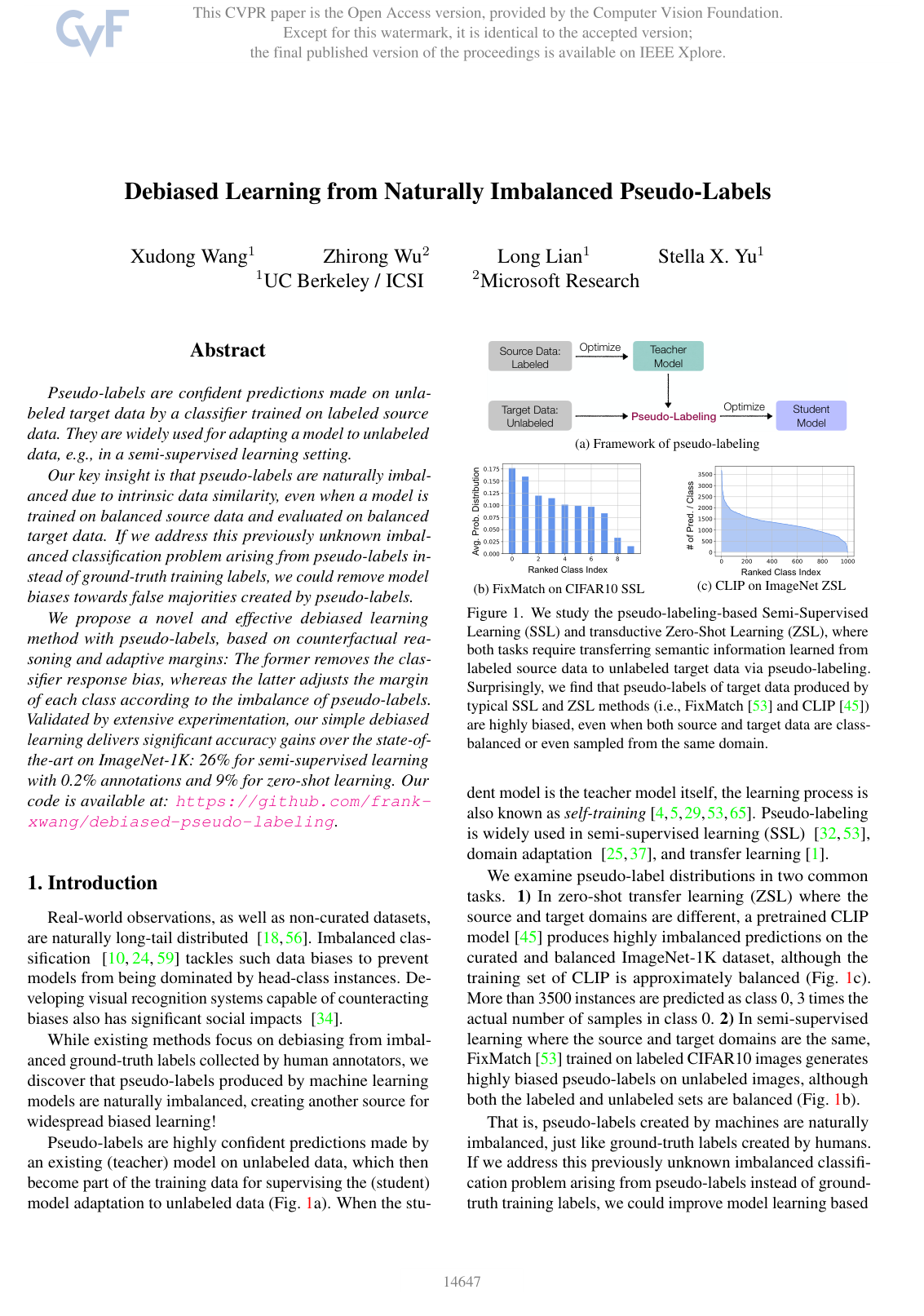
Modern computer vision models increasingly rely on pseudo-labels—model-generated predictions used to supervise training on massive unlabeled datasets—to cut annotation costs in semi-supervised and zero-shot learning. However, the article demonstrates that pseudo-labels naturally become highly imbalanced and biased due to inter-class similarities and model confusion, even when the underlying training and evaluation data are perfectly balanced. When models self-train on these biased predictions, they reinforce their own errors by creating false majority classes, trapping the systems in compounding performance deficits.
The article aims to introduce and validate a debiased learning framework, termed Debiased Pseudo-Labeling, that dynamically detects and removes these pseudo-label biases during training without requiring prior knowledge of the true class distributions.
To address this issue, the authors developed a two-part adaptive approach combining counterfactual reasoning to strip out response biases and an adaptive marginal loss to separate easily confused classes. They evaluated this framework across standard visual benchmarks—including ImageNet, CIFAR-10, and satellite imagery—testing its effectiveness across varying levels of supervision, severe class imbalances, and cross-domain zero-shot transfer.
The experimental findings show substantial performance gains. On ImageNet with only 0.2% labeled data, the proposed framework achieved an absolute top-1 accuracy gain of 26% over prior baselines, and delivered an 8.7% to 9% gain in zero-shot transfer learning. In zero-shot settings, a standard ResNet-50 model trained with this debiasing approach outperformed foundation models with up to fifteen times more parameters. Furthermore, the framework demonstrated universal utility across multiple learning architectures (such as FixMatch, MixMatch, and UDA) and improved accuracy by over 20% on difficult domain shifts, including an improvement of 25.7% on satellite land-cover classification.
These results demonstrate that machine learning teams can significantly lower human data annotation costs and compute requirements without sacrificing accuracy. Instead of relying on brute-force scale or manual data rebalancing, dynamically correcting algorithmic bias during training provides a robust, low-overhead safeguard against error propagation. Crucially, the method operates effectively even when the true distribution of the target data is unknown.
Organizations deploying semi-supervised and zero-shot pipelines should integrate adaptive debiasing modules into their existing training workflows as a plug-and-play enhancement. Before moving to full-scale deployment, teams should conduct internal pilot evaluations to calibrate debiasing hyperparameters, as excessively strong correction factors can impede model fitting while overly weak factors will fail to eliminate bias.
- Paper: Learning Imbalanced Datasets with Label-Distribution-Aware Margin Loss, Kaidi Cao et al. (2019). Introduces label-distribution-aware margins for class-imbalanced learning, providing the margin-adjustment foundational principle adapted by the source for imbalanced pseudo-labels.
- Paper: FixMatch: Simplifying Semi-Supervised Learning with Consistency and Confidence, Kihyuk Sohn et al. (2020). Establishes the standard confidence-thresholded pseudo-labeling framework in semi-supervised learning that the source analyzes and debiases.
- Paper: FlexMatch: Boosting Semi-Supervised Learning with Curriculum Pseudo Labeling, Bowen Zhang et al. (2021). Examines class-dependent learning difficulties and thresholding in pseudo-labeling, establishing key precursors to addressing imbalance in pseudo-labels.
- Paper: Unsupervised Domain Adaptation for Semantic Segmentation via Class-Balanced Self-training, Yang Zou et al. (2018). Introduces class-balanced self-training to mitigate majority-class dominance in pseudo-label generation, directly preceding the source's debiasing objectives.
- Paper: Decoupling Representation and Classifier for Long-Tailed Recognition, Bingyi Kang et al. (2019). Demonstrates decoupling representation learning from classifier debiasing in long-tailed data, inspiring the source's post-hoc counterfactual and margin adjustments.
- Paper: Class-Balanced Loss Based on Effective Number of Samples, Yin Cui et al. (2019). Develops sample-frequency re-weighting formulations for imbalanced learning that ground the source's margin adjustments based on pseudo-label frequencies.
- Paper: MixMatch: A Holistic Approach to Semi-Supervised Learning, David Berthelot et al. (2019). Presents foundational pseudo-label guessing and sharpening mechanisms used across contemporary semi-supervised learning paradigms.
- Paper: Contrastive Test-Time Adaptation, Dian Chen et al. (2022). Extends debiased online pseudo-labeling principles to test-time adaptation via contrastive learning and class diversification regularization.