Contrastive Test-Time Adaptation
Dian ChenDequan WangTrevor DarrellSayna Ebrahimi
Develops AdaContrast, a test-time adaptation framework that pairs contrastive representation learning with nearest-neighbor pseudo-label refinement to achieve state-of-the-art target accuracy and well-calibrated predictions without requiring source data.
Machine learning vision models often suffer severe performance drops when deployed to new operating environments that differ from their training data. Addressing this domain shift typically requires access to original training data, which raises significant data privacy and bandwidth concerns. The article develops and evaluates AdaContrast, a test-time adaptation method that enables visual classification models to adapt directly to unlabeled target data without accessing original source data.
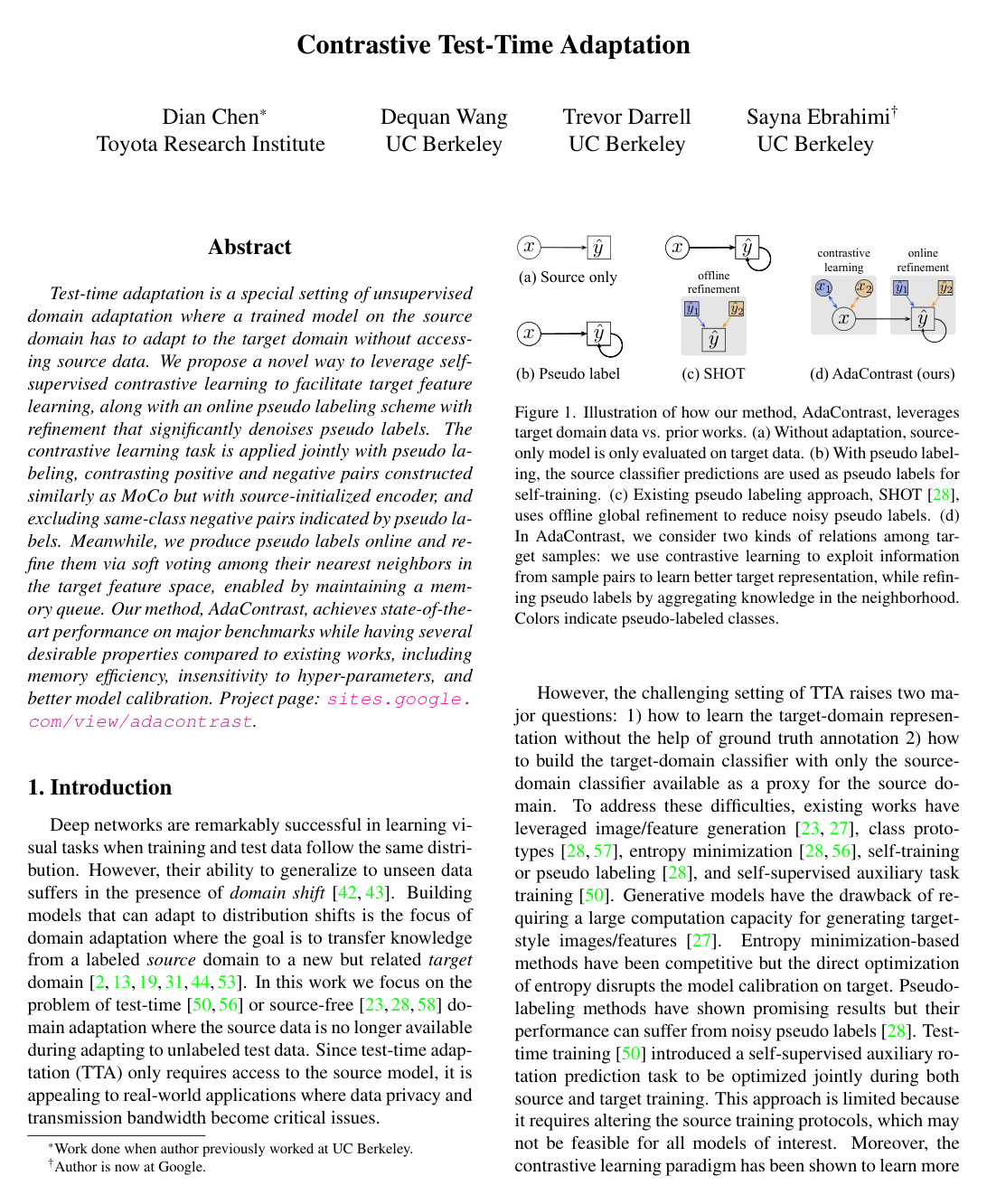
The approach combines joint self-supervised contrastive learning with an online pseudo-label refinement mechanism. Rather than relying on computationally heavy generative models or error-prone offline label updates, AdaContrast refines predictions per batch using soft voting among nearest neighbors in a target feature memory queue. In parallel, it initializes target feature encoders using source model weights and trains a contrastive objective that discards same-class negative pairs, while applying consistency and class diversification regularizations. Experiments were conducted on standard image classification benchmarks, including VisDA-C and the 126-class DomainNet dataset across seven domain shifts.
The evaluation demonstrates that AdaContrast establishes new state-of-the-art performance in source-free domain adaptation. On the VisDA-C benchmark, the method achieved an 86.8% average accuracy, outperforming the previous best source-free approach by 3.8 percentage points. On DomainNet-126, it delivered an average accuracy of 67.8% across seven shifts, outperforming competing test-time approaches by up to 10.1 percentage points and even surpassing standard adaptation methods that require source data. Furthermore, AdaContrast achieved substantial gains in model calibration, reducing expected calibration error by a factor of 4.5 compared to prior entropy minimization techniques. The method also proved stable across varying learning rates and retained high accuracy using a compact memory queue containing under 4% of target dataset features.
These findings indicate that organizations can safely and cost-effectively update artificial intelligence models at the edge or in streaming environments without transferring proprietary or private source datasets. By avoiding overconfident, miscalibrated predictions, the framework reduces operational risk in downstream decision systems. For deployment, engineering teams should consider adopting AdaContrast for streaming applications, such as robotics, while taking care to monitor model trustworthiness and potential misuse in safety-critical pipelines.
- Paper: Momentum Contrast for Unsupervised Visual Representation Learning, Kaiming He et al. (2020). Introduces Momentum Contrast (MoCo) and its dynamic memory queue mechanism, which forms the architectural and methodological foundation for the contrastive learning formulation used in AdaContrast.
- Paper: Test-Time Training with Self-Supervision for Generalization under Distribution Shifts, Yu Sun et al. (2019). Establishes the paradigm of test-time adaptation and training via self-supervision on unlabeled target samples, which this source paper directly builds upon and improves.
- Paper: Do We Really Need to Access the Source Data? Source Hypothesis Transfer for Unsupervised Domain Adaptation, Jian Liang et al. (2020). Demonstrates source-free unsupervised domain adaptation using hypothesis transfer and pseudo-labeling, setting the stage for test-time source-free feature adaptation.
- Paper: Improved Baselines with Momentum Contrastive Learning, Xinlei Chen et al. (2020). Refines the MoCo pipeline with improved projection architectures and augmentations that inform contrastive test-time adaptation strategies.
- Paper: Unsupervised Feature Learning via Non-parametric Instance Discrimination, Zhirong Wu et al. (2018). Pioneers instance discrimination using memory banks and non-parametric nearest neighbors, which underpins the target feature clustering and neighbor-based pseudo-label refinement.
- Paper: Supervised Contrastive Learning, Prannay Khosla et al. (2020). Develops class-aware contrastive learning objectives that motivate AdaContrast's strategy of excluding same-class negatives identified by pseudo-labels.
No sufficiently relevant recommendations were found.