
keyword
lesion classification
Lesion classification is the computational or clinical process of categorizing abnormal tissue changes, known as lesions, into distinct diagnostic classes or disease categories based on their visual, structural, or pathological features. In medical image analysis and computer-aided diagnosis, this task commonly relies on machine learning algorithms and deep neural networks to evaluate imaging data, such as dermoscopic photographs, radiographs, or computed tomography scans, to determine whether an identified abnormality is benign, malignant, or indicative of a specific condition like melanoma or carcinoma. By analyzing attributes including shape, color, texture, and margin characteristics, lesion classification systems assist healthcare professionals in screening, early disease detection, differential diagnosis, and personalized treatment planning.
2 items
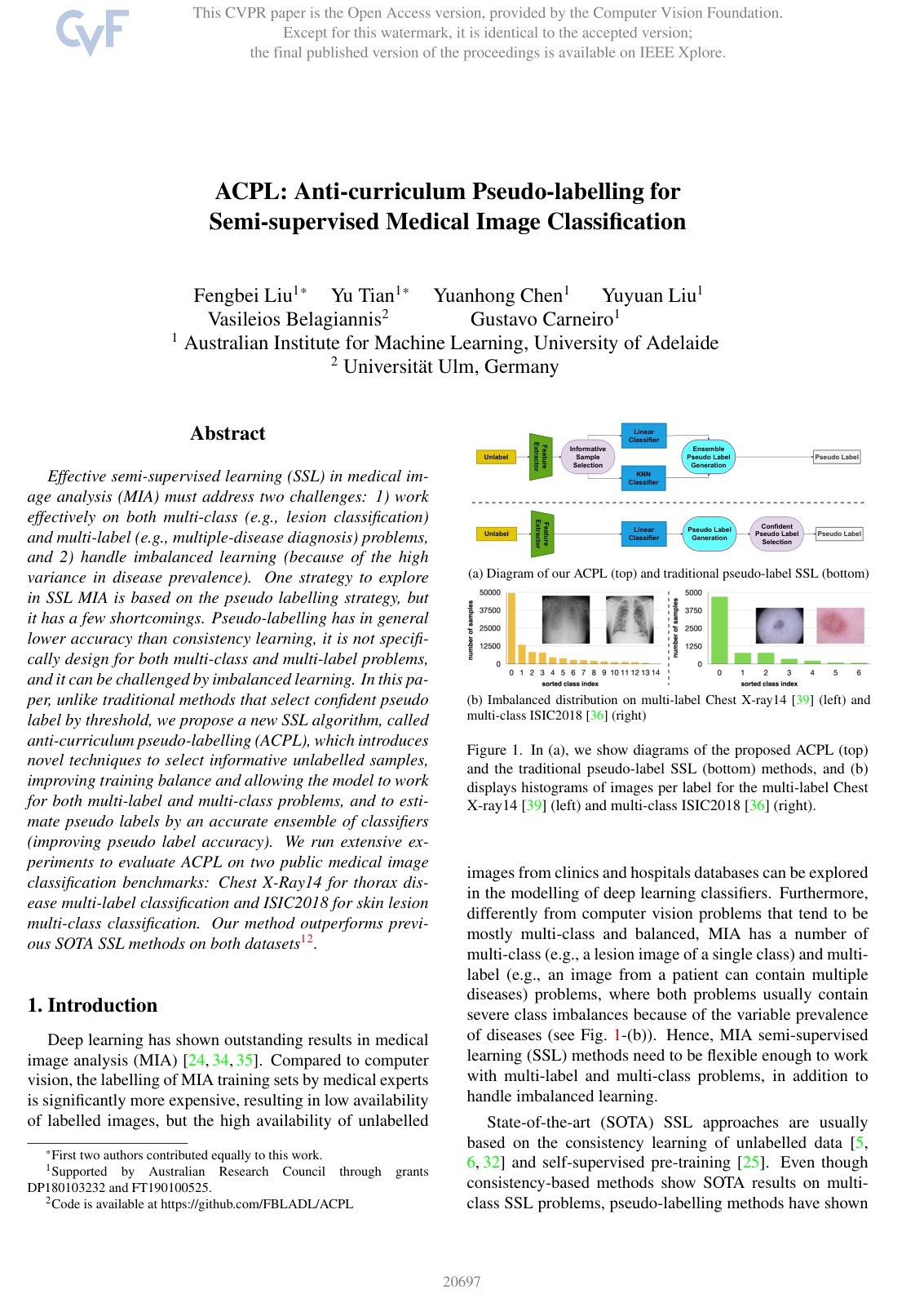
ACPL: Anti-curriculum Pseudo-labelling for Semi-supervised Medical Image Classification
Fengbei Liu, Yu Tian, Yuanhong Chen, Yuyuan Liu, Vasileios Belagiannis, Gustavo Carneiro
Why you should read this
Proposes an anti-curriculum pseudo-labelling framework that prioritizes informative unlabeled samples and ensembles neural network predictions with nearest-neighbor classifiers to outperform state-of-the-art semi-supervised methods on class-imbalanced multi-label and multi-class medical diagnosis tasks.
Effective semi-supervised learning (SSL) in medical image analysis (MIA) must address two challenges: 1) work effectively on both multi-class (e.g., lesion classification) and multi-label (e.g., multiple-disease diagnosis) problems, and 2) handle imbalanced learning (because of the high variance in disease prevalence). One strategy to explore in SSL MIA is based on the pseudo labelling strategy, but it has a few shortcomings. Pseudo-labelling has in general lower accuracy than consistency learning, it is not specifically design for both multi-class and multi-label problems, and it can be challenged by imbalanced learning. In this paper, unlike traditional methods that select confident pseudo label by threshold, we propose a new SSL algorithm, called anti-curriculum pseudo-labelling (ACPL), which introduces novel techniques to select informative unlabelled samples, improving training balance and allowing the model to work for both multi-label and multi-class problems, and to estimate pseudo labels by an accurate ensemble of classifiers (improving pseudo label accuracy). We run extensive experiments to evaluate ACPL on two public medical image classification benchmarks: Chest X-Ray14 for thorax disease multi-label classification and ISIC2018 for skin lesion multi-class classification. Our method outperforms previous SOTA SSL methods on both datasets.
Added
2026-09-26
Skin Lesion Analysis Toward Melanoma Detection 2018: A Challenge Hosted by the International Skin Imaging Collaboration (ISIC)
Noel Codella, Veronica Rotemberg, Philipp Tschandl, M. E. Celebi, Stephen W. Dusza, David Gutman, Brian Helba, Aadi Kalloo, Konstantinos Liopyris, Michael A. Marchetti, Harald Kittler, Allan C. Halpern
Why you should read this
Establishes standard benchmarks and evaluation protocols for automated melanoma detection across 12,500 dermoscopic images, revealing critical generalization failures among top-performing clinical diagnostic models.
This work summarizes the results of the largest skin image analysis challenge in the world, hosted by the International Skin Imaging Collaboration (ISIC), a global partnership that has organized the world's largest public repository of dermoscopic images of skin. The challenge was hosted in 2018 at the Medical Image Computing and Computer Assisted Intervention (MICCAI) conference in Granada, Spain. The dataset included over 12,500 images across 3 tasks. 900 users registered for data download, 115 submitted to the lesion segmentation task, 25 submitted to the lesion attribute detection task, and 159 submitted to the disease classification task. Novel evaluation protocols were established, including a new test for segmentation algorithm performance, and a test for algorithm ability to generalize. Results show that top segmentation algorithms still fail on over 10% of images on average, and algorithms with equal performance on test data can have different abilities to generalize. This is an important consideration for agencies regulating the growing set of machine learning tools in the healthcare domain, and sets a new standard for future public challenges in healthcare.
Added
2026-09-18