
keyword
curriculum learning
Curriculum learning is a machine learning training strategy in which a model is exposed to training examples or tasks in a structured sequence, typically progressing from simpler to increasingly complex concepts rather than sampling data uniformly at random. Inspired by biological and educational learning processes, this approach guides the optimization process by presenting easier representations first, functioning similarly to a continuation method to help models avoid poor local optima in non-convex loss landscapes. The framework encompasses methods for determining sample difficulty, scheduling the pace of difficulty progression, and dynamically adjusting training distributions through either predefined heuristics or automated policies. By systematically controlling how and when challenging data is introduced, curriculum learning aims to accelerate convergence, improve training stability, and enhance the generalization performance of machine learning models.
16 items
Curriculum Learning as Transport: Understanding Curricula with Wasserstein Geodesics
Chang-Ho Shin, David Alvarez-Melis
Why you should read this
Proposes an optimal transport framework that models curricula as Wasserstein trajectories over difficulty distributions, decoupling the distinct effects of example ordering, pacing, and sample exposure under fixed training budgets.
Curriculum learning is governed by several coupled design choices---how difficulty is defined, how examples are ordered, how much exposure each level receives, and how quickly training moves across levels---making it hard to isolate what actually helps. We present Wasserstein curriculum paths, a simple transport-based framework that decouples these factors by representing curricula as trajectories of training distributions over discrete difficulty levels. Across a calibrated synthetic suite with 12 tasks and 33 difficulty axes, we use this framework to isolate the effects of ordering, matched exposure, endpoint smoothness, and pacing under fixed training budgets. We find that curriculum effects are strongly context-dependent: no single strategy dominates across tasks, difficulty axes, and budgets, and curricula mainly change where a fixed budget is spent most effectively. Within this framework, easy-to-hard ordering improves hard-level performance relative to exposure-matched static sampling, showing that the benefit is not explained by cumulative exposure alone. We further show that endpoint smoothness and pacing substantially affect where along the difficulty spectrum a curriculum is effective. Finally, we show that the same transport view naturally supports extensions to learned pacing through geometry and to structured difficulty spaces beyond one-dimensional orderings.
Added
2026-10-05
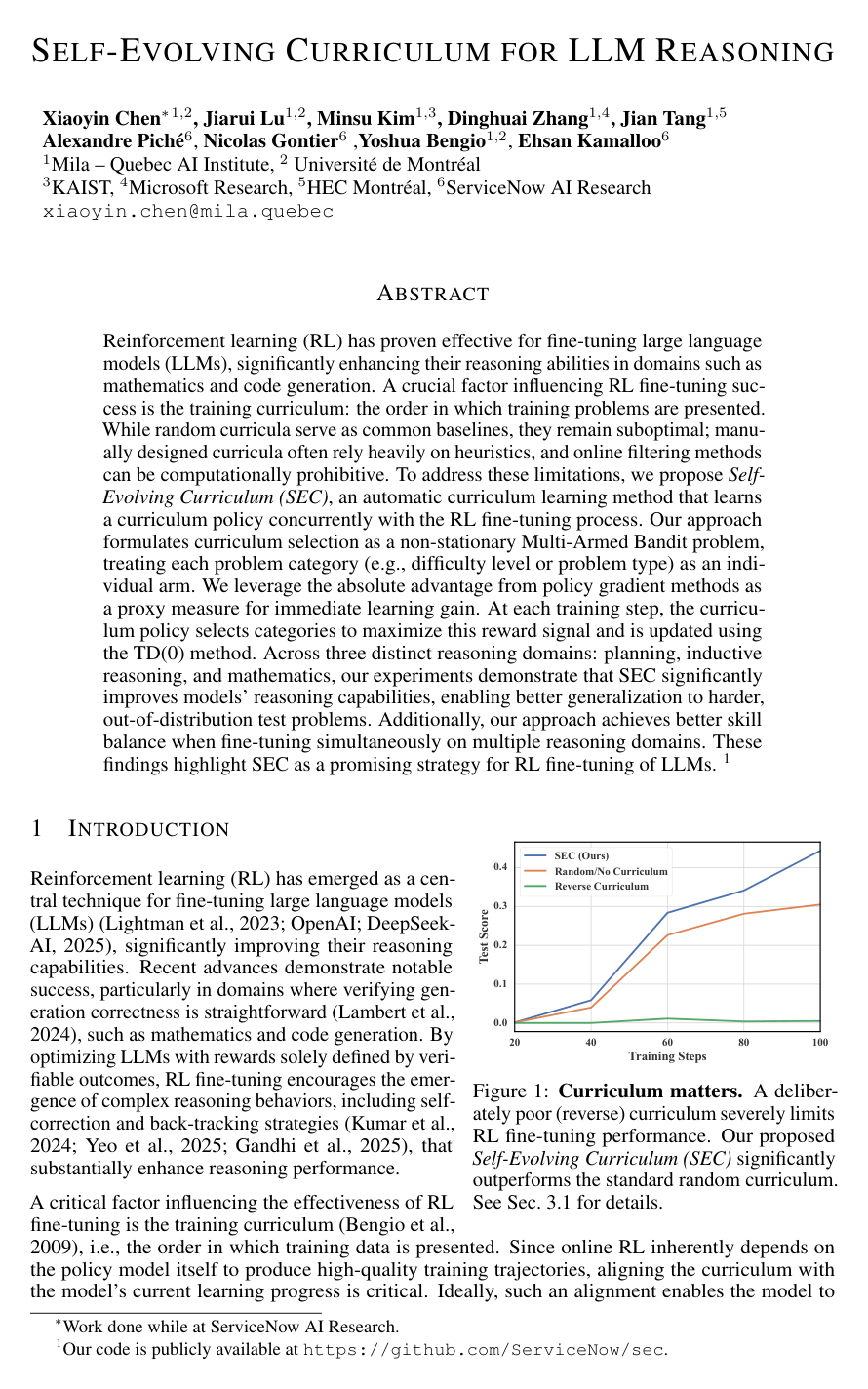
Self-Evolving Curriculum for LLM Reasoning
Xiaoyin Chen, Jiarui Lu, Minsu Kim, Dinghuai Zhang, Jian Tang, Alex Pich'e, Nicolas Gontier, Yoshua Bengio, Ehsan Kamalloo
Why you should read this
Introduces an automatic curriculum learning framework that formulates training task selection as a dynamic multi-armed bandit driven by policy gradient gains, markedly improving large language model reasoning and out-of-distribution generalization across planning, mathematics, and induction.
Reinforcement learning (RL) has proven effective for fine-tuning large language models (LLMs), significantly enhancing their reasoning abilities in domains such as mathematics and code generation. A crucial factor influencing RL fine-tuning success is the training curriculum: the order in which training problems are presented. While random curricula serve as common baselines, they remain suboptimal; manually designed curricula often rely heavily on heuristics, and online filtering methods can be computationally prohibitive. To address these limitations, we propose Self-Evolving Curriculum (SEC), an automatic curriculum learning method that learns a curriculum policy concurrently with the RL fine-tuning process. Our approach formulates curriculum selection as a non-stationary Multi-Armed Bandit problem, treating each problem category (e.g., difficulty level or problem type) as an individual arm. We leverage the absolute advantage from policy gradient methods as a proxy measure for immediate learning gain. At each training step, the curriculum policy selects categories to maximize this reward signal and is updated using the TD(0) method. Across three distinct reasoning domains: planning, inductive reasoning, and mathematics, our experiments demonstrate that SEC significantly improves models' reasoning capabilities, enabling better generalization to harder, out-of-distribution test problems. Additionally, our approach achieves better skill balance when fine-tuning simultaneously on multiple reasoning domains. These findings highlight SEC as a promising strategy for RL fine-tuning of LLMs.
Added
2026-10-04
TabICL: A Tabular Foundation Model for In-Context Learning on Large Data
Jingang Qu, David Holzmller, Gal Varoquaux, Marine Le Morvan
Why you should read this
Introduces TabICL, a tabular foundation model featuring a two-stage attention architecture that scales in-context learning to 500,000 samples, running up to ten times faster than TabPFNv2 while outperforming CatBoost on large classification datasets.
The long-standing dominance of gradient-boosted decision trees on tabular data is currently challenged by tabular foundation models using In-Context Learning (ICL): setting the training data as context for the test data and predicting in a single forward pass without parameter updates. While TabPFNv2 foundation model excels on tables with up to 10K samples, its alternating column- and row-wise attentions make handling large training sets computationally prohibitive. So, can ICL be effectively scaled and deliver a benefit for larger tables? We introduce TabICL, a tabular foundation model for classification, pretrained on synthetic datasets with up to 60K samples and capable of handling 500K samples on affordable resources. This is enabled by a novel two-stage architecture: a column-then-row attention mechanism to build fixed-dimensional embeddings of rows, followed by a transformer for efficient ICL. Across 200 classification datasets from the TALENT benchmark, TabICL is on par with TabPFNv2 while being systematically faster (up to 10 times), and significantly outperforms all other approaches. On 53 datasets with over 10K samples, TabICL surpasses both TabPFNv2 and CatBoost, demonstrating the potential of ICL for large data. Pretraining code, inference code, and pre-trained models are available at this https URL.
Added
2026-10-01
C-SFDA: A Curriculum Learning Aided Self-Training Framework for Efficient Source Free Domain Adaptation
Nazmul Karim, Niluthpol Chowdhury Mithun, Abhinav Rajvanshi, Han-Pang Chiu, Supun Samarasekera, Nazanin Rahnavard
Why you should read this
Proposes a curriculum-driven self-training framework for source-free domain adaptation that filters out noisy pseudo-labels to prevent early-stage memorization without needing memory banks or expensive feature clustering.
Unsupervised domain adaptation (UDA) approaches focus on adapting models trained on a labeled source domain to an unlabeled target domain. In contrast to UDA, source-free domain adaptation (SFDA) is a more practical setup as access to source data is no longer required during adaptation. Recent state-of-the-art (SOTA) methods on SFDA mostly focus on pseudo-label refinement based self-training which generally suffers from two issues: i) inevitable occurrence of noisy pseudo-labels that could lead to early training time memorization, ii) refinement process requires maintaining a memory bank which creates a significant burden in resource constraint scenarios. To address these concerns, we propose C-SFDA, a curriculum learning aided self-training framework for SFDA that adapts efficiently and reliably to changes across domains based on selective pseudo-labeling. Specifically, we employ a curriculum learning scheme to promote learning from a restricted amount of pseudo labels selected based on their reliabilities. This simple yet effective step successfully prevents label noise propagation during different stages of adaptation and eliminates the need for costly memory-bank based label refinement. Our extensive experimental evaluations on both image recognition and semantic segmentation tasks confirm the effectiveness of our method. C-SFDA is also applicable to online test-time domain adaptation and outperforms previous SOTA methods in this task.
Added
2026-09-26
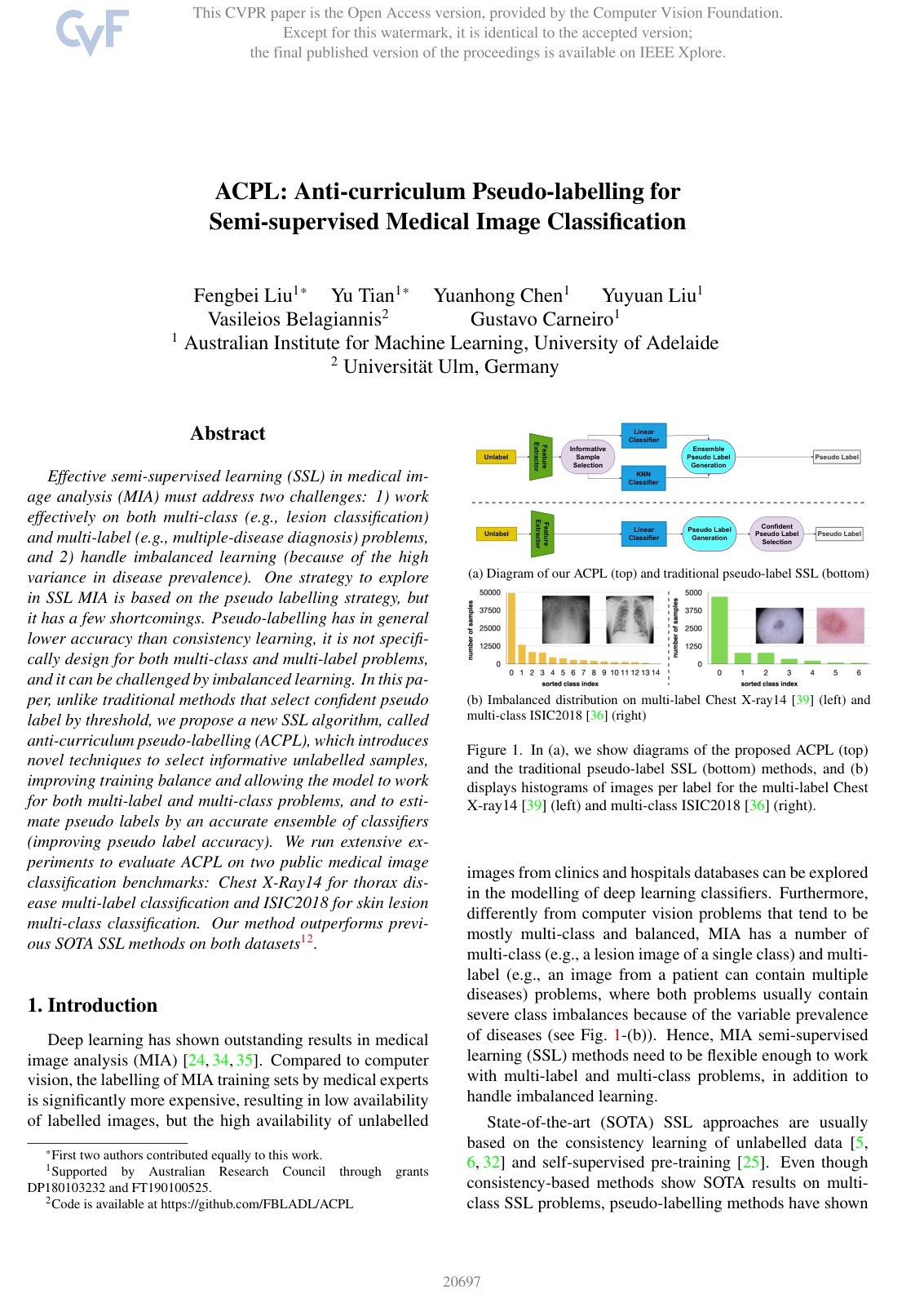
ACPL: Anti-curriculum Pseudo-labelling for Semi-supervised Medical Image Classification
Fengbei Liu, Yu Tian, Yuanhong Chen, Yuyuan Liu, Vasileios Belagiannis, Gustavo Carneiro
Why you should read this
Proposes an anti-curriculum pseudo-labelling framework that prioritizes informative unlabeled samples and ensembles neural network predictions with nearest-neighbor classifiers to outperform state-of-the-art semi-supervised methods on class-imbalanced multi-label and multi-class medical diagnosis tasks.
Effective semi-supervised learning (SSL) in medical image analysis (MIA) must address two challenges: 1) work effectively on both multi-class (e.g., lesion classification) and multi-label (e.g., multiple-disease diagnosis) problems, and 2) handle imbalanced learning (because of the high variance in disease prevalence). One strategy to explore in SSL MIA is based on the pseudo labelling strategy, but it has a few shortcomings. Pseudo-labelling has in general lower accuracy than consistency learning, it is not specifically design for both multi-class and multi-label problems, and it can be challenged by imbalanced learning. In this paper, unlike traditional methods that select confident pseudo label by threshold, we propose a new SSL algorithm, called anti-curriculum pseudo-labelling (ACPL), which introduces novel techniques to select informative unlabelled samples, improving training balance and allowing the model to work for both multi-label and multi-class problems, and to estimate pseudo labels by an accurate ensemble of classifiers (improving pseudo label accuracy). We run extensive experiments to evaluate ACPL on two public medical image classification benchmarks: Chest X-Ray14 for thorax disease multi-label classification and ISIC2018 for skin lesion multi-class classification. Our method outperforms previous SOTA SSL methods on both datasets.
Added
2026-09-26
Unsupervised Domain Adaptation for Semantic Segmentation via Class-Balanced Self-training
Yang Zou, Zhiding Yu, B. V. K. Vijaya Kumar, Jinsong Wang
Why you should read this
Proposes a class-balanced self-training framework for unsupervised domain adaptation in semantic segmentation that prevents dominant categories from biasing pseudo-label generation while using spatial priors to refine target predictions.
Recent deep networks achieved state of the art performance on a variety of semantic segmentation tasks. Despite such progress, these models often face challenges in real world “wild tasks” where large difference between labeled training/source data and unseen test/target data exists. In particular, such difference is often referred to as “domain gap”, and could cause significantly decreased performance which cannot be easily remedied by further increasing the representation power. Unsupervised domain adaptation (UDA) seeks to overcome such problem without target domain labels. In this paper, we propose a novel UDA framework based on an iterative self-training (ST) procedure, where the problem is formulated as latent variable loss minimization, and can be solved by alternatively generating pseudo labels on target data and re-training the model with these labels. On top of ST, we also propose a novel class-balanced self-training (CBST) framework to avoid the gradual dominance of large classes on pseudo-label generation, and introduce spatial priors to refine generated labels. Comprehensive experiments show that the proposed methods achieve state of the art semantic segmentation performance under multiple major UDA settings.
Added
2026-09-25
Self-Paced Learning for Latent Variable Models
M. P. Kumar, Ben Packer, D. Koller
Why you should read this
Introduces a self-paced learning framework that dynamically selects training samples from easiest to hardest to prevent latent variable models from getting trapped in poor local optima.
Latent variable models are a powerful tool for addressing several tasks in machine learning. However, the algorithms for learning the parameters of latent variable models are prone to getting stuck in a bad local optimum. To alleviate this problem, we build on the intuition that, rather than considering all samples simultaneously, the algorithm should be presented with the training data in a meaningful order that facilitates learning. The order of the samples is determined by how easy they are. The main challenge is that often we are not provided with a readily computable measure of the easiness of samples. We address this issue by proposing a novel, iterative self-paced learning algorithm where each iteration simultaneously selects easy samples and learns a new parameter vector. The number of samples selected is governed by a weight that is annealed until the entire training data has been considered. We empirically demonstrate that the self-paced learning algorithm outperforms the state of the art method for learning a latent structural SVM on four applications: object localization, noun phrase coreference, motif finding and handwritten digit recognition.
Added
2026-09-24
MentorNet: Learning Data-Driven Curriculum for Very Deep Neural Networks on Corrupted Labels
Lu Jiang, Zhengyuan Zhou, Thomas Leung, Li-Jia Li, Li Fei-Fei
Why you should read this
Introduces MentorNet, a neural network that learns a data-driven curriculum to dynamically reweight training samples, preventing deep models from overfitting to corrupted labels and achieving state-of-the-art performance on large-scale noisy benchmarks like WebVision.
Recent deep networks are capable of memorizing the entire data even when the labels are completely random. To overcome the overfitting on corrupted labels, we propose a novel technique of learning another neural network, called MentorNet, to supervise the training of the base deep networks, namely, StudentNet. During training, MentorNet provides a curriculum (sample weighting scheme) for StudentNet to focus on the sample the label of which is probably correct. Unlike the existing curriculum that is usually predefined by human experts, MentorNet learns a data-driven curriculum dynamically with StudentNet. Experimental results demonstrate that our approach can significantly improve the generalization performance of deep networks trained on corrupted training data. Notably, to the best of our knowledge, we achieve the best-published result on WebVision, a large benchmark containing 2.2 million images of real-world noisy labels. The code are at this https URL
Added
2026-09-24
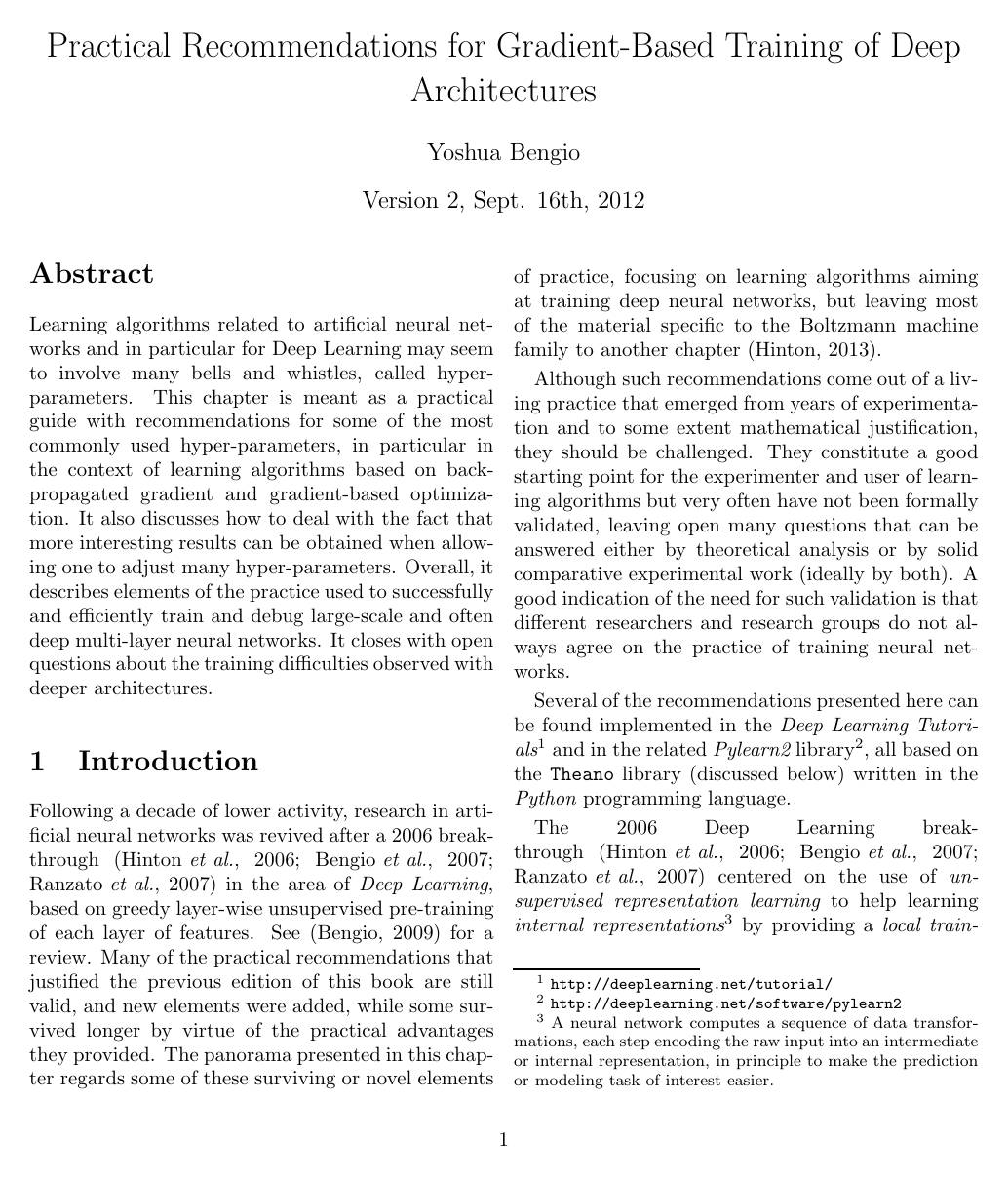
Practical Recommendations for Gradient-Based Training of Deep Architectures
Yoshua Bengio
Why you should read this
Presents essential practical heuristics and actionable guidelines for tuning hyperparameters, diagnosing optimization failures, and successfully training deep neural networks with gradient descent.
Learning algorithms related to artificial neural networks and in particular for Deep Learning may seem to involve many bells and whistles, called hyper-parameters. This chapter is meant as a practical guide with recommendations for some of the most commonly used hyper-parameters, in particular in the context of learning algorithms based on back-propagated gradient and gradient-based optimization. It also discusses how to deal with the fact that more interesting results can be obtained when allowing one to adjust many hyper-parameters. Overall, it describes elements of the practice used to successfully and efficiently train and debug large-scale and often deep multi-layer neural networks. It closes with open questions about the training difficulties observed with deeper architectures.
Added
2026-09-14
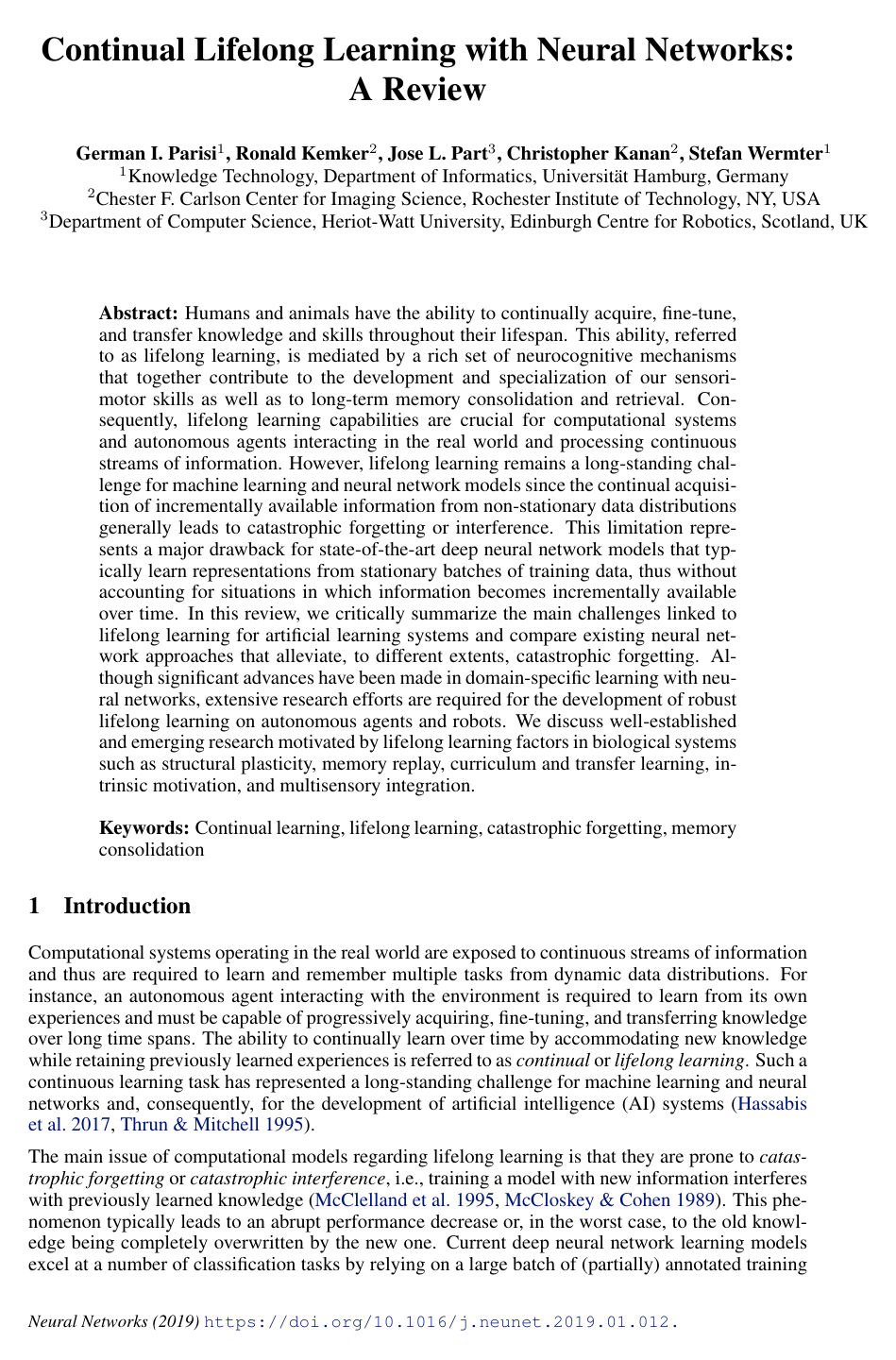
Continual Lifelong Learning with Neural Networks: A Review
German I. Parisi, Ronald Kemker, Jose L. Part, Christopher Kanan, Stefan Wermter
Why you should read this
Synthesizes neural network approaches for preventing catastrophic forgetting in continual learning and connects these algorithmic strategies to biological mechanisms such as structural plasticity and memory replay.
Humans and animals have the ability to continually acquire, fine-tune, and transfer knowledge and skills throughout their lifespan. This ability, referred to as lifelong learning, is mediated by a rich set of neurocognitive mechanisms that together contribute to the development and specialization of our sensorimotor skills as well as to long-term memory consolidation and retrieval. Consequently, lifelong learning capabilities are crucial for autonomous agents interacting in the real world and processing continuous streams of information. However, lifelong learning remains a long-standing challenge for machine learning and neural network models since the continual acquisition of incrementally available information from non-stationary data distributions generally leads to catastrophic forgetting or interference. This limitation represents a major drawback for state-of-the-art deep neural network models that typically learn representations from stationary batches of training data, thus without accounting for situations in which information becomes incrementally available over time. In this review, we critically summarize the main challenges linked to lifelong learning for artificial learning systems and compare existing neural network approaches that alleviate, to different extents, catastrophic forgetting. We discuss well-established and emerging research motivated by lifelong learning factors in biological systems such as structural plasticity, memory replay, curriculum and transfer learning, intrinsic motivation, and multisensory integration.
Added
2026-09-11
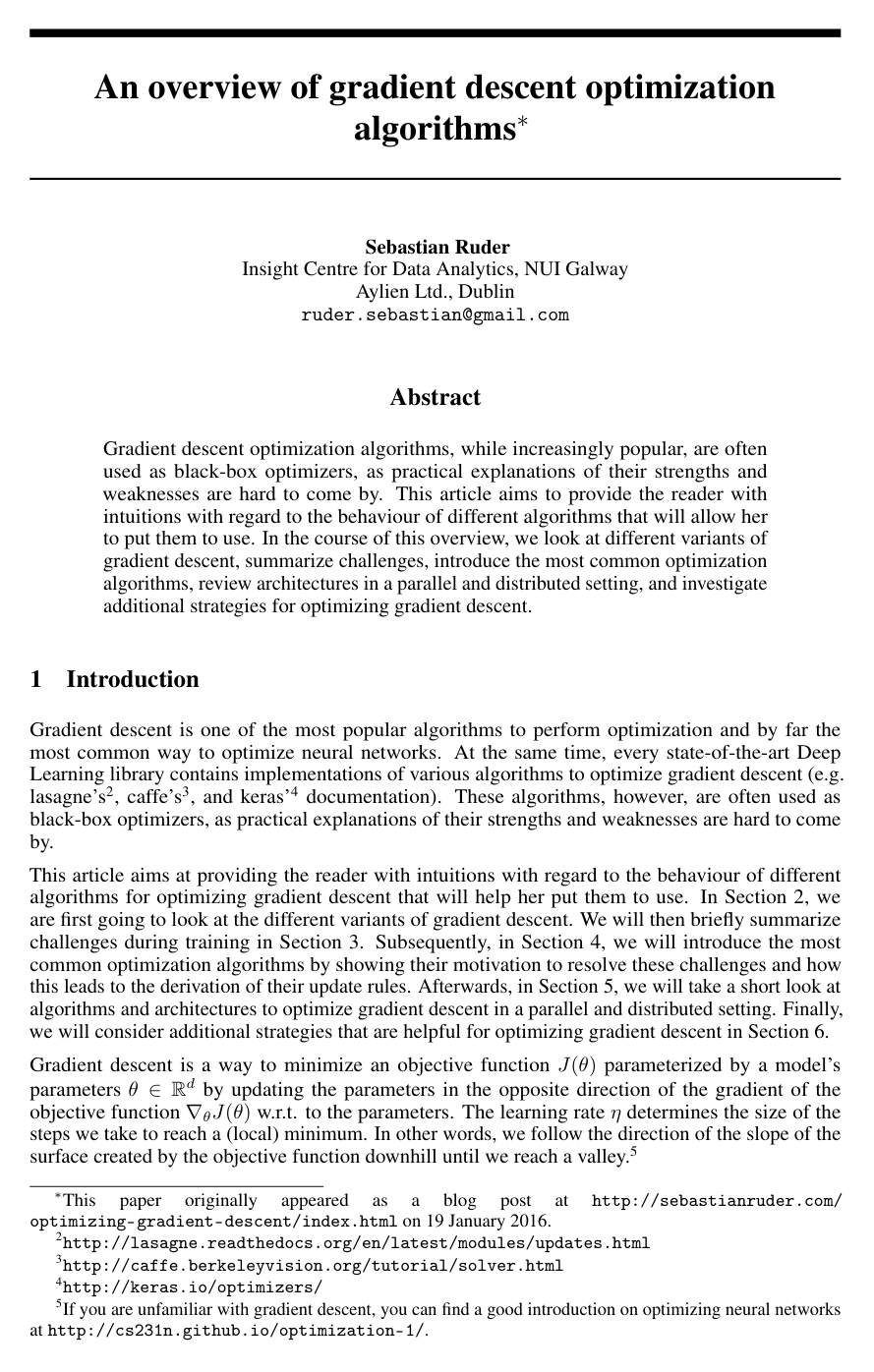
An overview of gradient descent optimization algorithms
Sebastian Ruder
Why you should read this
Explains the mechanics and practical trade-offs of modern gradient descent optimization algorithms, providing intuitive guidance on how to select and tune the right optimizer for training deep neural networks.
Gradient descent optimization algorithms, while increasingly popular, are often used as black-box optimizers, as practical explanations of their strengths and weaknesses are hard to come by. This article aims to provide the reader with intuitions with regard to the behaviour of different algorithms that will allow her to put them to use. In the course of this overview, we look at different variants of gradient descent, summarize challenges, introduce the most common optimization algorithms, review architectures in a parallel and distributed setting, and investigate additional strategies for optimizing gradient descent.
Added
2026-09-09
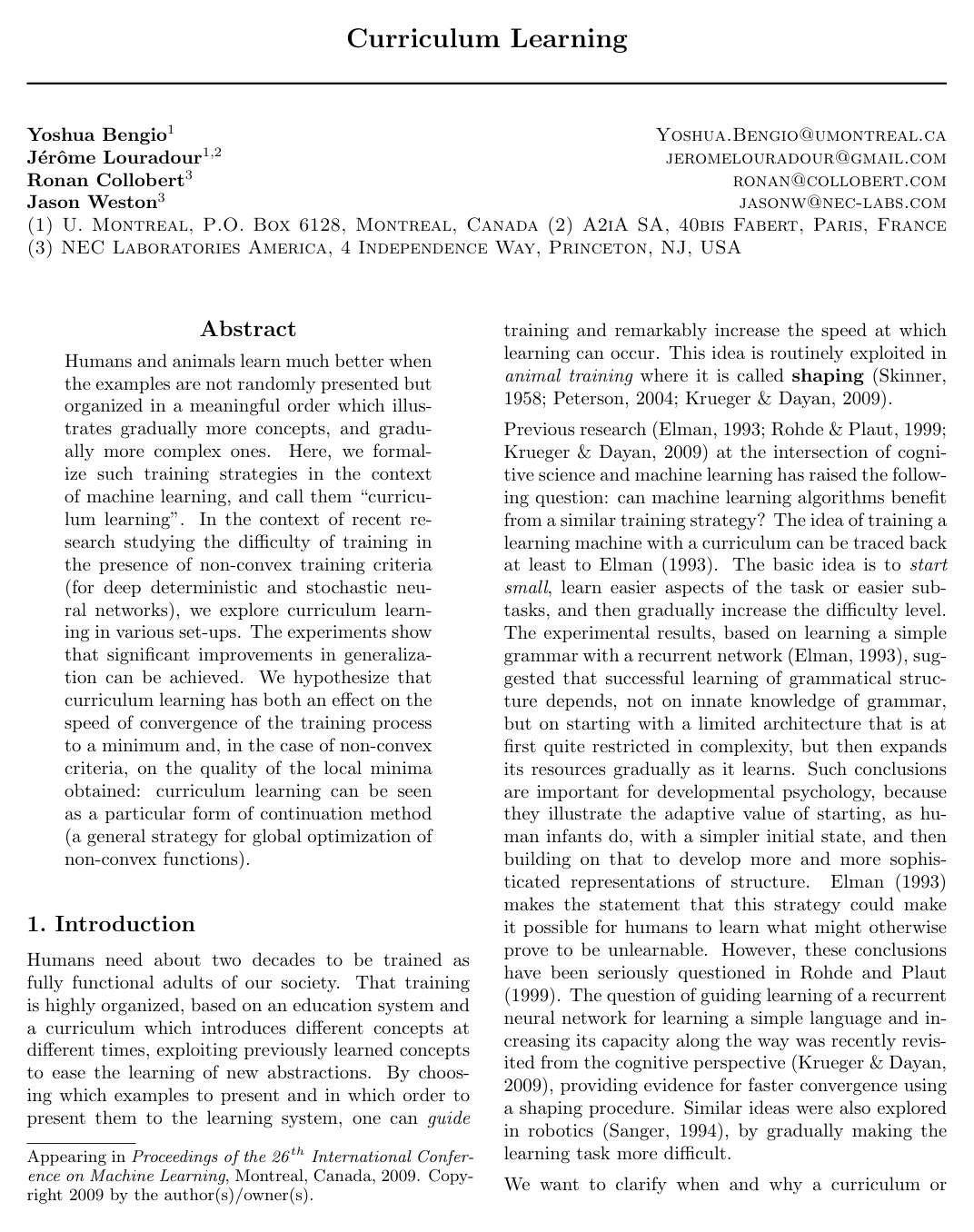
Curriculum learning
Yoshua Bengio, Jérôme Louradour, Ronan Collobert, Jason Weston
Why you should read this
Introduces curriculum learning as a machine learning training strategy that presents examples in order of increasing difficulty, demonstrating that staged data progression accelerates optimization convergence and improves generalization in deep neural networks.
Humans and animals learn much better when the examples are not randomly presented but organized in a meaningful order which illustrates gradually more concepts, and gradually more complex ones. Here, we formalize such training strategies in the context of machine learning, and call them “curriculum learning”. In the context of recent research studying the difficulty of training in the presence of non-convex training criteria (for deep deterministic and stochastic neural networks), we explore curriculum learning in various set-ups. The experiments show that significant improvements in generalization can be achieved. We hypothesize that curriculum learning has both an effect on the speed of convergence of the training process to a minimum and, in the case of non-convex criteria, on the quality of the local minima obtained: curriculum learning can be seen as a particular form of continuation method (a general strategy for global optimization of non-convex functions).
Added
2026-09-08
License
Published with permission
FitNets: Hints for Thin Deep Nets
Adriana Romero, Nicolas Ballas, Samira Ebrahimi Kahou, Antoine Chassang, Carlo Gatta, Yoshua Bengio
Why you should read this
Proposes the critical technique of intermediate feature distillation by forcing a deep student network to match the hidden representations of a teacher network to overcome capacity limitations.
While depth tends to improve network performances, it also makes gradient-based training more difficult since deeper networks tend to be more non-linear. The recently proposed knowledge distillation approach is aimed at obtaining small and fast-to-execute models, and it has shown that a student network could imitate the soft output of a larger teacher network or ensemble of networks. In this paper, we extend this idea to allow the training of a student that is deeper and thinner than the teacher, using not only the outputs but also the intermediate representations learned by the teacher as hints to improve the training process and final performance of the student. Because the student intermediate hidden layer will generally be smaller than the teacher's intermediate hidden layer, additional parameters are introduced to map the student hidden layer to the prediction of the teacher hidden layer. This allows one to train deeper students that can generalize better or run faster, a trade-off that is controlled by the chosen student capacity. For example, on CIFAR-10, a deep student network with almost 10.4 times less parameters outperforms a larger, state-of-the-art teacher network.
Added
2026-06-19
License
Published with permission
Robust Reinforcement Learning via Genetic Curriculum
Yeeho Song, Jeff Schneider
Why you should read this
Demonstrates how a genetic algorithm can automatically identify and generate training scenarios that expose an agent's weaknesses, enabling reinforcement learning systems to become 2-8 times more reliable without requiring expert-designed curriculum rules or adversarial agents that become too difficult to learn from.
Achieving robust performance is crucial when applying deep reinforcement learning (RL) in safety critical systems. Some of the state of the art approaches try to address the problem with adversarial agents, but these agents often require expert supervision to fine tune and prevent the adversary from becoming too challenging to the trainee agent. While other approaches involve automatically adjusting environment setups during training, they have been limited to simple environments where low-dimensional encodings can be used. Inspired by these approaches, we propose genetic curriculum, an algorithm that automatically identifies scenarios in which the agent currently fails and generates an associated curriculum to help the agent learn to solve the scenarios and acquire more robust behaviors. As a non-parametric optimizer, our approach uses a raw, non-fixed encoding of scenarios, reducing the need for expert supervision and allowing our algorithm to adapt to the changing performance of the agent. Our empirical studies show improvement in robustness over the existing state of the art algorithms, providing training curricula that result in agents being 2 - 8x times less likely to fail without sacrificing cumulative reward. We include an ablation study and share insights on why our algorithm outperforms prior approaches.
Added
2026-02-21
Automaton-Guided Curriculum Generation for Reinforcement Learning Agents
Yash Shukla, Abhishek Kulkarni, Robert Wright, Alvaro Velasquez, Jivko Sinapov
Why you should read this
Demonstrates how to automatically generate efficient learning sequences for complex multi-step tasks by leveraging formal automaton representations, achieving dramatically faster training than existing curriculum learning approaches.
Despite advances in Reinforcement Learning, many sequential decision making tasks remain prohibitively expensive and impractical to learn. Recently, approaches that automatically generate reward functions from logical task specifications have been proposed to mitigate this issue; however, they scale poorly on long-horizon tasks (i.e., tasks where the agent needs to perform a series of correct actions to reach the goal state, considering future transitions while choosing an action). Employing a curriculum (a sequence of increasingly complex tasks) further improves the learning speed of the agent by sequencing intermediate tasks suited to the learning capacity of the agent. However, generating curricula from the logical specification still remains an unsolved problem. To this end, we propose AGCL, Automaton-guided Curriculum Learning, a novel method for automatically generating curricula for the target task in the form of Directed Acyclic Graphs (DAGs). AGCL encodes the specification in the form of a deterministic finite automaton (DFA), and then uses the DFA along with the Object-Oriented MDP (OOMDP) representation to generate a curriculum as a DAG, where the vertices correspond to tasks, and edges correspond to the direction of knowledge transfer. Experiments in gridworld and physics-based simulated robotics domains show that the curricula produced by AGCL achieve improved time-to-threshold performance on a complex sequential decision-making problem relative to state-of-the-art curriculum learning (e.g, teacher-student, self-play) and automaton-guided reinforcement learning baselines (e.g, Q-Learning for Reward Machines). Further, we demonstrate that AGCL performs well even in the presence of noise in the task's OOMDP description, and also when distractor objects are present that are not modeled in the logical specification of the tasks' objectives.
Added
2026-02-21
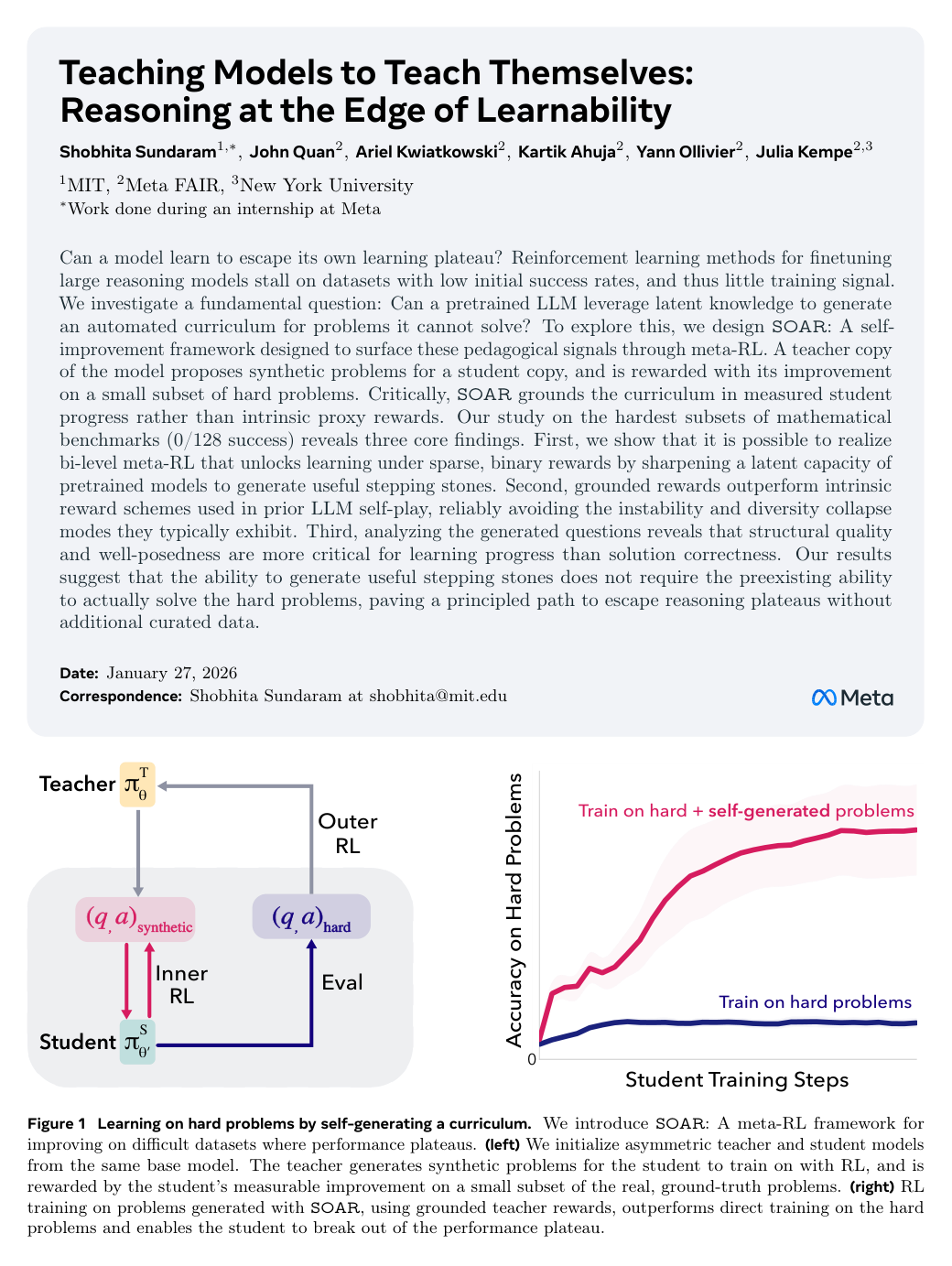
Teaching Models to Teach Themselves: Reasoning at the Edge of Learnability
Shobhita Sundaram, John Quan, Ariel Kwiatkowski, Kartik Ahuja, Yann Ollivier, Julia Kempe
Why you should read this
Introduces SOAR, a meta-reinforcement learning framework that enables models to escape performance plateaus by training an asymmetric teacher to generate synthetic stepping stone problems grounded in actual student progress on tasks the model cannot yet solve.
Can a model learn to escape its own learning plateau? Reinforcement learning methods for finetuning large reasoning models stall on datasets with low initial success rates, and thus little training signal. We investigate a fundamental question: Can a pretrained LLM leverage latent knowledge to generate an automated curriculum for problems it cannot solve? To explore this, we design SOAR: A self-improvement framework designed to surface these pedagogical signals through meta-RL. A teacher copy of the model proposes synthetic problems for a student copy, and is rewarded with its improvement on a small subset of hard problems. Critically, SOAR grounds the curriculum in measured student progress rather than intrinsic proxy rewards. Our study on the hardest subsets of mathematical benchmarks (0/128 success) reveals three core findings. First, we show that it is possible to realize bi-level meta-RL that unlocks learning under sparse, binary rewards by sharpening a latent capacity of pretrained models to generate useful stepping stones. Second, grounded rewards outperform intrinsic reward schemes used in prior LLM self-play, reliably avoiding the instability and diversity collapse modes they typically exhibit. Third, analyzing the generated questions reveals that structural quality and well-posedness are more critical for learning progress than solution correctness. Our results suggest that the ability to generate useful stepping stones does not require the preexisting ability to actually solve the hard problems, paving a principled path to escape reasoning plateaus without additional curated data.
Added
2026-01-29