
keyword
multi-label classification
Multi-label classification is a machine learning task where each input instance can be associated with multiple target labels simultaneously from a predefined set of categories. Unlike traditional binary and multi-class classification settings where classes are mutually exclusive and an instance is assigned to exactly one category, multi-label classification accounts for scenarios with overlapping characteristics, such as an image depicting several distinct objects, an article spanning multiple topics, or a medical record indicating concurrent diagnoses. Approaches to solving multi-label classification problems typically involve transforming the task into multiple independent binary decisions, adapting existing learning algorithms to predict label sets directly, or explicitly modeling correlations and dependencies among labels to enhance prediction performance.
7 items
Class Re-Activation Maps for Weakly-Supervised Semantic Segmentation
Zhaozheng Chen, Tan Wang, Xiongwei Wu, Xian-Sheng Hua, Hanwang Zhang, Qianru Sun
Why you should read this
Proposes ReCAM, an effective plug-and-play method that replaces binary cross-entropy with a secondary softmax cross-entropy learning stage to resolve multi-class pixel ambiguity and generate higher-quality pseudo masks for weakly-supervised semantic segmentation.
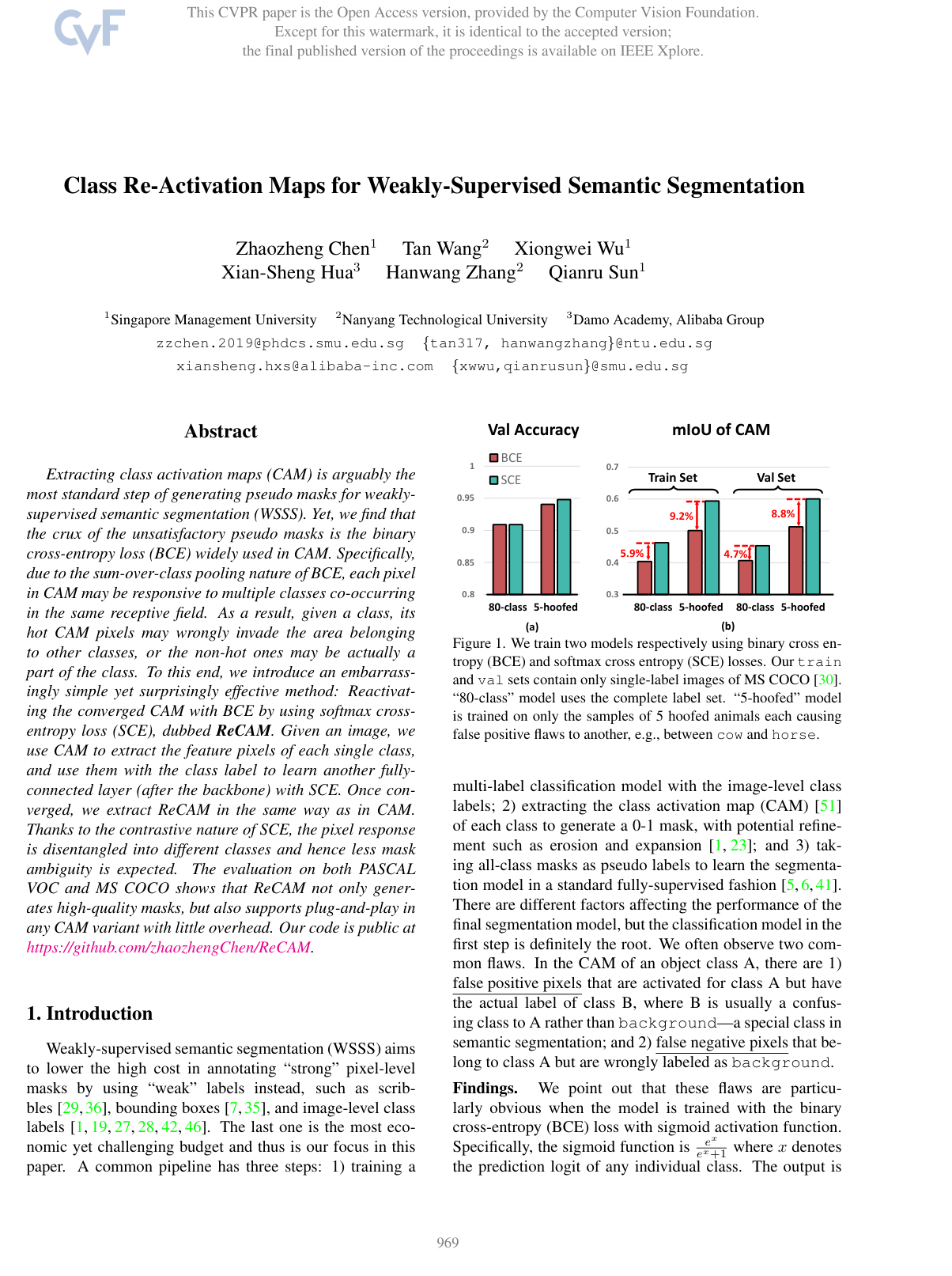
Extracting class activation maps (CAM) is arguably the most standard step of generating pseudo masks for weakly-supervised semantic segmentation (WSSS). Yet, we find that the crux of the unsatisfactory pseudo masks is the binary cross-entropy loss (BCE) widely used in CAM. Specifically, due to the sum-over-class pooling nature of BCE, each pixel in CAM may be responsive to multiple classes co-occurring in the same receptive field. As a result, given a class, its hot CAM pixels may wrongly invade the area belonging to other classes, or the non-hot ones may be actually a part of the class. To this end, we introduce an embarrassingly simple yet surprisingly effective method: Reactivating the converged CAM with BCE by using softmax cross-entropy loss (SCE), dubbed ReCAM. Given an image, we use CAM to extract the feature pixels of each single class, and use them with the class label to learn another fully-connected layer (after the backbone) with SCE. Once converged, we extract ReCAM in the same way as in CAM. Thanks to the contrastive nature of SCE, the pixel response is disentangled into different classes and hence less mask ambiguity is expected. The evaluation on both PASCAL VOC and MS COCO shows that ReCAM not only generates high-quality masks, but also supports plug-and-play in any CAM variant with little overhead. Our code is public at https://github.com/zhaozhengChen/ReCAM.
Added
2026-10-05
Code Synonyms Do Matter: Multiple Synonyms Matching Network for Automatic ICD Coding
Zheng Yuan, Chuanqi Tan, Songfang Huang
Why you should read this
Proposes a multiple synonyms matching network that incorporates UMLS terminology via a specialized attention mechanism to capture varied clinical expressions in electronic medical records, achieving state-of-the-art ICD coding performance on MIMIC-III.
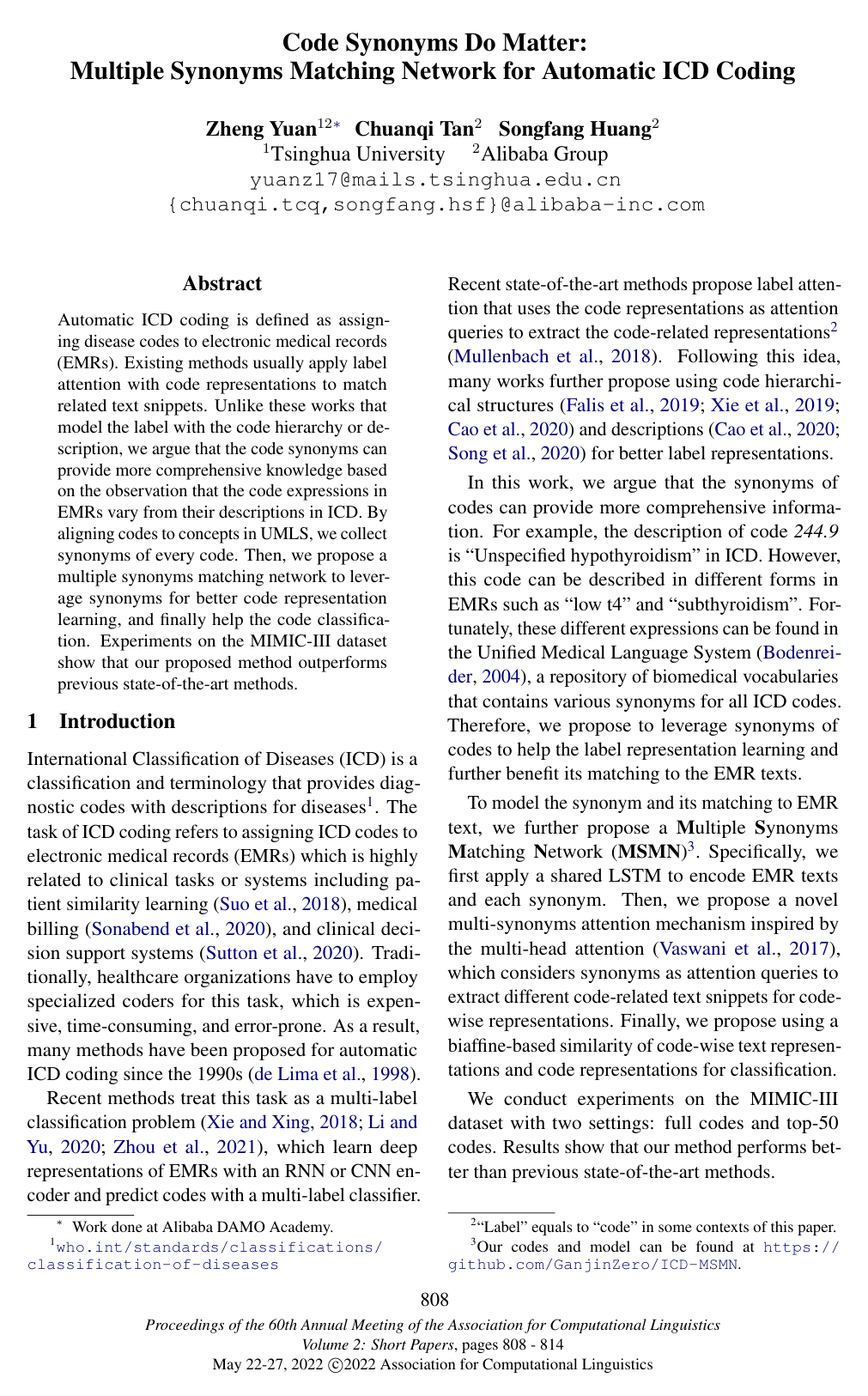
Automatic ICD coding is defined as assigning disease codes to electronic medical records (EMRs). Existing methods usually apply label attention with code representations to match related text snippets. Unlike these works that model the label with the code hierarchy or description, we argue that the code synonyms can provide more comprehensive knowledge based on the observation that the code expressions in EMRs vary from their descriptions in ICD. By aligning codes to concepts in UMLS, we collect synonyms of every code. Then, we propose a multiple synonyms matching network to leverage synonyms for better code representation learning, and finally help the code classification. Experiments on the MIMIC-III dataset show that our proposed method outperforms previous state-of-the-art methods.
Added
2026-10-02
ACPL: Anti-curriculum Pseudo-labelling for Semi-supervised Medical Image Classification
Fengbei Liu, Yu Tian, Yuanhong Chen, Yuyuan Liu, Vasileios Belagiannis, Gustavo Carneiro
Why you should read this
Proposes an anti-curriculum pseudo-labelling framework that prioritizes informative unlabeled samples and ensembles neural network predictions with nearest-neighbor classifiers to outperform state-of-the-art semi-supervised methods on class-imbalanced multi-label and multi-class medical diagnosis tasks.
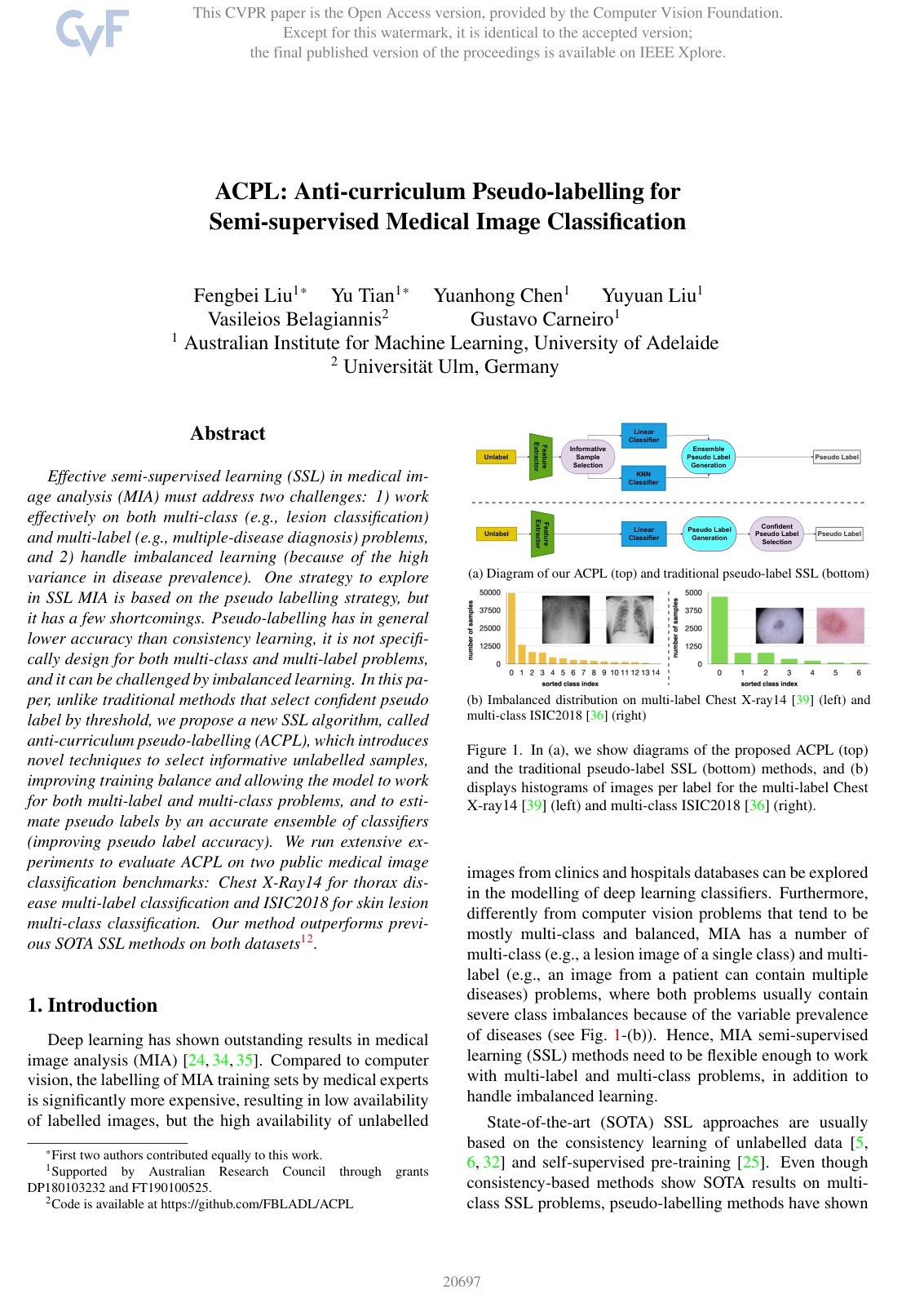
Effective semi-supervised learning (SSL) in medical image analysis (MIA) must address two challenges: 1) work effectively on both multi-class (e.g., lesion classification) and multi-label (e.g., multiple-disease diagnosis) problems, and 2) handle imbalanced learning (because of the high variance in disease prevalence). One strategy to explore in SSL MIA is based on the pseudo labelling strategy, but it has a few shortcomings. Pseudo-labelling has in general lower accuracy than consistency learning, it is not specifically design for both multi-class and multi-label problems, and it can be challenged by imbalanced learning. In this paper, unlike traditional methods that select confident pseudo label by threshold, we propose a new SSL algorithm, called anti-curriculum pseudo-labelling (ACPL), which introduces novel techniques to select informative unlabelled samples, improving training balance and allowing the model to work for both multi-label and multi-class problems, and to estimate pseudo labels by an accurate ensemble of classifiers (improving pseudo label accuracy). We run extensive experiments to evaluate ACPL on two public medical image classification benchmarks: Chest X-Ray14 for thorax disease multi-label classification and ISIC2018 for skin lesion multi-class classification. Our method outperforms previous SOTA SSL methods on both datasets.
Added
2026-09-26
BoosTexter: A Boosting-based System for Text Categorization
ROBERT E. SCHAPIRE, YORAM SINGER
Why you should read this
Develops a boosting-based multiclass text categorization system and shows its effectiveness across text, speech, and automatic call-type identification tasks.
This work focuses on algorithms which learn from examples to perform multiclass text and speech categorization tasks. Our approach is based on a new and improved family of boosting algorithms. We describe in detail an implementation, called BoosTexter, of the new boosting algorithms for text categorization tasks. We present results comparing the performance of BoosTexter and a number of other text-categorization algorithms on a variety of tasks. We conclude by describing the application of our system to automatic call-type identification from unconstrained spoken customer responses.
Added
2026-09-14
Classifier chains for multi-label classification
Jesse Read, Bernhard Pfahringer, Geoff Holmes, Eibe Frank
Why you should read this
Proposes classifier chains and ensemble extensions that model label correlations in multi-label classification while retaining the computational efficiency and linear scalability of binary relevance across large datasets.
The widely known binary relevance method for multi-label classification, which considers each label as an independent binary problem, has often been overlooked in the literature due to the perceived inadequacy of not directly modelling label correlations. Most current methods invest considerable complexity to model interdependencies between labels. This paper shows that binary relevance-based methods have much to offer, and that high predictive performance can be obtained without impeding scalability to large datasets. We exemplify this with a novel classifier chains method that can model label correlations while maintaining acceptable computational complexity. We extend this approach further in an ensemble framework. An extensive empirical evaluation covers a broad range of multi-label datasets with a variety of evaluation metrics. The results illustrate the competitiveness of the chaining method against related and state-of-the-art methods, both in terms of predictive performance and time complexity.
Added
2026-09-14
A Review on Multi-Label Learning Algorithms
Min-Ling Zhang, Zhi-Hua Zhou
Why you should read this
Presents a unified taxonomy and rigorous mathematical analysis of twelve representative multi-label learning algorithms across problem transformation and algorithm adaptation paradigms to guide the selection of appropriate methods and evaluation metrics.
Multi-label learning studies the problem where each example is represented by a single instance while associated with a set of labels simultaneously. During the past decade, significant amount of progresses have been made towards this emerging machine learning paradigm. This paper aims to provide a timely review on this area, with emphasis on state-of-the-art multi-label learning algorithms. Firstly, fundamentals on multi-label learning including formal definition and evaluation metrics are given. Secondly and primarily, twelve representative multi-label learning algorithms are scrutinized under common notations, with corresponding analyses and discussions. Thirdly, several extended topics on multi-label learning are briefly summarized. As a conclusion, online resources and open research problems on multi-label learning are outlined for reference purposes.
Added
2026-09-11
CheXpert: A Large Chest Radiograph Dataset with Uncertainty Labels and Expert Comparison
Jeremy Irvin, Pranav Rajpurkar, Michael Ko, Yifan Yu, Silviana Ciurea-Ilcus, Chris Chute, Henrik Marklund, Behzad Haghgoo, Robyn Ball, Katie Shpanskaya, Jayne Seekins, David A. Mong, Safwan S. Halabi, Jesse K. Sandberg, Ricky Jones, David B. Larson, Curtis P. Langlotz, Bhavik N. Patel, Matthew P. Lungren, Andrew Y. Ng
Why you should read this
Introduces CheXpert, a large-scale chest radiograph dataset with an automated uncertainty-aware report labeler, demonstrating how different uncertainty-handling training strategies enable deep learning models to match or exceed practicing radiologists across multiple thoracic pathologies.
Large, labeled datasets have driven deep learning methods to achieve expert-level performance on a variety of medical imaging tasks. We present CheXpert, a large dataset that contains 224,316 chest radiographs of 65,240 patients. We design a labeler to automatically detect the presence of 14 observations in radiology reports, capturing uncertainties inherent in radiograph interpretation. We investigate different approaches to using the uncertainty labels for training convolutional neural networks that output the probability of these observations given the available frontal and lateral radiographs. On a validation set of 200 chest radiographic studies which were manually annotated by 3 board-certified radiologists, we find that different uncertainty approaches are useful for different pathologies. We then evaluate our best model on a test set composed of 500 chest radiographic studies annotated by a consensus of 5 board-certified radiologists, and compare the performance of our model to that of 3 additional radiologists in the detection of 5 selected pathologies. On Cardiomegaly, Edema, and Pleural Effusion, the model ROC and PR curves lie above all 3 radiologist operating points. We release the dataset to the public as a standard benchmark to evaluate performance of chest radiograph interpretation models.¹
Added
2026-09-11