Standing Between Past and Future: Spatio-Temporal Modeling for Multi-Camera 3D Multi-Object Tracking
Ziqi PangJie LiPavel TokmakovDian ChenSergey ZagoruykoYu-Xiong Wang
Presents an end-to-end multi-camera 3D multi-object tracking framework that models both past temporal contexts and predicted future trajectories to maintain object continuity through long occlusions, reducing identity switches on the nuScenes benchmark by ninety percent.
Reliable 3D multi-object tracking is essential for the safe navigation of autonomous vehicles. While laser-based LiDAR systems are widely used, their high cost and hardware constraints make camera-only vision systems an attractive alternative. However, vision-only tracking faces significant hurdles, including depth ambiguity, noisy single-frame detections, and track loss during object occlusions or camera switches.
The article introduces and evaluates "Past-and-Future reasoning for Tracking" (PF-Track), an end-to-end framework designed to unify 3D object detection, tracking, and trajectory prediction. The primary objective is to demonstrate that integrating historical observations with future motion forecasting substantially improves tracking accuracy and maintains spatio-temporal continuity across multi-camera setups.
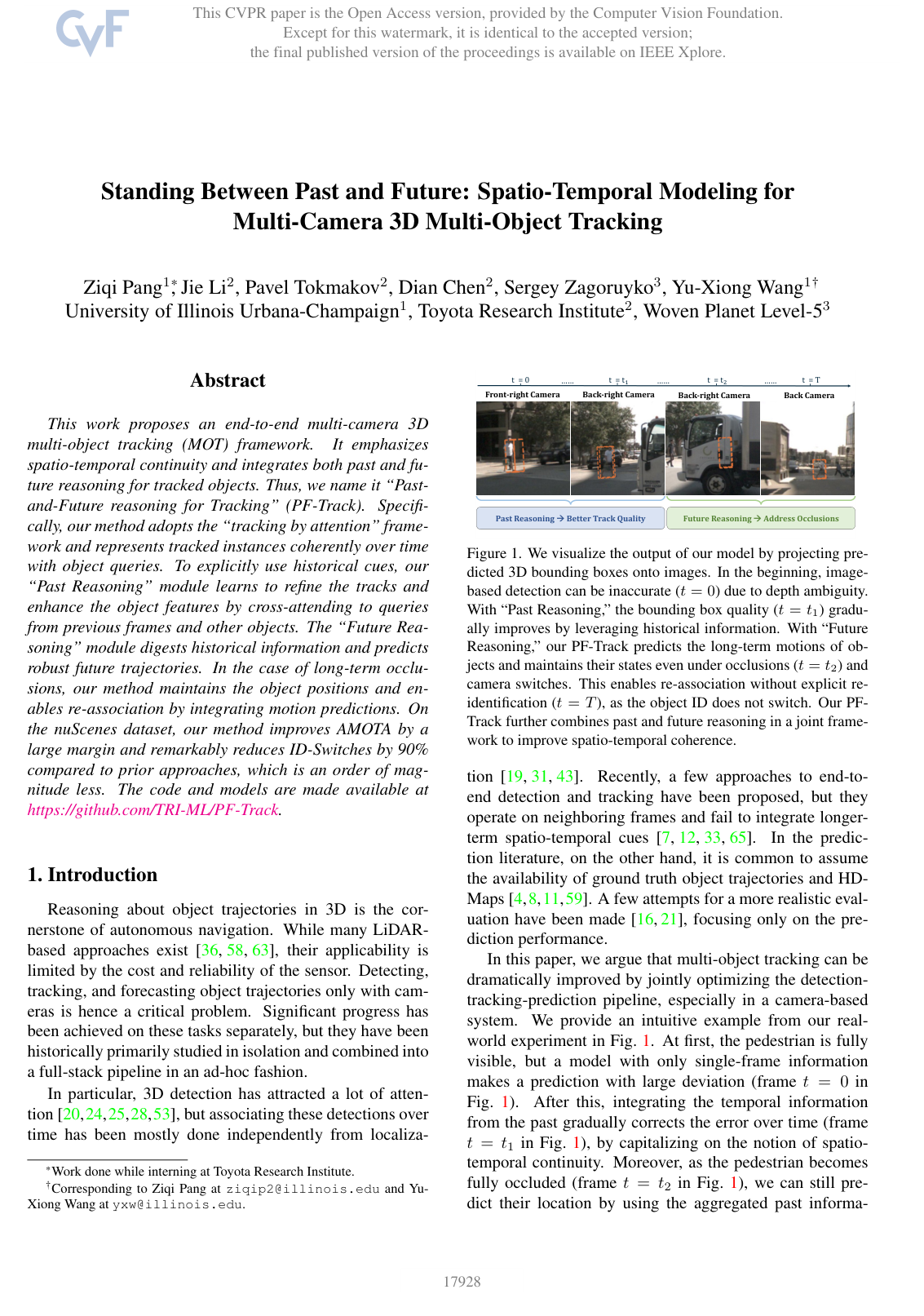
The approach operates within an attention-based tracking architecture using 3D object queries that persist over time. A "Past Reasoning" module refines object features and 3D bounding boxes by cross-referencing data across previous timeframes and neighboring objects. Simultaneously, a "Future Reasoning" module forecasts long-term trajectories, which are used both to advance query positions across frames and to sustain tracks through a strategy called track extension when objects are temporarily occluded. The methodology was evaluated on the large-scale nuScenes autonomous driving benchmark across 1,000 multi-camera video sequences spanning seven moving object categories.
The evaluation produced four key findings. First, PF-Track achieved state-of-the-art tracking accuracy on the nuScenes benchmark, reaching an Average Multi-Object Tracking Accuracy (AMOTA) score of 0.434 on the test set, outperforming existing camera-based methods. Second, the system reduced identity switches by approximately 90% compared to prior approaches, cutting ID switches by an order of magnitude (from several thousands down to a few hundred). Third, trajectory forecasting directly aided tracking, with track extensions of up to two seconds effectively preventing track loss during severe occlusions without requiring a dedicated re-identification module. Fourth, predicting future paths directly from high-dimensional query features reduced displacement errors compared to conventional methods that forecast strictly from low-level positional coordinates.
These findings indicate that end-to-end multi-task modeling resolves fundamental weaknesses in camera-based perception pipelines. By maintaining consistent object identities through visual occlusions and across different camera views, the framework enhances road safety and lowers system vulnerability. This demonstrates that camera-only autonomous navigation can achieve high spatio-temporal tracking fidelity without depending on expensive LiDAR hardware.
Organizations developing vision-based autonomous systems should transition from modular detection-and-tracking pipelines toward unified architectures that model both past context and future trajectories. Adopting learned motion forecasting to maintain occluded tracks offers an effective alternative to heuristic filters or complex re-identification models. Future work should focus on scaling the model for real-time edge hardware, testing across diverse sensor configurations, and evaluating performance in adverse environmental conditions.
- Paper: BEVFormer: Learning Bird's-Eye-View Representation from Multi-Camera Images via Spatiotemporal Transformers, Zhiqi Li et al. (2022). BEVFormer establishes the foundational spatiotemporal transformer framework that transforms multi-camera views into bird's-eye-view representations, upon which PF-Track builds its 3D tracking architecture.
- Paper: TrackFormer: Multi-Object Tracking with Transformers, Tim Meinhardt et al. (2022). TrackFormer introduces the autoregressive, query-based tracking-by-attention paradigm across video frames that provides the conceptual basis for PF-Track's persistent 3D object queries.
- Paper: Center-based 3D Object Detection and Tracking, Tianwei Yin et al. (2020). CenterPoint provides the core representation of tracking and detecting 3D dynamic objects in bird's-eye view coordinate systems.
- Paper: Planning-oriented Autonomous Driving, Yi Hu et al. (2022). UniAD pioneered the end-to-end integration of 3D detection, tracking, and trajectory prediction using unified query representations in multi-camera autonomous driving.
- Paper: Lift, Splat, Shoot: Encoding Images From Arbitrary Camera Rigs by Implicitly Unprojecting to 3D, Jonah Philion et al. (2020). Lift, Splat, Shoot provides the fundamental mechanism for implicitly lifting multi-camera 2D visual representations into a unified 3D bird's-eye-view space.
- Paper: Global Tracking Transformers, Xingyi Zhou et al. (2022). Global Tracking Transformers demonstrates how trajectory queries can associate object detections across multi-frame temporal windows within a transformer architecture.
- Paper: Trajectron++: Dynamically-Feasible Trajectory Forecasting with Heterogeneous Data, Tim Salzmann et al. (2020). Trajectron++ establishes dynamic trajectory forecasting principles essential for modeling multi-agent future motion.
- Paper: Tracking Objects as Points, Xingyi Zhou et al. (2020). CenterTrack demonstrates point-based multi-object tracking across consecutive frames, establishing the foundation for modern point- and query-based tracking.
- Paper: BEVNeXt: Reviving Dense BEV Frameworks for 3D Object Detection, Zhenxin Li et al. (2024). BEVNeXt advances dense temporal bird's-eye-view representations and multi-scale temporal fusion for 3D multi-camera perception.
- Paper: TAPVid-3D: A Benchmark for Tracking Any Point in 3D, Skanda Koppula et al. (2024). TAPVid-3D expands 3D temporal tracking from discrete bounding boxes and trajectories to arbitrary point-level tracks in real-world scenes.
- Paper: UCMCTrack: Multi-Object Tracking with Uniform Camera Motion Compensation, Kefu Yi et al. (2024). UCMCTrack extends 3D ground-plane motion modeling by compensating for camera motion to enhance tracking without heavy appearance features.
- Paper: MemFlow: Optical Flow Estimation and Prediction with Memory, Qiaole Dong et al. (2024). MemFlow builds on past temporal feature aggregation and future motion forecasting to achieve efficient online pixel motion estimation.