Lift, Splat, Shoot: Encoding Images From Arbitrary Camera Rigs by Implicitly Unprojecting to 3D

Jonah PhilionSanja Fidler

article2020ECCV1,758 citations

Proposes an end-to-end architecture that lifts multi-view camera images into 3D frustums and splats them into a bird's-eye-view grid, establishing a foundational approach for multi-camera 3D perception and motion planning without relying on lidar.

Listen

Autonomous driving systems rely on converting visual inputs from multiple surrounding cameras into a unified, top-down coordinate frameknown as a bird's-eye viewto safely plan vehicle trajectories. Traditional methods process camera feeds separately and merge detections post hoc, which prevents end-to-end learning across sensors and limits system-wide optimization. Developing a unified architecture that learns to fuse multi-camera data directly into a planning-ready representation without relying on expensive depth hardware is a critical step toward safer, more scalable autonomous navigation.

The article demonstrates an end-to-end deep learning framework, named Lift-Splat-Shoot, that maps 2D images from an arbitrary camera configuration directly into a 3D bird's-eye-view grid for semantic scene understanding and motion planning. The core objective is to evaluate whether predicting per-pixel depth distributions across multi-camera rigs enables accurate environmental mapping, sensor-fusion learning, and interpretable trajectory selection entirely without active depth sensors like lidar.

The evaluated method operates in three distinct stages. First, each camera image is "lifted" into a 3D feature representation by estimating discrete depth probability distributions at each pixel. Second, these 3D feature frustums are "splatted" onto a common ground-plane grid using an optimized pooling technique that eliminates spatial padding and speeds up training by a factor of two. Finally, candidate trajectories are evaluated or "shot" across the generated top-down cost map to identify the optimal path. The authors validated the architecture using large-scale autonomous driving benchmarks, specifically the nuScenes and Lyft Level 5 datasets, encompassing thousands of multi-camera urban driving scenes.

Evaluation against competitive camera-based baselines revealed several key findings. First, the proposed framework outperformed all camera-based alternatives across all benchmark tasks; for instance, car segmentation on the nuScenes benchmark achieved an intersection-over-union score of 32.06%, compared to 22.78% for standard networks and 29.72% for orthographic feature methods. Second, the architecture showed strong zero-shot transfer capability, demonstrating higher performance when evaluating on entirely unseen camera configurations, including transferring directly from nuScenes to Lyft datasets without model retraining. Third, intentional camera dropout during training increased real-world fault tolerance, enabling the network to maintain robust performance even when physical cameras failed or suffered from calibration errors. Fourth, in motion planning evaluations, the camera-only approach generated sensible behaviors, such as slowing down at crosswalks and following road contours, achieving a 15.52% top-5 trajectory matching accuracy despite operating without explicit speed inputs.

These findings indicate that end-to-end multi-view representation learning provides substantial architectural advantages over disconnected single-camera pipelines. By implicitly unprojecting images into 3D, the model allows downstream vehicle motion planners to train directly against raw camera feeds. This unified approach reduces sensor-rig rigidity, mitigates risks associated with camera calibration drift, and allows developers to utilize cost maps learned from human driving logs, which are significantly cheaper to scale than manually annotated 3D bounding boxes.

Organizations developing autonomous perception and planning stacks should consider adopting differentiable multi-view bird's-eye-view architectures to reduce dependency on rigid sensor geometry and high-cost active sensors. Teams should implement sensor dropout and extrinsic calibration perturbation during training to bake fault tolerance directly into perception models. Furthermore, trajectory selection frameworks can leverage learned cost maps to streamline planning validation while preserving system interpretability.

While the model sets a new standard for camera-only bird's-eye-view segmentation, some limitations remain. The camera-only model still trails behind lidar-based oracle systems, which achieved a 40.26% car segmentation score on nuScenes and higher motion-planning accuracy, particularly in low-light conditions and at longer distances. Because the current implementation analyzes individual static time steps, extending the model to incorporate multi-frame video sequences over time is the recommended next step to close the performance gap with lidar.

Cover for Lift, Splat, Shoot: Encoding Images From Arbitrary Camera Rigs by Implicitly Unprojecting to 3D

Abstract

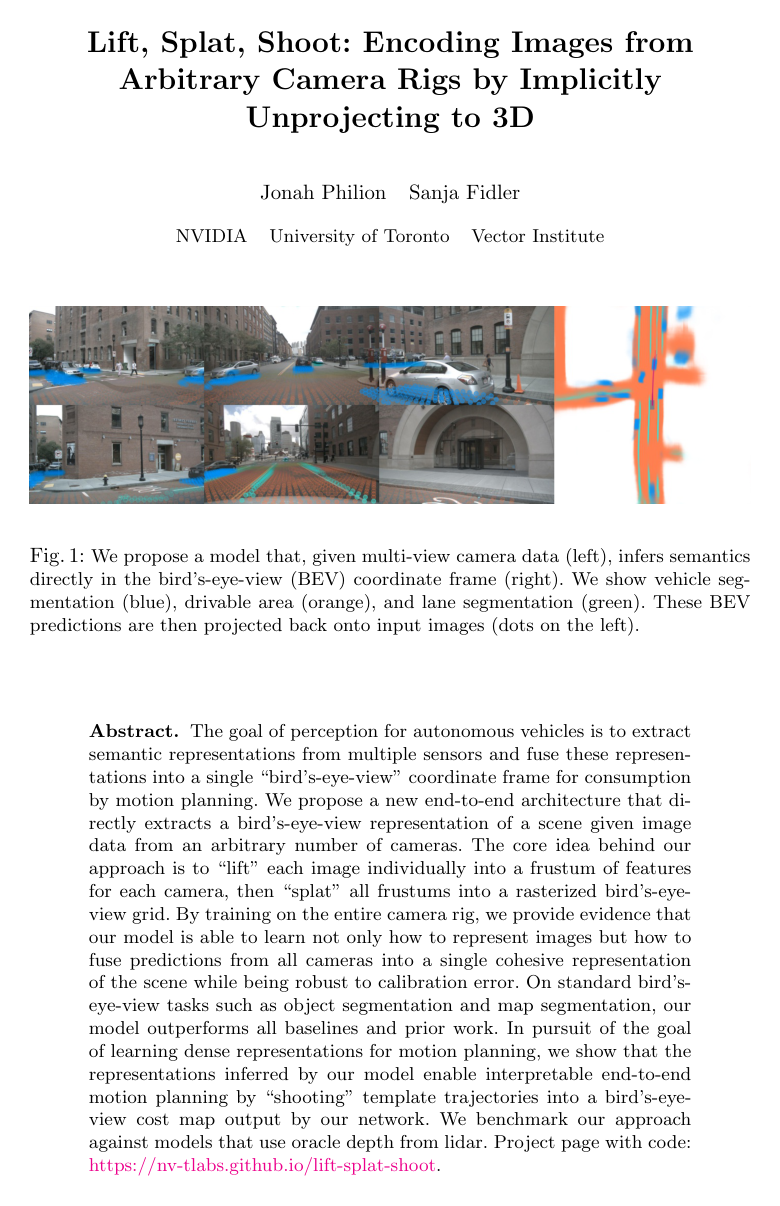
The goal of perception for autonomous vehicles is to extract semantic representations from multiple sensors and fuse these representations into a single "bird's-eye-view" coordinate frame for consumption by motion planning. We propose a new end-to-end architecture that directly extracts a bird's-eye-view representation of a scene given image data from an arbitrary number of cameras. The core idea behind our approach is to "lift" each image individually into a frustum of features for each camera, then "splat" all frustums into a rasterized bird's-eye-view grid. By training on the entire camera rig, we provide evidence that our model is able to learn not only how to represent images but how to fuse predictions from all cameras into a single cohesive representation of the scene while being robust to calibration error. On standard bird's-eye-view tasks such as object segmentation and map segmentation, our model outperforms all baselines and prior work. In pursuit of the goal of learning dense representations for motion planning, we show that the representations inferred by our model enable interpretable end-to-end motion planning by "shooting" template trajectories into a bird's-eye-view cost map output by our network. We benchmark our approach against models that use oracle depth from lidar. Project page with code: this https URL .

Table of Contents

  • 1 Introduction
  • 2 Related Work
  • 2.1 Monocular Object Detection
  • 2.2 Inference in the Bird’s-Eye-View Frame
  • 3 Method
  • 3.1 Lift: Latent Depth Distribution
  • 3.2 Splat: Pillar Pooling
  • 3.3 Shoot: Motion Planning
  • 4 Implementation
  • 4.1 Architecture Details
  • 4.2 Frustum Pooling Cumulative Sum Trick
  • 5 Experiments and Results
  • 5.1 Description of Baselines
  • 5.2 Segmentation
  • 5.3 Robustness
  • 5.4 Zero-Shot Camera Rig Transfer
  • 5.5 Benchmarking Against Oracle Depth
  • 5.6 Motion Planning
  • 6 Conclusion
  • References

Knowls

  1. Knowl 1 — Latent Depth Distribution for 2D-to-3D Image Lifting

    equation

    The "Lift" step transforms a 2D camera image into a 3D frustum-shaped point cloud of contextual features without requiring ground-truth depth supervision.

    Let XR3×H×WX \in \mathbb{R}^{3 \times H \times W} be an input image, IR3×3I \in \mathbb{R}^{3 \times 3} its intrinsic calibration matrix, and ER3×4E \in \mathbb{R}^{3 \times 4} its extrinsic calibration matrix. The depth dimension is discretized into a predefined set of D|D| discrete depth bins D={d0+Δ,d0+2Δ,,d0+DΔ}D = \{d_0 + \Delta, d_0 + 2\Delta, \dots, d_0 + |D|\Delta\}. For each pixel pp at image coordinates (h,w)(h, w), a convolutional neural network predicts a context feature vector cRCc \in \mathbb{R}^C and a discrete probability distribution over depth αΔD1\alpha \in \Delta^{|D|-1}, where ΔD1\Delta^{|D|-1} is the probability simplex.

    The feature cdRCc_d \in \mathbb{R}^C associated with the 3D point pd=(h,w,d)p_d = (h, w, d) along the optical ray at depth dDd \in D is given by the outer product scaling:

    cd=αdcc_d = \alpha_d c

    where αd\alpha_d is the predicted probability that the surface at pixel (h,w)(h, w) lies at depth dd.

    Each point pdp_d is mapped to reference coordinates (x,y,z)(x, y, z) in the ego frame using II and EE. If α\alpha is a one-hot vector, this operation collapses to a single depth per pixel as in pseudo-LiDAR. If α\alpha is a uniform distribution, the context cc is spread uniformly along the entire ray as in orthographic feature transform (OFT). By predicting α\alpha continuously, the network dynamically allocates context along spatial rays according to depth confidence.

  2. Knowl 2 — Frustum Pooling for Bird's-Eye-View Splatting

    algorithm

    Frustum Pooling aggregates the 3D frustum feature point clouds generated from nn arbitrary camera views into a uniform Bird's-Eye-View (BEV) pillar grid of dimensions C×X×YC \times X \times Y in the ego coordinate frame without using zero-padding.

    Input: Point features CallRN×CC_{all} \in \mathbb{R}^{N \times C} from nn camera frustums where N=nHWDN = n \cdot H \cdot W \cdot |D|
    Input: 3D point coordinates PallRN×3P_{all} \in \mathbb{R}^{N \times 3} in the ego frame
    Input: Grid bounds [xmin,xmax]×[ymin,ymax][x_{min}, x_{max}] \times [y_{min}, y_{max}] and cell resolutions (Δx,Δy)(\Delta_x, \Delta_y)
    Output: Rasterized BEV pseudo-image tensor YbevRC×X×YY_{bev} \in \mathbb{R}^{C \times X \times Y}
    for each point i=1i = 1 to NN do
        Compute discrete pillar coordinates (ui,vi)=((xixmin)/Δx,(yiymin)/Δy)(u_i, v_i) = (\lfloor (x_i - x_{min})/\Delta_x \rfloor, \lfloor (y_i - y_{min})/\Delta_y \rfloor)
        if 0ui<X0 \le u_i < X and 0vi<Y0 \le v_i < Y then
            Assign 1D pillar bin index bi=uiY+vib_i = u_i \cdot Y + v_i
        else
            Mark point ii as invalid / out-of-bounds
        end if
    end for
    Filter out invalid points, retaining MM valid points
    Sort valid features CvalidC_{valid} by their bin indices bb
    Compute cumulative sum of sorted features along the point dimension: Sk=j=1kCvalid[j]S_k = \sum_{j=1}^k C_{valid}[j] for k=1,,Mk = 1, \dots, M
    for each unique bin index bb with boundary indices [startb,endb][start_b, end_b] in the sorted array do
        Ybev[b]=SendbSstartb1Y_{bev}[b] = S_{end_b} - S_{start_b - 1} (with S0=0S_0 = 0)
    end for
    return YbevY_{bev}

    By computing pillar sums via cumulative sums of sorted bin segments rather than padding each pillar to a maximum capacity, memory usage is drastically reduced. An explicit analytic gradient is implemented for the cumulative sum and boundary subtraction operations, providing a 2×2\times speedup during backpropagation compared to automatic differentiation.

  3. Knowl 3 — Trajectory Distribution and Cost-Map Scoring for Motion Planning

    equation

    Motion planning is formulated as categorical classification over a pre-extracted dictionary of KK fixed template trajectories T={τ1,τ2,,τK}\mathcal{T} = \{\tau_1, \tau_2, \dots, \tau_K\}, where each template is a sequence of 2D coordinates over time τi={(xj,yj,tj)}j=1T\tau_i = \{(x_j, y_j, t_j)\}_{j=1}^T.

    Given sensor observations oo, the network outputs a spatial Bird's-Eye-View (BEV) cost map co(x,y)Rc_o(x, y) \in \mathbb{R}. The probability distribution over trajectory templates p(τio)p(\tau_i \mid o) is defined as a Boltzmann distribution parameterized by the accumulated spatial cost along each trajectory:

    p(τio)=exp((xj,yj)τico(xj,yj))τTexp((xj,yj)τco(xj,yj))p(\tau_i \mid o) = \frac{\exp\left(-\sum_{(x_j, y_j) \in \tau_i} c_o(x_j, y_j)\right)}{\sum_{\tau \in \mathcal{T}} \exp\left(-\sum_{(x_j, y_j) \in \tau} c_o(x_j, y_j)\right)}

    During training, given a ground-truth expert ego trajectory τ\tau^*, the closest template in T\mathcal{T} under the L2L_2 norm is selected as the target class label, and the cost map is optimized end-to-end using standard cross-entropy loss without requiring a hard-margin loss. During inference, the trajectory is selected via argmaxτiTp(τio)\arg\max_{\tau_i \in \mathcal{T}} p(\tau_i \mid o).

  4. Knowl 4 — Lift-Splat-Shoot Network Architecture and Hyperparameters

    experimental setup

    The Lift-Splat-Shoot architecture connects an image-plane feature extractor to a Bird's-Eye-View (BEV) processing network via frustum pooling:

    • Per-Image Feature Extractor: Backbone is an EfficientNet-B0 pretrained on ImageNet. Input camera images are cropped and resized to 128×352128 \times 352.
    • Depth Discretization: Depth range spans from 4.0m4.0\,\text{m} to 45.0m45.0\,\text{m} spaced at Δ=1.0m\Delta = 1.0\,\text{m}, yielding D=41|D| = 41 discrete depth bins.
    • BEV Coordinate Grid: The BEV space spans x[50m,50m]x \in [-50\,\text{m}, 50\,\text{m}] and y[50m,50m]y \in [-50\,\text{m}, 50\,\text{m}] at 0.5m×0.5m0.5\,\text{m} \times 0.5\,\text{m} resolution, creating a 200×200200 \times 200 grid (X=200,Y=200X=200, Y=200).
    • BEV Convolutional Network: Takes the sum-pooled C×200×200C \times 200 \times 200 pillar tensor, applies a 7×77 \times 7 convolution with stride 2 followed by BatchNorm and ReLU, passes features through the first 3 meta-layers of ResNet-18 producing multi-scale features (x1,x2,x3)(x_1, x_2, x_3), upsamples x3x_3 by 4×4\times, concatenates with x1x_1, applies a ResNet block, and upsamples by 2×2\times to return to the 200×200200 \times 200 resolution.
    • Model Capacity & Inference Speed: The entire network contains 14.3M trainable parameters and executes a forward pass at 35 Hz on an NVIDIA Titan V GPU.
    • Training Optimization: Trained using the Adam optimizer with a learning rate of 10310^{-3}, weight decay of 10710^{-7}, for 300,000 steps using PyTorch.
  5. Knowl 5 — BEV Semantic Segmentation Performance on nuScenes and Lyft

    data/table

    The Lift-Splat model was evaluated on multi-view Bird's-Eye-View (BEV) object and map segmentation tasks using the nuScenes and Lyft Level 5 datasets. Ground-truth targets were generated by projecting 3D bounding boxes and map layers into the BEV plane. Baselines include standard CNN concatenation, Frozen ImageNet Encoders, Orthographic Feature Transform (OFT), Pyramid Occupancy Networks (PON), and FISHING Net.

    nuScenes (IoU %) Lyft (IoU %)
    Model Car Vehicles Car Vehicles
    CNN 22.78 24.25 30.71 31.91
    Frozen Encoder 25.51 26.83 35.28 32.42
    OFT 29.72 30.05 39.48 40.43
    Lift-Splat (Us) 32.06 32.07 43.09 44.64
    PON 24.7 - - -
    FISHING Net - 30.0 - 56.0
    Model Drivable Area (IoU %) Lane Boundary (IoU %)
    CNN 68.96 16.51
    Frozen Encoder 61.62 16.95
    OFT 71.69 18.07
    Lift-Splat (Us) 72.94 19.96
    PON 60.4 -

    Lift-Splat outperforms all baseline architectures across both object segmentation and map segmentation tasks, achieving a 2.34% Car IoU gain on nuScenes and a 3.61% Car IoU gain on Lyft over the strongest baseline (OFT).

  6. Knowl 6 — Robustness to Sensor Dropout and Extrinsic Calibration Noise

    empirical result

    Training Lift-Splat with intentional sensor noise and sensor dropout provides significant robustness benefits:

    • Sensor Dropout Regularization: Training the network with one randomly dropped camera per batch sample improves generalization. When tested with all 6 cameras available, the model trained with 1 dropped camera achieves higher Car segmentation IoU than the model trained on the full 6 cameras without dropout, indicating that camera dropout encourages the network to learn meaningful cross-camera feature correlations.
    • Extrinsic Noise Resilience: Adding noise to camera extrinsic calibration matrices during training makes the model more robust to test-time extrinsic miscalibration, maintaining stable performance across high noise levels.
    • Camera Sensitivity: Testing car segmentation IoU while systematically removing individual cameras on nuScenes reveals that missing the backward-facing camera causes the steepest drop in performance, consistent with its wider field-of-view coverage relative to the other cameras.
  7. Knowl 7 — Zero-Shot Camera Rig Transfer Evaluation

    data/table

    Because Lift-Splat explicitly conditions on camera intrinsic and extrinsic calibration matrices during frustum splatting, it can perform inference on camera configurations unseen during training without fine-tuning.

    First, a model trained on only 4 of the 6 nuScenes cameras was evaluated when additional cameras (1fl1_{fl} = front-left, 1bl1_{bl} = back-left) were introduced at test time:

    Evaluated Camera Set Car IoU (%)
    4 Cameras 26.53
    4 + 1 front-left (1fl1_{fl}) 27.35
    4 + 1 back-left (1bl1_{bl}) 27.27
    4 + 1 front-left + 1 back-left 27.94

    Second, the model trained exclusively on nuScenes (with its 6-camera rig) was evaluated zero-shot on the Lyft dataset, which has an entirely different camera setup:

    Model Lyft Car IoU (%) Lyft Vehicle IoU (%)
    CNN 7.00 8.06
    Frozen Encoder 15.08 15.82
    OFT 16.25 16.27
    Lift-Splat (Us) 21.35 22.59

    Lift-Splat outperforms OFT by +5.10% Car IoU and CNN by +14.35% Car IoU in zero-shot cross-rig transfer.

  8. Knowl 8 — Benchmarking Lift-Splat Against LiDAR Oracle Depth

    data/table

    Lift-Splat was benchmarked against the PointPillars architecture trained with oracle 3D depth from LiDAR point clouds (single scan and aggregated >1 scans).

    nuScenes (IoU %) Lyft (IoU %)
    Model Drivable Area Lane Boundary Car Vehicle Car Vehicle
    Oracle Depth (1 scan) 74.91 25.12 40.26 44.48 74.96 76.16
    Oracle Depth (>> 1 scan) 76.96 26.80 45.36 49.51 75.42 76.49
    Lift-Splat (Camera only) 70.81 19.58 32.06 32.07 43.09 44.64

    Camera-only Lift-Splat approaches LiDAR performance on planar map tasks (70.81% vs 74.91% on Drivable Area) but exhibits a larger gap on 3D object segmentation. Analysis across environmental variables indicates that Lift-Splat suffers severe degradation in nighttime scenes compared to LiDAR and exhibits a roughly linear decrease in IoU as object distance increases.

  9. Knowl 9 — End-to-End Trajectory Classification Accuracy in Motion Planning

    data/table

    End-to-end motion planning was evaluated by predicting ego trajectory distributions over K=1000K=1000 template trajectories (5-second duration at 0.25-second increments) on nuScenes. Accuracy is measured as top-kk classification accuracy matching the ground-truth trajectory's nearest neighbor template.

    Model Top 5 (%) Top 10 (%) Top 20 (%)
    LiDAR (1 scan) 19.27 28.88 41.93
    LiDAR (10 scans) 24.99 35.39 49.84
    Lift-Splat (Camera only) 15.52 19.94 27.99

    While Lift-Splat produces qualitatively plausible planning behaviors—such as adhering to road boundaries and decelerating at crosswalks and behind braking vehicles—it lags behind LiDAR-based planners in template classification accuracy.

  10. Knowl 10 — Temporal Limitations of Single-Timestep Camera-Based Representation

    limitation

    The Lift-Splat architecture operates strictly on a single time step of multi-camera images. As a result, the model lacks explicit access to ego-vehicle or surrounding vehicle velocities and temporal dynamics. This contributes to a substantial performance gap between single-frame camera models and multi-scan LiDAR models, particularly in nighttime conditions and motion planning accuracy. Closing this gap requires extending the architecture to multi-timestep video sequences.

Coverage note — None was omitted; all primary contributions, including the lift-splat-shoot architecture, latent depth unprojection, frustum pooling algorithm, trajectory shooting planner, experimental evaluations on segmentation, robustness, zero-shot transfer, and LiDAR comparisons, are covered.

References

  1. 1.Badrinarayanan, V., Kendall, A., Cipolla, R.: Segnet: A deep convolutional encoder-decoder architecture for image segmentation. CoRR abs/1511.00561 (2015), http://arxiv.org/abs/1511.00561
  2. 2.Caesar, H., Bankiti, V., Lang, A.H., Vora, S., Liong, V.E., Xu, Q., Krishnan, A., Pan, Y., Baldan, G., Beijbom, O.: nuscenes: A multimodal dataset for autonomous driving. CoRR abs/1903.11027 (2019), http://arxiv.org/abs/1903.11027
  3. 3.Chang, M.F., Ramanan, D., Hays, J., Lambert, J., Sangkloy, P., Singh, J., Bak, S., Hartnett, A., Wang, D., Carr, P., et al.: Argoverse: 3d tracking and forecasting with rich maps. IEEE/CVF Conference on Computer Vision and Pattern Recognition (CVPR) (Jun 2019)
  4. 4.Chen, X., Kundu, K., Zhang, Z., Ma, H., Fidler, S., Urtasun, R.: Monocular 3d object detection for autonomous driving. In: IEEE/CVF Conference on Computer Vision and Pattern Recognition (CVPR). pp. 2147–2156 (06 2016)
  5. 5.Ghiasi, G., Lin, T., Le, Q.V.: Dropblock: A regularization method for convolutional networks. CoRR abs/1810.12890 (2018), http://arxiv.org/abs/1810.12890
  6. 6.Goodfellow, I., Bengio, Y., Courville, A.: Deep Learning. MIT Press (2016), http://www.deeplearningbook.org
  7. 7.He, K., Gkioxari, G., Doll´ar, P., Girshick, R.B.: Mask R-CNN. CoRR abs/1703.06870 (2017), http://arxiv.org/abs/1703.06870
  8. 8.He, K., Zhang, X., Ren, S., Sun, J.: Deep residual learning for image recognition. CoRR abs/1512.03385 (2015), http://arxiv.org/abs/1512.03385
  9. 9.Hendy, N., Sloan, C., Tian, F., Duan, P., Charchut, N., Xie, Y., Wang, C., Philbin, J.: Fishing net: Future inference of semantic heatmaps in grids (2020)
  10. 10.Ioffe, S., Szegedy, C.: Batch normalization: Accelerating deep network training by reducing internal covariate shift. CoRR abs/1502.03167 (2015), http://arxiv.org/abs/1502.03167
  11. 11.Kayhan, O.S., Gemert, J.C.v.: On translation invariance in cnns: Convolutional layers can exploit absolute spatial location. In: Proceedings of the IEEE/CVF Conference on Computer Vision and Pattern Recognition (CVPR) (June 2020)
  12. 12.Kehl, W., Manhardt, F., Tombari, F., Ilic, S., Navab, N.: SSD-6D: making rgb-based 3d detection and 6d pose estimation great again. CoRR abs/1711.10006 (2017)
  13. 13.Kesten, R., Usman, M., Houston, J., Pandya, T., Nadhamuni, K., Ferreira, A., Yuan, M., Low, B., Jain, A., Ondruska, P., Omari, S., Shah, S., Kulkarni, A., Kazakova, A., Tao, C., Platinsky, L., Jiang, W., Shet, V.: Lyft level 5 av dataset 2019. urlhttps://level5.lyft.com/dataset/ (2019)
  14. 14.Kingma, D.P., Ba, J.: Adam: A method for stochastic optimization. CoRR abs/1412.6980 (2014)
  15. 15.Kirillov, A., He, K., Girshick, R.B., Rother, C., Doll´ar, P.: Panoptic segmentation. CoRR abs/1801.00868 (2018), http://arxiv.org/abs/1801.00868
  16. 16.Krizhevsky, A.: Learning multiple layers of features from tiny images (2009)
  17. 17.Krizhevsky, A., Sutskever, I., Hinton, G.E.: Imagenet classification with deep convolutional neural networks. In: Pereira, F., Burges, C.J.C., Bottou, L., Weinberger, K.Q. (eds.) Advances in Neural Information Processing Systems 25, pp. 1097–1105. Curran Associates, Inc. (2012), http://papers.nips.cc/paper/4824-imagenet-classification-with-deep-convolutional-neural-networks.pdf
  18. 18.Lang, A.H., Vora, S., Caesar, H., Zhou, L., Yang, J., Beijbom, O.: Pointpillars: Fast encoders for object detection from point clouds. CoRR abs/1812.05784 (2018)
  19. 19.Lecun, Y., Bottou, L., Bengio, Y., Haffner, P.: Gradient-based learning applied to document recognition. In: Proceedings of the IEEE. pp. 2278–2324 (1998)
  20. 20.Lombardi, S., Simon, T., Saragih, J., Schwartz, G., Lehrmann, A., Sheikh, Y.: Neural volumes. ACM Transactions on Graphics 38(4), 114 (Jul 2019). https://doi.org/10.1145/3306346.3323020, http://dx.doi.org/10.1145/3306346.3323020
  21. 21.Mani, K., Daga, S., Garg, S., Shankar, N.S., Jatavallabhula, K.M., Krishna, K.M.: Monolayout: Amodal scene layout from a single image. ArXiv abs/2002.08394 (2020)
  22. 22.Nair, V., Hinton, G.E.: Rectified linear units improve restricted boltzmann machines. In: ICML (2010)
  23. 23.Paszke, A., Gross, S., Massa, F., Lerer, A., Bradbury, J., Chanan, G., Killeen, T., Lin, Z., Gimelshein, N., Antiga, L., Desmaison, A., K¨opf, A., Yang, E., DeVito, Z., Raison, M., Tejani, A., Chilamkurthy, S., Steiner, B., Fang, L., Bai, J., Chintala, S.: Pytorch: An imperative style, high-performance deep learning library. In: NeurIPS (2019)
  24. 24.Philion, J.: Fastdraw: Addressing the long tail of lane detection by adapting a sequential prediction network. In: Proceedings of the IEEE/CVF Conference on Computer Vision and Pattern Recognition (CVPR) (June 2019)
  25. 25.Philion, J., Kar, A., Fidler, S.: Learning to evaluate perception models using planner-centric metrics. In: Proceedings of the IEEE/CVF Conference on Computer Vision and Pattern Recognition (CVPR) (June 2020)
  26. 26.Poirson, P., Ammirato, P., Fu, C., Liu, W., Kosecka, J., Berg, A.C.: Fast single shot detection and pose estimation. CoRR abs/1609.05590 (2016)
  27. 27.Qin, Z., Wang, J., Lu, Y.: Monogrnet: A geometric reasoning network for monocular 3d object localization. Proceedings of the AAAI Conference on Artificial Intelligence 33, 8851–8858 (07 2019). https://doi.org/10.1609/aaai.v33i01.33018851
  28. 28.Roddick, T., Cipolla, R.: Predicting semantic map representations from images using pyramid occupancy networks. In: Proceedings of the IEEE/CVF Conference on Computer Vision and Pattern Recognition (CVPR) (June 2020)
  29. 29.Roddick, T., Kendall, A., Cipolla, R.: Orthographic feature transform for monocular 3d object detection. CoRR abs/1811.08188 (2018)
  30. 30.Russakovsky, O., Deng, J., Su, H., Krause, J., Satheesh, S., Ma, S., Huang, Z., Karpathy, A., Khosla, A., Bernstein, M., Berg, A.C., Fei-Fei, L.: Imagenet large scale visual recognition challenge (2014)
  31. 31.Simonelli, A., Bul`o, S.R., Porzi, L., L´opez-Antequera, M., Kontschieder, P.: Disentangling monocular 3d object detection. CoRR abs/1905.12365 (2019)
  32. 32.Srinivasan, P.P., Mildenhall, B., Tancik, M., Barron, J.T., Tucker, R., Snavely, N.: Lighthouse: Predicting lighting volumes for spatially-coherent illumination (2020)
  33. 33.Srivastava, N., Hinton, G., Krizhevsky, A., Sutskever, I., Salakhutdinov, R.: Dropout: A simple way to prevent neural networks from overfitting. Journal of Machine Learning Research 15, 1929–1958 (2014)
  34. 34.Su, H., Jampani, V., Sun, D., Maji, S., Kalogerakis, E., Yang, M., Kautz, J.: Splatnet: Sparse lattice networks for point cloud processing. CoRR abs/1802.08275 (2018), http://arxiv.org/abs/1802.08275
  35. 35.Sun, P., Kretzschmar, H., Dotiwalla, X., Chouard, A., Patnaik, V., Tsui, P., Guo, J., Zhou, Y., Chai, Y., Caine, B., Vasudevan, V., Han, W., Ngiam, J., Zhao, H., Timofeev, A., Ettinger, S., Krivokon, M., Gao, A., Joshi, A., Zhang, Y., Shlens, J., Chen, Z., Anguelov, D.: Scalability in perception for autonomous driving: Waymo open dataset (2019)
  36. 36.Takikawa, T., Acuna, D., Jampani, V., Fidler, S.: Gated-scnn: Gated shape cnns for semantic segmentation. In: Proceedings of the IEEE/CVF International Conference on Computer Vision (ICCV) (October 2019)
  37. 37.Tan, M., Le, Q.V.: Efficientnet: Rethinking model scaling for convolutional neural networks. CoRR abs/1905.11946 (2019), http://arxiv.org/abs/1905.11946
  38. 38.Tucker, R., Snavely, N.: Single-view view synthesis with multiplane images (2020)
  39. 39.Wang, Y., Chao, W., Garg, D., Hariharan, B., Campbell, M., Weinberger, K.Q.: Pseudo-lidar from visual depth estimation: Bridging the gap in 3d object detection for autonomous driving. CoRR abs/1812.07179 (2018)
  40. 40.You, Y., Wang, Y., Chao, W., Garg, D., Pleiss, G., Hariharan, B., Campbell, M., Weinberger, K.Q.: Pseudo-lidar++: Accurate depth for 3d object detection in autonomous driving. CoRR abs/1906.06310 (2019)
  41. 41.Zeng, W., Luo, W., Suo, S., Sadat, A., Yang, B., Casas, S., Urtasun, R.: End-to-end interpretable neural motion planner. IEEE/CVF Conference on Computer Vision and Pattern Recognition (CVPR) pp. 8652–8661 (2019)

Citation

MLA
Philion, J., and S. Fidler. “Lift, Splat, Shoot: Encoding Images From Arbitrary Camera Rigs by Implicitly Unprojecting to 3D”. arXiv, 2020, http://arxiv.org/abs/2008.05711v1.
APA
Philion, J., & Fidler, S. (2020). Lift, Splat, Shoot: Encoding Images From Arbitrary Camera Rigs by Implicitly Unprojecting to 3D. arXiv. http://arxiv.org/abs/2008.05711v1
Chicago
Philion, J., and S. Fidler. 2020. “Lift, Splat, Shoot: Encoding Images From Arbitrary Camera Rigs by Implicitly Unprojecting to 3D”. arXiv. http://arxiv.org/abs/2008.05711v1.
Harvard
Philion, J. and Fidler, S. (2020) “Lift, Splat, Shoot: Encoding Images From Arbitrary Camera Rigs by Implicitly Unprojecting to 3D”, arXiv [Preprint]. Available at: http://arxiv.org/abs/2008.05711v1.
Vancouver
1. Philion J, Fidler S (2020) Lift, Splat, Shoot: Encoding Images From Arbitrary Camera Rigs by Implicitly Unprojecting to 3D. arXiv

BibTeX

@article{philion2020lift,
  title = {Lift, Splat, Shoot: Encoding Images From Arbitrary Camera Rigs by Implicitly Unprojecting to 3D},
  author = {Philion, Jonah and Fidler, Sanja},
  year = {2020},
  journal = {arXiv},
  url = {http://arxiv.org/abs/2008.05711v1},
  eprint = {2008.05711}
}
Metadata:arXiv

Source Code

This paper has an official code repository available. Click below to access the source code.

View Repository

Access the Paper

This paper is available from its original source. Click below to access the PDF.

Open PDF